 Russia
 Belarus
 Georgia
 Kazakhstan
 Kyrgyzstan
 Uzbekistan
 China
 Nepal
 Bangladesh
 Poland
 Romania
 Slovakia
 Hungary
 N. Macedonia
 Vietnam
Introduction
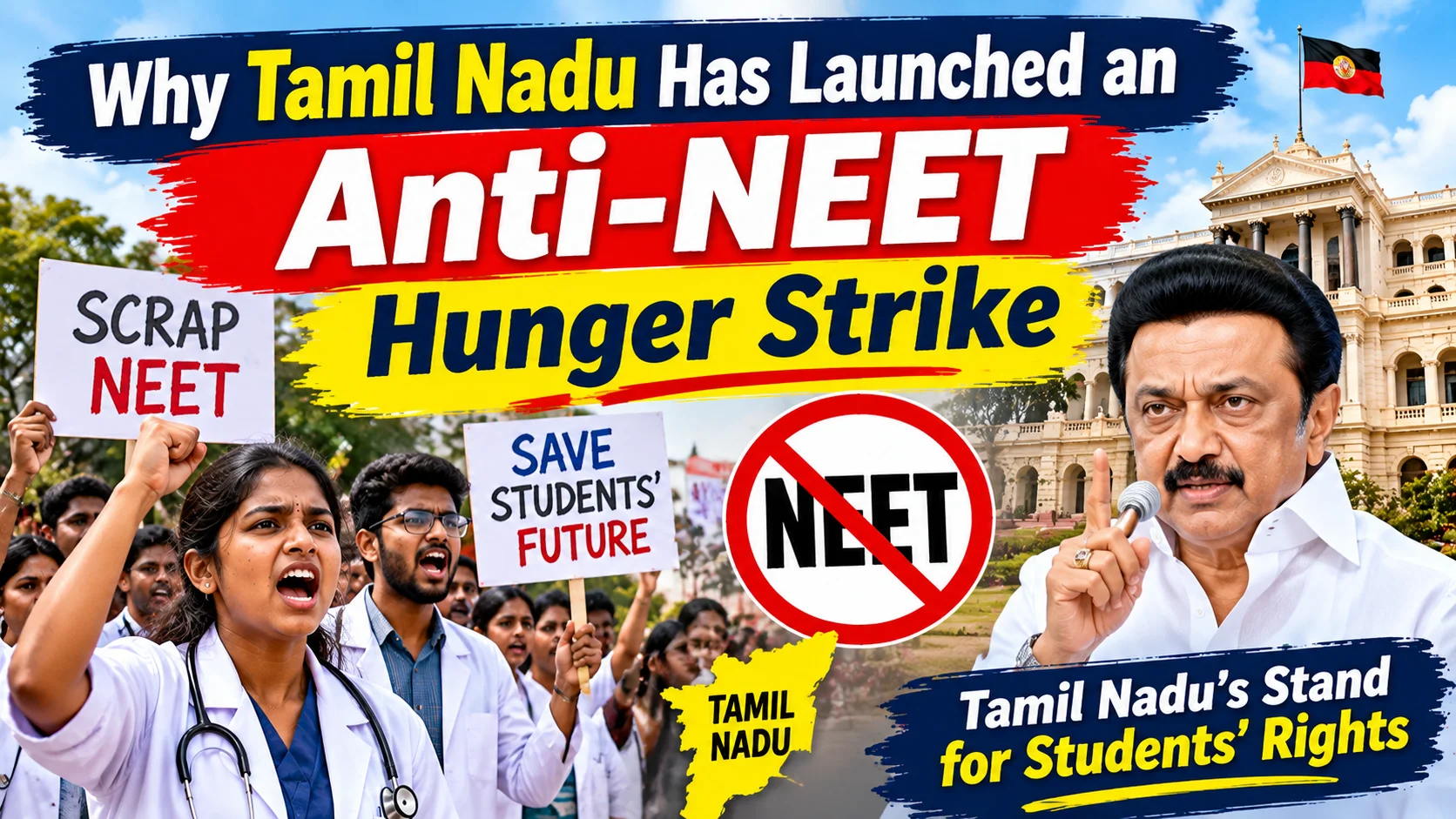
Tamil Nadu has been one of the strongest opponents of the National Eligibility cum Entrance Test (NEET). The state's opposition is based on concerns about educational equality, social justice and affordability. The government and protesters also want to ensure that the state has greater autonomy in deciding its medical admission policies. In August 2026, the anti-NEET movement gained attention again when protesters staged an indefinite hunger strike in Chennai, demanding the removal of NEET. The protest renewed political discussions about medical admissions. On 11 August 2026, the Tamil Nadu Legislative Assembly passed a resolution asking the Union government to abolish NEET and allow medical admissions based on Class 12 results. So why are protesters demanding the removal of NEET? Why do they believe the examination puts certain students in Tamil Nadu at a disadvantage? And what alternatives are being proposed?The issue is part of a wider discussion about equal access to medical education, the role of school examinations and the balance of power between state and central governments.
What Is NEET?
NEET-UG is a national-level entrance examination for students seeking admission to undergraduate medical courses, including MBBS. Students generally need to qualify for NEET to participate in the applicable medical admission and counselling process in India.The examination was introduced to establish a common admission system across the country. Previously, students could face several different entrance examinations conducted by states, universities and individual institutions.
The main objectives of a common entrance examination include:
- Standardising medical entrance examinations: Providing a common examination framework for candidates across India.
- Reducing multiple examinations: Limiting the need for students to appear for several separate medical entrance tests.
- Creating a common merit system: Establishing a national-level assessment process.
- Increasing transparency: Making the admission process more consistent.
- Reducing separate admission procedures: Bringing medical admissions under a more uniform framework.
However, some people disagree with this approach because they believe a common examination does not automatically provide equal opportunities. Students from different school boards, income groups and geographical locations may not have access to the same educational resources. This disagreement is one of the main reasons behind the anti-NEET movement in Tamil Nadu.
Students can check examination-related notifications and updates through the official National Testing Agency (NTA) NEET website.
What Happened During the 2026 Anti-NEET Hunger Strike?
The anti-NEET movement gained media attention again in August 2026 when four protesters started an indefinite hunger strike in Chennai.The protest was organised by S. Manirathnam, the brother of S. Anitha, who died by suicide in 2017 and became a prominent symbol of the anti-NEET movement in Tamil Nadu.The protesters wanted the state government and political representatives to continue demanding the removal of NEET. Their agitation highlighted concerns about students who feel that a national entrance examination does not fully reflect their academic performance in school.The hunger strike continued while the state government discussed the issue in the Legislative Assembly.On 11 August 2026, the Tamil Nadu Legislative Assembly passed a resolution asking the Union government to abolish NEET. The proposed alternative would allow students to gain admission to undergraduate medical courses based on their Class 12 examination results.The resolution also referred to concerns about examination fairness, question-paper leaks and repeated controversies surrounding the examination.However, the resolution does not mean NEET has been cancelled. The examination continues to operate under the applicable national legal and regulatory framework. Any change would require the necessary legal procedures.
1. Concerns About Equality in Education
One of the main reasons Tamil Nadu opposes NEET is the concern that students do not begin their preparation from an equal position.India has several school education boards, which means the syllabus, teaching methods, examination patterns and available resources can differ.
Students studying in well-resourced schools may have access to:
- High-quality laboratories and classroom facilities.
- Experienced teachers and specialist subject support.
- Online learning resources and digital study materials.
- Regular academic guidance.
- Additional preparation opportunities.
Students in rural areas or schools with fewer resources may not receive the same level of support.Protesters believe that a highly competitive entrance examination can put students from different educational backgrounds at a disadvantage.They argue that medical admissions should take educational differences into account rather than relying entirely on performance in one entrance examination.
2. The Cost of Private NEET Coaching
Another major concern is the importance of private coaching in NEET preparation.
Many students attend coaching classes to understand the examination pattern, practise multiple-choice questions, revise important concepts and take mock tests.
However, private coaching can be expensive.
Families with higher incomes may be able to afford:
- Long-term classroom coaching programmes.
- Online learning subscriptions.
- Additional study materials and test series.
- Personal academic guidance.
- Special preparation courses.
Students from low-income families may have to depend mainly on their school education and self-study.Anti-NEET campaigners believe this creates an unfair competitive environment. They argue that a student's ability to enter medical education should not depend heavily on whether their family can afford additional coaching.Supporters of NEET, on the other hand, argue that coaching is not compulsory. Students can prepare through school education, textbooks and affordable online resources.Nevertheless, the difference in access to preparation facilities remains an important part of the debate.
3. Concerns About Rural and Government School Students
Tamil Nadu's opposition to NEET also focuses on the representation of students from rural areas and government schools.
Many rural government school students face challenges such as:
- Limited access to specialist teachers.
- Fewer laboratory and practical learning facilities.
- Poor internet connectivity in some areas.
- Financial difficulties that restrict additional learning opportunities.
- Limited access to professional entrance examination guidance.
These challenges can affect a student's preparation for a national-level examination.
What Did Justice A. K. Rajan Committee Find?
The Tamil Nadu government established Justice A. K. Rajan Committee in 2021 to examine the impact of NEET on medical admissions.The committee's report raised concerns about changes in the representation of rural students, Tamil-medium students, state board candidates and students from economically weaker backgrounds.The committee recommended removing NEET from medical admissions in Tamil Nadu and proposed using Class 12 examination results with an appropriate normalisation method.These findings became an important part of the state's argument that medical admission policies should consider social and educational inequalities.
4. Concerns About Language and the State Board Syllabus
Language is another important issue in the anti-NEET debate.Tamil Nadu has a large number of students who complete their education in Tamil-medium schools. Although NEET is conducted in multiple languages, opponents argue that this does not completely remove educational inequalities.Many students may have studied science subjects using Tamil textbooks and classroom explanations. They may then need to become familiar with technical terminology, question formats and preparation materials used in national-level examinations.There are also concerns about differences between the Tamil Nadu state board syllabus and the syllabuses followed by other national education boards.This raises an important question: should medical admissions depend on a common national entrance examination, or should the state education system play a larger role?Those demanding NEET removal believe that students should have a fair opportunity regardless of their medium of instruction or school board.
5. The Role of Justice A. K. Rajan Committee
Justice A. K. Rajan Committee played a major role in strengthening opposition to NEET in Tamil Nadu.The committee was established by the state government in 2021 under the leadership of retired Madras High Court judge Justice A. K. Rajan.Its purpose was to examine the impact of NEET-based admissions on students from different social, economic and educational backgrounds.
The committee considered information relating to:
- School education boards.
- Family income.
- Rural and urban backgrounds.
- Medium of instruction.
- Access to private coaching.
- Representation of different student groups in medical admissions.
The report raised concerns about changes in the representation of students from different backgrounds after NEET was introduced.It recommended that Tamil Nadu should make efforts to remove NEET from medical admissions through the appropriate legal processes. It also recommended using Class 12 examination results with normalisation to account for differences between school boards.The report became an important reference for political parties and organisations demanding an alternative medical admission system.
6. NEET and the Issue of Social Justice
Many anti-NEET campaigners believe that the issue is closely connected to social justice.Tamil Nadu has a long history of policies aimed at increasing access to education and providing opportunities to students from disadvantaged backgrounds.Those opposing NEET believe that medical admissions should continue to reflect these principles.They argue that relying heavily on one competitive examination may favour students who have greater financial resources and access to better preparation facilities.
Their main arguments include:
- Students from low-income families should receive fair opportunities.
- Rural candidates should not be disadvantaged because of limited educational resources.
- Government school students should have a realistic opportunity to enter medical colleges.
- Tamil-medium students should receive equal consideration.
- Admission policies should account for differences in educational and social backgrounds.
Supporters of NEET argue that a common entrance examination ensures that candidates are assessed using the same basic criteria. They also point out that reservation policies can provide opportunities to eligible communities.The central debate is whether NEET creates a fair national standard or reinforces existing educational inequalities.
7. Why Does Tamil Nadu Want More Control Over Medical Admissions?
The anti-NEET issue also involves India's federal system and the distribution of powers between the Union and state governments.Education is included in the Concurrent List of the Indian Constitution. This means both the Union and state governments have legislative responsibilities in the field, subject to constitutional provisions.Tamil Nadu has argued that states should have greater control over medical admission policies because they understand their own education systems, regional circumstances and social requirements.The state believes that a centralised examination may limit its ability to develop admission policies suited to local educational conditions.In July 2026, the ruling Tamilaga Vettri Kazhagam (TVK) also called for NEET to be removed. It supported moving education to the State List or creating a special arrangement that would give states greater control.This shows that the controversy is not only about the examination itself. It is also about who should have the authority to decide how medical admissions are conducted.
8. What Alternative Is Tamil Nadu Proposing?
Tamil Nadu has repeatedly proposed that medical admissions should be based on Class 12 examination results.Under this approach, students would be selected according to their performance in higher secondary examinations rather than a separate national entrance test.Justice A. K. The Rajan Committee recommended using normalised Class 12 marks.Normalisation would be important because different school boards may have different examination patterns and marking standards. A suitable method would be required to make results comparable.The state has also discussed considering socio-economic disadvantages while developing an alternative admission framework.
Important Factors to Consider
Any alternative admission system would need to address several questions:
- Comparing school boards: How would results from different education boards be assessed fairly?
- Transparency: How would the admission process remain open and understandable?
- Merit and eligibility: How would academic merit and minimum eligibility requirements be maintained?
- Private and deemed universities: How would the proposed system apply to different types of medical colleges?
- Legal changes: What amendments or legal procedures would be necessary?
- Medical education standards: How would consistent standards in medical education be maintained?
These considerations would need to be addressed before a different admission system could replace NEET.
9. What Is the Union Government's Position?
The Union government's general position has supported a common national entrance examination for medical admissions.Supporters of NEET believe that one examination can reduce the complexity of multiple entrance tests and provide a common assessment framework for students across India.They argue that national-level selection can improve consistency and transparency in medical admissions.This position has led to disagreements between the Union and Tamil Nadu governments. These disagreements have appeared through legislative resolutions, political discussions and legal proceedings.In August 2026, the Tamil Nadu Assembly passed a resolution asking the Union government to abolish NEET. However, this does not mean that students in the state are exempt from the examination.As of November 2026, students should continue following the applicable NEET and counselling regulations unless an official legal or regulatory change is announced.
10. How Does the Anti-NEET Debate Affect Medical Aspirants?
The continuing debate can create uncertainty for students and parents planning medical education.Some students support NEET because they prefer a common entrance examination and a national merit framework. Others agree with protesters who believe school performance should receive greater importance.For students planning to pursue MBBS, the best approach is to remain informed and follow official admission requirements.
What Should Medical Aspirants Do?
Candidates should:
- Continue preparing for NEET: The examination remains part of the applicable MBBS admission process unless an official change is announced.
- Follow NTA notifications: Check the official NEET website for examination announcements, application details and updates.
- Understand medical education regulations: Visit the National Medical Commission (NMC) website for relevant medical education regulations and eligibility information.
- Follow counselling updates: Understand the counselling process conducted by the Medical Counselling Committee and the relevant state authorities.
- Avoid misinformation: Do not believe unverified claims that NEET has been cancelled or that a state-level exemption has been granted.
Students considering medical education abroad should also understand the eligibility and qualification requirements for Indian citizens who intend to return to India and practise medicine.They can use MBBS Advisor to explore general information about medical education options and admission-related guidance.For students researching international medical universities, the World Directory of Medical Schools (WDOMS) can be used to check whether a medical school is listed. However, a WDOMS listing alone does not guarantee recognition or eligibility for medical registration in India. Students must independently check the applicable NMC requirements.The World Health Organization (WHO) is another useful source for general information about global health and medical education-related topics.
Conclusion
The anti-NEET hunger strike in Tamil Nadu highlights a long-running debate about equality, affordability, social justice and state control over medical admissions.Those demanding the removal of NEET believe that rural students, government school students, Tamil-medium candidates and students from economically weaker backgrounds may be placed at a disadvantage by a national entrance examination. They argue that Class 12 results, with appropriate normalisation, could create a more inclusive admission system.Those supporting NEET believe that a common entrance examination provides a uniform selection process and reduces the complications of multiple admission tests.Justice A. K. Rajan Committee report, repeated legislative resolutions and the hunger strike in Chennai have kept this issue in the public eye. The Tamil Nadu Assembly's August 2026 resolution renewed the demand for NEET's removal, but it did not automatically cancel the examination.For medical aspirants, it is important to understand the difference between political demands and official admission regulations. Until the necessary legal and regulatory changes are made, students should continue to follow the NEET requirements announced by the appropriate authorities.
Frequently Asked Questions (FAQs)
1. Why are protesters in Tamil Nadu demanding that NEET be removed?
Protesters believe NEET can disadvantage rural students, government school students, Tamil-medium candidates and students from economically weaker families. They want a medical admission system that gives greater importance to Class 12 results.
2. What was the anti-NEET hunger strike in Tamil Nadu in 2026?
In August 2026, four protesters started an indefinite hunger strike in Chennai, demanding the abolition of NEET and renewed action from the state government.
3. Who was S. Anitha?
S. Anitha was a student from Tamil Nadu who became a prominent figure in the anti-NEET movement after her death by suicide in 2017. Her case brought national attention to concerns about NEET and access to medical education.
4. What is Justice A. K. Rajan Committee?
It was a committee established by the Tamil Nadu government in 2021 to examine the impact of NEET on medical admissions. Its report raised concerns about the representation of students from different educational and socio-economic backgrounds.
5. Does Tamil Nadu want medical admissions to be based on Class 12 results?
Yes. Tamil Nadu has proposed using Class 12 examination results, with an appropriate normalisation method to account for differences between school boards, as an alternative to NEET.
6. Did the Tamil Nadu Assembly cancel NEET in August 2026?
No. The Assembly passed a resolution asking the Union government to abolish NEET. The resolution did not automatically cancel the examination or exempt students from its requirements.
7. Why is private coaching a major concern in the NEET debate?
Anti-NEET campaigners believe private coaching can be expensive and may give financially stronger students an advantage. Students who cannot afford additional preparation may have fewer opportunities to practise the examination pattern.
8. Is NEET still mandatory for MBBS admission in India?
Yes. Students should follow the applicable NEET requirements unless an official legal or regulatory change is announced by the competent authorities.
9. What is the difference between NEET and Class 12-based medical admissions?
NEET uses a common national entrance examination to assess candidates. A Class 12-based admission system would use higher secondary examination results as the main selection criteria. Such a system would require a suitable legal framework and a fair method of comparing results from different boards.
10. Where can students find official NEET updates?
Students can visit the official National Testing Agency NEET website for examination notifications and the National Medical Commission website for relevant medical education regulations and updates.