
 Russia
 Belarus
 Georgia
 Kazakhstan
 Kyrgyzstan
 Uzbekistan
 China
China Nepal
Nepal Bangladesh
 Poland
 Romania
 Slovakia
 Hungary
 N. Macedonia
 Vietnam
 Canada
 Armenia
 UK
UK Australia
 USA
USA Ireland
 Germany
 New Zealand
 Italy
Italy France
 Singapore
 Netherlands
 Sweden
 Switzerland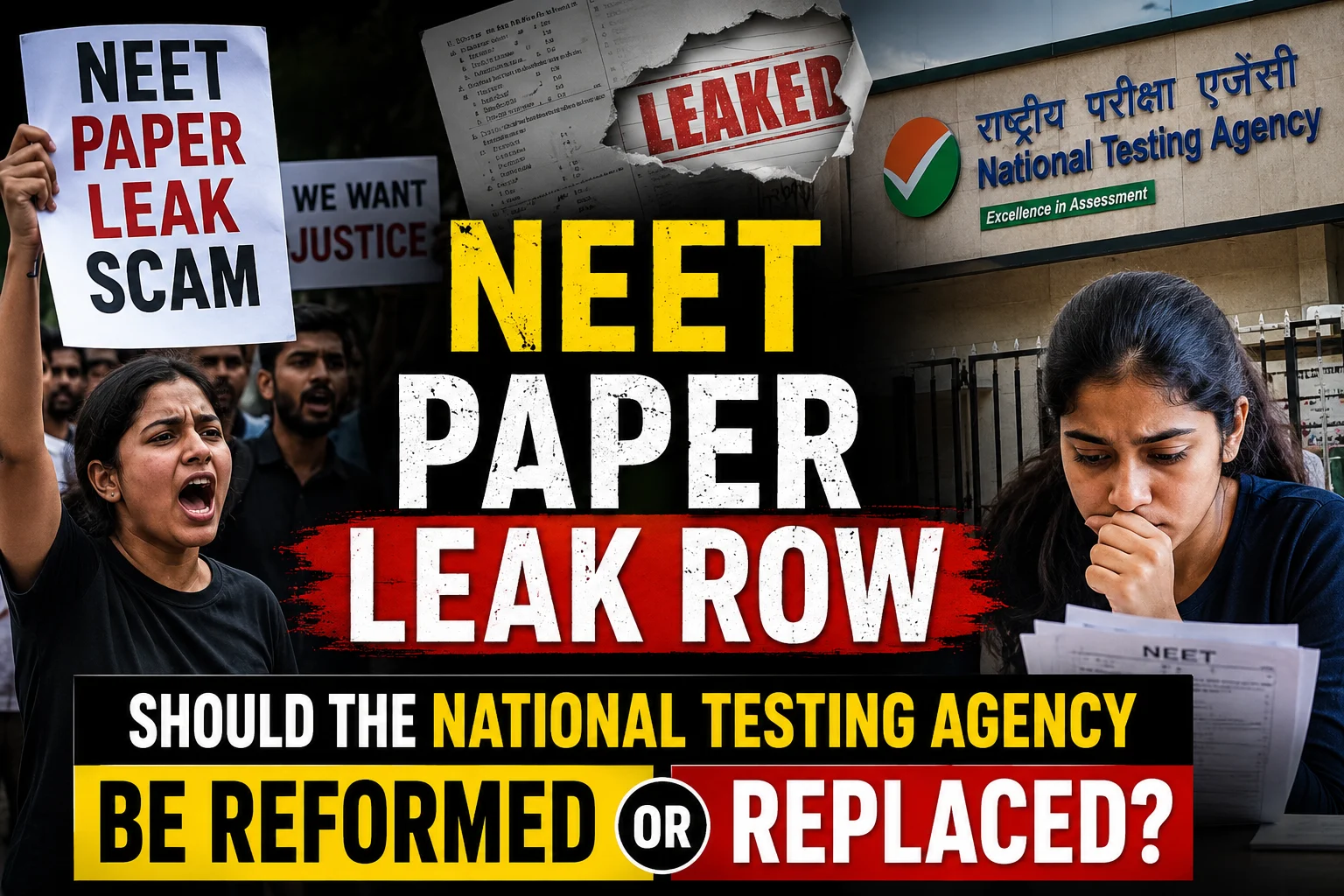
The National Testing Agency’s (NTA) accountability and legitimacy have been put to the test following the NEET paper leak debacle. Reforming the NTA to reclaim the trust of the public or replacing the NTA: What is the more viable option?
Rather than being limited to a single examination, the debate encompasses broader issues, including the accountability, transparency, and technological frameworks of India, as well as the future of significant, high-stakes examinations in the nation.
How Does the NTA Function?
One of the autonomous, self-sustained organizations established by the Government of India in 2017, the NTA was founded to create a more efficient, transparent, and standardized approach to the entrance examinations of higher education.
The NEET, JEE Main, CUET, UGC-NET, and a number of national recruitment and fellowship examinations are some of the prominent examinations conducted by the NTA.
The NTA is improving the quality of the examinations it conducts, as stated on its official website, by adopting modern tools and methods of scientific testing and assessment.
At first, the National Testing Agency's (NTA) creation was seen as positive. More recently, though, concerns emerged regarding the utility of the NTA.
Students and parents seeking regular updates on medical admissions frequently rely on MBBS Advisor for trusted guidance.
NEET Paper Leak Controversy
NEET is one of the largest, if not the largest, entrance exam in the world, with more than 20 lakh participants. Considering how much is at stake, the integrity of the process must be defended.
There have been many allegations about irregularities in the system and about the leaking of the test questions. In this case, the malpractice was organized, with exam centers, middlemen, and access to the question papers colluding.
This was the cause of protests across the nation from students and parents.
The media, judiciary, and opposition all became involved. This transformed the exam controversy into a critique of institutions from an examination problem.
Causes of the NEET Leak Controversy and Outrage
The rage can be attributed to many things.
Examination Size
NEET is the gateway to one out of more than one lakh available seats for MBBS in India.
Public trust erodes when there is reason to suspect the fairness of the exam. The financial and emotional sacrifices of countless families can be undone by the result of a single exam.
Student's Emotional and Mental State
For many students, the pressure of years of coaching and self-preparation culminates in the finality of the examination.
The perception that this has all been in vain, and that the process is unfair, has caused students and their parents to feel betrayed and frustrated.
Questions About Institutional Accountability
Some critics suggest that recurring controversies are indicative of structural weaknesses.
This has prompted many to demand broad reforms or a complete restructuring of the institution.
Arguments Supporting Reform of the NTA
Many education specialists think that replacing the NTA would not address the core issues.
They suggest that reforms should focus on the consolidation of the current system.
1. Security of the System
Securing the integrity of examinations is a system that has to be maintained and updated.
Some of the safeguards that could be adopted are:
- Question papers that are encrypted
- AI-based monitoring
- Biometric verification of candidates
- Increased surveillance
- Tracking of question papers
Adopting the various safety and security systems could eliminate many of the current risks.
2. Upholding the Trust of the Public
Trust is the most important factor in achieving the goals of the NTA and maintaining the integrity of the system.
Some of the steps that could be taken to restore the trust of the public are:
- The examination procedure is independently reviewed.
- Security of the examinations is made publicly available.
- Timely updates of critical incidents are communicated to the public.
- Results of inquiries are made public.
The four points above would address the concerns regarding both secrecy and accountability.
3. Accountability of the NTA
Some have suggested that a revised NTA and system of examinations could provide:
- Review of examination procedures
- Investigation of complaints
- Recommendation of corrective actions
- Institutional accountability
4. Improved Staff Training
The NTA would also require a more skilled and competent workforce who are adequately trained to manage the challenges of both routine and crisis situations.
Arguments Supporting Replacement of the NTA
In contrast, some argue that repeated controversies have irreparably affected the reputation of the NTA.
Structural reform alone is probably not enough from this angle.
Loss of Trust from the Public
Trust is a major asset for any evaluating entity.
It is said that trust for the NTA is now negative.
Once trust is lost, it is almost impossible to bring back.
Need for a Complete New System
Some people want to create an entirely new examining authority with:
- New Heads
- New Admin
- New Responsibility Measures
- New Tech
It shows that creating a new system will show that they are serious about the changes.
Learning from Others
Some countries have independent examining authorities that are free from the influence of politics and bureaucracy.
Those that advocate for a replacement say that India can take inspiration from such models for its education system.
The Legal Standpoint
The issue has also drawn the interest of the judiciary.
The Supreme Court of India has placed a lot of emphasis on the need for examining systems to maintain their credibility and the need to safeguard the interests of deserving candidates.
When it comes to the examinations, the judiciary usually has to deal with the challenge of:
- Ensuring that honest students are not wronged
- Ensuring that the normal academic schedule is not disrupted
- Responsibility
- Confidence of the public
The judiciary has the most concrete role to play in determining if the irregularities are of such gravity that a re-examination has to be ordered.
The Effect on Medical Students
For those who are preparing for NEET, the controversies are a source of anxiety and uncertainty.
The common worries are:
- Will the results of examinations be cancelled?
- Will there be a re-exam?
- Will the counselling be delayed?
- Will there be a delay in admissions?
- Will the stress of all this continue to rise?
Many students are unable to stay focused with all the debates and media coverage.
Educational guidance platforms like MBBS Advisor have been catering to the changing admission timelines and counseling advancements of students during uncertain times.
Technology and Future Evaluations
Technology can advantageously or disadvantageously impact examination systems based on implementation methods.
Some of the innovations can be:
Computer Based Assessment
Currently NEET is a pen and paper based assessment; some experts believe in a gradual adoption toward computer based assessments.
Potential advantages can be:
- Eased logistical concerns
- Increased security
- Quicker results
Concerns for digital equity and infrastructure gaps remain.
Artificial Intelligence
AI can help with examination system integrity via:
- Predictive analysis
- Detection of fraudulent behavior
- Verification of candidates
- Assessment of behavior
and may help with identification of problematic behavior on a timely basis.
Blockchain Based Security
Some experts have suggested a blockchain based question paper management system.
Such a system may offer a tamper proof audit trail and thus improved trust.
Restoring Trust of Students
When attempting to gain trust back, the priority should be placement of students.
Students want assurances of:
- Admission based on merit
- Fair assessments
- Secure systems
- Accountable governance
- No wrongful practices
Trust will be achieved through timely communication and visible corrections.
During times of uncertainty, platforms like MBBS Advisor can offer reliable information to mitigate the confusion of aspiring candidates.
The Wider Examination Reform Discussion
The NEET case has prompted discussion regarding the entire examination system in India.
Questions grow increasingly wide-ranging across various agencies.
Should India:
- Create a separate examination commission?
- Decree the decentralization of some entrance examinations?
- Allow multi-staged assessments?
- Expand the role of technology?
- Amplify legal consequences of malpractice?
The responses will particularly focus on the challenges of educational assessment in large systems, like India, with significant student populations.
Global organizations such as WHO continue to emphasize fairness and accessibility in education systems, while international medical standards reflected through WDOMS reinforce the importance of maintaining credibility in medical education pathways.
Reform or Replacement: Experts' Opinions
The opinions of experts diverge depending on whether they advocate for reform or replacement.
Those in favor of reform hold that:
- Time is a catalyst for the construction of new institutions.
- Existing expertise should not be discarded.
- Current weaknesses can be mitigated by operational improvements.
Those favoring replacement contend that:
- The damage to public trust has been significant.
- Change of institutions, although symbolic, is critically necessary.
- New institutional frameworks offer maximal scope for redesign of processes.
The common goal of both sides is to safeguard the examination system in the interests of students.
Candidates can continue following developments through MBBS Advisor for admission-related updates and expert insights.
The Student Perspective
For the large majority of NEET aspirants, the controversy is less about which institution should be in control and more about the fairness of the system.
Students desire a system of examination that is:
- Open
- Safe
- Systematized
- Accountable
- Based on achievement
The realization of either goal will be the purview of the policymakers.
What students desire the most is the assurance that their efforts will not be in vain.
Conclusions
The NEET paper leak controversy has brought vulnerabilities in high-stakes examination systems in India to the forefront and has mobilized the public to focus on institutional accountability.
The question of whether the National Testing Agency (NTA) should be altered or completely eliminated remains open for discussion. Some who are in favor of changes want to see security, transparency, and accountability addressed. Others who are in favor of completely removing the NTA want to see a new beginning for the existing model to regain public confidence.
Either way, the most important consideration is the priority of students.
The medical aspirants of the country deserve an entrance system founded on ethics and proven merit.
India has yet to learn from the NEET issues. The question of replacement versus reform is trivial in comparison to the challenges faced in protecting the future of students from the failures of such systems.
For students navigating these uncertainties, MBBS Advisor remains a useful source for tracking counselling updates and medical admission developments.