
 Russia
 Belarus
 Georgia
 Kazakhstan
 Kyrgyzstan
 Uzbekistan
 China
China Nepal
Nepal Bangladesh
 Poland
 Romania
 Slovakia
 Hungary
 N. Macedonia
 Vietnam
 Canada
 Armenia
 UK
UK Australia
 USA
USA Ireland
 Germany
 New Zealand
 Italy
Italy France
 Singapore
 Netherlands
 Sweden
 Switzerland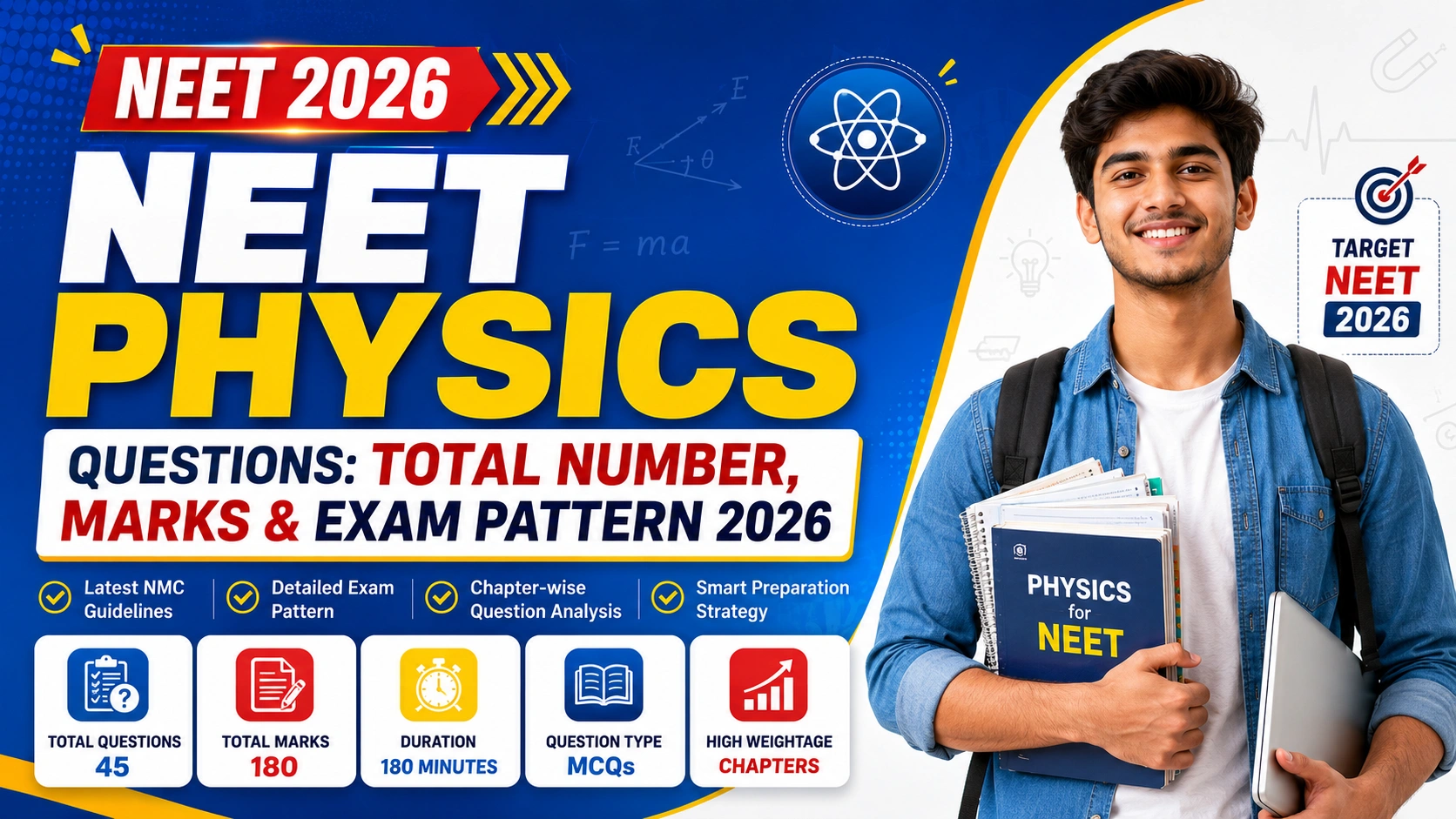
Introduction
NEET (National Eligibility cum Entrance Test) is India’s primary medical entrance examination for admission into MBBS, BDS, AYUSH, and other allied medical courses. Physics is one of the most difficult yet highly scoring subjects in NEET, and students often search for clarity on how many Physics questions are available in NEET, their marks distribution, and exam pattern for 2026.
Understanding the Physics section is important as it plays a decisive role in rank determination. Even small improvements in Physics score can significantly improve overall NEET rank.
Students can explore detailed NEET preparation resources, syllabus insights, and updates through the NEET section available on MBBS Consultant.
This article provides a complete breakdown of NEET Physics questions, marks distribution, exam pattern, chapter weightage, difficulty level, and preparation strategy for 2026.
NEET Physics Exam Pattern Analysis 2026
Physics in NEET is a part of the objective-type MCQ-based examination conducted by NTA.
Key Highlights
- Total subjects: Physics, Chemistry, Biology
- Mode: Pen and Paper (OMR-based)
- Total questions in Physics: 50 (approx.)
- Questions to attempt: 45
- Marks per question: +4
- Negative marking: -1
Physics contributes significantly to the total NEET score.
Total Physics Questions in NEET 2026
NEET Physics section is divided into two parts:
Section A
- 35 questions
- All questions compulsory
Section B
- 15 questions
- Attempt any 10 questions
Final Attempt Structure
- Total Physics questions: 50
- Questions to be attempted: 45
This structure may vary slightly depending on official NTA updates, but the overall format remains consistent.
Marks Distribution in NEET Physics
Physics carries equal weightage as Chemistry.
Total Marks
- Physics section: 180 marks
Breakdown
- 45 questions × 4 marks = 180 marks
Negative Marking Impact
- -1 mark for each incorrect answer
Therefore, accuracy plays a crucial role in Physics scoring.
NEET Physics Difficulty Level 2026
Physics is generally considered:
- Moderate to Difficult Level
Reasons
- Concept-based questions
- Numerical problem-solving
- Application of formulas
- Time-consuming calculations
However, with proper practice, Physics can become a high-scoring subject.
Class 11 vs Class 12 Physics Weightage
NEET Physics questions are distributed between Class 11 and Class 12 syllabus.
Class 11 Weightage
- Around 45%–50%
Topics Include
- Mechanics
- Thermodynamics
- Waves
Class 12 Weightage
- Around 50%–55%
Topics Include
- Electricity
- Optics
- Modern Physics
Balanced preparation is required for both classes.
Important Physics Chapters for NEET 2026
High-Weightage Chapters
- Current Electricity
- Ray Optics and Optical Instruments
- Electrostatics
- Laws of Motion
- Work, Energy and Power
- Modern Physics
- Semiconductors
- Magnetism
These chapters frequently contribute multiple questions.
NEET Physics Question Types
Physics questions are primarily:
Types
- Concept-based MCQs
- Numerical problems
- Formula-based questions
- Graph-based questions
- Assertion-Reason type (sometimes)
Understanding concepts is more important than memorization.
Strategy to Solve Physics Questions in NEET
Effective Strategy
- Start with easy questions first
- Avoid spending too much time on one question
- Use elimination techniques
- Practice numerical shortcuts
- Focus on accuracy over speed
Importance of Physics in NEET Rank
Physics often acts as a rank differentiator.
Impact
- High Physics score improves rank significantly
- Weak Physics can lower overall score despite strong Biology
Students can estimate their expected rank using the NEET Rank Predictor.
NEET Physics Syllabus Structure
Physics syllabus is based on NCERT Class 11 and 12.
Class 11 Topics
- Mechanics
- Thermodynamics
- Oscillations
- Waves
Class 12 Topics
- Electrostatics
- Current Electricity
- Magnetism
- Optics
- Modern Physics
Time Management for Physics Section
Physics is time-consuming, so proper time allocation is essential.
Suggested Strategy
- 45–50 minutes for Physics section
- Skip difficult questions initially
- Return later for review
Common Mistakes in NEET Physics
Mistakes
- Ignoring formula revision
- Lack of numerical practice
- Poor time management
- Guessing without logic
Preparation Strategy for NEET Physics 2026
Step-by-Step Plan
- Strong NCERT conceptual clarity
- Daily numerical practice
- Chapter-wise revision
- Weekly mock tests
- Error analysis after tests
Students can access structured preparation guidance through MBBS Consultant and the NEET section.
Role of NCERT in Physics Preparation
Although Physics is not purely NCERT-based, NCERT still plays an important role.
Importance
- Concept foundation
- Theoretical clarity
- Basic derivations
NEET Exam Authority and Regulation
The NEET examination is regulated by national medical authorities.
Role of NMC
The National Medical Commission (NMC) ensures medical education standards and MBBS admission structure in India.
Role of WHO in Medical Education Awareness
The World Health Organization (WHO) provides global health guidelines.
Contributions
- Health education
- Disease control awareness
- Medical research support
Importance of WDOMS for Medical Students
The World Directory of Medical Schools (WDOMS) helps students verify foreign medical universities.
Importance
- Degree recognition
- Global licensing eligibility
- Institutional validation
NEET Physics vs Other Subjects
Comparison
Biology
- Most scoring
Chemistry
- Balanced
Physics
- Most difficult
Physics requires more practice and conceptual clarity.
How to Improve Physics Score in NEET
Key Techniques
- Daily problem solving
- Formula revision sheet
- Mock test practice
- Conceptual clarity focus
Importance of Mock Tests for Physics
Mock tests help improve:
- Speed
- Accuracy
- Question selection strategy
- Time management
Conclusion
NEET Physics consists of about 50 questions (45 to attempt) carrying a total of 180 marks. It is one of the most important sections in NEET because it significantly affects overall rank.
Physics requires conceptual understanding, regular practice, and strong problem-solving skills. While it is considered difficult by many students, consistent preparation can turn it into a high-scoring subject.
For structured preparation, syllabus guidance, and updates, students can rely on MBBS Advisor and its NEET resources. Tools like the NEET Rank Predictor also help in analyzing expected performance.
A strong foundation in Physics, combined with a disciplined preparation strategy, is essential for achieving a top NEET rank and securing admission into a reputed medical college.