
 Russia
 Belarus
 Georgia
 Kazakhstan
 Kyrgyzstan
 Uzbekistan
 China
China Nepal
Nepal Bangladesh
 Poland
 Romania
 Slovakia
 Hungary
 N. Macedonia
 Vietnam
 Canada
 Armenia
 UK
UK Australia
 USA
USA Ireland
 Germany
 New Zealand
 Italy
Italy France
 Singapore
 Netherlands
 Sweden
 Switzerland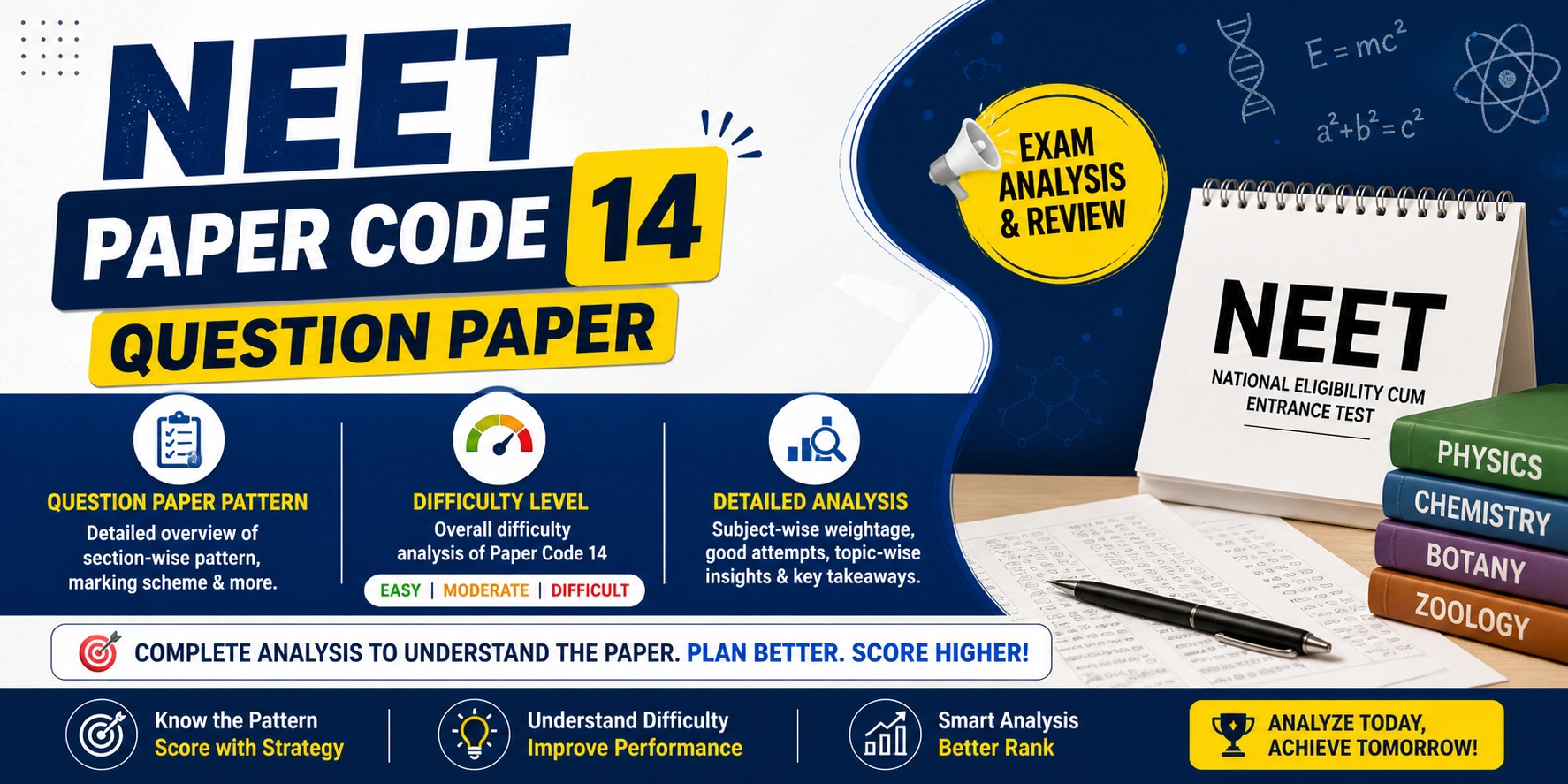
Among various competitive medical entrance exams, NEET is one of the toughest exams, and analysis of specific paper codes like Code 14 helps students in understanding exam pattern difficulty level as well as question trends. A thorough analysis of NEET Paper Code 14 can help aspirants finalize the approach to ace the test as well as improve their performance in this exam.
Moreover, for the students who begin with their medical journey and seek guidance from a reliable mbbs advisor it can also be instrumental in making informed career choices after NEET.
? NEET Paper Code 14: Exam Overview
NEET Paper Code 14: The overall pattern of the NEET paper code 14 is in accordance with the standard format laid down by the National Medical Commission.
- By the number Question: 200 (180 to attempt)
- SDP 13.— Design, Drawing and Engineering Materials Physics. (4 + 0) Chemistry. (3 + 1).
- Total Marks: 720
- Kind of Questions – MCQs (Multiple Choice Questions)
- Negative Marking: Yes [1 for each incorrect answer]
GitHub To prepare for Acuitus Global exams, Practice questions will be divided into Sections. It allows flexibility whilst testing deep understanding.
? Subject-Wise Question Distribution
? Biology (Botany + Zoology)
- Total Questions: 100
- Weightage: 50% of the paper
Biology in Code 14 was mostly dependent on NCERT concepts. The questions mostly dealt with facts and diagrams in a more direct way. This section was kind of easy for those who are done with NCERT.
?? Chemistry
- Total Questions: 50
Paper Code 14 was a combination of:-
- Organic Chemistry (reaction-based questions)
- Inorganic Chemistry (NCERT-focused)
- Physical Chemistry (numericals and formula-based)
This section was of moderate difficulty level with even distribution across topics.
? Physics
- Total Questions: 50
In Code 14, Physics was the most difficult section. It included:
- Lengthy numerical problems
- Concept-based questions
- Application-oriented problems
Students whose problem-solving skills and practice were solid had the greatest advantage.
? Difficulty Level Analysis
NEET Paper Code 14 difficulty level can be summarized as:
- Biology: Easy to Moderate
- Chemistry: Moderate
- Physics: Moderate to Difficult
The paper was above average length mostly just because of the Physics section. Also, as you go throughout the exam it is important to be able to manage your time trying all the questions.
For estimation of your anticipated score on such difficult levels, measurements through the Neet Rank Predictor is quite helpful. It guides students to predict his rank and is useful in estimating admission chances into the top medical colleges.
? Key Highlights of paper code 14
- The NCERT has played a major role, especially in Biology & Inorganic Chemistry
- Physics needed clarity of concept and speed
- Many questions were a statement and required careful reading.
- Analytical thinking was on the test with assertion-reason type questions
- Students who revised and gave mock tests did so much better
? Time Management Strategy
An ideal time strategy based on analysis of Code 14 would be:
- Biology: 45–50 minutes
- Chemistry: 40–45 minutes
- Physics: 60–65 minutes
So, we tried out Biology first to be our confidence boosters and then Physics took a lot of time and concentration.
? Career Scope After NEET
Students can check their career options at this stage by reading papers similar to Code 14 and using tools like Neet Rank Predictor after estimating your rank.
Most of the aspirants also look to study abroad with options such as MBBS in Georgia, a country that provides affordable medical courses with worldwide recognized GMP degrees.
The World Health Organization maintains quality standards in medical education globally to facilitate good healthcare practices.
In addition, there is a World Directory of Medical Schools which helps students validate if an institution really exists or not.
? Common Mistakes Observed
- Second mistake: spending extra time on tough Physics questions
- Ignoring NCERT-based preparation
- Not Understanding the Mock Tests
- Time Management on the exam
Not making these mistakes would result in a much better performance.
? Final Analysis
NEET Question Paper Code 14 was a moderate but slightly tough paper owing to Physics. Students who stuck to NCERT, practiced regularly & managed time well could secure higher marks.
The bottom line is that you have to stick with a wise prep regimen:
Success = Concept Clarity + Practice + Time Management
With the help of a good mbbs advisor, you can plan your career and also opt for the NEET Rank Predictor to guide you along.