
 Russia
 Belarus
 Georgia
 Kazakhstan
 Kyrgyzstan
 Uzbekistan
 China
China Nepal
Nepal Bangladesh
 Poland
 Romania
 Slovakia
 Hungary
 N. Macedonia
 Vietnam
 Canada
 Armenia
 UK
UK Australia
 USA
USA Ireland
 Germany
 New Zealand
 Italy
Italy France
 Singapore
 Netherlands
 Sweden
 Switzerland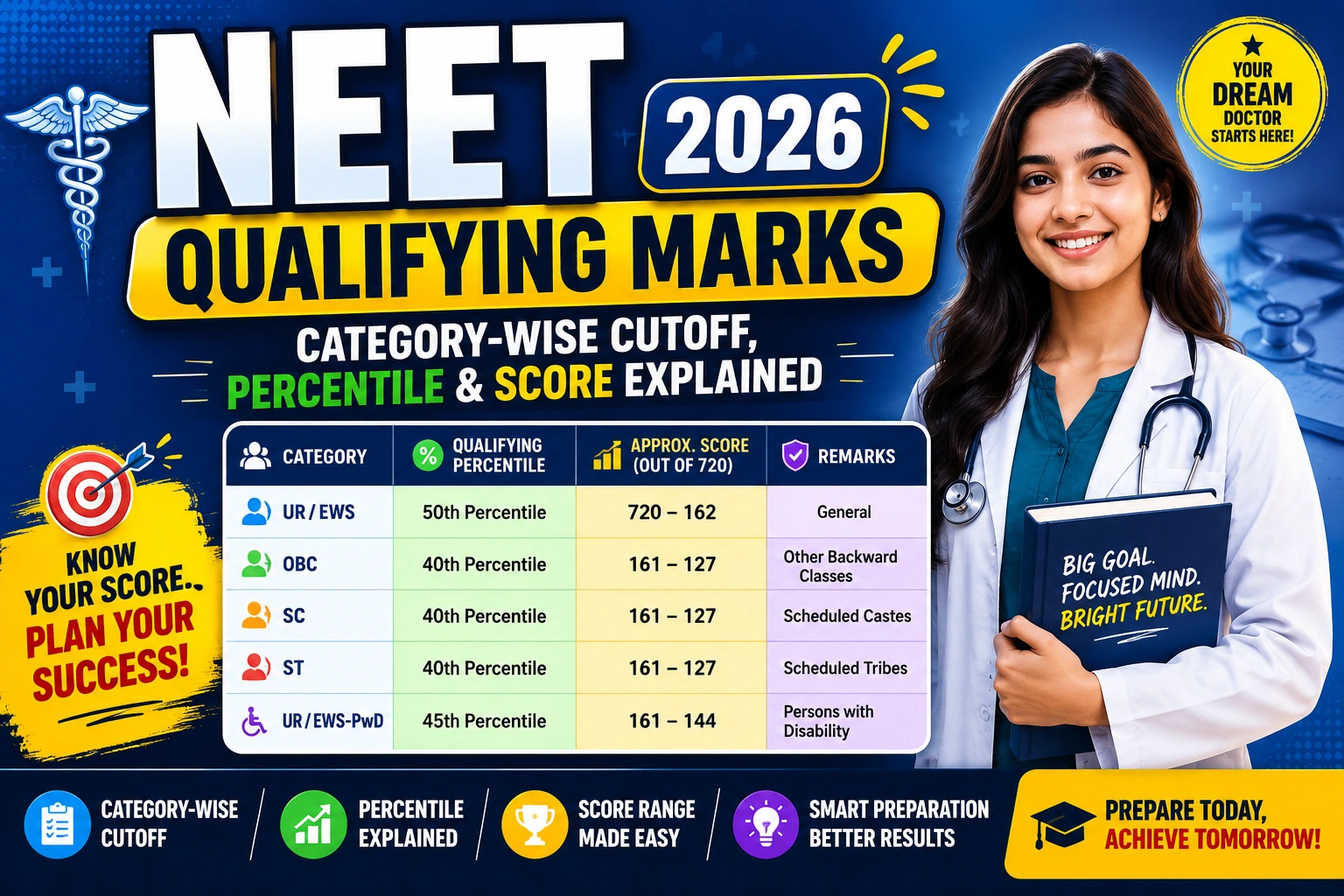
Introduction
NEET (National Eligibility cum Entrance Test) is the gateway to admission into MBBS, BDS, AYUSH, and other medical courses in India. Every year, lakhs of students appear for this highly competitive examination, but only those who meet the NEET qualifying marks criteria become eligible to participate in the counselling process.
NEET qualifying marks are not fixed like school examination passing marks. Instead, they are based on a percentile system defined by the National Testing Agency (NTA) and regulated by the National Medical Commission (NMC). This makes NEET qualifying marks dynamic, meaning they change every year depending on exam difficulty, candidate performance, and overall competition.
In this comprehensive guide, we will explain NEET Qualifying Marks 2026, category-wise cutoff trends, percentile calculations, expected score ranges, and their impact on medical admissions. We will also discuss how MBBS Advisor, NEET Rank Predictor, and global organizations such as WHO and WDOMS are connected to the medical admission journey.
Meaning of NEET Qualifying Marks
NEET qualifying marks refer to the minimum score or percentile required to pass the NEET examination and become eligible for counselling.
It is important to understand that qualifying marks do not guarantee admission to MBBS, BDS, or other medical courses. They only make a candidate eligible to participate in the next stages of the admission process.
Unlike traditional examinations, NEET qualification is based on percentile rather than a fixed score out of 720. This means a student's performance is evaluated relative to other candidates.
If a student fails to achieve the required qualifying percentile, they cannot participate in counselling, regardless of their overall score.
NEET Qualifying Marks 2026 Overview
NEET qualifying marks vary every year depending on:
- Difficulty level of the examination
- Number of candidates appearing
- Overall student performance
- Reservation policies
For NEET 2026, the expected qualification system will continue to follow the percentile-based model used in previous years.
Generally, General category candidates require a higher percentile, while reserved category candidates benefit from relaxed qualification criteria.
A difficult examination often results in lower qualifying marks, whereas an easier paper may lead to higher qualifying scores.
This system helps maintain fairness across different exam sessions and candidate groups.
NEET Qualifying Percentile System Explained
NEET uses a percentile-based evaluation system instead of fixed passing marks.
A percentile represents a student's relative performance compared to all other candidates.
For example:
- 50th percentile means the candidate has performed better than 50% of all test takers.
The expected qualifying percentiles are:
|
Category |
Qualifying Percentile |
|
General (UR) |
50th Percentile |
|
OBC |
40th Percentile |
|
SC |
40th Percentile |
|
ST |
40th Percentile |
|
PwD (General) |
45th Percentile |
This system ensures equal opportunities and fair competition among different categories.
Category-Wise NEET Qualifying Marks 2026
NEET qualifying marks differ across categories due to India's reservation policies.
General Category
Candidates must secure at least the 50th percentile.
OBC Category
Candidates must achieve the 40th percentile.
SC Category
Candidates require the 40th percentile.
ST Category
Candidates also need the 40th percentile.
PwD Candidates
Separate relaxed criteria apply according to government regulations.
It is important to remember that qualifying marks are not fixed numbers. They vary every year because percentile thresholds correspond to changing score ranges.
NEET Qualifying Marks vs NEET Cutoff
Many students mistakenly assume that qualifying marks and cutoff marks are the same. However, they serve different purposes.
NEET Qualifying Marks
- Minimum marks required to pass NEET.
- Eligibility for counselling.
- Applicable to all candidates.
NEET Admission Cutoff
- Minimum score required to secure admission to a particular medical college.
- Varies by institution, category, seat availability, and competition.
Qualifying marks make students eligible for counselling, whereas cutoff marks determine actual admission opportunities.
Understanding this distinction is essential for effective counselling planning.
How NEET Qualifying Marks Are Calculated
NEET qualifying marks are not determined using a fixed formula.
The process generally involves:
- Evaluating all answer sheets.
- Ranking candidates according to scores.
- Calculating percentile positions.
- Determining category-wise qualifying percentiles.
Because qualification depends on percentile ranking, qualifying marks automatically adjust based on the overall performance of candidates.
This dynamic approach helps maintain fairness and consistency in a highly competitive national examination.
Importance of NEET Qualifying Marks
NEET qualifying marks play a critical role in the medical admission process.
If a student does not achieve the qualifying percentile:
- They cannot participate in counselling.
- They become ineligible for MBBS and BDS admissions through NEET.
- Their NEET attempt is considered unsuccessful for admission purposes.
Qualifying marks therefore act as the first screening stage in medical admissions.
Role of NMC in NEET Qualifying Criteria
The National Medical Commission (NMC) plays a major role in regulating medical education and admission standards in India.
NMC is responsible for:
- Medical admission regulations
- Eligibility standards
- Reservation implementation
- Recognition of medical colleges
- Overall quality assurance in medical education
The NEET qualification framework operates under NMC-approved guidelines to ensure transparency and fairness.
NEET Qualifying Marks and MBBS Admission
Qualifying NEET does not guarantee admission into a medical college.
After qualifying, students must proceed through:
- Counselling registration
- Choice filling
- Seat allotment rounds
- Document verification
- Admission confirmation
Actual admission depends on:
- All India Rank (AIR)
- Category rank
- College-specific cutoff
- Seat availability
Thus, qualifying marks represent only the beginning of the admission journey.
Role of MBBS Advisor After NEET Qualification
After clearing NEET, many students become confused about their admission prospects.
This is where an MBBS Advisor becomes valuable.
MBBS Advisor helps students:
- Predict suitable MBBS colleges
- Compare government and private institutions
- Explore MBBS abroad opportunities
- Analyze admission possibilities based on scores
Many students use MBBS Advisor to make informed counselling decisions.
NEET Rank Predictor and Its Importance
A NEET Rank Predictor helps students estimate their expected rank based on marks obtained.
Benefits include:
- Predicting All India Rank (AIR)
- Understanding admission chances
- Planning counselling strategy
- Reducing post-exam anxiety
The NEET Rank Predictor serves as an important bridge between exam performance and admission planning.
WHO and WDOMS in Medical Education Context
The World Health Organization (WHO) establishes global healthcare and medical education standards that indirectly influence medical training quality worldwide.
The World Directory of Medical Schools (WDOMS) is an internationally recognized database of approved medical universities.
Students considering MBBS abroad should verify:
- WDOMS listing status
- NMC recognition
- Eligibility for licensing examinations such as FMGE or NExT
This ensures that medical qualifications remain internationally recognized and professionally valid.
NEET Qualifying Marks Trends Over the Years
NEET qualifying marks fluctuate annually due to several factors:
- Examination difficulty
- Candidate participation levels
- Overall performance trends
- Reservation and seat allocation policies
Generally:
- Difficult papers lead to lower qualifying scores.
- Easier papers lead to higher qualifying scores.
This flexible system helps maintain balanced competition each year.
Common Misunderstandings About NEET Qualifying Marks
Many students misunderstand how qualification works.
Common misconceptions include:
- Believing qualifying marks remain the same every year.
- Confusing qualifying marks with college cutoffs.
- Assuming qualification guarantees admission.
- Ignoring the importance of percentile calculations.
Understanding these concepts correctly helps students make realistic admission plans.
NEET Qualifying Marks for Government Medical Colleges
Qualifying NEET only allows participation in counselling.
Admission to government medical colleges generally requires:
- Higher NEET scores
- Better All India Rank
- Strong category rank
- Competitive percentile
Therefore, merely qualifying is not enough for securing a government MBBS seat.
Students must aim significantly higher than the minimum qualifying threshold.
Importance of Understanding NEET Qualifying Marks Early
Knowing the qualifying criteria early helps students create realistic preparation goals.
Benefits include:
- Setting target scores
- Planning preparation strategies
- Understanding competition levels
- Preparing for counselling in advance
Early awareness improves confidence and reduces confusion after results are declared.
Conclusion
NEET Qualifying Marks 2026 are a crucial component of the medical admission process in India. They determine whether a candidate becomes eligible for counselling and further admission procedures. However, these marks are not fixed numbers; they are based on percentile systems established by NTA and regulated by NMC.
Qualifying for NEET is only the first step. Final admission depends on rank, category, counselling performance, and college-specific cutoffs. Tools like MBBS Advisor and NEET Rank Predictor help students evaluate their admission prospects, while international organizations such as WHO and WDOMS support globally recognized medical education standards.
In conclusion, NEET qualifying marks are more than just a score—they are the gateway to a medical career, and understanding them thoroughly is essential for every aspiring doctor.