
 Russia
 Belarus
 Georgia
 Kazakhstan
 Kyrgyzstan
 Uzbekistan
 China
China Nepal
Nepal Bangladesh
 Poland
 Romania
 Slovakia
 Hungary
 N. Macedonia
 Vietnam
 Canada
 Armenia
 UK
UK Australia
 USA
USA Ireland
 Germany
 New Zealand
 Italy
Italy France
 Singapore
 Netherlands
 Sweden
 Switzerland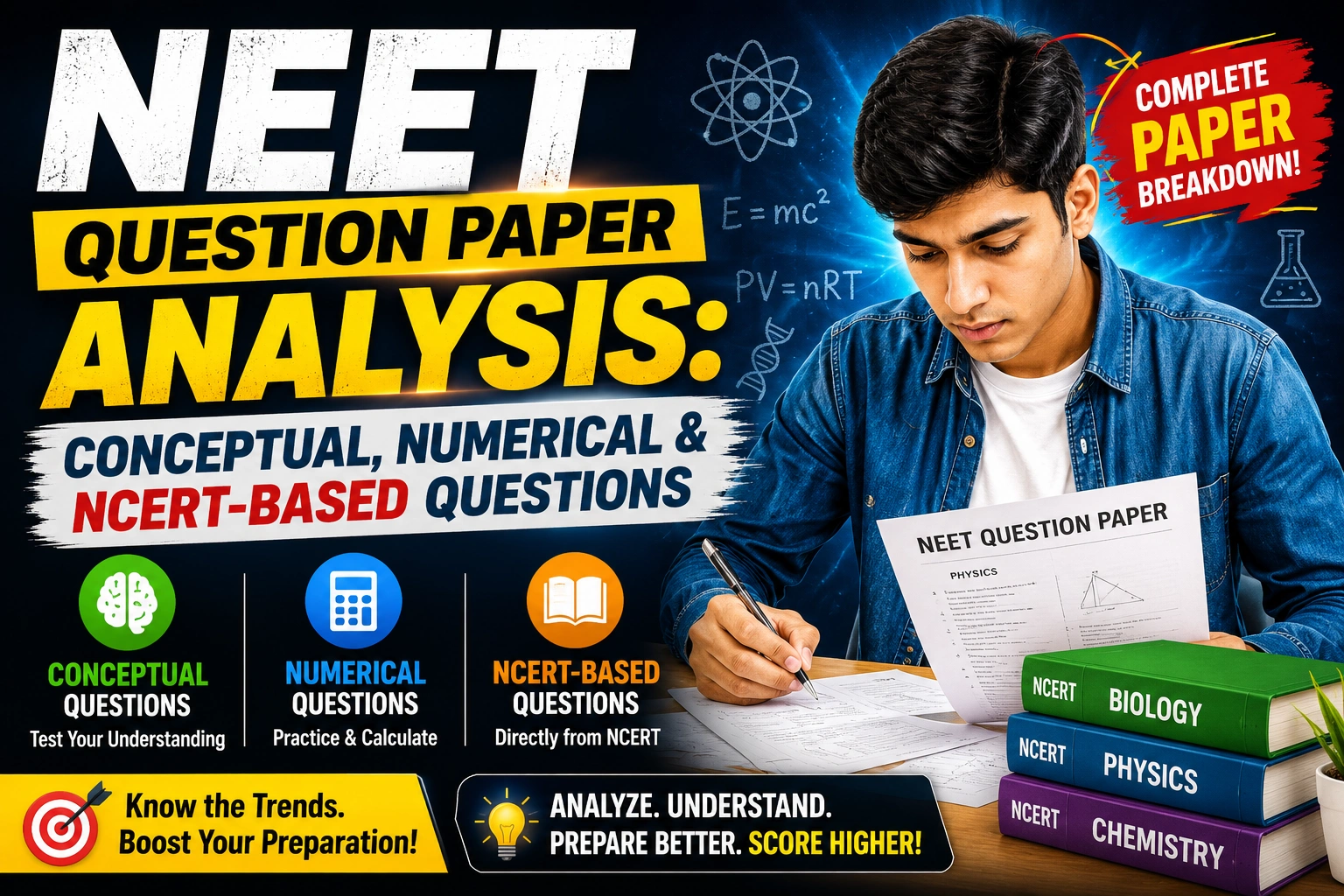
The demand for medical education in India has resulted in NEET being one of the most competitive entrance exams. Completing the syllabus is necessary, but understanding the NEET exam pattern is crucial, given the high level of competition.
Question pattern analysis is neglected by the majority of students who prepare for NEET by learning the theory content chapter-wise. A comprehensive analysis of NEET question papers assists students in realizing the structure of the exam and helps them in designing a strategy to boost their probability of securing a rank they desire.
For further NEET preparation guidelines, refer to MBBS Advisor, a trustworthy source for NEET preparation advice. A NEET Rank Predictor can be used to provide an approximate rank based on the test taker’s score and provides a list of medical colleges that can be applied to based on the NEET score.
This guide will help you analyze the NEET exam papers, rank the subjects from easiest to highest level of difficulty, learn how to approach the NCERT and concepts, practice numericals, and understand how to face the examination.
Decoding the NEET Exam Pattern
It is essential to develop a basic understanding of the patterns of the NEET question papers before studying the question type. The NEET question papers are based on the understanding of the NEET syllabus (for classes 11 and 12) with a focus on Physics, Chemistry, and Biology.
The design of the question paper, however, goes beyond testing the mere ability to memorize, recognize, and recall. It is a test of the understanding of concepts, their application, and the ability to analyze a situation and think critically.
The NEET question paper is a blend of the following:
- Questions designed to test the fundamental understanding of concepts.
- Numerical problems and Direct and Indirect NCERT questions.
- Assertion, Reasoning, and Application based questions.
- Questions based on diagrams and practical knowledge (especially Biology).
- Understanding the blend helps students go beyond memorizing (rote learning) and prepares them for the actual requirements of the exam.
Analyzing the NEET Question papers
One of the best ways to prepare for the exam is to study the previous years’ NEET papers. This helps students recognize patterns of frequently asked questions, the level of difficulty of the exam, and the knowledge depth required for various topics.
Students develop a realistic exam approach and the ability to identify quick and easy questions. This also helps students understand the importance of the right amount of time for each question and not spending too much time on the difficult questions.
Understanding prior exam questions leads students to greatly improve year on year, as they form an understanding of not only the exam format, but how the type of thinking the examiners employ.
The Understanding of Conceptual Questions in NEET
Conceptual questions make up a considerable number of questions on the NEET exam, as these questions differentiate the students that know science from the students that only know how to memorize.
Conceptual questions are really simple, but are deceptively difficult, requiring the student to understand the very basic foundation of a whole topic.
Conceptual Questions in Physics
NEET students do not have a very easy time answering questions on physics because these questions rely heavily on the understanding of laws, principles, relationships of physical quantities and their practical applications.
For example, students may need to analyze the behavior of a system rather than directly apply a formula. Concepts in questions may be derived from mechanics, modern physics, optics, electricity and thermodynamics.
Again, students must understand why a certain formula derives a certain answer instead of the answer.
Conceptual Questions in Chemistry
Conceptual questions in Chemistry contain questions in Physical, Organic and Inorganic Chemistry.
Organic Chemistry relies on the understanding of reaction mechanisms and properties of organic compounds and Inorganic Chemistry relies on the understanding of the periodicity of elements and of their chemical properties and of theories of Chemistry.
Concepts of Physical Chemistry may be arguably the most difficult due to the interplay between Chemistry and Mathematics.
Conceptual Questions in Biology
Many of the Biology questions are directly based on the NCERT and conceptual understanding, and therefore must not be ignored as they carry the highest weight within the NEET exam.
Questions may include biological processes and systems, genetics, evolution, ecology, and human physiology.
Students will benefit more from considering the relationships between biological concepts than by memorizing definitions.
NEET Numerical Questions: Practice, Precision, and Preparation
Numerical questions are primarily found in Physics and Physical Chemistry. These assess your ability to do calculations, apply formulas, and think analytically.
The most common reason students lose marks in numerical questions is because they frequently miscalculate. This is especially vital in NEET due to negative marking.
The best strategy to prepare for numerical questions is the understanding of related formulas, practicing varying difficulties of questions, and developing fast calculation skills.
Physics Numerical Questions Preparation Strategy
Numerical questions in Physics can be simple questions that require little more than the application of a formula to complex questions requiring multi-step calculations.
A great preparation strategy is to understand the theory of each chapter and practice a large number of questions.
A separate notebook for formulas can aid in the retention of critical information.
Numerical questions practice also improves through the repeated application of solving questions in a limited time through the completion of mock tests.
Physical Chemistry Numerical Questions Preparation Strategy
A great strategy for Physical Chemistry is the understanding of the theory and Mathematics of the chapter.
Numerical questions are common in the Chemistry chapters of chemical equilibrium, thermodynamics, electrochemistry, and solutions.
Each of these requires that students practice different variations of the same question to answer correctly since the same concept can be applied in many forms.
Accuracy also plays a large role in the overall score of this chapter along with unit conversion.
NCERT Questions: NEET Prep Foundation
NCERT books are vital for NEET prep. Most Biology and Chemistry questions are based on NCERT.
Top students suggest reading the NCERT books multiple times. This is because reading them once is not enough. Questions can be based on the smallest details including diagrams and scientific terms.
Students should highlight the important lines, make short notes, and revise the NCERT books often.
Importance of NCERT for Biology
Biology has the highest weightage in NEET, and NCERT is the core of this subject.
Questions are asked based on definitions and diagrams or even on tables and scientific terms.
Because of this, students should not rely on many other reference books and ignore the NCERT books.
Repeated reading and revising the NCERT Biology books can help improve scores greatly.
Importance of NCERT for Chemistry
NCERT is of huge importance for Inorganic and Organic Chemistry.
Direct questions are based on theories of reactions, properties of elements and trends, and Chemistry covered in NCERT.
Students should revise the NCERT books and important reactions.
Analysis of the NEET Exam Pattern by Subject
Each subject in NEET has a different pattern and students should study for the exam based on this.
Physics
Physics has questions that involve concepts and calculations. For this, students should practice.
Students should do lots of practice questions instead of going through the theory multiple times.
Chemistry
Chemistry is a mix of theory, concepts and calculations.
The key components of a successful study strategy are the fundamentals, a thorough review of NCERT, memorization of the important reactions, and practice.
Biology
This is the highest scoring subject, as this has the highest number of questions.
Most of the questions are NCERT based; however, students need to develop the ability to solve application-based questions with a sound knowledge of the concept.
The key to gaining command of Biology is continuous practice.
How Previous Year NEET Papers Help in Preparation
Previous year question papers help students understand the examination pattern and the level of difficulty.
Practicing these papers helps students become aware of:
- The concepts that are most likely to be asked.
- The most important chapters.
- The most effective time management.
- The most frequent errors committed by students.
- The level of difficulty of the conceptual and numerical problems.
To build the confidence and enhance the performance, students must practice the previous papers as though they are in the actual NEET examination.
The Role of Mock Tests and Analysis of Performance
Mock tests play an important role as they recreate the NEET environment.
Most students practice tests on a regular basis, but fail to see their mistakes. Improvement truly happens ????? students realize the rationale behind the incorrect answers.
For each mock test, the students must reflect upon:
- Wrong answers.
- Time taken in each segment.
- Weak concepts.
- Errors in calculations.
- Revision requirements.
In this cycle of practice of mock tests, students gain the edge in their NEET score.
Common Errors Committed by Students in NEET Questions
Common errors in NEET test responses are:
- Lack of understanding of concepts beyond rote learning.
- Dismissing the NCERT textbooks.
- Lack of confidence in solving numericals.
- Excessive time spent on challenging questions.
- Errors in calculations.
- Failure to study.
Random guessing of answers.
Avoiding these errors even to a small extent can meaningfully improve the performance of students and eliminate negative marking.
How NEET Rank Predictor Assists After the Exam
It's natural for students to become eager about their prospective rank and admission chances after the NEET exam. A NEET Rank Predictor assists students in anticipating their future rank based on the marks they received and the admission statistics from prior years. Utilizing this tool can help students assess the level of their competition, devise a plan for counseling and determine which medical colleges are a viable option.
They should also keep in mind that the final rank will only be established with the official announcement of the results.
NEET’s Importance for MBBS in India and Other Countries
NEET is the first step for students seeking an MBBS admission in India. A student must qualify for NEET in order to gain admission to a medical school in India. It is also a pre-requisite for Indian students planning to pursue an MBBS outside of India. Students considering an MBBS from outside of India must ensure the medical school is listed with the World Health Organization and the National Medical Commission.
NEET Aspirants and MBBS Advisor
A prospective medical student’s journey officially begins with the correct advice and information.Everyone working at MBBS Advisor has a thorough understanding of the medical admission process at all levels from NEET to the selection of the medical colleges.
They understand the NEET exam, counseling, MBBS admission in India and other countries, recognition of universities and eligibility, and medical career pathways.
The platform includes features like the NEET Rank Predictor resource, where students can view their probable ranks to help them with their next steps.
Final Tips to Master the NEET Question Paper
The correct balance of understanding concepts, practicing the mathematics of it all, and thorough revisions of NCERT is the cornerstone of a successful NEET strategy.
Building a solid foundation, solving the last year's question papers, and taking periodic mocks with the analysis of the mocks is the primary focus.
Instead of plowing through volumes of study material, the focus should be on a few of the best quality resources.
Conclusion
The NEET question paper has been crafted to test a student’s understanding of concepts, their ability to solve NCERT-based numericals, and their knowledge of the NCERT syllabus.
Focus on building fundamentals, practice regular NCERT revisions, and develop your own flexible revision.
Conceptual learning, mastery of numericals, and the NCERT textbooks all deserve the same focus. The primary focus should be on the analysis of the last year's papers and taking periodic mocks.
With the right directions from MBBS Advisor, strategies that place importance on learning, understanding the roles of WHO and NMC, the WDOMS, while using the NEET Rank Predictor, give aspirants the tools to take the NEET with confidence and closer to their goal of being successful doctors.