 Russia
 Belarus
 Georgia
 Kazakhstan
 Kyrgyzstan
 Uzbekistan
 China
China Nepal
Nepal Bangladesh
 Poland
 Romania
 Slovakia
 Hungary
 N. Macedonia
 Vietnam
 Canada
 Armenia
 UK
UK Australia
 USA
USA Ireland
 Germany
 New Zealand
 Italy
Italy France
 Singapore
 Netherlands
 Sweden
 Switzerland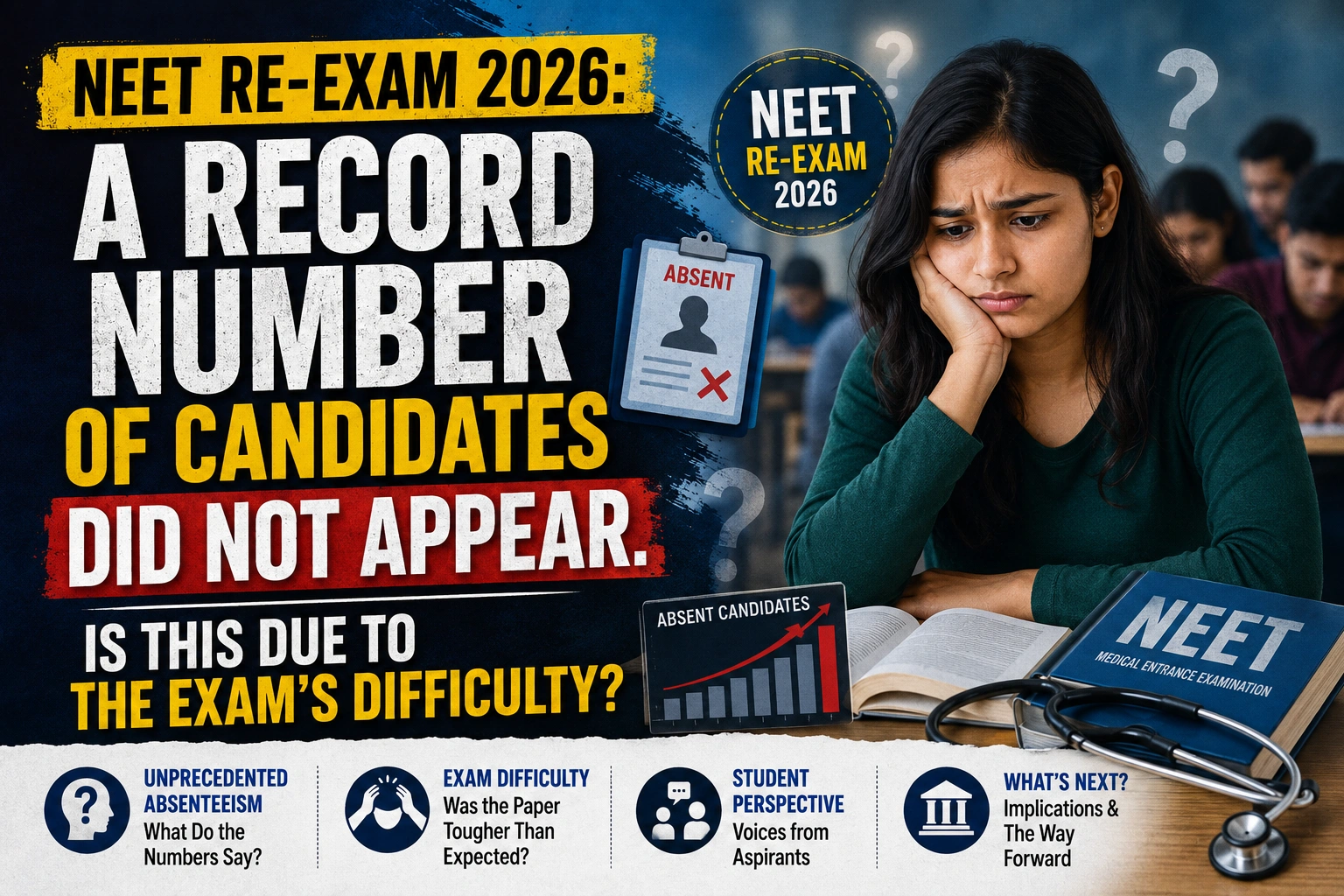
The NEET UG 2026 Re-Exam, which occurred on June 21, 2026, presented the medical education community with what is perhaps the most disturbing and perplexing statistic to date: a record number of candidates, who officially registered, chose not to attend the exam. In the case of the NEET (National Eligibility cum Entrance Test), which was attended by around 25 lakh exam candidates, 2.79 lakh failed to show up for the re-exam. Many educational analysts point to this NEET cycle as having the highest absentee rate since 2021.
A record absentee rate for a gateway exam into MBBS, BDS, AYUSH and Veterinary courses is a worrying concern for the medical aspirants, their parents and various coaching centers. A hard exam may be the least of the reasons. In this article, we explain the analytics and the possible reasons, and the implications for cut-offs, rankings and the admission procedure for 2026.
Why was there a Re-Exam in the First Place?
To explain the absentee crisis, we will go back to the original NEET UG 2026, which was officially conducted on May 3, 2026, across 55 cities in India. Soon after, various news outlets reported that a ‘guide’ paper with questions likely to appear in the actual exam had been circulated prior to the exam.
Investigators reportedly started identifying an alleged solver network after a significant portion of a leaked document was found to match the actual version of the question paper. The exam was canceled and subsequently conducted as a Re-NEET on June 21, 2026, in an offline, pen-and-paper format. The exam was originally scheduled to take place on May 3, 2026. Exercise your right to a free and fair election, or face the tyranny of oppressive rule... because it was a re-examination instead of a new registration cycle, no registrations were accepted from the public. The original registrants of the examination, scheduled for May 3, 2026, were automatically scheduled to sit the examination on June 21, 2026, and application fees were reimbursed. In theory, near-total participation was expected, as examination candidates were already registered, and had invested time and money preparing for the examination. Instead, participation dropped significantly, and that gap is the subject of current discourse.
The intensity of competition for MBBS seats has direct relations with cutoffs, percentiles, and closing ranks and their behaviors during counseling. With fewer applicants this year, NEET rank bands may also exhibit some changes, especially mid-rank segments when compared to previous years. Those who wish to check how they stand should closely monitor the NEET Rank Predictor tool.
Is the Difficulty of the Exam to Blame?
This is the most common query in student forums and coaching centers. The simple answer is that it is partially true, but not wholly.
Feedback on Paper Difficulty from the Students
Relatively most of the feedback from candidates who appeared for the Re-NEET was that the Physics section was long and had a lot of calculations, Chemistry was of moderate difficulty, and Biology was of an expected difficulty and was easy. Those who attempted both noted that the Re-NEET paper on June 21 was more difficult than the May 3 paper. There are also claims that the qualifying cutoff for this year will be less than 600, which is a target score for most of the candidates who wish to secure a seat in the top government colleges.
There are huge problems with attendance at this exam and the claimed level of difficulty in the exam is one reason. Difficult exams can dissuade less adequate candidates from attending, especially when they are aware of their poor chances of clearing the cutoff. However, the absence of so many candidates can be attributed to a combination of factors and not difficulty alone.
Fatigue and the Factors Behind It
The largest segment of candidates who failed to attend the exam were not students who made a deliberate effort to skip it because of the difficulty. Rather they were victims of circumstance.
Numerous incidents occurred on exam day that deserve criticism. These include the following:
- In multiple cities, students were denied entry after arriving just a few minutes after the 1:30 PM gate-closure deadline. Some of these students had traveled long distances to take the exam.
- Several students in Uttar Pradesh arrived at the wrong location due to problems with the provided maps, causing them to miss the reporting time completely.
- Dress-code enforcement at exam centers was the subject of public discussion after a student from Rajasthan was told she would not be allowed to enter unless she changed her hijab.
- Emotional pleas to let children enter the exam hall were made to officials by family members who were denied entry in several cities like Bengaluru and Delhi.
Some students decided against another attempt due to the canceled exam and the stress that accompanied a new date after a confusing period of registration. The financial burden of travel to distant centers and exhaustion after months of an uncertain schedule that included the controversial exam leak was real. The exam was considered strenuous by many as well.
The Compressed Preparation Window
Timing was also against the candidates. Students had prepared intensively for the exam on the initial date of May 3. After the cancellation of the exam on this date, the new date of June 21 gave candidates approximately seven weeks to readjust.
This compressed re-exam schedule discouraged many, especially those who perceived their preparation to have plateaued or those who anticipated weak exam performance. For these individuals, the window compounded disinterest in the re-exam with their potential gap year or MBBS abroad options.
What It Means for Cutoffs and Prediction of Ranks
A reducing number of applicants does not guarantee a decreased competition across all score bands. Patterns from NEET and Re-NEET cycles reveal:
- The highest scores are never truly less competitive, as those highest scorers are the hardest working students who show up to the exam regardless of the difficulty and logistics of the situation.
- The most significant shifts in test-taker numbers are observed within the score band ranges of 450-600, where a drop of 10-15% test-takers translates to a change in rank of several thousand.
- This is the degree of change that results in obtaining a seat in a government medical college versus a private medical college; or qualifying for state quota counselling versus not qualifying at all.
- The qualifying percentile cutoffs are unaffected by the number of students showing up to the exam. The qualifying percentiles for the General category that represent the 50th percentile, and the lower reserved percentiles, continue to be fixed.
- What changes are the raw marks that correspond to that percentile, along with closing ranks for each individual college that occurs in the counselling rounds conducted by the Medical Counselling Committee.
Given this situation, there is a high chance that relying on last year's cutoff data alone will not yield the most accurate results this year. By using some of the tools that account for the actual number of applicants this year, as well as the reservation data of the applicants by category, and the state and domicile data, you would likely be better off. This is the type of situation that the NEET Rank Predictor found on MBBS Advisor attempts to forecast. The NEET Rank Predictor helps those who are interested to likely predict their rank after the Re-NEET 2026 results are released.
The Absentee Issue: NMC, WHO, WDOMS and the Regulatory Framework
While the Absentee Issue is playing out at the exam-hall level, understanding the larger regulatory framework of medical education in India and abroad, which NEET scores unlock for students, is worthwhile.
The NMC and what it Does
The NMC is the supreme regulatory authority for medical education and medical practice in India. The NMC passes the seat matrices of medical colleges, sets the parameters and eligibility requirements for the licensing of both Indian and foreign graduates, and conducts the licensing examinations for medical practice in India.
Any student planning their MBBS journey — be it through a government seat, a private college, or an abroad university — will be working under the framework the NMC sets. Understanding the NMC guidelines is as important as understanding the NEET exam pattern.
WHO's Influences
Although the WHO does not have direct control over the operations of separate medical colleges, the guidelines on the global health workforce and the WHO’s early recognition of international medical establishments have influenced countries on how to assess the validity of foreign medical degrees. While many students consider foreign medical recognition in the WHO system an ad hoc quality indicator, it is unclear how reliable it is, as direct listing has shifted to specialized global databases.
WDOMS and MBBS Abroad Aspirants
The WDOMS is a relevant example here. WDOMS is the officially recognized international medical school database, and is a great improvement over the global listing systems with which the WHO was historically associated. Aspirants planning to pursue their MBBS degree abroad have to confirm their university is listed on WDOMS, as NMC’s eligibility to practice in India after obtaining their medical degree from abroad is highly dependent on it. They are also advised to thoroughly review the information on their MBBS Abroad section of MBBS Advisor before applying to universities.
Should Absentee Students Be Worried?
The approximately 2.79 lakh students who could not take the Re-NEET 2026 have justifiable concerns regarding their next steps.
In contrast with the prior NEET 2024 grace-marks controversy, when a very small number of affected candidates were ordered by the Supreme Court to have a separate retest, this year's Re-NEET concerned all candidates as a complete replacement of the first test. This means that candidates who did not sit the exam on June 21 do not have a re-attempt scheduled in this admission cycle.
This situation is especially difficult for absent candidates. They can either wait for the NEET 2027 cycle with the possibility of studying for the exam in the meantime, or they can find alternative methods that do not rely on the result of this year's NEET. For many of them, especially those that have the financial means, the MBBS abroad option is an appealing one. This is due to other years like this one, when disruptions of the domestic exams affect even the most prepared students. Other countries with WDOMS schools and NMC recognized medical programs have a structured alternative for students who meet the NEET eligibility requirement to study medicine abroad.
What Aspirants Should Do Now
For candidates that did appear for the Re-NEET 2026 exam, the focus is now on the results and starting the counseling process. In order to reduce some apprehension for this period, there are some things that can be done.
- For starters, when the provisional answer key is released, be sure to check how your responses were recorded. If there are discrepancies, they should be addressed in the official objection window.
- Second, you shouldn't compare your score to last year's cutoffs. The candidate pool, test difficulty, and score distributions will all be different in 2026.
- Third, formal ranking tools should be used instead of ranking calculations done in WhatsApp groups because these calculations don't take into account the absence and resulting changes to order in the ranking.
Once the final Re-NEET 2026 results come out, and with the All India Rank list released, students will be able to predict which colleges they can get admission to more realistically by inputting their scores in the NEET Rank Predictor. This predictor relies on the most recent data as opposed to antiquated data. You can visit the MBBS Advisor NEET page for the most current data on exam eligibility, the exam structure and the steps of the counseling process. This is the go to page for data during the admission process. The reasons for the high absenteeism in the Re-NEET 2026 exam are many. The people who decided to show up have to assess how the situation is going to affect their individual ranking and seat while ignoring the absurd explanations given by the people who decided to stay home. This will be a government MBBS seat from counseling, a private seat, or MBBS abroad from a WDOMS accredited university. The same advice applies: rely on official NMC guidelines, check university listings for recognition, and use the NEET Rank Predictor which takes into account the current year, instead of the previous years, as a tool.
Go to MBBS Advisor for the most recent updates on the Re-NEET 2026 results and official counselling schedule.