 Russia
 Belarus
 Georgia
 Kazakhstan
 Kyrgyzstan
 Uzbekistan
 China
China Nepal
Nepal Bangladesh
 Poland
 Romania
 Slovakia
 Hungary
 N. Macedonia
 Vietnam
 Canada
 Armenia
 UK
UK Australia
 USA
USA Ireland
 Germany
 New Zealand
 Italy
Italy France
 Singapore
 Netherlands
 Sweden
 Switzerland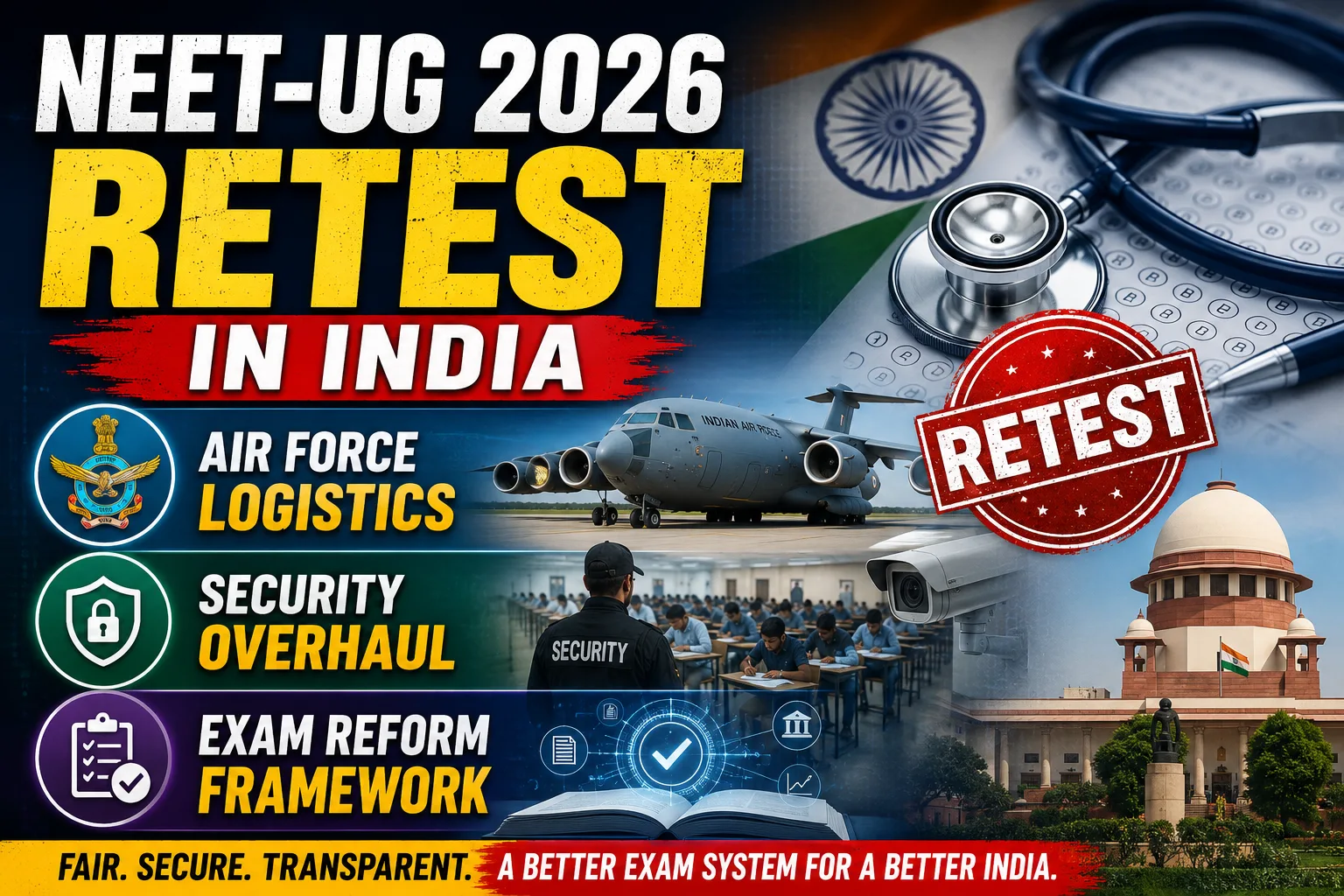
Recently, the relevant arrangements for the retest of India’s 2026 National Eligibility cum Entrance Test (Undergraduate) (NEET) have drawn widespread national attention.
The National Testing Agency (NTA) is the official body responsible for conducting the examination, which remains the primary gateway for MBBS admissions across India.
Background: NEET-UG 2026 Exam Cancellation and Retest Decision
The originally scheduled NEET-UG exam on May 3 was cancelled following serious question paper leak allegations.
This triggered:
- Large-scale student protests
- Legal proceedings in multiple courts
- Nationwide academic uncertainty
More than 2.2 million (22 lakh) candidates were affected, leading to widespread anxiety among medical aspirants.
Following this, NTA announced a national retest on June 21, 2026 along with a complete security revamp.
Core Highlight: Indian Air Force Involvement in Exam Paper Transport
One of the most significant updates in this retest is the use of the Indian Air Force (IAF) for transporting question papers.
This marks a first in NEET history.
Key Objectives:
- Secure transportation of exam papers
- Prevent interception or tampering
- Ensure time-bound delivery across regions
- Strengthen public confidence in exam integrity
India’s Ministry of Education confirmed that military-grade logistics support will be used to strengthen exam credibility.
Full Security Framework for NEET-UG 2026 Retest
The NTA has implemented a multi-layered security system covering the entire examination chain.
1. Question Paper Security (Pre-Exam Stage)
- Full isolation of paper setters
- No external communication allowed
- Confidential secure locations until exam completion
2. Logistics and Transportation Security
- GPS tracking on exam paper movement
- Continuous real-time monitoring
- Armed escort (including Indian Air Force support)
- Weather and risk contingency planning
3. Exam Center Security
- AI-powered CCTV surveillance systems
- Biometric verification for candidates
- Metal detection and identity authentication
- Strict entry/exit control mechanisms
4. Monitoring and Coordination System
- Central monitoring unit
- State-level coordination teams
- Network-based surveillance systems
- Real-time logistics tracking dashboard
Anti-Leak Strategy: End-to-End Control Model
Authorities have redesigned the exam flow to eliminate leak risks at every stage:
- Paper creation
- Review and translation
- Printing and packaging
- Transportation
- Distribution to centers
Each stage is independently monitored to prevent single-point failure.
Social Media Monitoring and Misinformation Control
The NTA has issued strict warnings against fake news, including:
- False paper leak claims
- Early access to exam questions
- Sale of unauthorized exam materials
Legal action will be taken against individuals spreading misinformation.
Impact on 2.2 Million NEET Aspirants
The retest has created mixed outcomes for students:
Positive Impact:
- Fair opportunity for all candidates
- Opportunity for revision and improvement
- Stronger exam integrity measures
Negative Impact:
- Increased psychological stress
- Extended preparation timeline
- Admission delays and uncertainty
- Financial pressure due to longer coaching cycles
Student Support and Guidance via MBBS Advisor
During this period, many students rely on MBBS Advisor for:
- MBBS admission planning
- Overseas medical education guidance
- Exam updates and policy interpretation
- Alternative study pathway support
It acts as an information support platform for medical aspirants navigating uncertainty.
Academic Strategy for Retest Preparation
Experts recommend:
- Prioritizing NCERT textbooks (Physics, Chemistry, Biology)
- Focusing on revision instead of new topics
- Practicing mock tests regularly
- Maintaining consistent study schedules
- Avoiding misinformation from unofficial sources
Official Instructions for Candidates
Students must regularly check:
- Exam city announcements
- Admit card updates
- Exam center instructions
- Official notifications via NEET portal and NTA
Supreme Court Decision on Exam Format
India’s Supreme Court reviewed a petition requesting a shift to a computer-based exam format.
Final Decision:
- Retained pen-and-paper format
- Rejected computer-based transition for this retest
This ensured continuity and reduced logistical disruption.
Long-Term Reform Direction
The NEET-UG controversy has accelerated discussions on long-term exam reforms:
- AI-based exam monitoring systems
- Enhanced cybersecurity infrastructure
- Improved identity verification systems
- Centralized question bank model
- Stronger accountability frameworks
Key Benefits of the New Security System
Authorities believe the new structure will:
- Reduce leak risks significantly
- Improve traceability of exam processes
- Increase transparency in administration
- Strengthen institutional accountability
Psychological and Academic Impact on Students
Experts highlight dual effects:
Benefits:
- Extended preparation time for weak areas
- Better opportunity for score improvement
Challenges:
- Increased stress and uncertainty
- Mental fatigue due to prolonged preparation cycle
Exam Preparation Advisory
Four key recommendations for candidates:
- Focus on already studied syllabus
- Use mock tests for time management
- Follow official updates only
- Maintain mental and physical well-being
Conclusion: A Turning Point in India’s Exam System
The 2026 NEET-UG retest represents a major structural reform in India’s medical entrance system.
With unprecedented measures such as:
- Indian Air Force-backed logistics
- AI surveillance systems
- Full isolation of exam personnel
- GPS-tracked paper movement
the system is undergoing a fundamental redesign aimed at restoring public trust.
For verified updates and guidance, students should rely only on official sources and trusted platforms such as: