 Russia
 Belarus
 Georgia
 Kazakhstan
 Kyrgyzstan
 Uzbekistan
 China
China Nepal
Nepal Bangladesh
 Poland
 Romania
 Slovakia
 Hungary
 N. Macedonia
 Vietnam
 Canada
 Armenia
 UK
UK Australia
 USA
USA Ireland
 Germany
 New Zealand
 Italy
Italy France
 Singapore
 Netherlands
 Sweden
 Switzerland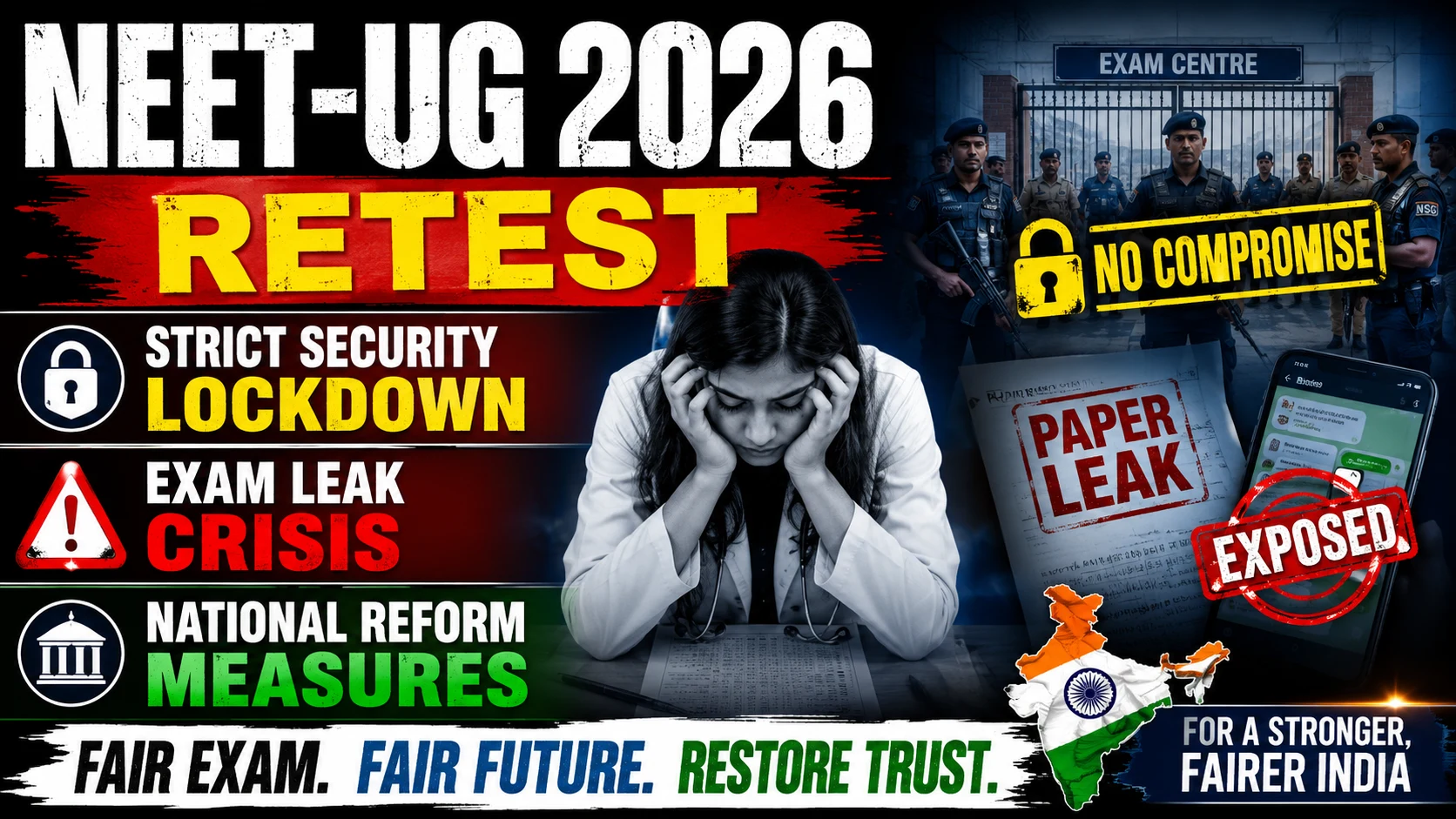
India's National Testing Agency (NTA) recently launched an unprecedented strict quarantine and control regime targeting all personnel linked to test development for the 2026 National Eligibility cum Entrance Test (Undergraduate) (NEET) retake.
The National Testing Agency (NTA) oversees the examination process, which remains the primary gateway for MBBS admissions across India.
Background: NEET-UG 2026 Cancellation and Retest Decision
The first NEET-UG exam, originally scheduled for May 3, was canceled after a large-scale question paper leak incident.
Following:
- Public protests
- Legal proceedings
- Government-level investigations
Authorities confirmed a nationwide retest scheduled for June 21, 2026.
The incident impacted over 2.2 million (22 lakh) candidates, making it one of the most disruptive exam events in India’s education history.
Public Reaction and Student Anxiety
After cancellation of the original exam:
- Students and parents experienced widespread uncertainty
- Anxiety levels increased sharply among aspirants
- Admission planning became unstable
During this period, platforms like MBBS Advisor saw a surge in student queries related to:
- Retest preparation strategies
- MBBS admission planning
- Alternative study pathways abroad
Strict Quarantine Measures for Exam Personnel
NTA implemented strict isolation protocols for all personnel involved in:
- Question paper development
- Translation
- Review and verification
- Printing supervision
Key Restrictions:
Personnel under quarantine are:
- Transferred to confidential facilities
- Cut off from all external communication
- Banned from mobile phones and internet access
- Prohibited from social media and email use
- Restricted from receiving outside visitors
Multi-Layer Security Framework for NEET Retest
NTA clarified that quarantine is only one part of a broader security system.
Core Security Measures Include:
- Full isolation of exam setters
- End-to-end monitoring of exam process
- Secure logistics for paper transportation
- Enhanced surveillance at exam centers
Multi-Level Exam Security Deployment
A multi-dimensional security system has been implemented across the exam chain.
Key Features:
- Multiple rounds of question paper review
- Coordination with security agencies for transport
- Armed escort for question paper movement
- Strict monitoring at all exam centers
Role of Indian Air Force in Exam Security
For the first time, coordination with defense agencies has been included:
- Indian Air Force support in logistics chain
- Secure transportation of exam materials
- Prevention of tampering or leaks during transit
Challenges Faced by 2.2 Million Candidates
The retest situation has created multiple challenges for aspirants:
- Extended preparation period
- Increased psychological stress
- Uncertainty in admission timelines
- Financial burden due to extended coaching
- Delays in counseling processes
Social Media Monitoring and Rumor Control
NTA has strengthened digital surveillance systems:
- Monitoring of social media platforms
- Rapid debunking of fake leak claims
- Action against misinformation spreaders
Measures to Restore Public Trust in NEET
Authorities introduced four long-term reform directions:
- Increased transparency in exam processes
- Independent third-party monitoring
- Upgraded national exam security standards
- Stronger accountability mechanisms
Judicial Decision on Exam Format
The Supreme Court of India reviewed requests to convert the retest into a computer-based exam.
Decision:
- Retained pen-and-paper format
- Rejected conversion to digital-only mode
Candidate Preparation Guidelines
Experts recommend the following strategies:
- Focus on NCERT syllabus (Physics, Chemistry, Biology)
- Regular participation in mock tests
- Avoid unverified information sources
- Maintain mental health and balanced routine
Official Candidate Instructions
Students are advised to regularly check:
- Exam city allotment
- Admit card download updates
- Exam center details
- Entry rules and instructions
- Official notifications from NEET portal
Structural Reforms Under Discussion
The controversy has triggered long-term reform discussions:
- AI-based exam monitoring systems
- Stronger cybersecurity infrastructure
- Enhanced identity verification systems
- Centralized question bank system
- Full-chain accountability mechanisms
Key Security Safeguards in Retest
To ensure fairness, the following safeguards have been enforced:
- Continuous tracking of question setters
- Secure multi-stage exam monitoring
- Controlled transportation of question papers
- Strict exam center entry controls
Impact on Indian Medical Education System
The NEET-UG 2026 retest is expected to influence:
- National exam governance structure
- Future security policies
- Admission timelines across medical colleges
Role of MBBS Advisor in Admission Guidance
During the crisis period, MBBS Advisor provided:
- Admission counseling support
- Policy updates for students
- Study-abroad alternatives for affected candidates
- Guidance on MBBS career pathways
Conclusion
The NEET-UG 2026 retest represents a major turning point in India’s medical entrance system.
With unprecedented security measures—including full isolation of exam personnel, military-supported logistics, and enhanced surveillance—the system is undergoing one of its most significant structural overhauls.
While challenges remain for students, the reforms aim to restore trust and ensure fairness in one of India’s most competitive national-level examinations.
For verified updates, candidates should rely only on official sources: