 Russia
 Belarus
 Georgia
 Kazakhstan
 Kyrgyzstan
 Uzbekistan
 China
China Nepal
Nepal Bangladesh
 Poland
 Romania
 Slovakia
 Hungary
 N. Macedonia
 Vietnam
 Canada
 Armenia
 UK
UK Australia
 USA
USA Ireland
 Germany
 New Zealand
 Italy
Italy France
 Singapore
 Netherlands
 Sweden
 Switzerland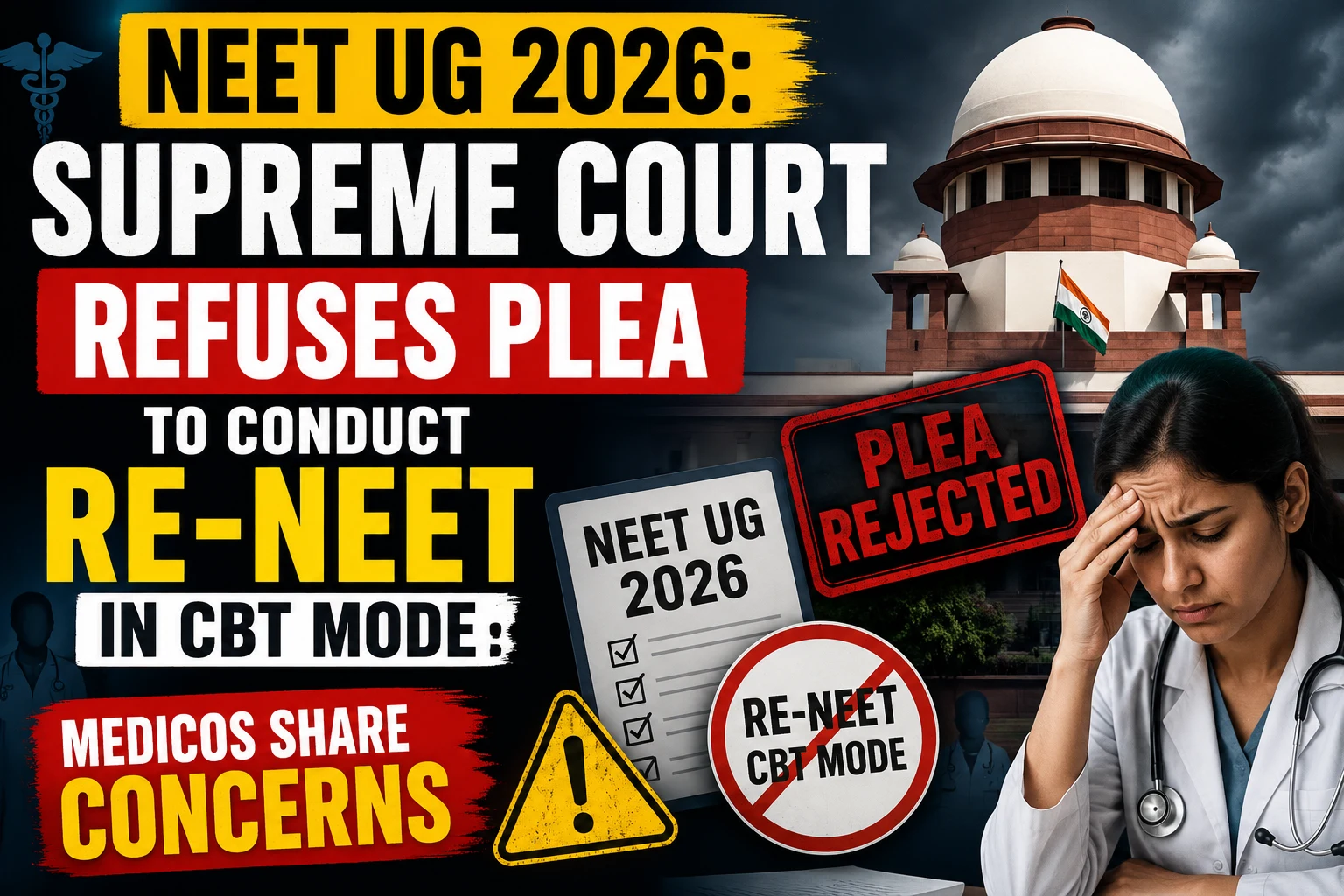
According to Business Standard, India’s Supreme Court recently dismissed a petition concerning the retest format for the 2026 NEET UG, India’s national medical entrance examination. The petition had requested that the retest, originally scheduled for June 21, replace the traditional offline OMR pen-and-paper format with computer-based testing (CBT).
This core ruling immediately pushed this long-simmering controversy over India’s largest national medical entrance exam to a new peak of public discussion.
NEET UG is the only national-level admission pathway for core healthcare programs including the Bachelor of Medicine, Bachelor of Surgery (MBBS) and Bachelor of Dental Surgery (BDS) in India.
The original 2026 exam was scheduled to be held on May 3; shortly after the exam commenced, large-scale question paper leaks were reported consecutively across multiple regions nationwide. After relevant Indian central regulatory bodies completed investigation and verification, the original exam was fully canceled, affecting millions of registered candidates across the country.
Why Petitioners Wanted CBT for Re-NEET 2026
The petitioners had outlined five core advantages of CBT:
- Reduced risk of question leaks
- Improved exam security
- Optimized proctoring efficiency
- Greater transparency
- Fewer logistical loopholes
These points served as the core basis for their application to change the exam format.
However, stakeholders in the incident hold sharply divided positions.
Arguments Against a Last-Minute CBT Shift
Some candidates and medical practitioners argue that a hasty switch of exam formats on the eve of the retest would trigger unforeseeable logistical chaos, which would in turn disrupt candidates’ ability to perform to their normal standard.
Arguments Supporting CBT
Another group of stakeholders supports the petitioners’ demands, arguing that CBT can close loopholes that enable question leaks through technical measures and rebuild public trust in the national entrance exam.
Currently, local education platform MBBS Advisor has launched a dedicated consultation channel for candidates affected by the incident, providing support services including further study planning and connection to pathways for studying medicine abroad.
NEET UG 2026 Retest Controversy Intensifies
Recently, the controversy surrounding the retake format of India’s national unified medical entrance exam, NEET UG 2026, has continued to intensify.
Student-Led Campaign for CBT
The first demands that caught public attention came from thousands of medical students who registered to participate in this retake. They launched an online joint petition via social media, calling for the adoption of technical measures to prevent violations such as question leaks and proxy test-taking that may occur during the retake.
This dispute later entered judicial proceedings.
Supreme Court's Official Position
The Supreme Court of India issued an official ruling on the relevant emergency applications, rejecting the demand to convert the retake, originally scheduled for June 21, to a Computer-Based Test (CBT).
The court ruled to uphold the original Optical Mark Recognition (OMR) pen-and-paper format for the retake and also postponed discussions on a comprehensive reform of India’s national medical entrance exam system to start only after this retake concludes.
Education Community Divided Over the Decision
In response to this ruling, India’s education community and the group of medical students have formed two sharply opposing camps.
Education Experts Supporting the Ruling
Mainstream education scholars who support the ruling argue that less than 30% of grassroots exam centers across India meet the hardware requirements to host CBT exams.
They contend that a last-minute switch of test format would very likely trigger new problems such as:
- Network outages
- Equipment failures
- Operational disruptions
which would instead undermine exam fairness.
Students Opposing the Ruling
The group of medical students opposing the ruling, meanwhile, cited confirmed cases of answer sheet swapping and pre-exam question leaks that occurred in three previous OMR-format exams of the same type.
They point out that CBT’s real-time random question selection mechanism can fundamentally narrow the room for question leak manipulations.
All core facts in this paragraph are cited from official follow-up reports by Press Trust of India (PTI), and all proper nouns retain their original English labels to avoid ambiguity.
NTA Responds to the NEET Leak Crisis
The leak scandal surrounding India’s 2026 NEET UG medical entrance exam has continued to escalate in recent days.
The National Testing Agency (NTA), the body responsible for overall coordination of the exam, was the first to issue an official response.
All information compiled to sort out this incident is synthesized from public discussion content from:
Five Enhanced Security Measures for Re-NEET 2026
To advance the smooth implementation of the 2026 retest (Re-NEET 2026), the NTA has introduced five enhanced security measures:
- Strengthening security across the entire process of test paper transportation
- Upgrading monitoring systems at all exam centers nationwide
- Coordinating with law enforcement agencies across multiple regions
- Optimizing candidate identity verification procedures
- Tightening confidentiality controls across the full workflow of exam materials
Candidates Remain Divided
Regarding this retest arrangement, candidates across India hold divided stances.
Candidates Supporting the Retest
Some candidates support the retest to guarantee fairness in admissions.
Candidates Opposing the Retest
Others have protested over their disrupted preparation schedules and the uncertainty created by the cancellation of the original examination.
The Supreme Court of India has stepped in to handle related petitions.
Four Major Factors Creating Admission Uncertainty
Currently, the national medical admissions process is facing significant uncertainty, with four core driving factors:
1. Cancellation of the Original Examination
The cancellation disrupted the normal admission timeline.
2. Ongoing Legal Proceedings
Court cases continue to influence policy decisions.
3. Retest Schedule Coordination
Authorities must coordinate logistics for millions of candidates.
4. Investigation into the Leak Scandal
The pace of the official investigation continues to affect public confidence.
A series of delays have directly impacted the smooth transition of this year’s candidates into MBBS admissions.
Long-Term Reform Plans Proposed by NTA
The NTA has simultaneously put forward five long-term exam reform directions.
Planned Reforms
- Full rollout of Computer-Based Testing (CBT)
- Piloting a hybrid exam model
- Popularizing biometric verification
- Deploying AI-powered proctoring systems
- Building a dedicated cybersecurity framework
However, analysis from MBBS Advisor points out that disputes over the compatibility of CBT with traditional pen-and-paper exams will persist long into the future, and multiple uncertainties remain surrounding the implementation of upcoming reforms.
CBT vs OMR: Comparing the Two Formats
Advantages of CBT
Computer-Based Testing (CBT) boasts the advantages of:
- Strong security
- High scoring efficiency
- Random question selection from item banks
- Reduced paper usage
Advantages of Pen-and-Paper Exams
Traditional pen-and-paper testing has its own distinct strengths:
- Familiarity for candidates
- No risk of technical failures
- Easy nationwide deployment
- Accessibility in remote regions
As a result, both formats possess unique merits and challenges.
What the Supreme Court Decision Means
India’s Supreme Court recently rejected a mandate to enforce CBT for the 2026 NEET UG retest.
The retest, scheduled to be held on June 21, will adopt the pen-and-paper format, a decision that immediately sparked intense discussion centered on:
- Exam security
- Transparency
- Fairness
- Modernization
Medical students and practicing medical professionals have called for a gradual shift to CBT, citing recent allegations of exam question leaks.
Officials have stated that any reform must first complete supporting planning, infrastructure construction, and consultations with relevant stakeholders before implementation.
Impact on Future Medical Admissions
India’s National Testing Agency (NTA) will advance security upgrades and follow-up reforms.
This incident will shape the future trajectory of India’s medical entrance examinations.
Students planning to pursue medicine in India or abroad should continue monitoring updates through trusted sources, including:
- NEET UG
- National Medical Commission (NMC)
- World Directory of Medical Schools (WDOMS)
- World Health Organization (WHO)
Meanwhile, MBBS Advisor, a platform that provides higher education admission guidance, offers support covering:
- Medical admissions guidance
- MBBS abroad counseling
- University selection
- Career planning
- Licensing requirement information
Conclusion
The Supreme Court’s refusal to mandate CBT for the 2026 NEET UG retest reflects a decision grounded in practical feasibility rather than technological preference. While supporters view CBT as a long-term solution to exam security concerns, authorities prioritized operational stability and timely completion of the admission cycle. As India continues exploring modernization of its examination system, the debate between CBT and traditional pen-and-paper testing is likely to remain central to future education reforms.