 Russia
 Belarus
 Georgia
 Kazakhstan
 Kyrgyzstan
 Uzbekistan
 China
China Nepal
Nepal Bangladesh
 Poland
 Romania
 Slovakia
 Hungary
 N. Macedonia
 Vietnam
 Canada
 Armenia
 UK
UK Australia
 USA
USA Ireland
 Germany
 New Zealand
 Italy
Italy France
 Singapore
 Netherlands
 Sweden
 Switzerland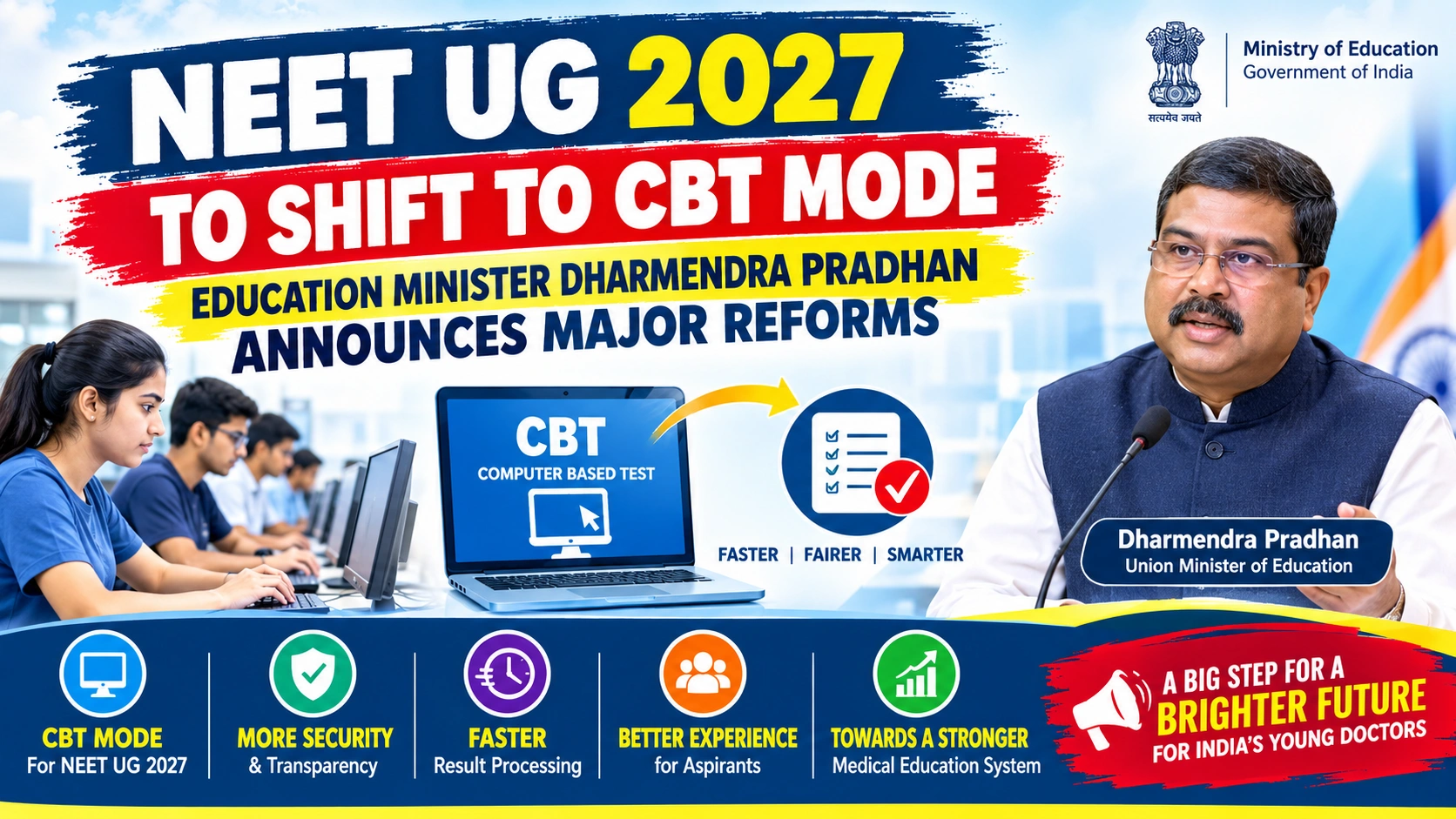
For years, NEET aspirants have entered examination halls carrying a transparent pen, an admit card and one persistent fear—what if a small OMR mistake ruins an otherwise good paper? From 2027, that familiar routine is set to change. Union Education Minister Dharmendra Pradhan announced that NEET-UG will move from the pen-and-paper format to a Computer-Based Test, commonly called CBT, beginning with the 2027 examination. The proposed shift forms part of broader examination reforms aimed at improving security, reducing opportunities for paper leaks and making evaluation more accurate. It is a major change. No doubt. Yet it also creates new questions about computer availability, rural candidates, technical failures and the number of examination centres required for more than 20 lakh medical aspirants. MBBS Advisor explains what the CBT announcement means, what may remain unchanged and how students should adjust their preparation.
What Has Dharmendra Pradhan Announced?
The announcement is fairly direct: NEET-UG is expected to be conducted entirely in computer-based mode from 2027. This would end the physical question-paper and OMR-sheet system used in previous years. Under the proposed format, candidates will visit an authorised examination centre, receive an assigned computer terminal and answer questions digitally. Responses will be recorded by selecting options on the screen rather than shading circles with a ballpoint pen. The reform was announced alongside measures aimed at protecting major entrance examinations from leaks, impersonation and organised cheating. Authorities have also discussed digitally delivering question papers to centres, expanding the network of secure test locations and using technology to detect suspicious examination activity. Students should still treat the official NEET-UG 2027 information bulletin as the final rulebook. The announcement confirms the planned direction, but operational details—including shift arrangements, navigation controls and mock-test access—must come through the official NEET website.
Why Is NEET Moving From OMR to CBT?
Think about the journey of a printed question paper. It must be prepared, printed, sealed, transported, stored and delivered to thousands of examination rooms without unauthorised access. Every physical stage creates another point that must be secured. A computer-based system can reduce several of these risks. Encrypted question papers may be delivered closer to the examination time, candidate responses can be stored electronically and unusual activity can be tracked using digital records. CBT may also remove common OMR problems. Students occasionally darken the wrong answer bubble, damage the response sheet, use correction fluid or fill the booklet code incorrectly. One careless mark. Big consequences. Digital testing allows candidates to select, change and review an answer before final submission, subject to the rules programmed into the examination platform. It also reduces manual handling during response-sheet scanning. Honestly, the technology itself won’t guarantee a leak-free examination. Servers, centre operators, login credentials and local networks can also be compromised. Security has to cover the complete process, not just replace paper with a screen.
NEET-UG 2027: Expected Changes at a Glance
The basic purpose of NEET remains the same: selecting students for undergraduate medical admission. The way candidates answer the paper, however, will change considerably.
|
Exam feature |
Earlier pen-and-paper system |
Expected CBT system from 2027 |
|
Question delivery |
Printed booklet |
Questions displayed on a computer |
|
Response method |
Answers marked on an OMR sheet |
Options selected on screen |
|
Answer correction |
Difficult or impossible after shading |
Response may be changed before submission |
|
Review facility |
Candidates manually track questions |
Digital “mark for review” tools may be available |
|
Submission |
Physical OMR sheet collected |
Answers submitted electronically |
|
Response record |
Scanned OMR image |
Digital response sheet and logs |
|
Technical requirement |
Minimal |
Computer terminal, power and network support |
|
Security focus |
Printing, transport and storage |
Encryption, server protection and centre monitoring |
The exact interface may differ from other NTA examinations. Students shouldn’t assume that NEET will automatically follow the same screen design or navigation rules as JEE Main. Wait for the official demonstration test.
Will the NEET Exam Pattern Also Change?
A new delivery mode doesn’t automatically mean a new syllabus or marking scheme. As of now, the main confirmed reform is the shift to CBT. Authorities are expected to publish the final question count, examination duration, marking rules and subject structure in the 2027 information bulletin. Students should continue studying Physics, Chemistry and Biology according to the prescribed NEET syllabus. Don’t pause preparation while waiting for interface details. Concepts remain concepts, whether the question appears on paper or a monitor. The marking system has traditionally awarded four marks for a correct answer and deducted one mark for an incorrect response. That structure may continue, but MBBS Advisor recommends treating it as provisional until NTA confirms the 2027 rules. One more point: proposals to hold NEET twice a year or in multiple phases have also entered public discussion. A proposal isn’t an implemented rule. Until NTA issues a formal notice, students should prepare for one annual examination.
How the CBT Interface May Work
Picture the screen. A question appears in the main area, four answer choices sit underneath it and a numbered question palette shows attempted, unanswered and review-marked items. Candidates may be able to move between questions, save an answer, clear a response and mark difficult items for later review. A countdown timer would display the remaining examination time. Once the test ends, the system may submit saved responses automatically. That sounds convenient. It can also be distracting during the first few attempts. Students who repeatedly jump between questions may waste time checking the palette instead of solving the paper. The solution is practice. Not random practice—timed practice using a computer, a proper mouse and a full-screen mock environment. Mobile-based quizzes are useful for revision, but they don’t reproduce the experience of sitting at a desktop terminal for three hours.
The Biggest Concern: The Digital Divide
Will a student from a village with limited computer access compete on equal terms with someone who has taken online mocks for two years? This is the most serious question surrounding the change. Many aspirants are comfortable with smartphones but don’t regularly use a desktop computer. Clicking small radio buttons, scrolling through lengthy questions and managing an on-screen timer may feel unfamiliar at first. That isn’t a knowledge problem. It is an access problem. Students shouldn’t lose marks because their school never had a functioning computer laboratory. Authorities may need to provide free mock-test centres, multilingual practice software and familiarisation sessions across districts—not just in major coaching cities. Reliable electricity matters too. So do backup servers, spare terminals and clear rules for compensatory time when equipment fails. A computer freezing during a national examination is not a minor inconvenience. It can alter a student’s career. MBBS Advisor believes NTA should publish a detailed technical-failure protocol well before the exam. Candidates need to know what happens if a screen stops responding, the mouse fails or the centre loses connectivity.
Will NEET Be Conducted in Multiple Shifts?
This issue could become tricky. More than 20 lakh candidates have appeared for NEET in recent examination cycles, while the number of secure computer terminals available on a single day is limited. NTA may need additional centres, multiple shifts or a combination of both. If the examination is held in several shifts, different question sets may be required. That immediately raises another question: will score normalisation be used? No final assumption should be made here. Multiple shifts, normalisation and question-set equivalence require explicit official confirmation. A single-shift test offers the advantage of one common paper, but arranging enough verified computers across India would be a massive exercise. Multiple shifts make centre management easier, though candidates often worry about variation in difficulty. This part needs transparent rules. Very transparent.
What CBT Could Improve
Digital delivery offers several practical benefits if implemented properly. First, physical question-paper movement can be reduced. Second, candidate responses are recorded immediately, lowering the risk of damaged or incorrectly scanned OMR sheets. Third, audit logs can show when answers were saved or changed. Fourth, results may be processed faster. It may also become easier to give students a recorded response sheet after the examination. Candidates could compare their selected options with the provisional answer key and raise objections using a clearer digital trail. CBT centres can use identity verification, CCTV monitoring, system logs and controlled access to identify suspicious activity. Still, every security tool needs human supervision. Technology records events; competent investigators must interpret them.
New Risks That Authorities Must Address
A digital exam has different weaknesses. Malware, unauthorised remote access, compromised centre staff, server attacks and pre-configured terminals are real possibilities. Moving online changes the security challenge. It doesn’t make the challenge disappear. There is also the risk of poorly managed centres. A laboratory may look adequate during inspection but have old computers, uncomfortable screens or insufficient backup power on examination day.
The reforms should therefore include:
- Independent technical audits of every centre
- Encrypted question delivery with controlled decryption
- Offline response backup at regular intervals
- Spare computers in each laboratory
- Power and network redundancy
- Standard screen size and system configuration
- Recorded incident reporting
- A fair retest or compensatory-time policy for verified failures
MBBS Advisor would also like to see public disclosure of centre-selection standards. Students deserve to know that an examination laboratory has been assessed for more than seating capacity.
How NEET Aspirants Should Prepare for CBT
Start with your normal syllabus plan. Biology still demands NCERT-based revision, Chemistry still requires conceptual clarity and recall, and Physics still rewards repeated problem-solving. The computer won’t solve the question for you. Then add digital test practice gradually.
Practise With a Desktop or Laptop
A small phone screen is not enough. Take at least one full-length mock every week on a computer, then increase the frequency closer to the examination. Use a mouse. Sit at a table. Keep the timer visible.
Learn Question Navigation
Practise saving answers, clearing selections and marking questions for review. Develop a fixed system—for example, answer certain questions immediately, review doubtful ones later and leave time for a final check.
Read From a Screen
Long Physics statements and Biology assertion-based questions can feel different on a monitor. Increase your screen-reading stamina without rushing. Use rough paper for calculations if the examination rules permit it.
Don’t Overuse the Review Button
Marking 70 questions for review creates confusion, not control. Reserve it for questions you genuinely intend to revisit.
Keep Paper Practice Too
Written calculation remains essential. Solve equations, organic reactions and numerical steps by hand. CBT changes response entry, not the need for rough work. Students can follow the MBBS Advisor NEET section for preparation and admission updates, while final instructions should always be checked against NTA notices.
Eligibility and Medical Admission Will Continue Through NEET
The switch to CBT doesn’t remove the basic admission requirements. Candidates must meet the prescribed age and Class 12 criteria, including Physics, Chemistry, Biology or Biotechnology and English. Category-specific minimum marks will continue to follow the official regulations. After qualifying, students will participate in MCC or state counselling depending on the institution and quota. College recognition must be verified through the National Medical Commission. For students considering an international option, the World Directory of Medical Schools can help identify listed institutions, while the World Health Organization provides broader health and education resources. Neither source replaces NMC rules governing the eligibility of Indian students and foreign medical graduates. Families comparing Indian private colleges with overseas universities can also read the MBBS Abroad guide. Course duration, internship eligibility, clinical language and the Indian licensing route should all be checked before paying fees.
What Should Parents Do Differently?
Parents don’t need to purchase an expensive computer immediately. Regular access matters more than ownership. A school laboratory, public computer centre, coaching library or shared family laptop can provide enough initial practice. Watch how the student performs during digital mocks. If scores drop only because of scrolling, navigation errors or screen fatigue, the problem is correctable. Identify it early. Avoid coaching packages that claim access to a “secret official CBT interface.” Until NTA releases its own mock platform, such claims are marketing. That’s all. MBBS Advisor suggests keeping an extra budget for mock tests or computer access, but the cost shouldn’t be allowed to grow without reason. Good preparation still depends on NCERT books, revision and thoughtful testing—not flashy software.
Frequently Asked Questions
Will NEET-UG 2027 definitely be conducted in CBT mode?
The Education Minister announced the shift to computer-based testing from 2027. Candidates should still read the official NTA bulletin for final operational instructions and examination dates.
Will NEET-UG 2027 be held twice?
Holding NEET twice a year has been suggested by student and policy groups, but a final rule requires an official government or NTA notification. Don’t treat the proposal as confirmed.
Will students receive rough sheets at CBT centres?
Computer-based examinations usually provide rough sheets for calculations, but NEET-specific rules must be confirmed in the 2027 bulletin.
Can candidates change an answer during the CBT?
Most CBT systems allow answers to be changed before final submission. The exact NEET interface and response rules will be explained through official instructions and mock tests.
Will the NEET syllabus change because of CBT?
CBT is an examination-delivery format. It does not itself require a syllabus change. Candidates should follow the syllabus officially prescribed for NEET-UG 2027.
What happens if a computer stops working?
Centre staff should shift the candidate to a spare terminal or restore the session without losing saved answers. NTA must publish the exact technical-failure and compensatory-time policy before the test.
Conclusion
Moving NEET-UG to CBT could reduce OMR errors, limit physical question-paper handling and provide a clearer digital record of candidate responses. Those are meaningful improvements. But the reform will be judged inside examination centres, not at a press conference. If students face broken systems, distant centres or unclear shift-normalisation rules, the new format could replace old worries with new ones. Aspirants shouldn’t panic. Start practising digitally, keep studying the syllabus and wait for formal instructions before believing claims circulating online. MBBS Advisor will continue tracking the NEET-UG 2027 changes so students can prepare for the new format with facts, not rumours.