
 Russia
 Belarus
 Georgia
 Kazakhstan
 Kyrgyzstan
 Uzbekistan
 China
China Nepal
Nepal Bangladesh
 Poland
 Romania
 Slovakia
 Hungary
 N. Macedonia
 Vietnam
 Canada
 Armenia
 UK
UK Australia
 USA
USA Ireland
 Germany
 New Zealand
 Italy
Italy France
 Singapore
 Netherlands
 Sweden
 Switzerland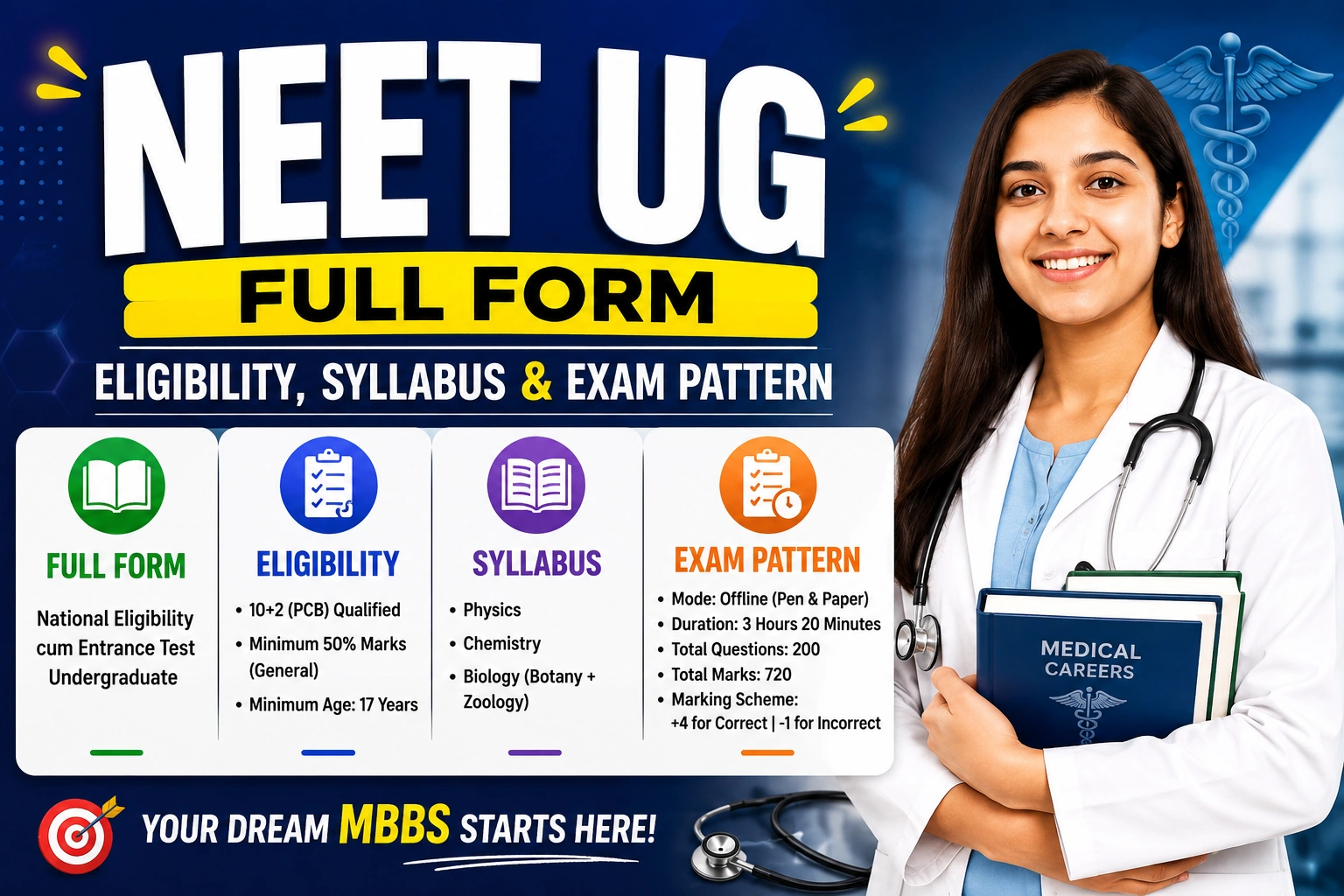
Introduction
NEET (National Eligibility cum Entrance Test – Undergraduate) is the first and most important step for aspiring doctors in India. NEET UG is one of the most competitive medical entrance examinations, offering admission into MBBS, BDS, AYUSH, and other medical courses in India.
Students preparing generally follow different pathways, including understanding the exam deeply, focusing on eligibility, syllabus, and exam pattern, or aiming directly for medical college admission. Regardless of the approach, clarity about NEET UG is essential for success.
Platforms like NEET UG Advisor and tools like the NEET Rank Predictor help students estimate their rank and plan medical college options after the exam.
This guide covers NEET UG meaning, eligibility, syllabus, exam pattern, counseling process, and the importance of NMC, WHO, and WDOMS for MBBS abroad.
What is the Full Form of NEET UG?
The full form of UG is National Eligibility cum Entrance Test – Undergraduate.
UG is a national-level entrance exam for students seeking admission into undergraduate medical courses such as:
- MBBS (Bachelor of Medicine, Bachelor of Surgery)
- BDS (Bachelor of Dental Surgery)
- BAMS, BHMS, BUMS, and other allied health programs
Before NEET was introduced, medical admissions in India were conducted through multiple state and college-level exams. created a single standardized national-level entrance system.
Why is NEET UG Important for Medical Aspirants?
UG is important because it determines admission into medical colleges across India.
It evaluates students in Physics, Chemistry, and Biology and plays the biggest role in MBBS admissions in government and private colleges.
A good NEET score increases the chances of admission into top medical colleges. However, competition is extremely high due to limited seats.
NEET is also essential for students planning MBBS abroad, as per guidelines, which require NEET qualification for future medical practice in India.
Students must also check whether foreign universities are listed in and follow standards set by .
NEET UG Eligibility Criteria
To appear for UG, students must meet the following conditions:
Educational Qualification
- Must have passed or be appearing in Class 12 or equivalent
- Must have Physics, Chemistry, Biology/Biotechnology, and English
Minimum Percentage Requirement
- General category requires minimum aggregate in PCB
- Reserved categories have relaxed criteria as per rules
Age Requirement
- Minimum age requirement must be fulfilled as per official notification
Students should always check the latest eligibility updates from the official NEET portal.
NEET UG Syllabus
The UG syllabus is based on Class 11 and Class 12 NCERT curriculum.
Physics Syllabus
Physics includes conceptual understanding and numerical problem-solving:
- Mechanics
- Motion
- Thermodynamics
- Waves
- Electricity and Magnetism
- Optics
- Modern Physics
Chemistry Syllabus
Chemistry is divided into:
- Physical Chemistry
- Organic Chemistry
- Inorganic Chemistry
NCERT plays a crucial role, especially in Inorganic Chemistry.
Biology Syllabus
Biology carries the highest weightage in :
- Cell Biology
- Genetics
- Human Physiology
- Plant Physiology
- Ecology
- Biotechnology
- Reproduction
- Diversity of Living Organisms
Most questions are directly or indirectly based on NCERT.
NEET UG Exam Pattern
UG is an MCQ-based exam consisting of:
- Physics
- Chemistry
- Biology
The exam tests:
- Conceptual clarity
- Analytical thinking
- Numerical ability
- Accuracy and speed
Negative marking is applicable, making accuracy very important.
NEET Marking System and Time Management
In :
- Correct answers get positive marks
- Incorrect answers get negative marks
- Unanswered questions carry no penalty
Time management is crucial due to the large number of questions.
Importance of NCERT Books for NEET Preparation
NCERT books are the foundation of preparation, especially for Biology and Chemistry.
Most questions come directly or indirectly from NCERT. Students must revise NCERT multiple times and focus on diagrams, definitions, and concepts.
Keys to Effective NEET UG Preparation
A strong preparation strategy includes:
- NCERT mastery
- Concept clarity
- MCQ practice
- Previous year papers
- Regular mock tests
- Error analysis
- Time management
Consistency is more important than long study hours.
Importance of NEET Rank Predictor
The NEET Rank Predictor helps students estimate their expected rank based on scores.
It helps in:
- Predicting rank
- Planning counseling
- Shortlisting medical colleges
NEET Counseling and MBBS Admission
After qualifying , students must attend counseling based on:
- NEET score
- NEET rank
- Category
- Seat availability
- College preference
- Reservation policy
Counseling plays a major role in final admission.
MBBS Abroad: NMC, WHO, WDOMS
Students choosing MBBS abroad must understand:
regulates medical education standards for Indian students abroad.
lists globally recognized medical universities.
sets international healthcare education standards.
These ensure recognition and future licensing eligibility.
How MBBS Advisor Helps NEET Aspirants
MBBS Advisor provides guidance on:
- preparation
- Eligibility and counseling
- MBBS admission in India and abroad
- College selection
- Fee and admission details
It also offers the tool for planning admissions.
Common Mistakes Students Make in NEET Preparation
Common mistakes include:
- Ignoring NCERT
- Lack of revision
- Poor mock test practice
- Rote learning without concepts
- Weak time management
Avoiding these improves NEET performance significantly.
Conclusion
UG is the foundation of medical admission in India. Understanding its syllabus, eligibility, and exam pattern is essential for success.
Strong NCERT preparation, regular practice, and proper planning are key to scoring well in NEET.
With tools like the and guidance from MBBS Advisor, students can make informed decisions about medical careers in India and abroad.