
 Russia
 Belarus
 Georgia
 Kazakhstan
 Kyrgyzstan
 Uzbekistan
 China
China Nepal
Nepal Bangladesh
 Poland
 Romania
 Slovakia
 Hungary
 N. Macedonia
 Vietnam
 Canada
 Armenia
 UK
UK Australia
 USA
USA Ireland
 Germany
 New Zealand
 Italy
Italy France
 Singapore
 Netherlands
 Sweden
 Switzerland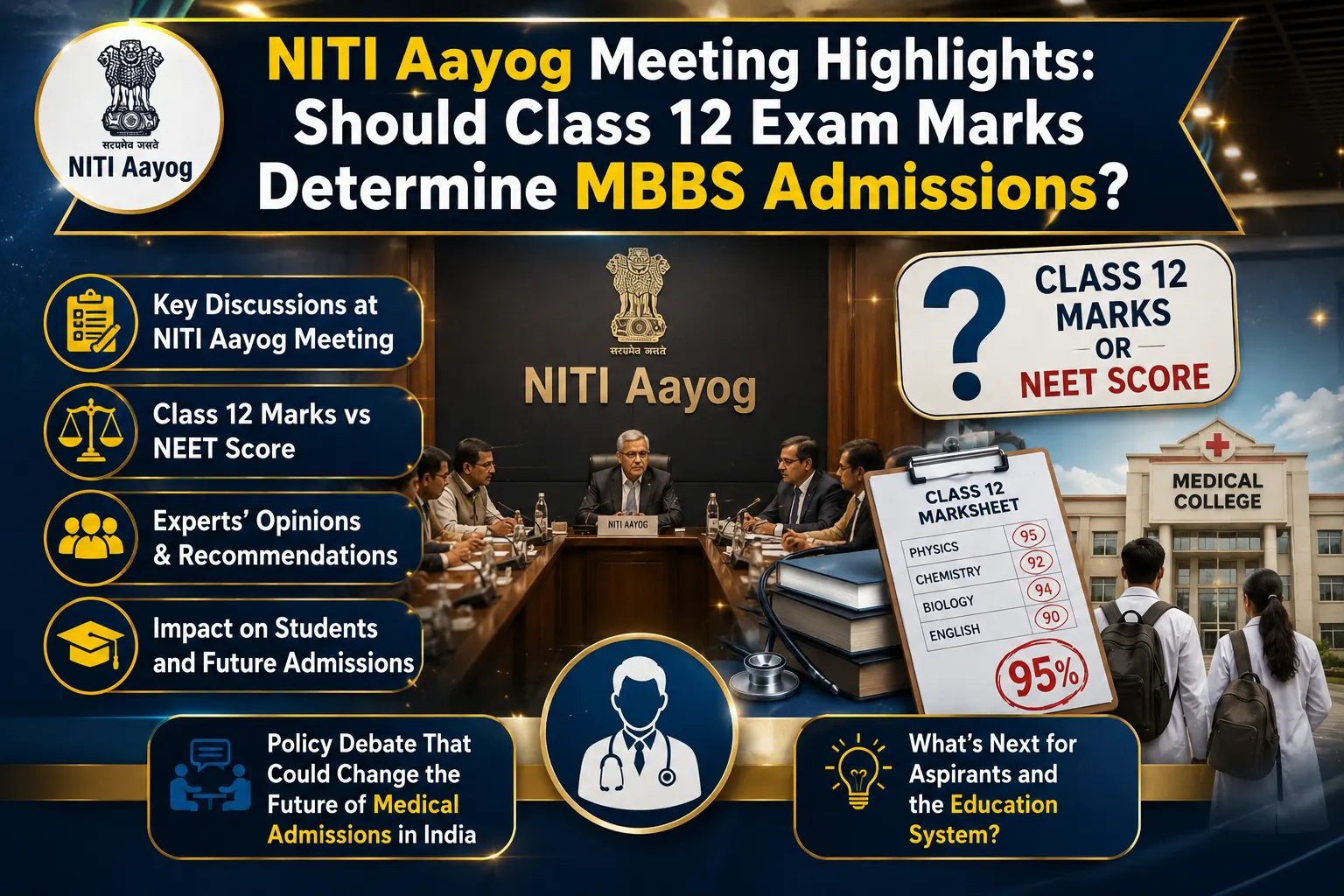
Discussions in the latest NITI Aayog Governing Council Meeting have invigorated the discourse on the need for reform in the field of medical education in India. A prominent focus has been whether MBBS Admissions should be based on Class 12 scores in the absence of NEET.
This proposal has ignited an interdisciplinary debate of national proportion, bringing politicians, educators, students and aspiring medical practitioners to the forefront. Proponents of this proposition are of the view that this negates the level of stress and restores the relevance of board examinations, whereas in opposition it is perceived that medical admissions would be at the cost of standardization.
MBBS Advisor addresses the need for students to have reliable and authentic sources of advice and guidance for new and emerging systems of medical admissions as they keep abreast of trends and eligibility and provide options for study abroad.
Background: The Debate on the MBBS Admission System
The last decade has witnessed unprecedented changes to the medical admissions architecture in India, particularly post the establishment of NEET.
To ensure fairness and consistency in medical admissions in India, the NEET examination was instituted and is administered under the aegis of the National Medical Commission.
However, critics say this has caused:
- A large reliance on coaching institutes
- Increased pressure on rural students
- More attempts to get into medical school
- Inequitable access to quality coaching
On the other hand, supporters say this has:
- Led to admission based on merit
- Instituted a standardized testing system
- Lowered admission-related corruption
- Instilled fairness to a national competitive level
Recent NITI Aayog Meetings on MBBS Admissions
Recent reports on the NITI Aayog meeting show that some state representatives are saying there should be a system of MBBS admissions that does not rely on NEET.
According to them, this would entail:
- Admitting MBBS students based on 12th class board exam scores
- Medical admissions would be under the jurisdiction of each state
- Decreased reliance on entrance exams that are centralized
The objective of this system would be to make medical admissions less difficult for students, and more inclusive.
This has created a national discourse among the policy-making and academic communities.
Why Propose MBBS Admissions Based on 12th Class Board Exam Scores?
Supporters of this system argue that Class 12 board scores are a more comprehensive measure of a student’s academic performance.
What are the Advantages of This System?
1. Reduces the Pressure of Another Entrance Exam
Students currently have to prepare for the board exam and NEET, which places an additional mental burden.
2. School Education is Finally Valued
If board exams will determine who gets into medical school, they will have a great deal of importance.
3. Reduced Reliance on Coaching
A leading criticism of NEET is the reliance on costly coaching centers.
4. More Rural Representation
There is a significant lack of NEET level coaching centers in rural areas.
For detailed admission analysis and comparison, many students are now relying on MBBS Advisor, an informative site on trends regarding medical admissions.
Why The NEET System Is The Permanent Standard
The NEET system continues to be the sole entrance exam to study MBBS in India, regulated by the National Medical Commission, despite the criticism.
For official updates, visit:
- NEET official information
- National Medical Commission
Why NEET is favorably seen:
1. Equivalence of Competition
NEET ensures that everyone is assessed by an identical national benchmark.
2. Standardization of Medical Education
Medicine is one of the fields that needs academic precision, especially in the subject of biology and chemistry.
3. Avoiding Leaking of Capitation Fees
Prior to NEET, many private medical colleges had opaque admission systems.
4. National System of Admission
NEET has simplified the admission process for all states in India.
About the WHO and Global Medical Standards
Medical education is unavoidably global, as is the case with most other sectors. The WHO deals with establishing quality benchmarks and supervision of medical education.
Visit World Health Organization
The WHO speaks about medical education and ensures the following:
- Strong clinical skills
- Standardized and objective evaluative procedures
- Ethics
- Global acceptance of degrees
Following the same concept, the evaluation of medical school is done globally via the World Directory of Medical Schools (WDOMS):
World Directory of Medical Schools
This guarantees that graduates will be eligible to take international medical licensing exams, like the USMLE and PLAB.
How MBBS Advisor Helps You Understand the Trends In Admission
With the education system changing so rapidly, students are the ones who suffer the most. The best option students can take is the one that is the most beneficial to them.
This is where MBBS Advisor is extremely useful.
MBBS Advisor Offers:
- NEET admission updates
- MBBS abroad support
- Analysis of tuition fees by country
- Key dates for applications
- Information on university recognition
MBBS Advisor is also useful for comparing medical education in India vs other countries.
MBBS Advisor aids students in understanding new policies, including the possibility of MBBS admissions returning to the Class 12 model.
For many students, MBBS Advisor is frequently consulted during the career counseling and admission stages.
Implications of Changing Admission Policies for Students
Medical MBBS admissions based on Class 12 marks, as opposed to NEET, has the potential to impact the medical education system in the following ways.
Advantages:
- Less stress from entrance tests
- Less dependency on coaching
- Emphasis on high school education
- More flexibility within states
Disadvantages:
- No national standard
- Variation in the difficulty of board exams
- Potential for disparities between state boards
- Subjective grading
MBBS Advisor is often used to study the impact of these policies on possible career paths.
NEET and its Predecessors
The NEET system was the result of many years of discussion.
Previously, there were:
- The AIIMS entrance exam
- State medical entrance exams
- Private university exams
Leading to confusion and a lack of parity in the admissions system.
NEET was designed to unify all of the systems.
Views of Education Policy Specialists
Education policy analysts have differing opinions on the subject.
Supporters of Class 12 Based Admission Argue:
- School performance provides a more reliable assessment
- Less competitive admissions reduce exam related stress
- Focuses on the development of the student as a whole
Trusting the NEET Exam Argues:
- Competitive admissions are crucial to a profession like medicine
- A standardized test provides an opportunity to assess all candidates on the same level
- Identifies candidates with the highest level of performance
These debates are often analyzed by education platforms, like MBBS Advisor, that are on the lookout for developments in the field and education policy changes.
Is there a Compromise in the Admission Process?
Some have proposed a compromise.
- NEET and Class 12 exams would be given equal weight (50% each).
This would allow for a greater balance in:
- Fairness for different regions of India
- Academic integrity and consistency
- Competitive exams
Similar blended methods are used in countries such as Germany, as well as some other European nations.
What is the Global View of Medical Admissions?
Many countries have their own systems, such as:
- USA: MCAT exam
- UK: UCAT/BMAT exams + score assessments
- India: NEET
- China: National entrance exam + boarding exam scores
There is no exam system that is universally accepted. What all these systems do emphasize, however, is the importance of an academic education with a focus on the sciences.
What is the Future of MBBS Admission in India?
The future of MBBS admission in India will depend on the policies of:
- The Government of India
- National Medical Commission
- Education Policies
Substantial changes to the system will require consultation across the entire country.
In the meantime, students should monitor changes using trusted sources such as:
- MBBS Advisor
- Official NEET
Final Thoughts
The aim of the proposal to allow admissions based on Class 12 performance, instead of MBBS NEET, is to make education more accessible and reduce stress on students. However, the proposal raises considerable debate.
Currently, the National Medical Commission oversees NEET as the only entrance test to gain admission to medical schools in India.
System developments can be confusing for students. The role of companies such as MBBS Advisor is to provide guidance, clarification, and up-to-date information to students.
Selecting aspiring doctors who are competent and committed to serve society is equally important regardless if it is done through NEET or through Class 12-based evaluation system.