 Russia
 Belarus
 Georgia
 Kazakhstan
 Kyrgyzstan
 Uzbekistan
 China
China Nepal
Nepal Bangladesh
 Poland
 Romania
 Slovakia
 Hungary
 N. Macedonia
 Vietnam
 Canada
 Armenia
 UK
UK Australia
 USA
USA Ireland
 Germany
 New Zealand
 Italy
Italy France
 Singapore
 Netherlands
 Sweden
 Switzerland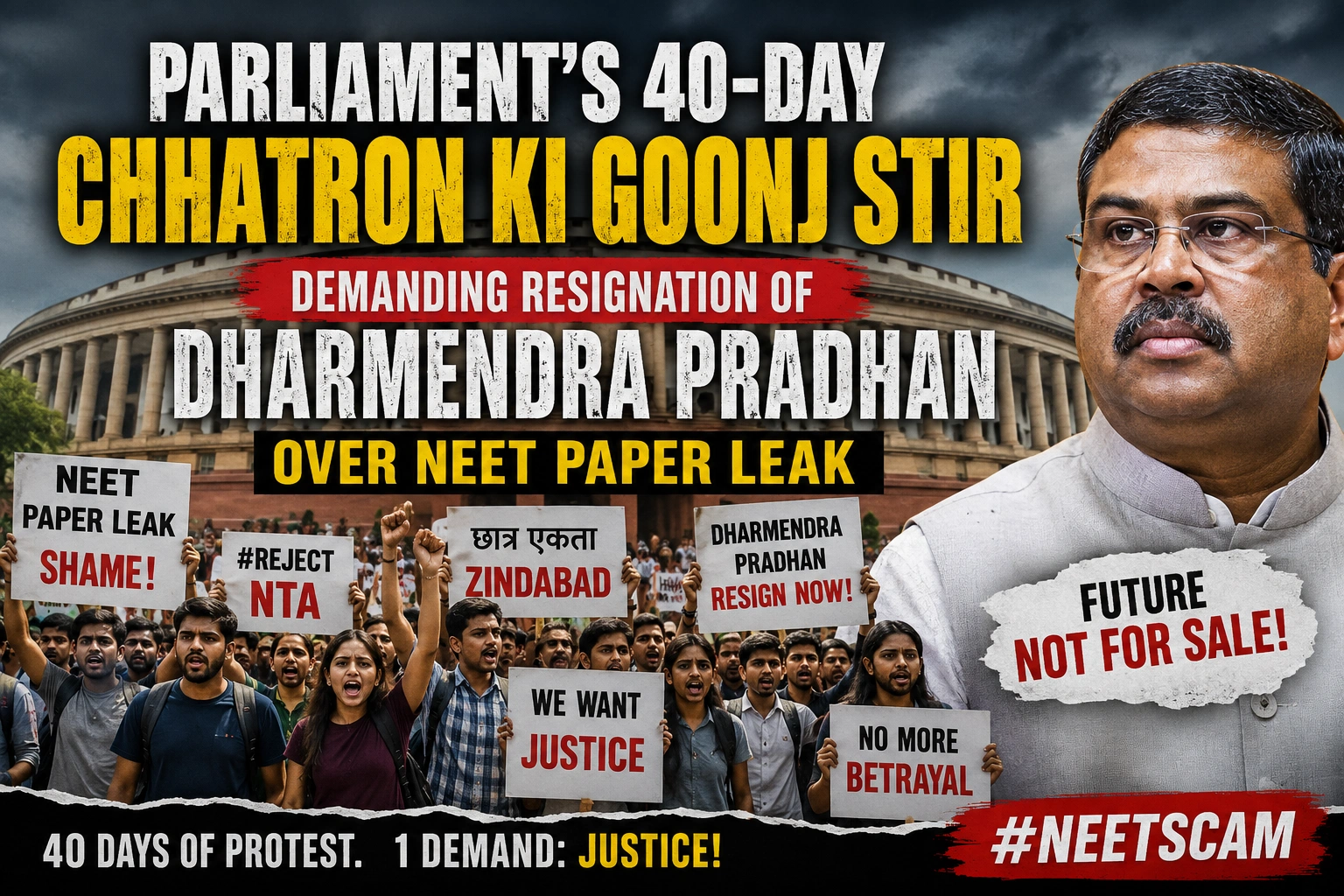
The NEET-UG 2026 controversy has moved beyond the examination hall to the political arena. What began as a paper leak involving the National Testing Agency has triggered a political fight with the Congress party kicking off a 40-day campaign across the country demanding the resignation of Union Education Minister Dharmendra Pradhan. The ‘Chhatron Ki Goonj’ (Voice of Students) campaign highlights the anger among the thousands of medical students whose mental health, career, and time have been impacted by the paper leak and cancellation of the examination.
This article explains the NEET-UG 2026 controversy, what the Congress party is demanding, the responses from the government and the National Testing Agency, and the implications for students who are currently preparing to take the NEET. Given the ongoing and fluid nature of the situation, it is recommended that students closely monitor official announcements and consider using a NEET Rank Predictor to improve preparedness in order to factor in political and administrative developments.
Background: NEET-UG 2026 Paper Leak
The NEET-UG 2026 exam, conducted on May 3, 2026, drew in over 2.2 million participants. It aimed to offer admissions to a variety of allied healthcare courses. Typically, such a large-scale examination is resource-intensive. Within days of the examination, many complaints were raised claiming that portions of the Chemistry and Biology sections had been leaked and were available in the resource material of some of the coaching networks. Investigators found that the overlap actually covered well over a hundred questions. This caused alarm and concern that the leak was deliberate and beyond isolated incidents.
The investigation was initially conducted by the Rajasthan Police's Special Operations Group. Due to the large scale and interstate nature of the illicit operation, the investigation was handed over to the Central Bureau of Investigation. The NEET examination was officially cancelled by the National Testing Agency on May 12, 2026. It was stated that the decision sought to protect the trust the students and their families had on the examination system. The CBI's investigation resulted in the arrest of many individuals, including subject experts and teachers who had planned to be part of the investigative paper setting or translation and had leaked upcoming questions to coaching networks which operated in Rajasthan, Maharashtra and other states.
A re-examination for the 2026 NEET-UG was scheduled for June 21 with new registrations and fees to not be required. In the lead-up to the re-examination, the Indian government decided to temporarily restrict access to the messaging service Telegram to prevent misinformation and further attempts to leak exam information. The government made the decision to protect the integrity of the re-examination. The National Testing Agency (NTA) created a grievance portal for students to report websites they believe to be of fraudulent news, to report the claim of exam papers being leaked, to report attempts of impersonations and to submit a request for a refund of the examination fee, which was reinstated due to the cancellation of the original examination.
NEET-UG 2026 Examination Controversy
The NEET-UG 2026 examination case is unique from other examination controversies in India due to it being an immediate national political case. It was a major disruption, impacting an excess of 2 million students about to begin their admissions in a matter of weeks and new reports of suicides of students due to the stress of the cancellation and re-examination. The Indian Government faced immense social pressure to take action and provide answers. The opposition, primarily the Congress, asserted that these incidents illustrate a pattern of systemic, as opposed to periodic, service failures and immediate accountable actions were needed.
Congress's "Chhatron Ki Goonj" Campaign
The Setup and Duration of the Campaign
On June 25, 2026, Congress published the first details of the 40-day campaign, stating the first phase would run from June 30 until August 9. 28 sites around the country held press conferences, including Ahmedabad, Bhopal, and Nagpur and organized simultaneous outbreaks to assure the coverage was national rather than state-specific. The campaign's structure calls for a show of protest outside the district collector's office across several cities on August 1, and the first phase will be capped by a "Delhi Chalo" protest where students and party workers will march towards the national capital on August 9.
Congress’ Demands
At the heart of the campaign is a call for the Union Education Minister Dharmendra Pradhan to take moral responsibility for his failure to protect national level examinations and resign from his position. Congress leaders including Satej Patil noted that around 23 lakh take NEET every year, and only 2 lakh get into medical colleges, making the examination process traumatic and any system failure a major setback. Apart from the resignation, the party has also demanded an annual calendar, to be made public, for conducting examinations, publishing results, and recruitment to avoid the type of disruption witnessed this year. Congress leaders, especially from Madhya Pradesh, have also called for a complete overhaul of the examination system. They say that the examination and recruitment process has, over time, changed from one that involved isolated wrongdoings on the part of a few people to an organized and systemic crime.
Mobilizing Students with NSUI
As part of the Congress party, the National Students' Union of India has taken charge of the mobilisation efforts. With the introduction of a QR code-based registration system and a missed-call facility, NSUI has created a way for students to directly report grievances or issues concerning all types of examinations, including NEET. NSUI’s campaign plan identifies daily interaction with students, town-hall style events, and the posting of materials as its campaign focus. The goal is to transform individual student grievances towards an organized and unified movement in preparation of the March on August 9.
Rahul Gandhi's War of Words
Congress leader Rahul Gandhi has been very proactive with the campaign and has been targeting Pradhan directly. This has been especially clear after Pradhan’s remarks where he called some of the protesting students ‘troublemakers,’ and Gandhi characterized Pradhan’s remarks as not acknowledging the students’ grievances. Gandhi called for Pradhan to apologize to the students and resign from the post due to his administrative negligence. He has noted that the students’ grievances of having a fair examination have been dismissed with negligence and without accountability. Gandhi has also stated that the competitive examination system has turned into a system that has a disproportionately negative financial impact on average Indian families. He has also linked the NEET paper leak to the greater problem of the coaching and entrance system, and made the case for the argument energetically. Other members of Congress have also supported this argument. Lok Sabha MP Gaurav Gogoi has also claimed that the irregularities of the system indicate that there are embedded issues in the recruitment and entrance examination systems.
Government's Response: Investigation, Accountability and Reform
Three parallel strategies have characterized the government’s response: immediate exam-day solutions, and being more accountable through investigations and longer-term structural reforms. As a part of the continuing investigation, the Central Bureau of Investigation has made several more arrests for individuals who allegedly translated the exam question papers to distribute them to coaching centers. It has been reported that the integrity of the investigation will be upheld, and whoever is found to be responsible, no matter the rank, will be held accountable.
A lapse in the chain of custody of exam materials was acknowledged by Pradhan, but he did mention that implementation of the Radhakrishnan Committee's recommendations, which were made after the 2024 NEET controversy, had occurred. Citing a reliance on Optical Mark Recognition for exams, he stated that the structural inefficiency will be eradicated by the implementation of a Computer-Based Test for NEET-UG for 2027, which will adopt testing models of the internationally recognized medical entrance exams, the MCAT and UCAT. The 2026 NEET-UG will still be a pen-and-paper exam; however, the government has stated that structural inefficiencies will be addressed by the implementation of additional exam day safety measures, and a lengthened exam in response to the concerns of students and educators. Other measures of the recently implemented India's Public Examinations Act, which cites organized examination crimes and provides for substantial imprisonment and fines, will be the legal framework for the ongoing and previous examination leak cases.
Effects on NEET Candidates During the Political Stalemate
With more than 2.2 million NEET aspirants, the political indecision disrupted the students in very real, practical ways. NEET's cancellation and rescheduling clashed with pre-existing schedules, causing time constraints on NEET related preparation and counseling. The NEET aspirants had to deal with the added problem of the stress of NEET related preparation and counseling for an uncertain date, and reports of the first known student suicides because of the stress of NEET cancellation were shocking. These reports changed the way people looked about the NEET issue from an administrative or political issue to a humanitarian issue. Congress members also started speaking and providing student counseling and support services during the NEET process.
Unverified information is being disseminated on platforms, including Telegram, leading to false claims. This all makes it difficult to distinguish between valuable information and false claims. Because of this, the National Testing Agency has found it necessary to issue clarification statements, while also escalating legitimate concerns to cybercrime authorities. This is clearly indicative of the lack of planning and control.
Impacts on Students Preparing for NEET Counseling
Out of everything happening, students only care about one thing: how do I plan for this when everything keeps changing? Students should ignore social media for statements about NEET counseling and look at the official statements from the National Testing Agency. There has been widespread misinformation and social media only adds to it during this year. When the scores come out, use an NEET Rank Predictor to create a college list. Try to avoid the news and create a list of colleges based on a predictable source rather than getting another response to the news.
You should remember political statements and the CBI will not impact admissions. Your score on the NEET and counseling will determine that. Using MBBS Advisor will help you identify updates you need to pay attention to counseling.
The first time you go to an office to ask for counseling slots and to see the counseling seat matrix, will be the only time you can do that. There will still be ongoing political issues and administrative issues happening, and we will still have counseling.
The Role of NMC, WDOMS and WHO
The credibility of India's medical education system extends beyond the admission process. The NMC is responsible for regulating medical education standards and approving medical colleges across the country. Institutions recognized by the NMC are eligible to award medical degrees that are valid for practice in India.
For international recognition, the WDOMS maintains the World Directory of Medical Schools, which helps licensing authorities verify recognized medical institutions worldwide. The directory continues the global recognition framework that was historically supported by the WHO. Maintaining transparent and fair admission procedures is therefore important not only for domestic students but also for preserving the international reputation of Indian medical education.
Conclusion
Phase one of “Chhatron Ki Goonj” will take place until the Delhi Chalo march on August 9. This will create opportunities for continuous political pressure on the government amidst the ongoing CBI probe and the implementation of reforms, such as computer-based testing starting in 2027. Even if this movement does not achieve its primary goal of Pradhan’s resignation, the movement has sparked a debate regarding the security of examinations, the level of accountability, and the enormous pressure on India’s medical aspirants. This will influence policy discussions for a long time. At this moment, political movements are no substitute for admission processes, and students should keep this in mind. Students should keep informed from credible sources and should focus on their own preparation and counseling. Everything is needed to keep the political movements as a backdrop.