 Russia
 Belarus
 Georgia
 Kazakhstan
 Kyrgyzstan
 Uzbekistan
 China
China Nepal
Nepal Bangladesh
 Poland
 Romania
 Slovakia
 Hungary
 N. Macedonia
 Vietnam
 Canada
 Armenia
 UK
UK Australia
 USA
USA Ireland
 Germany
 New Zealand
 Italy
Italy France
 Singapore
 Netherlands
 Sweden
 Switzerland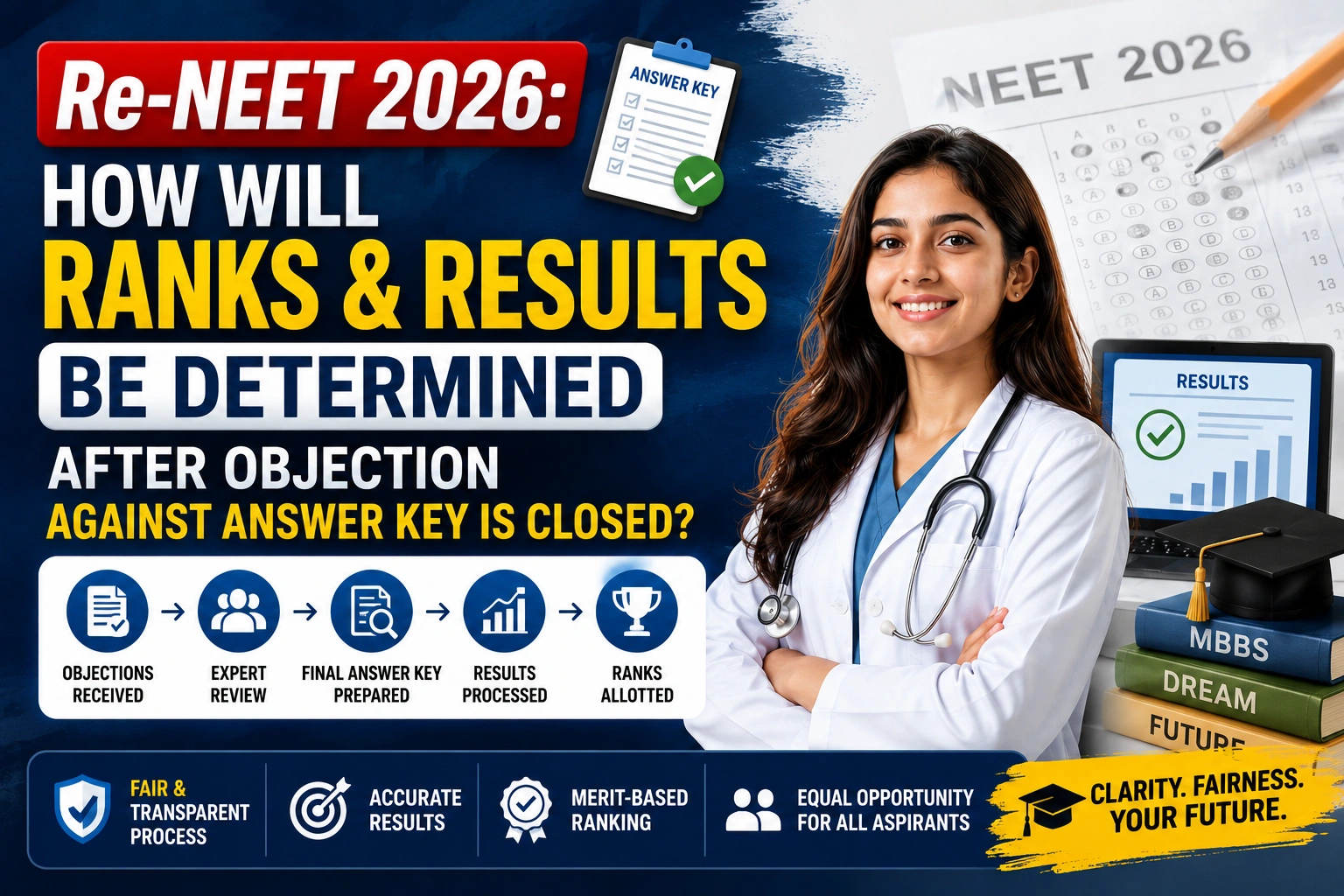
The 2026 medical entrance season has been one of the most hectic and chaotic to date. After the original NEET UG 2026 exam was cancelled due to the Paper Leak Controversy, a new Re-NEET UG 2026 exam was conducted for over 22 lakh aspiring candidates. Now that the provisional answer keys have been published and the objection window has closed, the question that all the candidates are asking is: what happens before the final result and All India Rank are published? In this article, we explain in detail the steps taken after the objection window has closed, including, but not limited to, expert review, verification of OMR sheets, rank calculation, and what to do in the meantime. For all the individuals that are following this exam cycle, we recommend you to bookmark MBBS Advisor for real-time updates regarding NEET, admissions, and career guidance.
Why This Re-Exam Happened
The post-objection process may first require some context regarding the necessity of a re-examination. The original NEET UG 2026 was scheduled for 3rd of May 2026. However, shortly after this event, law enforcement discovered a leaked ‘guess paper’ that had a near-exact copy of the actual test questions. Subsequently, the National Testing Agency had no other choice than to cancel the examination and implement a new test, now widely known as Re-NEET UG 2026. The stakes for precision and transparency in the evaluation process were sky high for this exam attended by more than 22 lakh applicants. This was observed by students, parents, and various coaching institutes. A great level of scrutiny was put on each step that followed from the provisional answer key to the final result.
The objection window for the Re-NEET UG 2026 answer key has now closed. The answer key was published on June 25, 2026, giving a few days for potential challenges on the answer key to be submitted. That window was closed on June 28, 2026, at 11:50 PM, and the agency has been clear that no challenges submitted after this time will be considered.
To challenge an answer, candidates must:
- Submit a challenge with a fee of ?200.
- Include supporting evidence that is not the NCERT, such as a reference from a different academic source.
- Receive a refund if the challenge is accepted.
The agency has created this challenge system to be a way to process challenges that are legitimate while also being costly to submit frivolous challenges.
Strong consideration for the challenges submitted for this exam is important to candidates considering studying medicine abroad. The WHO and other organizations will consider the credibility of this exam when they assess other licensing exams, and so it is important that this challenge system be clear and easy to understand. This challenge system will allow this exam to be recognized in other jurisdictions as well.
What Happens Immediately After Objections Close
When the clock strikes the deadline, the National Testing Agency does not just publish the results. A structured, multi-stage internal review is initiated. Candidates can learn about the review process to keep realistic expectations about the timeframes.
Compilation and Categorization of Challenges
In this phase, every objection for each of the four subjects is collected and organized. For the Physics, Chemistry, Botany, and Zoology papers, objections are organized by question and paper version. The Re-NEET UG 2026 exam utilized multiple versions of question papers. Because of this, the review process is lengthy; a Re-NEET reviewer must consolidate multiple objections that relate to the same question for paper versions 50, 60, 70, and 80.
Expert Panel Review
The subject-matter challenges are collected and reviewed by a panel of experts for each of the four subject areas. Usually, these experts must not have had any involvement with the original paper, making this review process independent. Objections and the supporting evidence are reviewed. The panel verifies if the challenged question and answer are correct and if the question posed is clear and if there are other reasonable answers that could have been derived from the CBSE syllabus and NCERT textbooks.
This is an especially detail-oriented process. An incorrect entry in the answer key, if not corrected, would impact thousands of candidates and would likely create an advantage or disadvantage for them. Conversely, an unsubstantiated change that would correct an entry in the answer key would likely cause the merit list to lose its integrity. For these reasons, the review is not done in a hurry, even though the public has a right to know the outcome sooner.
Revised Answer Key
If the expert panel agrees with the challenge, the answer key is changed for that question, and the change is applied for all candidates that answered that question. If a question is beyond repair and is factually incorrect, or if the question has more than one scientifically correct answer, that question is also omitted. If a question is omitted, the NTA’s precedent in previous NEET cycles is to award all candidates full credit for that question.
After all challenges are addressed, the final answer key is published. This key is the only document that will determine the score of any candidate and is not subject to any challenge.
Parallel Processing of OMR Sheet Verification
A notable feature in the Re-NEET UG 2026 cycle is NTA's decision to run two processes simultaneously. OMR sheet digitization was traditionally done first, and answer key scrutiny followed. This time, NTA released a provisional answer key and opened the objection window while OMR digitization was being done for around 22 lakhs. NTA’s intent behind this was to reduce the time taken, as the expert review of the objections could start before all OMR digitizations were completed.
After OMR digitization is completed, OMR sheets are made available to the candidates. The OMR sheets are made available on the candidates’ login in the NTA website. Each OMR sheet is printed with the candidate’s personal details and the ID of the questions along with the options selected. The candidates are advised to check their OMR sheet against the answer key once it is published. This would give the candidates an approximate idea of their score, as the answer key and score card are released after NTA does the score calculations.
Understanding Rank and Score Calculation
After the OMR data is scrutinized and the final answer key is published, the score is calculated using the formulae which are standard and publicly available, and which NTA has consistently relied on across all NEET examinations.
The Marking Scheme
- Correct answers yield 4 points.
- Incorrect answers yield a penalty of -1 point.
- Not answering a question means no points are awarded and none are lost.
- There are 180 total questions with 45 each from Physics and Chemistry and 90 from Biology, which is divided into Botany and Zoology.
- The maximum score is 720.
The scoring system is simple: 4 points are awarded for each correct answer, and 1 point is deducted for each incorrect answer. For example, if a candidate answered 150 questions correctly and 20 questions incorrectly, their score would be 580 out of a possible 720.
Normalization Is Not Applicable Here
There are other national exams that are conducted in multiple shifts or need some sort of statistical normalization to account for differences in exam papers that increase or decrease difficulty. Such exams need score normalization for NEET UG was not conducted on multiple days or in multiple shifts. The same was true for the Re-NEET UG 2026. This means that each candidate's scores are calculated directly from their responses to the questions with no percentile adjustment. This makes the process easier for the candidate to verify and helps them understand how their scores were calculated.
Tie-Breaking Criteria for Rank Assignment
It’s not unusual for several candidates to end up with the same total score since NEET generates raw scores and NEET scores are not given as percentile ranks. The NTA uses the procedure of tie-breaking criteria to distribute each candidate a unique All India Rank.
Rank for candidates with the same total score is decided based on:
- Biology score.
- Chemistry score.
- Physics score.
- Ratio of correct answers to incorrect answers.
- Age (older candidate gets preference if the tie still remains).
Result Declaration: Knowledge of the Past
We can study historical results of previous years to better anticipate timing, although results will never be guaranteed. After the original NEET exam in 2024, results were announced about a month later. Restrictions were loosened after the re-exam and results were announced a week after the exam. In 2025, results were stated about 41 days after the exam. In the current cycle, many education portals and industry experts anticipate that the Re-NEET UG 2026 results will be stated between July 1 and July 15, 2026. NTA has not officially confirmed this, and students should be cautious about any unofficial sources. When results are announced, they can be found on the NTA NEET website and students will be able to log into the portal using their application number and birth date to download their individual scorecards. These scorecards will show final results (scores out of 720), all India results, category-wise results, and qualifying status.
Rank Prediction While You Wait
Many prefer forecasting their likely standing based on numerical evidence in the time between their examination and the release of the results, which can last several long days. Predicting tools, developed for this purpose, examine previous years’ data concerning cut-off scores, ranks and scores, and patterns of reservations among categories and combine this with the score the candidate calculates from the final answer key to estimate a likely rank range. If you want an estimate to your likely rank in advance of the official results, the NEET Rank Predictor tool on MBBS Advisor will provide that estimate, and will also be a likely first step to determine college options and to devise a counseling strategy.
What Comes After the Result: Counselling and Beyond
Announcing the results is not the end; it marks the beginning of the more significant counselling phase. After the ranking, the counselling for MBBS, BDS and allied health science seats starts. This process is administered by national authorities who work closely with the National Medical Commission (NMC), the highest authority who regulates medical education in India. The National Medical Commission is heavily involved in the admission process of medical colleges which are connected to NEET to ensure the medical colleges fulfill the requirements for staff, adequate facilities and sufficient clinical training. The guidelines of the National Medical Commission determine the seat distribution based on the NEET rank by the counselling authorities at the state and central level.
Those who want more information regarding the working of the exam, the historical trends, the syllabus and the preparation tips can visit the specific NEET resources, which offer guidance. The resources are updated on a regular basis to align with the recent changes in the exam and the counselling process.
Exploring the U.S. Medical Schools as an Alternative
Due to extreme competition in India, a large number of students are choosing to pursue medical education abroad. There are two frameworks that will help in making this decision.
- First, the World Health Organization leads with affiliated agencies in developing norms and standards for the quality of medical education globally, and although such direct accreditation does not happen as the WHO does not accredit single institutions, the oversight of a country's medical education does offer an assurance.
- The other major framework, the WDOMS keeps a global record of medical schools whose graduates are eligible to register and practice medicine.
Indian students are expected to verify that the chosen medical school is included in the WDOMS, when considering their options to study medicine abroad and to take the medical licensing examinations in India.
Students pursuing a degree abroad need to consider that practicing medicine in India will require passing an examination that assesses eligibility for licensing, as administered by the National Medical Commission. Therefore, students need to choose abroad institutions carefully to avoid discovering such institutions' compliance issues after studying there for several years. Those interested in MBBS Advisor abroad options can find detailed descriptions of the pathways that include entry requirements by country, available universities, and pertinent regulations that students need to verify prior to enrollment.
Remaining Updated During the Process
The time between the closing of the objection window and the announcement of the official results is the most anxious period of the exam cycle. This is because during most of this period, the evaluation system of the agency works veiled from the public view. Although candidates cannot affect the results, they can still take advantage of this time. Analyzing the final answer key, checking the answer sheet, calculating and estimating a score, and rank prediction to understand the potential admission opportunities are all productive actions that help to prepare in advance for a counseling strategy.
Given the situation and the previous cancellation and subsequent re-conduction of the examination, candidates should stay alert for any official communication regarding changes in the counselling schedules. A shortened gap between the announcement of results and the commencement of counselling is highly likely this year. Considering this scenario, one can get help of varied online resources, especially the official NTA NEET website, as well as the reputed third-party websites, like MBBS Advisor, during this hectic and high-stress admission cycle to avoid missing any deadlines.
Conclusion
The journey from a closed objection window to an announced result is a long and complicated one. It includes expert reviews of thousands of individual cases, along with the processing of lakhs of OMR answer sheets, an answer sheet evaluation scheme, a strict tie-breaker rule, and the announcement of a final list of candidates. For the over 22 lakh candidates who took the Re-NEET UG 2026 exam, the window of patience is most certainly here. However, this period can be made more tolerable with reliable guidance and self-assessment tools. Passion and an informed approach can take one to the government-funded medical colleges in India through NEET counselling or to a WDOMS-recognised college abroad. Understanding the system and processes of counselling more thoroughly can help one make a better decision when the rank is published.