 Russia
 Belarus
 Georgia
 Kazakhstan
 Kyrgyzstan
 Uzbekistan
 China
China Nepal
Nepal Bangladesh
 Poland
 Romania
 Slovakia
 Hungary
 N. Macedonia
 Vietnam
 Canada
 Armenia
 UK
UK Australia
 USA
USA Ireland
 Germany
 New Zealand
 Italy
Italy France
 Singapore
 Netherlands
 Sweden
 Switzerland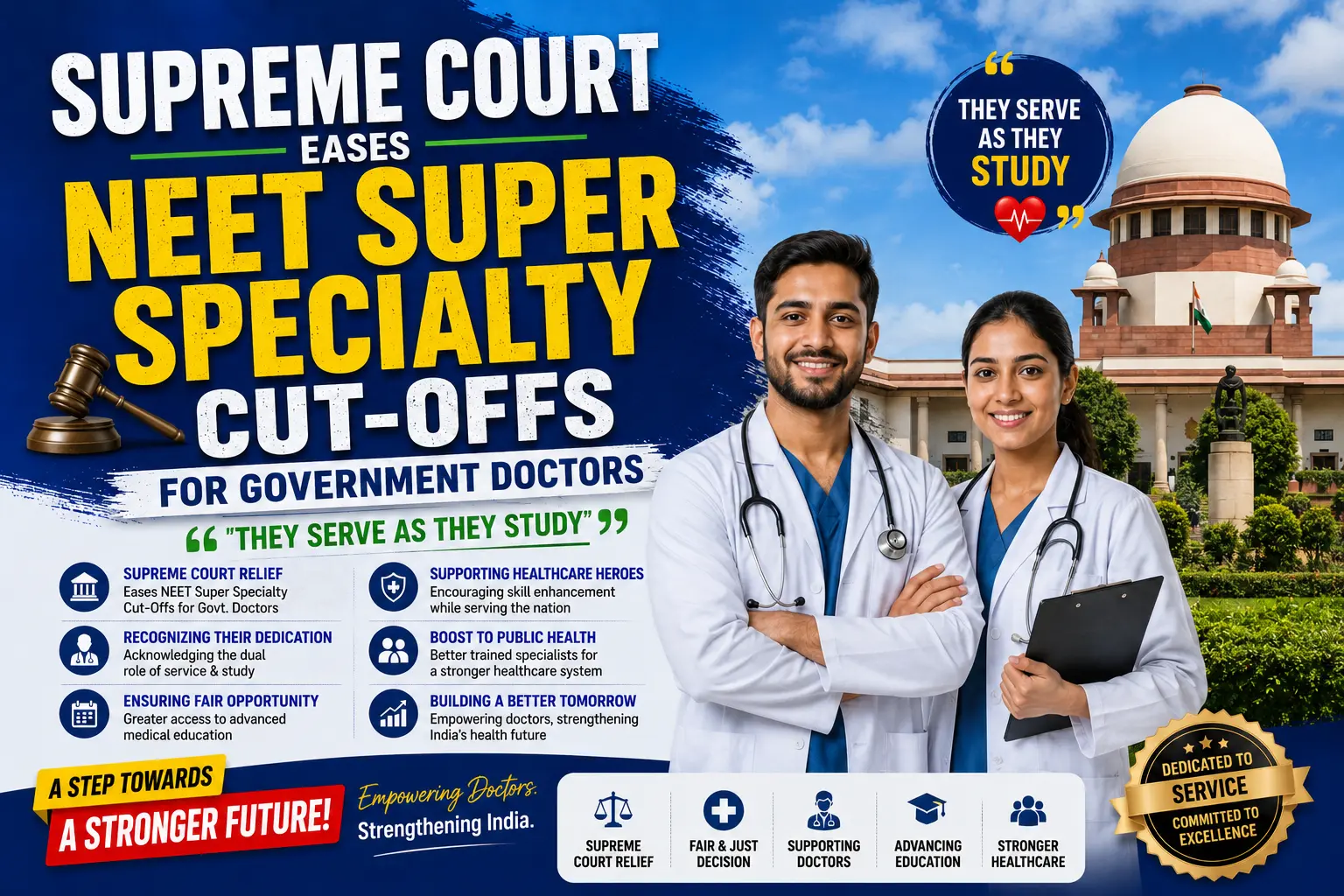
On June 24 2026, the Supreme Court of India announced that in-service Government doctors deserve special consideration in the NEET-SS. The Court explained that government doctors who work long hours to provide public service and take lengthy study leaves to prepare for super specialty training deserve to be set cut-offs at a lower percentile. The Court’s description of their condition was that “They Serve as They Study.” The description and this verdict signify the difficulty of government doctors aspiring to be super specialists.
This decision is the result of a petition by the Tamil Nadu Medical Officers Association, which was filed to the Court to stop the surrender of one hundred and fifty two in-service super-specialty seats, which are to be made vacant in Tamil Nadu, to the All India Quota. Justices B.V. Nagarathna and Joymalya Bagchi said that because government doctors work directly to provide public service, they do not have the luxury of studying full time for NEET-SS, like other medical aspirants. The skills that government doctors attain after super specialty training will ultimately be beneficial to the public.
The NEET Ecosystem and Its Transformations
In India, the NEET examination has become central to medical school admission. To meet the need for a fair admission system to medical schools and to prevent admission-related corruption, NEET was established to bring some fairness to the admission process for postgraduate medical courses. For admission to undergraduate MBBS courses, applicants rely on medical counseling services. An example of a trustworthy counseling service is MBBS Advisor, which provides a thorough description of the admission process and counseling.
For NEET preparers, MBBS Advisor has resources for preparing for the NEET exam, including the syllabus and exam patterns, as well as preparation tips. Other resources, such as the NEET Rank Predictor, enable students to determine their expected rank based on a mock NEET exam and select colleges based on their expected rank.
Even at the super-specialty level, NEET-SS is more competitive. It admits students to DM and MCh in Cardiology, Neurosurgery, Neurology, and Onco-surgery, among other super-specialties. With fierce competition for limited seats, the exam requires an extraordinary level of commitment from aspirants. The playing field for in-service candidates is grossly uneven, especially with the Supreme Court's recognition of the dual burden of preparation for the exam and clinical responsibilities.
Influence of NMC on Medical Education
The NMC is instrumental in the oversight of medical education and practice in India. As a replacement for the Medical Council of India, the NMC is focused on improving the quality of medical education; making medical education more ethical and quality-based; and overseeing NEET, among other things. NEET and NEET-SS are regulated in terms of cut-offs, allocations of seats, and recognition.
NMC's regulatory framework reflects a commitment to the goals of equitable healthcare delivery. The Supreme Court's support of relaxed norms for government doctors coincides with the NMC's commitment to integration of rural and public health, including strengthening rural and public health. The in-service candidates have a higher likelihood of filling the rural and urban gap of specialists in government hospitals than candidates who do not have a rural or urban commitment.
Government doctors deal with the high demands of managing an emergency, outpatient departments, and fulfilling administrative duties. The fresh graduate doctors who have no other commitments are the ones who have the ability to focus on exam preparation. The professionals who have other commitments need to serve while they study. As the Court observed, if there are no additional accommodations or considerations, the rigid requirements of the profession will ultimately harm the public health of the population.
What is WDOMS and its Relevance?
The WDOMS is the most significant global database of medical school listings. WDOMS is an initiative of World Federation for Medical Education (WFME) in collaboration with FAIMER and provides a comprehensive listing of medical schools for the benefit of medical trainees as well as regulators and international organizations.
For Indian students who are authorized to pursue an MBBS in a foreign country and seek recognition of foreign medical qualifications, it is a prerequisite to check WDOMS for a listing in addition to NMC approval. WDOMS ensures that a medical degree is eligible for the international qualifying examinations of the USMLE, PLAB, and FMGE. While the current Supreme Court deliberations are on the domestic NEET-SS, WDOMS provides a global significance to recognized qualifications in medical education that are standardized and of a high quality. In the interest of transparency in the system, WDOMS is frequently cited by the NMC.
MBBS Advisor and others help applicants in the NMC and WDOMS listings using their knowledge of local and global routes.
Why Relaxing Cut-Offs Affects Public Health
The Supreme Court’s decision to accept lower cut-offs for in-service candidates considers workplace conditions. Government doctors in Tamil Nadu’s rural and semi-urban areas face a huge workload. NEET-SS prep can only occur at the expense of rest and family. A singular high percentile is of no advantage to full-time researchers.
Reduced cut-offs would allow many government doctors to undergo super-specialty training. This would:
- Increase Specialist Availability – Doctors return to government service from training in higher specialties. States no longer need to lose doctors to other states and retain advanced skills.
- Promote better Public Health – With fewer referrals to private or higher tier facilities, training in high-demand specialties improves the affordability and accessibility of health care.
- Improve Public Service Motivation – An obvious career advancement system inspires government doctors to remain in public service.
- Narrow Urban-rural Disparities – Those unable to serve in rural and semi-urban areas because of smaller training quotas will fill in higher specialty training.
The Court maintained that government doctors with more super-specialization skills cater to the needs of the majority of the populace better than private health care practitioners.
Historical Context and Previous Relaxations
When it comes to specific category relaxations in medical entrance exam policies, India has a history. In-service quotas are included in many states' postgraduate admissions policies because they recognize the contributions made by serving doctors. The current comments made by the Supreme Court build on this and are asking for the same in NEET-SS.
In previous years, there were different cut-off percentiles that were adjusted on the basis of representations made by the states and the medical associations. The Tamil Nadu petition saw a surrender of seats to All India Quota and a lack of consideration for in-service medical personnel, which initiated a court case. The next hearing, on July 15, 2026, will be more specific about practice.
NMC and state governments need to work together to formalize these relaxations, ensuring the overall standards are not negatively impacted. A middle ground may be creating a different counseling round and merit lists for in-service candidates, or a mandatory service-bond after the training.
Challenges in Implementation
Although the framework is good, there are some obstacles to achieving full integration. A clear definition of in-service as years of experience and current placement, as well as performance, is needed. Seat allocation must be fair and transparent to prevent abuse. Medical colleges may need to offer flexible, sponsored seats to working doctors, with a distance-learning option for the practicals.
Sitting doctors may also need to be compensated by the states while they are away for training. Without this funding, relaxed cut-offs will have no positive impact on medical admissions.
Aspirants need to feel prepared by understanding the full context of medical admissions. This is especially true for those aiming to enter as MBBS doctors via NEET, or as super-specialists via NEET-SS. In either case, they can find real value in tools like the Rank Predictor found in the NEET section of MBBS Advisor.
Wider Consequences for Medical Training in India
There is a clear progression in how medical planning is developing. India trains a high number of doctors, but shortages in specialists still exist, especially in the public sector. Providing service doctors with opportunities for further training demonstrates a commitment to developing the workforce, in contrast to relying on short-term solutions of producing medical graduates.
Service doctors are encouraged to migrate or seek work in other states which have developed in-service opportunities. Tamil Nadu is the only state which has shown initiative in filing the petition, while the other states with the same problems can learn from Tamil Nadu.
For doctors, this means work in areas like Interventional Cardiology, Pediatric Neurology, or Surgical Oncology, which has the potential to be life-changing. The “serve while they study” ideology of NEET-SS recognizes the sacrifice of people in the exam process, and more importantly, it serves to humanize the process.
NEET-SS Preparation for Service Doctors
Doctors aspiring to a super-specialty and are in government service should adopt preparation strategies that maximize their time. Focus on high-yield areas and utilize peer study groups. Take advantage of short work breaks to complete quick revisions with the help of digital study resources.
Participating in NEET-SS mock tests is a great way to evaluate candidate preparation. Preparation should also include utilizing different platforms that offer counsel, guidance, and rank prediction services. Although the primary focus of these platforms is on the undergraduate level, they can also be very helpful for other levels of medical education.
Do not neglect your physical and mental health. Adequate time management, and an understanding family as well as institutional support for study leave (where applicable), play a vital role.
Global Outlook and WDOMS Integration
The focus is on the increasing number of countries that offer myriad routes for working doctors to obtain fellowships and/or postgraduate degrees. WDOMS presents an opportunity for equalizing recognition in other countries for Indian doctors. Many doctors prefer to look for employment and exposure in foreign countries. The WDOMS emphasis on graduate medical education listed by the WHO and the NMC would assist with the standardisation of medical training in India.
The indirect support of the Supreme Court’s decision is to assist with the formation of a domestic pool of medical specialists in order to lessen the brain drain. It also supports self-reliance in providing advanced medical care.
Anticipations
With the ongoing case, anticipations are for more NMC and court guidelines, with the possibility of relaxations set to a lower standard. States may set up service-oriented schemes, guaranteeing specialists to serve in their desired state.
From a wider lens of the medical community, the judgment reflects that policy implementation must incorporate practical aspects. The judgment strengthens the balance between merit and equity, and excellence and service.
Reliability with advisors and tools, such as the NEET Rank Predictor, and the integration of the MBBS Advisor, alleviate some of the challenges faced in the medical field.
Conclusion: Progression for Healthcare Policy Arising from Empathy
The Supreme Court in India acknowledged that They Serve while They Study. The Supreme Court also supports a retailing of the cut-offs for NEET-SS to serve Public Health Initiatives. The alignment of WDOMS, the NEET-SS, and the NMC regulations set the standards for an equitable medical system.
The ruling seems to have given in-service doctors power and improves the healthcare system of millions of Indians. As this goes into effect, constant discussions among the judges, regulators, and medical personnel will help create a better healthcare system. The people trying to enter the field have to be given the right advice in order to be able to do what they want and help society.