
 Russia
 Belarus
 Georgia
 Kazakhstan
 Kyrgyzstan
 Uzbekistan
 China
China Nepal
Nepal Bangladesh
 Poland
 Romania
 Slovakia
 Hungary
 N. Macedonia
 Vietnam
 Canada
 Armenia
 UK
UK Australia
 USA
USA Ireland
 Germany
 New Zealand
 Italy
Italy France
 Singapore
 Netherlands
 Sweden
 Switzerland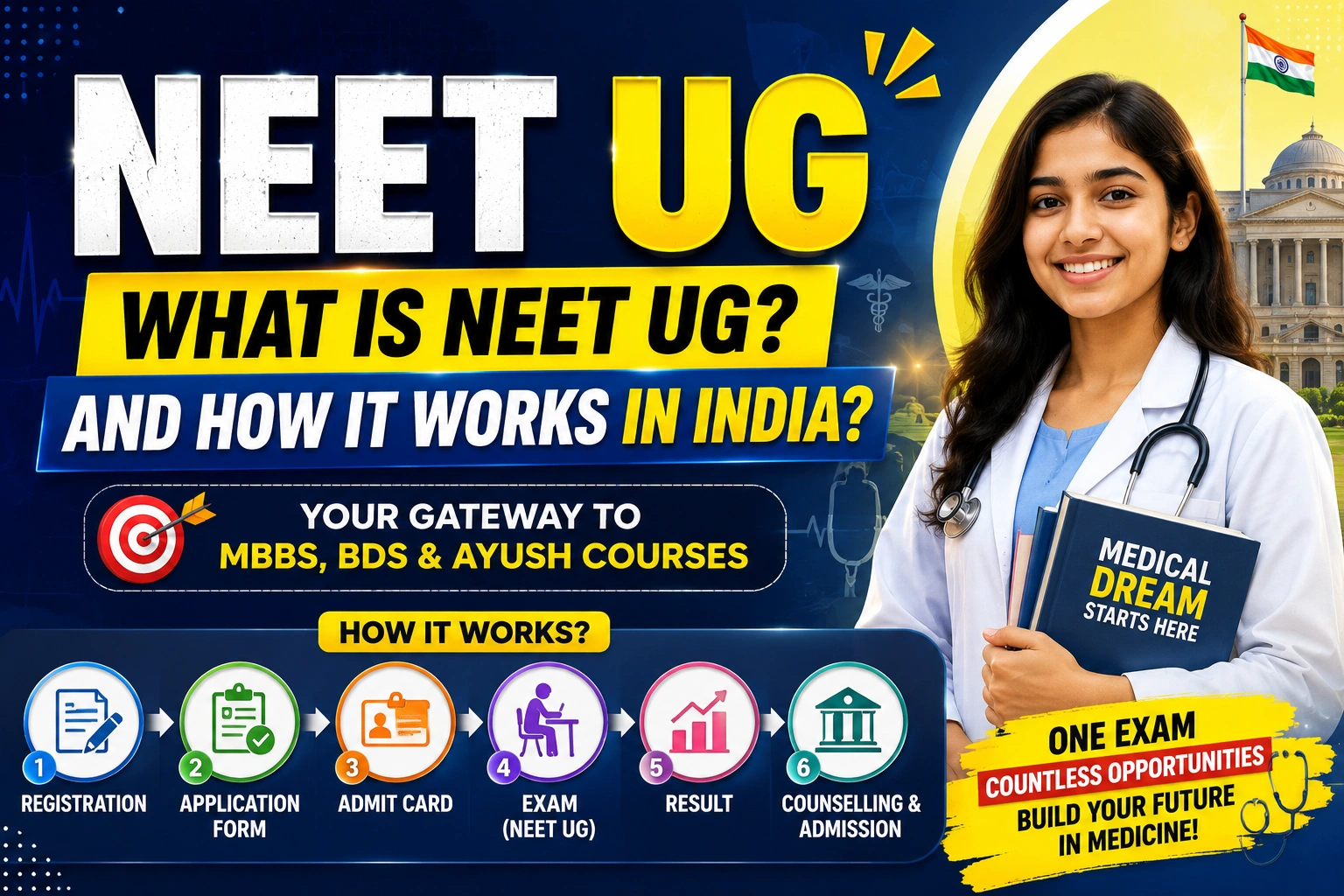
Introduction
NEET UG (National Eligibility cum Entrance Test – Undergraduate) is India’s single national-level entrance exam for admission into undergraduate medical and dental courses such as MBBS, BDS, AYUSH, and other allied medical programs. It is conducted every year by the National Testing Agency (NTA) and serves as the gateway for medical education in India.
Every year, millions of students appear for NEET UG with the dream of becoming doctors. However, very few understand how the system actually works behind the exam—how admission is allotted, how ranking is calculated, what role NMC (National Medical Commission) plays, and how tools like MBBS Advisor and NEET Rank Predictor help students after the exam.
In this detailed guide, we will explain what NEET UG is, how it works in India, its structure, eligibility, exam process, counselling system, and its importance in medical education. We will also connect global references like WHO and WDOMS to understand how Indian medical education aligns with international standards.
What is NEET UG?
NEET UG is a competitive entrance examination conducted at the national level for students who wish to pursue undergraduate medical courses in India. It is mandatory for admission into government and private medical colleges for MBBS and BDS programs.
The exam is conducted in offline mode (pen and paper-based) and consists of multiple-choice questions from Physics, Chemistry, and Biology (Botany and Zoology). The syllabus is based on Class 11 and Class 12 NCERT curriculum.
NEET UG is the only valid entrance exam for medical admission in India, replacing all state-level and private medical entrance tests.
Why NEET UG Was Introduced in India
Before NEET UG, medical admissions were conducted through different state-level exams and private college entrance tests. This created inconsistency, unfair competition, and lack of transparency.
To solve this problem, NEET UG was introduced as a single national-level exam to:
- Create a common platform for all medical aspirants
- Ensure merit-based selection
- Reduce corruption and donation-based admissions
- Standardize medical education quality across India
The National Medical Commission (NMC) oversees medical education policies, while NTA conducts the exam.
How NEET UG Works in India
NEET UG works in a structured system that includes exam registration, examination, result declaration, ranking, and counselling.
First, students register for the exam through the official NEET portal. After registration, they appear for the exam on the scheduled date. Once the exam is conducted, results are declared in the form of marks, percentile, and All India Rank (AIR).
After results, students go through counselling processes where seats are allotted based on rank, category, and college preference.
This entire system ensures fair and transparent admission into medical colleges.
Eligibility Criteria for NEET UG
To appear for NEET UG, students must fulfill eligibility conditions set by NMC.
A student must have completed Class 12 or equivalent examination with Physics, Chemistry, Biology/Biotechnology, and English as core subjects. Minimum marks in Class 12 are required depending on category rules.
The minimum age requirement is 17 years at the time of admission or by the end of the admission year. There is no strict upper age limit as per current rules, making NEET UG accessible to a wide range of students.
These eligibility rules ensure that students have a strong academic foundation before entering medical education.
NEET UG Exam Pattern and Structure
NEET UG consists of 200 questions, out of which 180 are to be attempted. The paper is divided into three subjects: Physics, Chemistry, and Biology.
Biology carries the highest weightage, followed by Chemistry and Physics. Each correct answer carries marks, while incorrect answers lead to negative marking.
The exam is designed to test conceptual understanding, speed, accuracy, and application skills. It is not just a memory-based exam but requires deep understanding of NCERT concepts.
How NEET UG Ranking System Works
NEET UG results are not just based on marks but also percentile and rank. The All India Rank (AIR) is used for admission purposes.
The ranking system compares performance of all students who appeared in the exam. Higher marks lead to better ranks, which increases chances of admission in top medical colleges.
This is where tools like NEET Rank Predictor become useful, as they help students estimate their expected rank before official counselling begins.
NEET UG Counselling Process in India
After results, the counselling process begins. It is conducted at both national and state levels.
Students are allotted seats based on:
- NEET rank
- Category (General, OBC, SC, ST, etc.)
- College preference
- Seat availability
Counselling ensures that students are placed in medical colleges based on merit and availability.
Role of NMC in NEET UG System
The National Medical Commission (NMC) plays a major role in regulating medical education in India. It ensures that NEET UG remains the standard entrance exam for MBBS and related courses.
NMC is responsible for:
- Defining eligibility criteria
- Approving medical colleges
- Setting admission guidelines
- Maintaining education quality standards
NEET UG operates under the regulatory framework of NMC.
Importance of NEET UG in Medical Career
NEET UG is not just an exam; it is the foundation of a medical career in India. Without qualifying NEET, students cannot pursue MBBS or BDS in recognized institutions.
It ensures that only deserving and qualified students enter the medical profession, which is crucial for maintaining healthcare standards in the country.
Role of MBBS Advisor After NEET UG
After NEET UG results, many students feel confused about college selection and admission chances. This is where MBBS Advisor becomes helpful.
MBBS Advisor helps students:
- Understand expected college options based on rank
- Compare government and private medical colleges
- Explore MBBS abroad opportunities
- Plan counselling strategy effectively
It simplifies decision-making during the admission process.
Students can also use MBBS Advisor to compare admission pathways and identify suitable colleges according to their scores and budget.
NEET Rank Predictor and Its Importance
A NEET Rank Predictor is a useful tool that estimates a student’s expected rank based on marks or mock test scores.
It helps students:
- Understand their admission chances
- Plan counselling choices
- Decide whether to take a drop or proceed
- Compare performance with cutoffs
This tool helps students make informed decisions after NEET UG.
WHO and WDOMS in Medical Education Context
The World Health Organization (WHO) plays an indirect role in global medical education standards by ensuring quality healthcare practices worldwide.
The World Directory of Medical Schools (WDOMS) is important for students planning MBBS abroad. It ensures that medical universities are internationally recognized and valid for licensing exams.
Students must check:
- University listing in WDOMS
- NMC recognition
- Eligibility for FMGE or NExT exam in India
These factors ensure global validity of medical degrees.
Common Misconceptions About NEET UG
Many students have misconceptions about NEET UG.
Some believe it is extremely difficult without coaching, while others think only top scorers can become doctors. In reality, NEET UG is competitive but achievable with proper preparation.
Another misconception is that NEET UG is based on trick questions, but most questions are directly based on NCERT concepts.
Challenges Faced by Students in NEET UG
NEET UG is a highly competitive exam, and students often face challenges such as:
- High syllabus volume
- Time management issues
- Pressure and stress
- Conceptual difficulties in Physics and Chemistry
However, with proper strategy and consistency, these challenges can be overcome.
Preparation Strategy for NEET UG
Successful NEET UG preparation requires:
- Strong NCERT foundation
- Regular revision cycles
- Mock test practice
- Time management skills
- Error analysis
Consistency and discipline are more important than long study hours.
Future Scope After NEET UG
After qualifying NEET UG, students can pursue MBBS, BDS, AYUSH, or other medical-related courses.
After MBBS, students must complete internship and licensing exams like FMGE or NExT (for foreign graduates or new system), and then register under NMC to practice medicine in India.
Conclusion
NEET UG is the most important gateway for medical education in India. It ensures a fair, transparent, and merit-based selection system for MBBS and other medical courses.
Understanding how NEET UG works helps students plan better, prepare smarter, and make informed decisions about their future.
Tools like MBBS Advisor help in college selection, while NEET Rank Predictor helps in estimating results. Institutions like NMC, along with global bodies like WHO and WDOMS, ensure that medical education remains standardized and globally recognized.
In conclusion, NEET UG is not just an exam—it is the foundation of a medical career in India, and understanding its system is the first step toward becoming a successful doctor.