
 Russia
 Belarus
 Georgia
 Kazakhstan
 Kyrgyzstan
 Uzbekistan
 China
China Nepal
Nepal Bangladesh
 Poland
 Romania
 Slovakia
 Hungary
 N. Macedonia
 Vietnam
 Canada
 Armenia
 UK
UK Australia
 USA
USA Ireland
 Germany
 New Zealand
 Italy
Italy France
 Singapore
 Netherlands
 Sweden
 Switzerland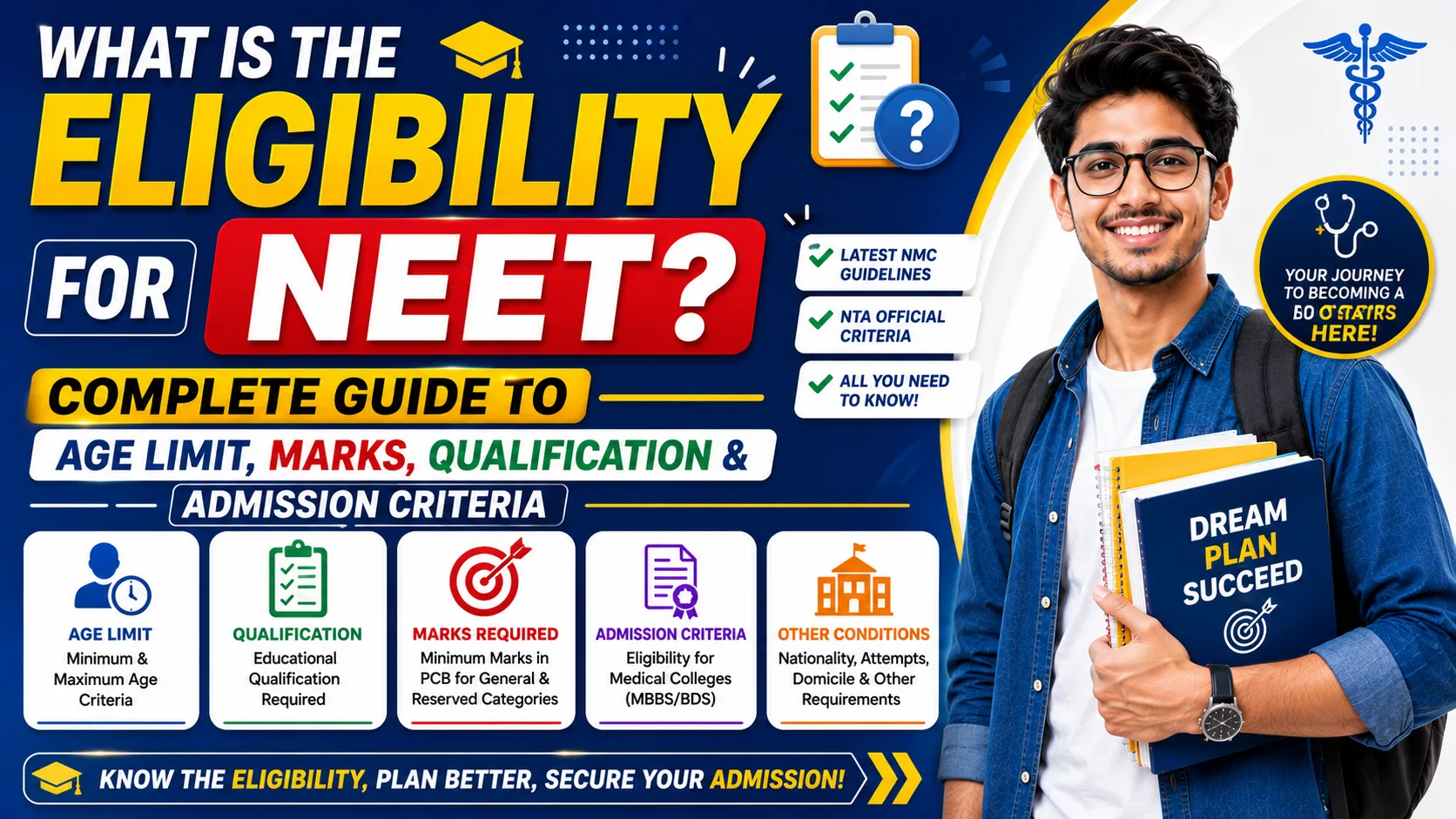
Introduction
NEET (National Eligibility cum Entrance Test) is the single national-level medical entrance examination in India conducted for admission into MBBS, BDS, AYUSH, and other medical courses. Every year, lakhs of students apply for NEET with the dream of becoming doctors, but not all candidates are eligible to appear for the examination. This makes NEET eligibility criteria one of the most important topics for every medical aspirant.
NEET eligibility is defined by the National Testing Agency (NTA) and regulated by the National Medical Commission (NMC). It includes conditions related to age, academic qualification, minimum marks, subject requirements, and nationality. Students must carefully understand these rules before filling out the application form because even a small mistake can result in rejection.
In this detailed guide, we will explain the complete NEET eligibility criteria, including age limits, required marks, qualification rules, subject combinations, and special category requirements. We will also understand how tools like MBBS Advisor, NEET Rank Predictor, and organizations like WHO and WDOMS are connected to the medical admission journey after eligibility is cleared.
Meaning of NEET Eligibility
NEET eligibility refers to the set of rules and conditions that a student must fulfill in order to appear for the NEET examination. These rules ensure that only academically qualified and age-appropriate students are allowed to compete for medical seats in India.
Eligibility is not limited to passing Class 12. It also includes subject requirements, minimum percentage criteria, and nationality regulations. NEET eligibility ensures fairness and standardization in medical admissions across the country.
If a student does not meet the eligibility criteria, their application may be rejected even after successful registration. Therefore, understanding eligibility requirements is essential before applying.
NEET Age Eligibility Criteria
Age is one of the most important eligibility conditions for NEET.
As per current NMC guidelines, a candidate must be at least 17 years old at the time of admission or by 31st December of the admission year.
Minimum Age Requirement
- Candidates must complete 17 years of age by 31st December of the admission year.
Upper Age Limit
- Currently, there is no upper age limit for NEET.
This rule allows candidates of any age above 17 years to appear for the examination, making medical education accessible to a wider group of students.
However, students should always verify the latest updates through the official NEET website before applying.
Educational Qualification Required for NEET
Academic qualification is another crucial component of NEET eligibility.
Students must have:
- Passed Class 12 or equivalent examination from a recognized board.
- Appeared in Class 12 and awaiting results (eligible provisionally).
- Studied required science subjects.
The candidate must have studied:
- Physics
- Chemistry
- Biology/Biotechnology
- English
These subjects are compulsory because the NEET syllabus is based primarily on Class 11 and Class 12 science curriculum.
Students who have studied Biology as an additional subject may also be eligible according to prevailing NMC regulations.
Minimum Marks Required for NEET Eligibility
Marks obtained in Class 12 play a vital role in determining NEET eligibility.
Category-Wise Minimum Marks Requirement
|
Category |
Minimum PCB Aggregate |
|
General |
50% |
|
General-PwD |
45% |
|
OBC |
40% |
|
SC |
40% |
|
ST |
40% |
The percentage is calculated using marks obtained in:
- Physics
- Chemistry
- Biology/Biotechnology
It is important to understand that these marks determine only eligibility for appearing in NEET. Admission rank is determined solely by performance in the entrance examination.
Subject Combination Requirement for NEET
NEET requires a specific subject combination in Class 12.
Mandatory subjects include:
- Physics
- Chemistry
- Biology or Biotechnology
- English
Students who have not studied these subjects are generally not eligible to appear for NEET.
These subjects form the foundation of medical education and are therefore mandatory for MBBS and related healthcare programs.
Nationality Eligibility for NEET
NEET is open to multiple categories of candidates based on nationality.
Eligible candidates include:
- Indian Citizens
- Overseas Citizens of India (OCI)
- Non-Resident Indians (NRI)
- Persons of Indian Origin (PIO)
- Foreign Nationals
Indian students can use their NEET scores for admissions in Indian medical colleges and also for several international universities approved by NMC and listed in WDOMS.
Foreign nationals may also appear for NEET if they intend to pursue medical education in India.
NEET Eligibility for MBBS Abroad
Many students use their NEET qualification to pursue MBBS abroad when they are unable to secure a seat in India.
For students planning international medical education, the following conditions are important:
- NEET qualification must be valid.
- The university should be approved under applicable NMC guidelines.
- The medical university must be listed in WDOMS.
Without meeting these requirements, students may face difficulties in obtaining recognition for medical practice in India after graduation.
Role of NMC in NEET Eligibility
The National Medical Commission (NMC) is responsible for regulating medical education standards and eligibility requirements.
NMC determines:
- Age criteria
- Academic qualification requirements
- Subject eligibility
- Recognition of foreign medical institutions
- Medical admission standards
All NEET eligibility criteria are implemented under the framework established by NMC.
NEET Eligibility vs NEET Qualification
Many students confuse eligibility with qualification, but both terms are different.
NEET Eligibility
Determines whether a candidate is allowed to appear for the examination.
NEET Qualification
Determines whether a candidate has achieved the required cutoff score after the examination.
A student may be eligible to appear for NEET but may not qualify if their score falls below the official cutoff.
Understanding this distinction is important for proper admission planning.
Importance of NEET Eligibility Criteria
NEET eligibility criteria are essential because they ensure that only qualified students enter medical education.
Eligibility criteria help:
- Maintain medical education standards
- Ensure fair competition
- Prevent ineligible admissions
- Standardize the national admission process
- Strengthen the healthcare education system
Without proper eligibility rules, the admission process would become inconsistent and unfair.
Role of MBBS Advisor After NEET Eligibility
Once students satisfy NEET eligibility requirements and appear for the examination, they often require guidance regarding admissions and counselling.
This is where MBBS Advisor becomes useful.
MBBS Advisor helps students:
- Analyze admission possibilities
- Understand college options
- Compare MBBS programs
- Explore MBBS abroad opportunities
- Develop counselling strategies
Many students use MBBS Advisor to make informed decisions regarding medical admissions.
NEET Rank Predictor and Its Importance
A NEET Rank Predictor helps students estimate their expected rank after appearing for the examination.
Benefits include:
- Estimating All India Rank (AIR)
- Understanding admission chances
- Planning counselling choices
- Reducing uncertainty after the exam
Although it does not affect eligibility, a NEET Rank Predictor serves as an important bridge between examination performance and admission planning.
WHO and WDOMS in Medical Education Context
The World Health Organization (WHO) establishes global healthcare standards and indirectly influences medical education quality across countries.
The World Directory of Medical Schools (WDOMS) serves as a global database of recognized medical institutions.
Students planning MBBS abroad should ensure:
- The university is listed in WDOMS.
- It satisfies NMC recognition requirements.
- It follows internationally accepted education standards.
These factors help ensure worldwide recognition of medical qualifications.
Common Mistakes in NEET Eligibility
Many students make errors while evaluating their eligibility.
Common mistakes include:
- Misunderstanding age criteria
- Choosing incorrect subject combinations
- Ignoring minimum marks requirements
- Assuming eligibility without verifying official guidelines
- Failing to check updated NMC regulations
Such mistakes can lead to application rejection or future admission complications.
Conclusion
NEET eligibility is the foundation of medical admission in India. It determines who can appear for the examination and ensures that only qualified students enter the medical education system. The eligibility criteria include age requirements, educational qualifications, subject combinations, nationality conditions, and minimum marks requirements.
Understanding eligibility is the first and most important step in the medical admission journey. Once eligibility is confirmed, students can focus on exam preparation, rank prediction, counselling, and college selection.
Tools like MBBS Advisor and NEET Rank Predictor, along with regulatory bodies such as NMC and international organizations like WHO and WDOMS, help students successfully move from eligibility verification to final admission.
In conclusion, NEET eligibility is not just a rule—it is the starting point of every medical aspirant's journey toward becoming a doctor.