
 Russia
 Belarus
 Georgia
 Kazakhstan
 Kyrgyzstan
 Uzbekistan
 China
China Nepal
Nepal Bangladesh
 Poland
 Romania
 Slovakia
 Hungary
 N. Macedonia
 Vietnam
 Canada
 Armenia
 UK
UK Australia
 USA
USA Ireland
 Germany
 New Zealand
 Italy
Italy France
 Singapore
 Netherlands
 Sweden
 Switzerland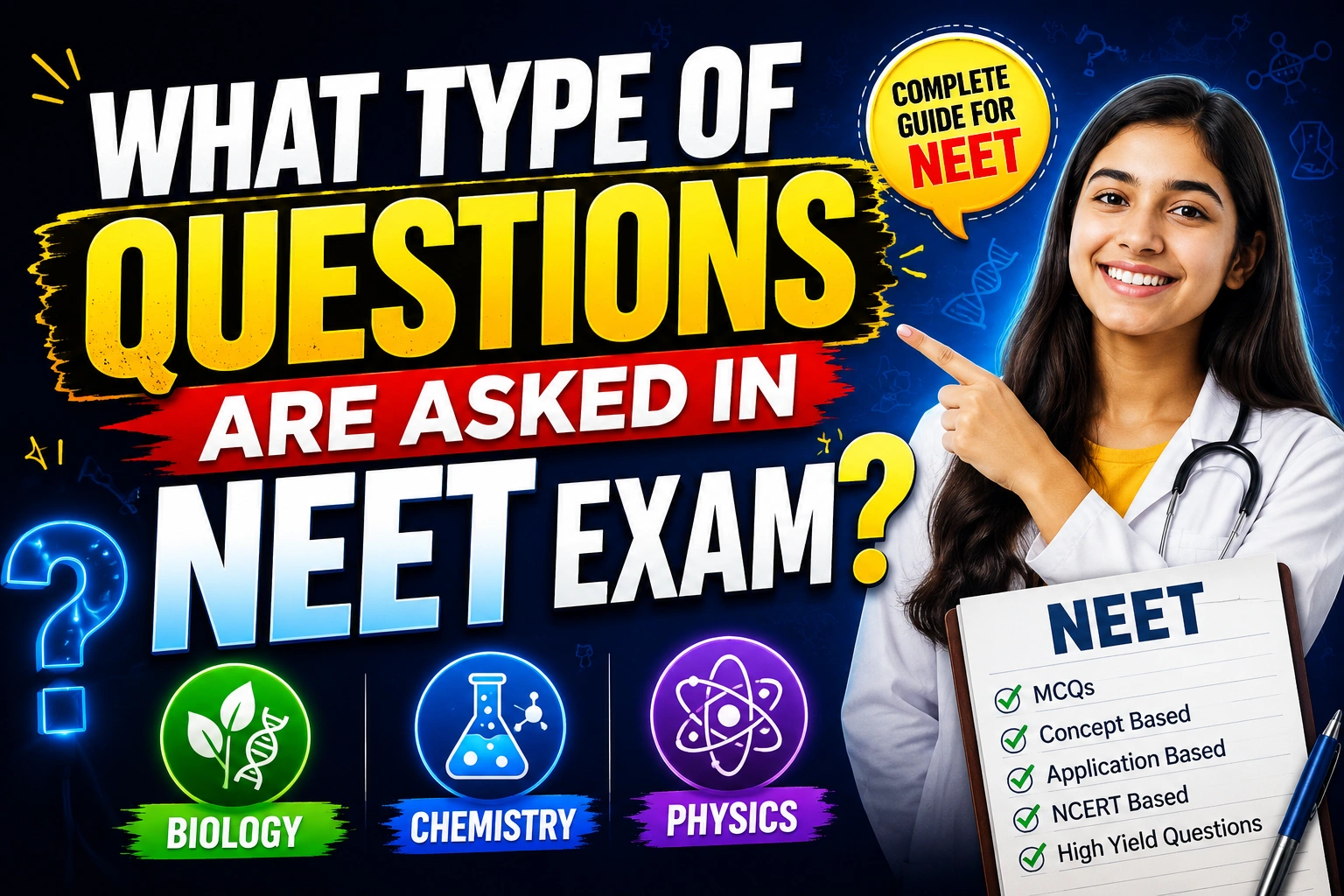
Introduction
NEET (National Eligibility cum Entrance Test) is India’s single largest medical entrance exam for admission into MBBS, BDS, AYUSH, and other undergraduate medical courses. Every year, lakhs of students appear for this exam, but only a limited number secure seats in top medical colleges.
One of the most important things every aspirant must understand before preparing is: what type of questions are asked in NEET exam? Because NEET is not just about studying hard, it is about understanding the pattern, difficulty level, and concept-based nature of questions.
NEET is conducted by the National Testing Agency (NTA) under the guidance of the National Medical Commission (NMC). The exam is fully based on NCERT syllabus of Class 11 and 12 for Physics, Chemistry, and Biology.
In this detailed guide, we will explore the types of questions asked in NEET, subject-wise question pattern, difficulty level, conceptual style, and how tools like MBBS Advisor, NEET Rank Predictor, along with global references like WHO and WDOMS, connect to your medical career journey.
Nature of Questions in NEET Exam
NEET questions are primarily multiple-choice questions (MCQs). Each question has four options, and students must select the correct answer.
The questions are designed to test:
- Conceptual understanding
- Application of knowledge
- Problem-solving ability
- Speed and accuracy
NEET is not a rote learning exam. Most questions are indirect and require deep understanding of NCERT concepts rather than memorization.
Subject-Wise Distribution of Questions
NEET consists of three main subjects: Physics, Chemistry, and Biology. Each subject has a specific type of question pattern.
Biology carries the highest number of questions, followed by Chemistry and Physics. Biology is more factual and NCERT-based, while Physics is numerical and Chemistry is a mix of theory and application.
Understanding subject-wise question patterns is very important for effective preparation.
Type of Questions in Biology (NEET)
Biology is the most scoring section in NEET and consists of Botany and Zoology. Most questions are directly or indirectly based on NCERT textbooks.
Questions in Biology are usually factual, diagram-based, and concept-based. Many questions are directly lifted from NCERT lines, while others require interpretation of biological processes.
Some questions are based on diagrams, such as human anatomy, plant structures, or cell biology. These require careful observation and understanding.
There are also assertion-reason type conceptual questions where students must understand relationships between biological concepts.
Biology questions test memory, understanding, and application of NCERT content.
Type of Questions in Chemistry (NEET)
Chemistry in NEET is divided into Physical, Organic, and Inorganic Chemistry, and each section has a different question style.
In Physical Chemistry
Questions are mostly numerical and formula-based. Students need to apply formulas to solve problems related to mole concept, thermodynamics, and equilibrium.
In Organic Chemistry
Questions are based on reaction mechanisms, named reactions, and conversion-based problems. These questions test logical understanding of chemical reactions.
In Inorganic Chemistry
Questions are mostly NCERT-based and memory-oriented. Many questions come directly from textbook lines, periodic table trends, and chemical bonding concepts.
Chemistry questions require both understanding and practice.
Type of Questions in Physics (NEET)
Physics is often considered the most challenging subject in NEET due to its numerical and conceptual nature.
Questions in Physics are mostly calculation-based and require application of formulas. Students are expected to solve problems related to mechanics, electricity, optics, thermodynamics, and modern physics.
Some questions are direct formula-based, while others require multi-step reasoning.
Physics Questions Test:
- Concept clarity
- Mathematical ability
- Speed of calculation
- Application skills
Regular practice is essential to master Physics questions in NEET.
Concept-Based Questions in NEET
Most NEET questions are concept-based rather than direct memory-based. Even factual questions often require understanding of underlying concepts.
For example, instead of asking a direct definition, NEET may ask a question that applies that concept in a real-life or biological scenario.
This makes NEET different from simple board exams. Students must focus on understanding rather than memorization.
NCERT-Based Question Pattern
NEET is heavily based on NCERT textbooks. Almost 80–90% of questions come directly or indirectly from NCERT content.
In Biology and Inorganic Chemistry, many questions are directly lifted from NCERT lines. Even Physics questions are often based on NCERT concepts and examples.
This is why NCERT is considered the most important study material for NEET preparation.
Assertion and Reason Type Questions
NEET often includes assertion-reason type questions where two statements are given, and students must analyze their relationship.
These questions test deep understanding of concepts rather than surface-level knowledge.
Students must evaluate whether both statements are correct and whether one explains the other.
These questions are common in Biology and Chemistry.
Diagram-Based Questions in NEET
Diagram-based questions are mainly found in Biology and sometimes in Physics.
Students may be asked to identify parts of a diagram or understand processes shown in diagrams.
For example:
- Human anatomy diagrams
- Plant structure diagrams
- Cell division stages
- Lens and optics diagrams in Physics
These questions test visual understanding and attention to detail.
Numerical Questions in NEET
Numerical questions are mostly found in Physics and Physical Chemistry.
These questions require calculations using formulas and concepts.
Students must practice regularly to improve speed and accuracy because time management is very important in NEET.
Even small calculation errors can lead to wrong answers due to negative marking.
Trick and Application-Based Questions
Some NEET questions are designed to test application skills and logical thinking.
These questions may not look straightforward and often require multiple steps of reasoning.
However, NEET does not include very tricky or out-of-syllabus questions. Most application-based questions still come from NCERT concepts.
Difficulty Level of NEET Questions
The difficulty level of NEET questions is moderate to high.
Biology is generally easier compared to Physics and Chemistry. Physics is considered the toughest section due to numerical complexity, while Chemistry is balanced.
Overall, NEET is designed to test consistency, understanding, and application rather than extreme difficulty.
Role of MBBS Advisor in Understanding NEET Pattern
After understanding question types, students often want to know what score is needed for MBBS admission. This is where MBBS Advisor becomes helpful.
MBBS Advisor helps students:
- Understand expected college options based on NEET score
- Compare medical colleges
- Explore MBBS abroad opportunities
- Plan counselling strategy
It connects NEET performance with real admission possibilities.
Students can also use MBBS Advisor to evaluate government and private medical college options based on expected scores.
NEET Rank Predictor and Question Strategy
A NEET Rank Predictor helps students estimate their expected rank based on performance in mock tests.
It helps students:
- Understand how question accuracy affects rank
- Improve weak areas
- Analyze performance subject-wise
- Plan revision strategy
It is useful for understanding how question-solving performance impacts overall rank.
Many students use the NEET Rank Predictor before counselling to estimate their admission chances and prepare realistic college preferences.
Role of NMC in NEET Question Pattern
The National Medical Commission (NMC) regulates medical education and ensures NEET follows a standardized structure.
NMC Ensures That:
- NEET syllabus is based on NCERT
- Question pattern remains consistent
- Medical selection is merit-based
- Quality of medical education is maintained
NEET question design indirectly follows NMC guidelines.
WHO and WDOMS in Medical Education Context
The World Health Organization (WHO) sets global healthcare standards that influence medical education quality worldwide.
The World Directory of Medical Schools (WDOMS) ensures that foreign medical universities are globally recognized.
Students planning MBBS abroad must check:
- WDOMS listing
- NMC recognition
- Eligibility for licensing exams like FMGE or NExT
This ensures safe and valid medical career planning.
Common Mistakes Students Make in Question Preparation
Many students struggle in NEET because they misunderstand question patterns.
Common Mistakes Include:
- Focusing only on memorization
- Ignoring NCERT diagrams
- Not practicing MCQs
- Skipping mock tests
- Poor time management
Avoiding these mistakes improves performance significantly.
Effective Strategy to Handle NEET Questions
To handle NEET questions effectively, students must:
- Focus on NCERT concepts
- Practice MCQs regularly
- Solve previous year papers
- Take mock tests
- Improve speed and accuracy
Consistency is key to mastering NEET question patterns.
Conclusion
NEET questions are designed to test understanding, application, and conceptual clarity rather than rote memorization. The exam includes a mix of factual, numerical, diagram-based, and concept-based questions across Physics, Chemistry, and Biology.
Understanding question types is the first step toward effective preparation. With proper strategy, NCERT focus, and regular practice, students can handle NEET questions confidently.
Tools like MBBS Advisor help in understanding admission outcomes, while NEET Rank Predictor helps analyze performance. Institutions like NMC, along with global systems like WHO and WDOMS, ensure that medical education remains standardized and globally valid.
In conclusion, NEET is not just about studying—it is about understanding how questions are asked and how concepts are applied in real exam situations.