 Russia
 Belarus
 Georgia
 Kazakhstan
 Kyrgyzstan
 Uzbekistan
 China
China Nepal
Nepal Bangladesh
 Poland
 Romania
 Slovakia
 Hungary
 N. Macedonia
 Vietnam
 Canada
 Armenia
 UK
UK Australia
 USA
USA Ireland
 Germany
 New Zealand
 Italy
Italy France
 Singapore
 Netherlands
 Sweden
 Switzerland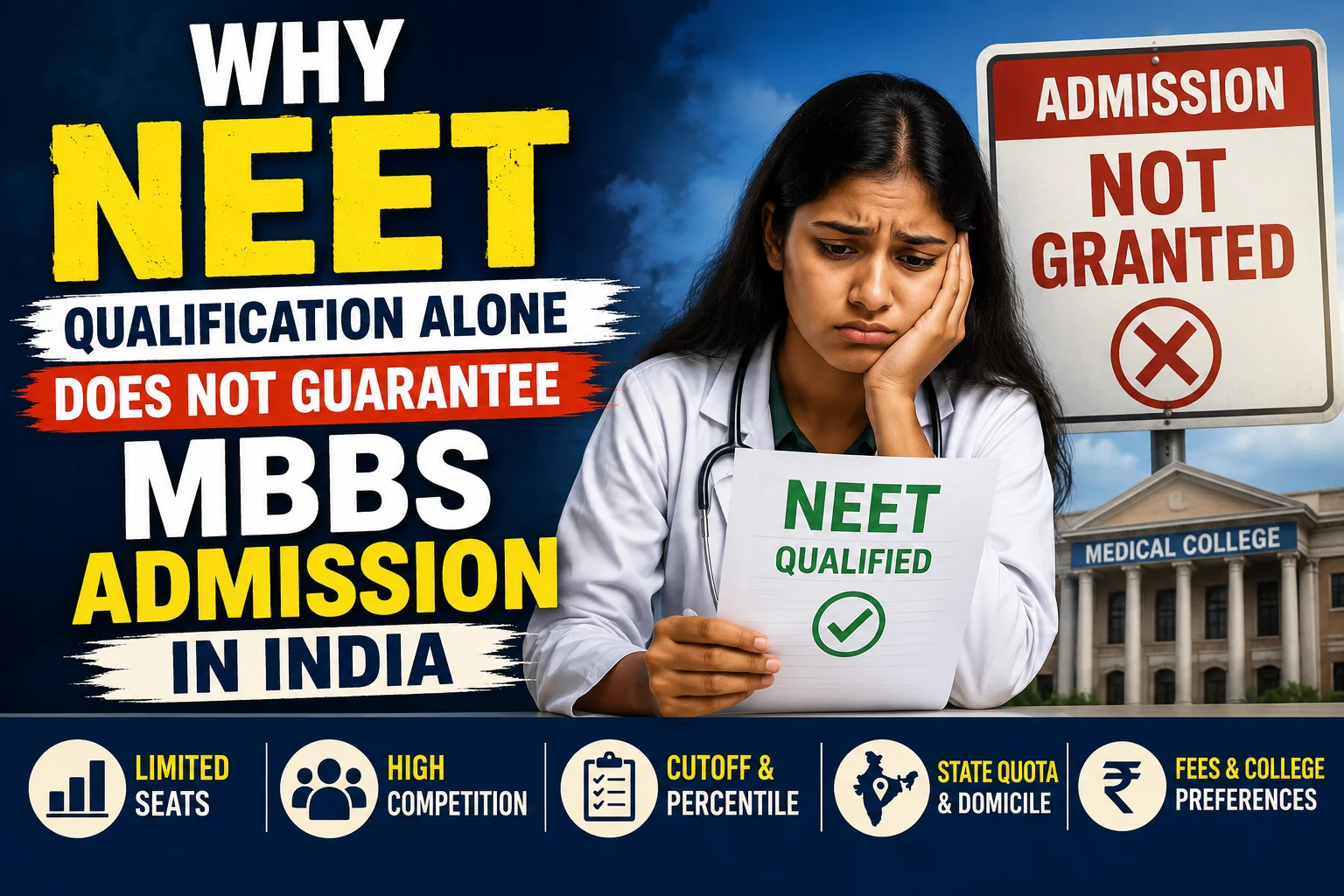
In India, the vast majority of young people aiming to enter the medical field regard the national unified NEET-UG entrance examination as the core threshold to apply for the undergraduate MBBS program at medical schools. Every year, more than 2 million candidates spend months or even years preparing for this exam. Successfully passing the test and obtaining a qualifying score has long been seen as the core milestone to enter the medical profession by countless candidates and their parents.
However, the vast majority of families are trapped in the same unsolvable dilemma: merely meeting the NEET qualifying cutoff is far from enough to secure an MBBS admission seat. Behind this core contradiction that hits the pain point of millions of candidates lie six primary root causes that lead to candidates failing to gain admission. Only by clarifying these causes can candidates avoid related pitfalls, and the professional medical application support platform MBBS Advisor was launched precisely to provide customized admission support for this group of candidates.
This article will break down all these core causes one by one in subsequent sections and put forward actionable plans to improve candidates’ admission odds.
Passing NEET Is Only the First Step
First, we must correct the most widespread cognitive misunderstanding among candidates: passing the NEET qualifying standard only grants a candidate eligibility to participate in the official centralized admission counselling process and does not mean they have directly secured an admission seat.
The 2025 NEET-UG data directly illustrates this supply-demand gap: this year, a total of 1.236 million candidates passed the exam to qualify for admission, but the total number of MBBS seats available across the country ranges only from 118,000 to 126,000. This imbalance plays out every year.
Even though the National Medical Commission (NMC) of India has continuously expanded medical education resources over the past decade, pushing the total number of seats past 126,000, this expansion still cannot keep up with the growth in the size of the candidate pool.
This supply-demand imbalance is therefore the leading factor among the six root causes of failed admission.
Why Government Medical Colleges Are So Competitive
Candidates’ extremely strong preference for public medical schools further intensifies the intensity of competition. The remaining causes, including barriers in the counselling process, reservation quota policies, inability to cover related costs, and mistakes in application strategy, will also be elaborated on one by one in later content.
Candidates may also leverage the professional support of MBBS Advisor to optimize their own application plans.
The vast majority of candidates applying for India’s Bachelor of Medicine, Bachelor of Surgery (MBBS) program rank public government medical colleges as their top choice.
Key Advantages of Government Medical Colleges
These institutions hold four core strengths:
- Low tuition fees
- Strong affordability
- Access to sufficient hands-on clinical practice opportunities during enrollment
- A far higher return on investment than other peer medical colleges
Even though the appeal of this ideal option is clear, the vast majority of applicants encounter four major obstacles during the application stage.
Obstacle 1: Limited Government Seats
Cutthroat competition driven by the extremely small share of seats available at government medical colleges remains the biggest challenge.
Many candidates who score over 600 on India’s unified National Eligibility cum Entrance Test (NEET) in multiple states still fail to secure a seat due to the very high admission cutoffs set by these institutions. Even a tiny score gap of just one or two points can lead to a ranking difference of thousands of places, which directly and completely undermines their final chances of admission.
Obstacle 2: Reservation Policy Differences
Categorical admission disparities caused by India’s reservation policy also play a major role.
All seats are divided into seven categories, namely:
- UR
- OBC
- EWS
- SC
- ST
- PwD
- Other applicable reserved categories
These categories often have vastly different admission cutoffs.
While this policy was designed to advance social equity, it has led to starkly divergent admission outcomes for candidates who all meet the basic qualifying score.
Obstacle 3: High Cost of Private Medical Colleges
The prohibitive tuition barrier of private medical colleges is another major challenge.
The total tuition for the full program at most private institutions exceeds 500,000 to 1,000,000 Indian rupees, on top of which students must pay additional fees for accommodation, miscellaneous expenses, and deposits.
This cost is unaffordable for many ordinary middle-class families, leaving a large number of NEET-qualified candidates unable to enroll.
Obstacle 4: Application Process Errors
Many candidates mistakenly believe that obtaining their NEET score completes the entire application process.
Common mistakes include:
- Missing registration deadlines
- Submitting an unreasonably ordered list of program preferences
- Providing incomplete application materials
- Forgoing supplementary admission rounds such as mop-up rounds and stray vacancy rounds
Currently, the third-party tool MBBS Advisor can help candidates analyze historical admission trends and avoid a range of application consulting pitfalls.
Common Admission Misunderstandings
NEET medical exam candidates applying for India’s MBBS program often encounter many easily overlooked barriers and cognitive misunderstandings during the college admission process.
Lack of Understanding of State Counselling
The most widespread core misunderstanding is the lack of understanding of state-level admission consultation, which leads many candidates to make four typical mistakes:
- Failing to register for state-level admission
- Missing admission notifications
- Ignoring the admission window for private colleges
- Misunderstanding residency eligibility requirements
It is recommended that candidates participate in both the All India Quota (AIQ) and state-level admission processes to increase their chances of receiving an offer.
Rank Inflation
Candidates must also guard against the problem of rank inflation.
The growth in the total number of test-takers has pushed up the score requirements of all colleges, and the reference value of public medical colleges’ admission cutoff scores from previous years has dropped sharply.
Candidates should not settle for only meeting the minimum passing score; they must strive to achieve high marks.
Seat Blocking and Admission Irregularities
Candidates also need to note the distortion of admission order caused by illegal practices such as seat blocking.
Investigations in some states show that such behaviors, alongside other violations including document fraud, have severely squeezed the admission opportunities for rule-abiding candidates.
At present, exam and admission authorities have rolled out rectification measures to upgrade transparency and strengthen monitoring.
Regional Differences in MBBS Admissions
There is significant regional inequality in the distribution of MBBS seats across India’s states.
Resource-rich states have:
- More medical colleges
- More admission seats
- More complete public medical education infrastructure
Candidates need to learn about regional admission trends in advance to support their application decisions.
Rising Competition for Medical Seats
The number of NEET test-takers has surged year after year, driven by factors including:
- The social prestige of the medical profession
- Job stability in the field
- Growing national demand for medical services
- Improved public understanding of medical careers
Simply expanding the number of seats cannot resolve the current admission crisis.
Emotional Impact of Admission Failure
Many candidates who pass the minimum qualifying score but fail to secure an admission offer fall into negative emotions such as:
- Frustration
- Anxiety
- Loss of self-confidence
- Confusion about the future
A common misunderstanding that must be corrected is that this failure is never a sign of insufficient personal ability.
The core root of the problem is the industry-wide structural shortage of seats.
Alternative Medical Career Pathways
Even if candidates do not obtain an MBBS seat, they still have alternative higher education pathways to pursue.
For Indian students planning to study medicine, beyond the mainstream MBBS degree, they may also consider a diverse range of other professional medical degrees including:
- BDS
- BAMS
- BHMS
- BPT
- BSc Nursing
- Allied Health Sciences
Education experts specifically remind students that they do not need to limit their focus solely to MBBS and can explore a wider range of medical career paths.
MBBS Abroad as an Alternative
In recent years, applying to study MBBS abroad has become a growing trend among Indian students.
Currently, seven countries including Kyrgyzstan and Kazakhstan offer low-cost medical programs whose degrees are globally recognized.
Most students applying for these overseas programs use the MBBS Advisor tool to complete tasks such as:
- Comparing universities
- Verifying application eligibility
- Evaluating career prospects
Before choosing an overseas medical university, students should verify its recognition through the World Directory of Medical Schools (WDOMS).
Importance of Professional Admission Planning
Admission outcomes for medical higher education are never determined by exam scores alone and rely far more on a scientific planning framework.
Professional consulting covers five core components:
- Practical school selection
- Program category analysis
- State quota assessment
- Financial planning
- Development of backup plans
There have been cases where low-scoring applicants who used professional consulting received admission offers earlier than many higher-scoring applicants.
MBBS Advisor also offers seven total services:
- Personalized consulting
- University comparison
- Admission guidance
- Application coaching
- Assistance with overseas MBBS applications
- Guidance on document processing
- Career planning
Access to accurate information can greatly increase an applicant’s chance of securing admission.
Key Takeaways for NEET Aspirants
Passing the NEET exam is only the first step in gaining admission to medical school.
Every year, only a small fraction of the millions of students who meet the NEET cutoff score can secure an MBBS seat. Six core factors lead to this situation.
The problem is not that applicants lack ability; most barriers stem from structural limitations in India’s domestic medical education system.
Applicants can improve their chances of admission through four approaches:
- Scientific planning
- Engaging in strategic consulting
- Practical school selection
- Seeking expert guidance
Resources such as MBBS Advisor help applicants navigate the competitive landscape and make informed choices.
Conclusion
In the future, success in obtaining medical school admission will increasingly rely on awareness, planning, and informed decision-making throughout the entire process, rather than depending solely on NEET scores.
Candidates should regularly follow updates from the National Medical Commission (NMC), verify overseas medical institutions through the World Directory of Medical Schools (WDOMS), stay updated with the official NEET portal, and remain aware of global healthcare developments highlighted by the World Health Organization (WHO) while planning their medical education journey.