 Russia
 Belarus
 Georgia
 Kazakhstan
 Kyrgyzstan
 Uzbekistan
 China
China Nepal
Nepal Bangladesh
 Poland
 Romania
 Slovakia
 Hungary
 N. Macedonia
 Vietnam
 Canada
 Armenia
 UK
UK Australia
 USA
USA Ireland
 Germany
 New Zealand
 Italy
Italy France
 Singapore
 Netherlands
 Sweden
 Switzerland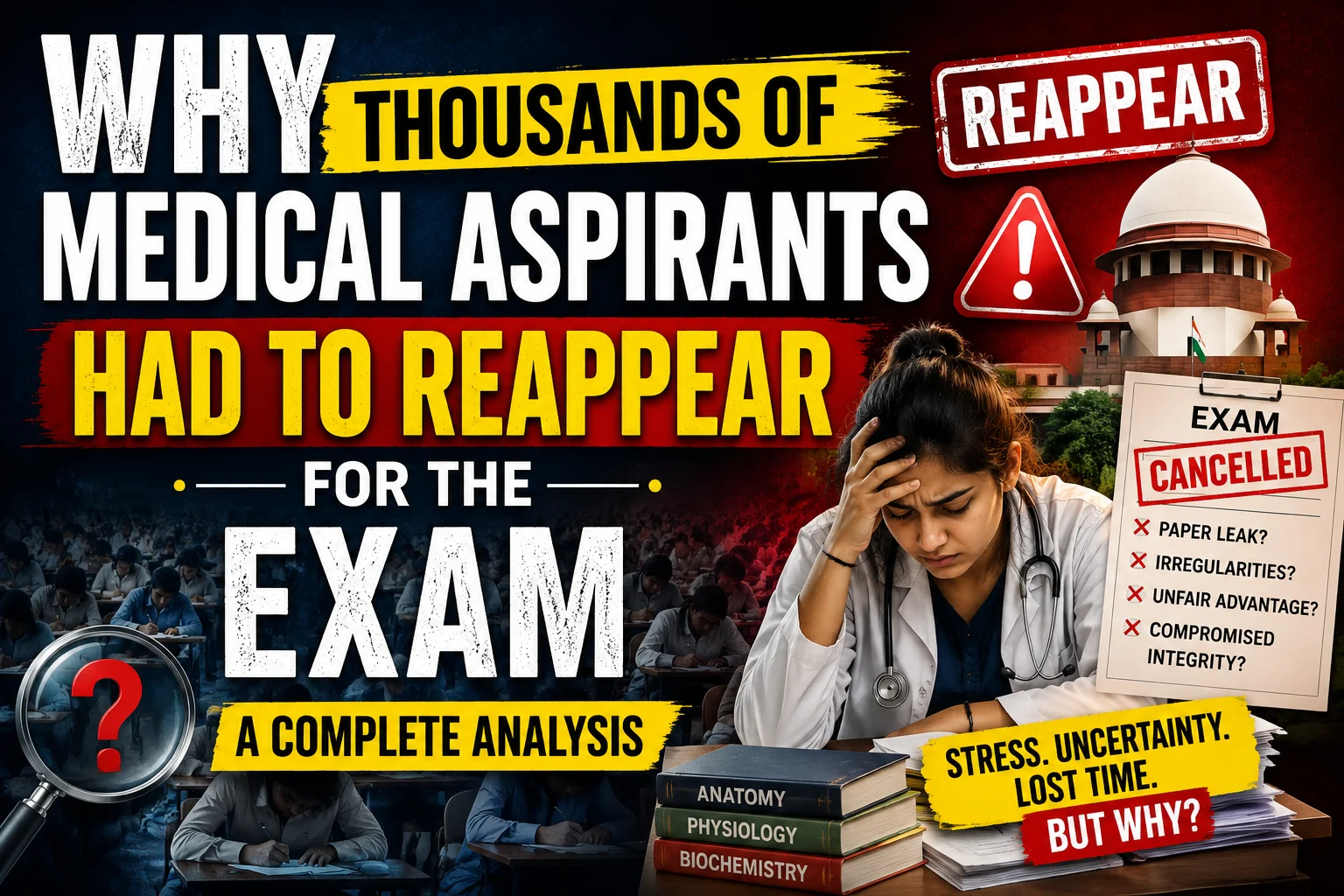
The National Eligibility cum Entrance Test (NEET) for millions of students in India is more than just a test. It allows access to years of financial investments, sacrifices made by family, and the culmination of their dreams to be accepted into a medical program. To make an assessment on the fairness, transparency, or processes surrounding the exam is to make an assessment on something that will affect them above and beyond the events of a single test day.
The last few years have given rise to several controversies of the NEET exam that have caused thousands of students to take the exam again and more than a handful of extraordinary situations. Never is this taken lightly. It affects students emotionally, academically, and financially. Maintaining the integrity of the admissions process is important even if exam authorities must take the decision to conduct the examination again.
This article is a complete study on the reasons that caused thousands of medical aspirants to take the exam again,ap? the factors that caused it, the roles of the authorities involved, and the impact on medical admissions in the years to come.
The students rely heavily on the MBBS Advisor to seek the most recent updates on medical admissions, counseling procedures, and other support related to the exam for professional and expert services.
NEET and Medical Admissions
The NEET exam is the sole national entrance exam for candidates wishing to study an undergraduate medical program in India. It is the only entrance exam for programs in MBBS, BDS, AYUSH, veterinary, and other allied health care services.
Every year, millions of applicants vie for a limited number of spots in both public and private medical colleges. Given the competition, even a minor error during an exam can have large consequences on the ranking and chance of admission for thousands of students.
Due to the highly impactful nature of the NEET exam and subsequent results, candidates are vigilant and concerned for any potential disruption to the process including policy changes, exam disruptions, and changes to procedure.
Since so many students rely on the exam for admission, authorities will be expected to perform their duties regarding the exam with the utmost care and the highest regard for equity, access, transparency, and safety.
What Warranted Re-Examinations
Generally, re-examinations are done when the authorities adjudged the original exam process was compromised or when certain cohorts of candidates experienced inequitable testing conditions.
Allegations of Question Paper Leakage
One of the most common reasons for conducting re-examinations is suspicion or confirmation of a leak of the question paper.
If examination authorities receive any credible information of an uneven testing condition due to advance access of some candidates to the examination questions, re-examination is the method to restore the equilibrium in merit-based admissions.
Technical difficulties that may compel a re-test include the following:
- Problems with biometric verification
- Server downtime
- Issues with digital attendance
- Failures of examination centre systems
- Errors in data transmission
If challenges of this nature inhibit candidates from undergoing the examination under normal conditions, a re-test may be scheduled.
Administrative Mistakes
A re-test may also occur due to administrative mistakes, including the following:
- Inappropriate distribution of question papers
- Distribution of question papers in the wrong language
- Commencement of the examination beyond the stipulated time
- Poor arrangements at the examination centre
- Poor administration during the verification of candidates
If these inhibit or undermine the performance of candidates, a re-test may be scheduled.
Effects of Examination Disruptions on Candidates
For medical candidates, the disruption of an examination may be catastrophic.
Many candidates devote up to three years in preparation for NEET. A considerable number of candidates relocate to different cities for coaching, and spend considerable financial resources.
A re-test, when announced, presents a multitude of challenges to candidates.
Psychological Stress
The preparation for an important examination is a stressful activity.
The completion of the examination is expected to provide closure. The announcement of a re-test causes candidates to prepare once again, considerably increasing the stress and anxiety.
Candidates have reported:
- Insomnia
- Poor focus
- Emotional fatigue
- Anxiety about the competition
Economic Stress
The re-test may be an additional financial burden on families.
The following may be incurred:
- Travel costs
- Costs related to lodging
- Costs for coaching
- Costs for new study materials
- Cost of lost working days for parents
Families in a lower economic bracket bear the most severe impact.
Uncertainty about Academics
A re-test may disrupt the timetable for the academic year, the admission processes, and the counselling sessions.
Candidates may be left wondering:
- What will their rank be?
- Which college will they be assigned?
- When will the counselling occur?
- When will the academic year commence?
This uncertainty may remain for weeks or months.
The Role of Examination Authorities
National examination authorities must guarantee the selection process is just.
When there are irregularities, they will usually carry out an investigation to determine if a re-examination is warranted.
The decision-making process usually entails the following steps.
Evidence Collection
Authorities collect evidence from:
- Examination centers
- Invigilators
- Members of the technical team
- Law enforcement
- Complaints by candidates
Expert Evaluation
An independent committee may examine the collected evidence to assess the scope of the irregularity.
The primary concern is whether the irregularity has impacted the fairness of the examination.
Legal Review
Many controversies surrounding examinations have led to litigation.
The courts will provide an essential function of assessment as to the validity of an examination and if the aggrieved candidates ought to have a new opportunity to be examined.
Security Challenges Facing Large Scale Examinations
Examinations that may have millions of candidates examined at thousands of centers can present logistical challenges to authorities.
They will have to secure the transportation of the question papers, the infrastructure at the Examination centers, the verification of the identity of the candidates, and the digital systems that communicate and process the results.
Even with the greatest precaution, the system will have exposed vulnerabilities.
Social Media Amplification
Fraud networks have become especially sophisticated.
Ways they may carry out networks may include the use of:
- Electronic means of communications
- Impersonation
- Cheating
- Data Theft
Social Media Disinformation Campaigns
Carries a significant level of risk.
Rumors about examinations and their irregularities can spread instantaneously, and concerns can be voiced on social media.
Candidates and their parents are likely to communicate and share their concerns over irregularities.
Authorities are often pressured to act in a timely manner with the assurance their decisions are based on verified evidence.
How Re-Examinations Impact Merit Ordering
Medical admissions highly depend on a rank ordering of candidates for selection.
A re-evaluation can greatly change the following:
- State merit lists
- Category-wise ranks
- All India rankings
- Cut-off scores
- College allotment results
Students who previously did well may feel the re-test will introduce the level of competition that will cause them to lose their place.
On the other hand, those who feel the main exam did not go well may consider the re-test as a new opportunity.
This may lead to a conflicting situation where the re-test may serve the different needs of the different groups of students.
Why Communicate Effectively
Exam controversies often stem from the fact that the regulatory bodies do not provide answers in a timely manner.
Students want answers for the following:
- Progress of the inquiry
- Criteria for re-exam
- Date the results will be released
- Timeline for counselling
- Legal matters
Uncertainty leads to rash conclusions, however, when communications are clear persons are less likely to feel anxious.
During this time of uncertainty, people will often turn to educational guidance and admission counseling as their main sources of information.
Functions of the Regulatory Bodies in Indian Medical Education
There are several regulatory bodies in Indian Medical Education which serve to ensure that the highest standards are maintained.
The World Health Organization
The WHO spearheads policy development in health and ensures that the necessary human resources and personnel are available. Students will often look to the official WHO site.
The National Medical Commission
The NMC has the responsibility to determine the standards for Medical Education in India. The NMC site will provide official notices. The NMC has a hand in the following:
- Standards for Medical colleges
- Medical curriculum
- Medical faculty
- Reforms for Medical education
- Recognition policies
The World Directory of Medical Schools
The WDOMS is a key resource for medical schools the world over.
International medical students send WDOMS a listing for verification before finalizing the Admission decision.
Why Does Exam Integrity Matter More Now?
Plenty of competent and fully trained medical staff are required to run the Health Care system smoothly.
The first step of selecting qualified candidates to become doctors is the Admissions process.
Examination Integrity Matters:
- Opportunities can be lost for deserving candidates
- Trust can be lost for the system
- The law can be engaged
- The integrity of academics can potentially be lost
This is why authorities usually favor integrity over the inconvenience of temporary re-examinations.
What We Have Gained From Previous Re-Examination Situations
Re-Examination situations in the past have taught us quite a bit.
A More Reliable and Secure Health Care System
With the denoted value of integrity in examination systems we see systems that:
- Have Secure and Patented Question Paper Systems
- Invest in sophisticated tracking systems
- Have the ability to monitor for deviations through artificial intelligence
- Have enhanced protective controls in cyberspace
- Have more reliable verification systems
Biometric systems are being developed to reduce impersonation.
The systems are also being enhanced for security for examination sites using:
- CCTV with real time reporting and digital logging
- Centralized monitoring
- Systems of tracking audits
Greater Accountability and Efficiency
The system is now holding a greater responsibility for time constraints concerning the investigations of violations and breaches of examination integrity.
What Should Students Do?
When there is news of re-examinations or investigations into examination integrity, students can do the following:
- Seek valid and updated information
- Follow official notification and communications
- Discontinue engagement with unsubstantiated information on social media
- Continue your studies
- Watch for notifications concerning counseling and stand ready to act
Other tools that are available to students to gain insight into the possible need for alternative admission pathways include the NEET Rank Predictor, which is based on trends and statistics to predict a score, and allow students to compare their overall national rank.
The Future of NEET and Medical Entrance Examinations
The future of large-scale entrance examinations is likely to balance advanced technology and sophisticated security.
Advancements might include:
- Highly encrypted systems
- AI-based exam security
- Real-time abnormal behavior detection
- Secure environments
- Improved candidate validation stem
The goal is not strictly to stop malpractice. It is just as critical to help the public trust the examination system.
The competition for medical seats gets stiffer each year. Trust, efficiency, and accountability will be expected of the examination authorities.
Conclusion
Decisions that require thousands of aspiring doctors to undergo the examination process again are never easy to make. Such drastic measures are taken because the examination authorities are of the opinion that fairness, transparency, or equal opportunity are no longer guaranteed. Whether caused by perceived leaks, examination system malfunctions, administrative failures, or some other irregularity, the re-examinations are an attempt to uphold the integrity of the entry processes of a highly competitive system.
For students, these measures add stress and uncertainty, and new challenges. It is vital to ensure trust in the medical admission process, as this system determines the future of the country’s healthcare workforce.
As long as NEET is the primary medical entrance examination in India, security, communication, and transparent administration will help avoid repeating the same problems. Candidates are advised to use reliable sources, pay attention to official notifications, and concentrate on studying, not speculating.
With reliable supportive guidance platforms, such as MBBS Advisor, students are able to better traverse the complex processes of medical admission.