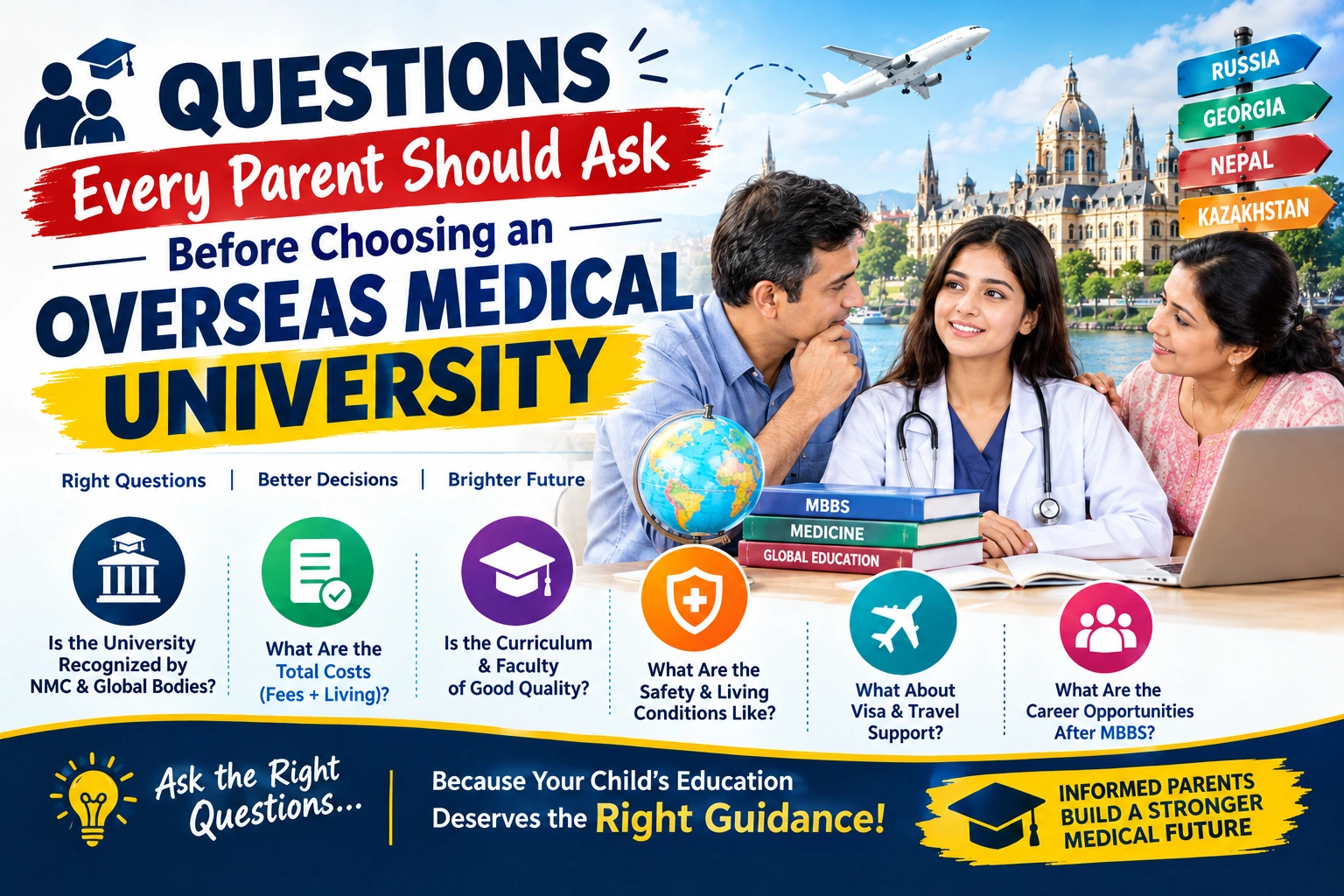
 Russia
 Belarus
 Georgia
 Kazakhstan
 Kyrgyzstan
 Uzbekistan
 China
China Nepal
Nepal Bangladesh
 Poland
 Romania
 Slovakia
 Hungary
 N. Macedonia
 Vietnam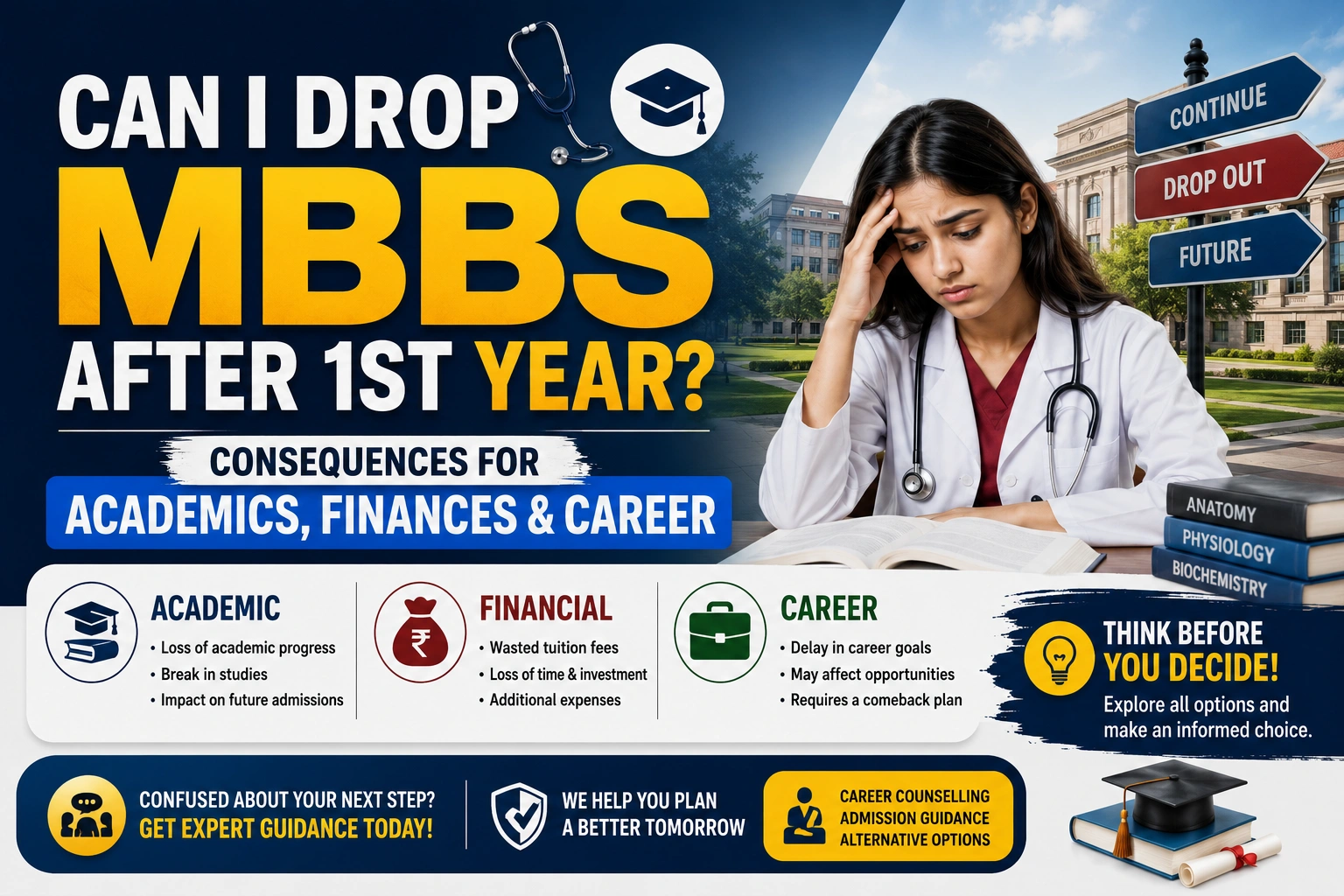
It is a common trend for many MBBS students to walk into medical school filled with excitement only for them to feel like quitting in the first twelve months. Switching from the normal school life to the MBBS program is extremely taxing. Therefore, it is common for first-year MBBS students to find themselves asking, "what happens if I drop MBBS in 1st year?" This question is indeed loaded with a spectrum of emotions, concerns and implications, including academics, family pressure, finances, and career pathways. Because of the irreversible nature of withdrawing from medical school, it is prudent to analyze the real-life implications of quitting medical school, the costs associated with your NEET and NEET Rank Predictor results if you decide to quit, and what options you have if you feel stuck and are uncertain if quitting medicine is the right decision.
This article explores the actual impact on your academics, finances, and career if you quit MBBS in the first year, based on factual information and not empty threats. This enables you to make the best decision possible for your future
Why Do Students Want to Drop MBBS After 1st Year?
Some short causes and some long causes lead to the situation you are asking about. The first year is the most difficult for MBBS students as this is the year that students go through the toughest adjustment period.
To start with, the academic burden is severe. Anatomy, Physiology and Biochemistry involve scales of memorization the students have never encountered, and the volume of dissections, practicals and viva exams is overwhelming in the first few months. Many students who used to be the top in their school struggle to pass the internal assessments, and this negatively impacts the self-confidence of the student.
The combination of homesickness, the stress of adjusting to hostel life (especially for students who are in an MBBS program in a different country or in a different state from their home), anxiety caused by the climate and food of the new country, and living with new people can cause depression and anxiety that students often misattribute to poor career choice. Financial concerns where families take out loans or sell their belongings to fund the student's private or foreign medical education adds to the stress the students feel because the families expect a return on their investment through the students' successful medical careers.
Some of these students do recognize that perhaps medicine was never their first choice. It could have been things like:
- Family expectations
- Friends' decisions
- The amazing feeling of introducing themselves with the title of "doctor" before their names
And after realizing the struggle of seeing cadavers, learning things that have little relevance to them, and long shifts, they understand their choice doesn't match with their expectations.
The Academic Aftermath of Leaving Med School After Year 1
Leaving medicine after just one year goes far beyond the concept of just having to "start over" by losing a year. It is of utmost importance to clearly understand the academic side of this before you make any moves.
What Happens to Your Admission and MBBS Seat
When you withdraw from any MBBS course, your seat will, depending on the time of your exit from the MBBS course, be made available to the counselling agency or the college. If this happens after that year’s counselling, the seat will, in most cases, remain unoccupied or will be transferred to some other round for a new candidate, and there will be no way to "return" and get that seat back. This is completely different from taking a break from studies; this is a complete exit from the medical education system for that admission cycle.
If your goal is to redo NEET to apply for a different course, college, or even relocate to a different country, you will have to apply for NEET UG from scratch. Since your previous rank and admission were directly associated with a seat that you have now vacated. This is the time to be creative with the options you have. The NEET Rank Predictor tool is an example of a platform that may help you understand which score you need to achieve in order to gain admission to a seat of preference for the next academic year. You will be able to make an informed decision rather than relying on your emotions and making a decision that is not based on logic.
Starting from the Beginning vs Determining If You Are Able to Complete the Remaining Year
If you have ever had to deal with academic realities, you learn that in general, when it comes to MBBS, academic credits do not transfer as they may through other academic programs. When a student drops out and later wants to pursue the MBBS program again, whether they decide to do so in India or through the MBBS route abroad, they will have to start the first year again. There is no skipping or using the excuse that a year of the program was completed elsewhere. The MBBS program is a heavily regulated program, and the organization that regulates the program and sets the standards for medical curricula have established that there is a break in the program. Students will not be allowed to proceed to the graduate entry to the clinical years of the program.
Regulatory rigidity is a problem because medical training is done in a series of steps. Year 1 of medical school is spent learning Anatomy and Physiology, which provide a foundation for Pathology and Pharmacology, which together support the clinical rotations. A gap or a break in medical training disrupts this chain. It is for this reason that the NMC has established rigid continuity policies in regards to the MBBS programs offered in India.
Recognition Issues If You Switch Countries or Colleges
If you quit your MBBS program in India and decide to restart it in another country, or the other way around, your medical degree will likely not be recognized, for the purpose of your future licensing examination and right to practice. If students are considering legitimate medical schools in India or elsewhere, they should check to see if the school is listed in the WDOMS (World Directory of Medical Schools), as a valid school of medicine recognized around the world. If students neglect to take this verification seriously, then they will face significant issues in the future when they apply for internships and licensing and when they register to practice.
The Financial Impact of Dropping MBBS After 1st Year
Without a doubt, money is a huge issue when considering quitting the MBBS program in India. It needs to be carefully and honestly addressed as part of this process.
Fees Previously Paid
MBBS programs incur high fees, and a lot of first-year fees typically become non-refundable after a specific period of attendance. Medical colleges not only in India but abroad as well, have strict refund policies and once withdrawal deadlines pass, families must bear the loss of tuition for the entire year, as well as the hostel fees and other costs, including fees for the library, the lab, and the exams.
It is even worse for families that have to take loans to pay for MBBS abroad. Loan repayment starts immediately even if the student has withdrawn from the MBBS program. The debt remains but the student will not be able to earn any income, because they are not going to be a doctor.
The Cost of Starting Over
If a student drops out of medical school and then attempts to join medical school again after some years, that student will be paying for the first year of medical school twice. Once at the school where they dropped out and again at the new school. This would likely be combined with a new NEET attempt, potential coaching for another year, and if the student decides to go abroad to study medicine again, there will be new application, visa and migration costs. All of these costs combined are much greater than the costs of staying in school for one more year and getting the much-needed support.
Opportunity Cost
There is an opportunity cost associated with this too. Each year spent not working as a doctor is a year where the student will not earn a medical salary to start paying back loans. There is also a longer wait to achieve financial independence. This also delays financial plans for families that are hoping to be financially secure after the student starts working as a doctor.
The Impact of Leaving Medicine Early
The farthest reaching impact of this decision are the professional consequences because they impact not just the next few years but also the remainder of the entire profession.
Re-Entry Into Medicine Later in Life
For many who dropout after their first year of med school, returning to a career in medicine happens after another NEET attempt the next year, or through MBBS abroad. The option to re-enter the field does exist, and it's what thousands of students attempt to do year after year. The process takes a lot of dedication as you face NEET competition on what could be viewed as a level playing field with significantly younger aspirants.
During this process, tools like the official NEET information page and the NEET Rank Predictor can help you formulate your goals based on the score you are projected to get, preventing you from applying to colleges and countries that are statistically out of reach, and helping you be realistic in what is possible instead.
Switching to a Non-Medical Career Path
For those who are certain they do not want to pursue a career in medicine, switching to a new career is possible, but comes with a significant time cost. The first year of an MBBS is a professional degree that cannot be transferred, so students who pursue a new career after first year do so with no formal credits in that new field. The first year of MBBS provides a strong foundation in discipline and builds on biology knowledge which is certainly not a waste.
Before deciding on a big life change like leaving medical school, it is important to have open discussions with your academic advisors, your family, and even practicing doctors. In the first year of medical school, you may think that you hate being in the field, but it could be a result of other stressors like a difficult hostel, homesickness, or other challenges. More often than not, it is not actually a bad fit with the field of medicine.
Future Registration and Licensing
If a student drops out to complete their MBBS degree in a different school, that student will be required to go through the same registration and licensing procedures as other graduates of that school. For students who study MBBS in other countries, they must ensure that the medical school that they are studying in is listed in WDOMS and will be recognized by the Indian NMC so that they can practice medicine in India, as students with foreign degrees must pass India’s medical licensing exam. Medical education standards are not the domain of one country, but are also governed by the WHO, which has also established directories and standards for medical school recognition.
Questions to Consider
Leaving school is a big decision that you will have to live with for the rest of your life, whereas the challenges you are currently facing are temporary and the result of a lack of self-confidence. Consider the consequences thoroughly before you make such an important decision.
Contemplate whether the struggle involves a permanent situation, such as medicine as a career, or an easily alterable situation, such as:
- A difficult roommate
- A nasty professor
- Homesickness
- A class you just have yet to find the correct study technique for
Many first-year struggles disappear by the second semester when students have acclimated to the pace and workload.
It is also helpful to talk with seniors who felt the same exact way in their first year and who eventually persevered. Because of their difficult first-year, the struggles will be helpful in providing guidance to cope with the first-year struggles that you are currently facing.
It is a good idea to talk to a college counselor or mentor before you formally request a withdrawal, because many colleges offer support that includes tutoring and other interventions, or even a leave of absence that is less permanent than a full withdrawal. You may also want to include your family in an open, non-judgmental conversation about how you feel emotionally, as well as the financial impact, because they are often part of the investment and, it is often the case that a shared decision creates more stability than one made in a moment of impulsiveness.
Exploring Alternatives Before Total Withdrawal
If the primary issue is stress related to a particular class, then the addition of personal tutors, a peer support study group, or revision programs may lead to improvements of the situation within the next one or two semesters.
If the problem is more of a personal fit to the institution or country of study, then some students may prefer to transfer rather than fully resign. This requires some assessment to ensure that the new institution recognizes the courses and allows for the transfer of the study credits. If someone is contemplating a move to the international medical study route because the present setting is not tenable, then the available options, especially the resources in the MBBS abroad guide, may indicate if a new country with a different style of the medical program and a different campus may help alleviate the dissatisfaction without a complete restart in the medical studies.
If you do not find any of the options acceptable and you do not think you want to practice medicine, you will not get any argument from us. As long as you acknowledge the academic, financial, and personal consequences of your decision, it will be better to leave the field of medicine than to keep studying medicine for another five years if that is what you truly think will make you happy. Just make sure that you know the consequences before you act on a temporary low.
Various options like learning about NEET preparation to attempt it again, estimating scores with the NEET Rank Predictor, and choosing domestic or MBBS abroad options are available to students who are still in doubt and want to learn about their options. Seeking guidance from MBBS Advisor can help to convert a very confusing decision to a detailed and defined decision.