
 Russia
 Belarus
 Georgia
 Kazakhstan
 Kyrgyzstan
 Uzbekistan
 China
China Nepal
Nepal Bangladesh
 Poland
 Romania
 Slovakia
 Hungary
 N. Macedonia
 Vietnam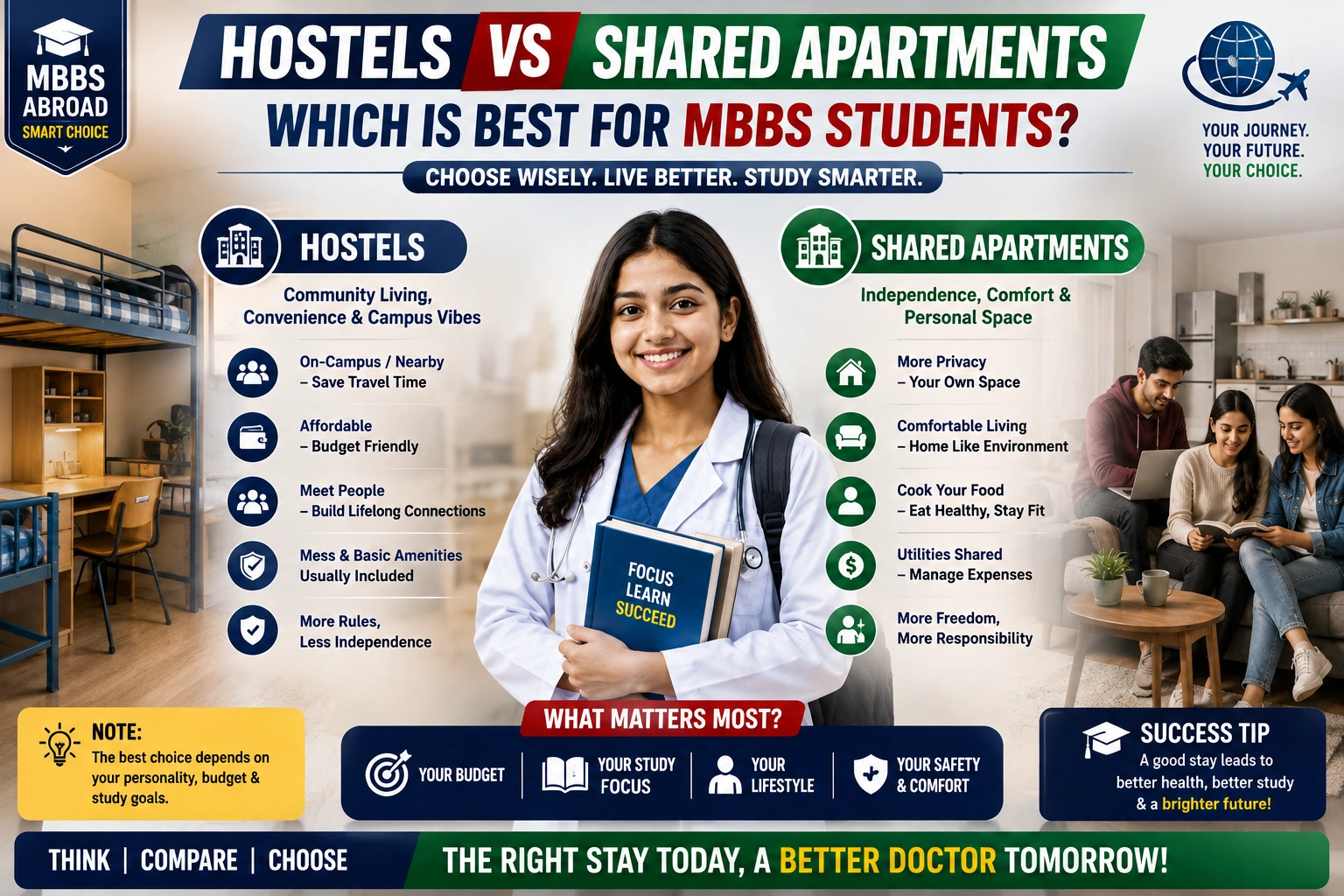
The type of accommodation a student decides on plays an integral role in shaping their overall education experience. A decision about how and where to study abroad does not only focus on finding a place to stay. Students must consider the impact it will have on their studies, their wellbeing, the expenses involved, and how safe it is.
Many students who plan their medical studies overseas through MBBS Advisor often ask about the advantages and disadvantages of living in a university hostel vs shared apartments.
Students studying MBBS Abroad should research the pros and cons of living in a hostel vs an apartment because it is a new environment to them.
Understanding Hostel Life and University Accommodation for MBBS Students
University hostels are the most common types of accommodations offered to students studying medicine abroad. Most international medical universities offer university hostels to Indian and other international medical students. Most universities try to house their students near campus to make it easy for students to attend lectures and clinical postings.
Most hostels are located nearby or on campus and, therefore, students do not have to take long trips to attend their classes and attend clinical postings. Additionally, for students of the MBBS program, it is quite important to stay nearby as the program is often demanding.
Hostels listed in global medical education databases often offer on-campus housing to international students. International students can choose between fully-furnished rooms with a mess, Wi-Fi, common areas, and security.
Hostel Advantages
The main advantage of hostels is convenient accessibility. Hostels are located next to classrooms, labs, libraries, and hospitals.
Hostels fasten the acclimatization process of students to a different country or city. Cultural, language, and social adaptation are extremely difficult and challenging for many international students. Hostels provide students with a supportive community where new friendships and a feeling of safety can be easily established.
Another main advantage is safety since most habitable universities have security, entry control, and oversight systems. Most of the parents send their children to hostel studies because of the safety concerns that remote studies have.
Hostel rooms are usually much cheaper than leased apartments. Universities have special facilities for students to hostel. As a result, the prices are low and rooms have basic infrastructure.
Residential and competitive studies for the FMGE and MCI exams would be easier in a hostel. Each student can focus on his own competitive studies while groups can study and share learning resources.
Challenges of Hostel Life
Hostels provide a lot of aid to adjust in big cities, but they come with challenges too. One of these challenges is lack of privacy. Students are often accommodated in a room with multiple roommates, disturbing their devoted study routine.
Another challenge is the lack of personal freedom. There are hostel rules that embrace rigidity, and different universities have different hostel schedules for visitors, entry, etc. Students do not prefer this.
Food often becomes an issue for Indian students studying abroad. Most universities have mess facilities, but many universities do not have Indian food.
Differences in lifestyles and inconvenience from having roommates can cause issues in concentration. First year MBBS students have to study long hours to develop their concentration.
Understanding Shared Apartment Living for MBBS Students
Shared apartments are a more independent option for MBBS students, after they get used to the city. Unlike hostels, shared apartments offer more flexibility and independence. Roommates can be hand picked, and routine can be easily adjusted to fit their preferred lifestyle.
For many students studying MBBS after clearing NEET, shared apartments are preferred because of the independent lifestyle offered hassle free.
The Benefits Of Shared Apartments
Having your personal study area and a private space of your own is the primary benefit of shared apartments. This is especially nice if you've been in a hostel before. Shared apartments provide more flexibility when making your own plans as you're not as restricted as you are in a hostel. You have more freedom to create your own ideal routine and lifestyle plan, as well as being able to prepare your own meals.
Another large benefit shared apartments have over hostels is the cost. If you get a shared apartment with 2-3 classmates, you can split the cost of food, utilities, and Internet. In some places, this is way cheaper than staying in a hostel.
Shared apartments also help you learn to be an independent adult. Being able to take care of payments and responsibilities like chores helps you learn how to live on your own.
The Challenges Of Shared Apartments
Even with all the benefits, living in shared apartments is not without its cons. You have more responsibilities like making sure the apartment is cleaned and chores taken care of as well as paying the bills.
If you're moving to another country for the first time, safety is definitely going to be a concern. Private apartments don't always offer the same security systems and student services that university hostels do.
The additional cons of a shared apartment includes the location. Having to compare everything like how close it is to your university and how affordable the transportation is, to how safe the neighborhood is and the length of your lease is a huge burden.
And of course, you and your shared apartment roommates are bound to run into conflicts. Because of differences in people's habits, standards of cleanliness, and various disagreements over how to share responsibility, you and your roommates will face conflicts of interest.
Hostel vs Shared Apartment: An Extensive Analysis
Cost Analysis
Hostels tend to be easier to predict in terms of expenses since costs are typically fixed by the universities. Hostels may even include utilities like electricity, water, internet, and security.
Although shared apartments may appear cheaper, costs such as deposits, utility bills, groceries, maintenance, and transportation create additional expenses for students.
Safety and Security
University managed hostels are safer since they are equipped with security personnel and systems. Furthermore, security is enhanced by campus wide monitoring and student registration systems.
In shared apartments, safety and security rely on building management and the location. Students should thoroughly review safety before making a rental decision.
Privacy and Independence
Greater privacy and more independence are afforded by living in an apartment when compared to living in a hostel.
While hostels lack privacy, they promote a stronger sense of community among students.
Academic Environment
For many students, the first year of the MBBS program is the first time they will study abroad. Many of these students prefer living in hostels since it offers them greater interaction with classmates as well as seniors. It improves the students' ability to participate in group based learning.
While student apartments may be more quiet, students must develop self-discipline to help them maintain and participate in their academic activities.
Which Option Is Better for MBBS Students?
There is no clear answer as the situation of each student is different. For many students studying abroad for the first time, especially the first year MBBS students, the university hostels are truly the safest and overall most convenient option out of the two.
New students strengthen their transitions from their home country's new academic and cultural environments with support of the hostels on campus, and engagement with their newly formed international peers.
Those students who appreciate independence might favor a shared apartment once they familiarize themselves with the new surroundings.
Students should always scrutinize Universities that waive international recognition and professional standards of medical practice and education by reviewing information available on reputable sources such as the NMC and the WHO.
Additional Information
WDOMS provides information related to medical schools and their listings.
Tips for Indian Students Doing MBBS Abroad
Before traveling for your MBBS, students should review foreign accommodations and ensure that the hostels are adequate and safe. They should review the availability of food, room-sharing policies, and the hostel's internet and transportation.
One should consider the cost of living, not just the cost of accommodations, when budgeting. The NEET Rank Predictor is a useful tool to help students plan their journey as it provides real-time data on the cost of medical study and living abroad.
The current students living on campus are the best source of info on living expenses, and accommodations so students should not hesitate to reach out.
Conclusion
Graduate students love the security and student focused environment of a hostel, and postgraduate students appreciate the privacy and independence of a shared apartment.
Generally, the first option in accommodations for Indian students going abroad for the MBBS is typically a hostel. Because of the nature of international MBBS, students usually shift to a rental apartment after they trust the environment.
TL,DR: All these factors, financial, emotional, academic, etc., are what you need to consider when you make this big decision.
When students make a choice of the accommodation that will serve them best, the rest of the MBBS journey is smooth and a success.