 Russia
 Belarus
 Georgia
 Kazakhstan
 Kyrgyzstan
 Uzbekistan
 China
China Nepal
Nepal Bangladesh
 Poland
 Romania
 Slovakia
 Hungary
 N. Macedonia
 Vietnam
 Canada
 Armenia
 UK
UK Australia
 USA
USA Ireland
 Germany
 New Zealand
 Italy
Italy France
 Singapore
 Netherlands
 Sweden
 Switzerland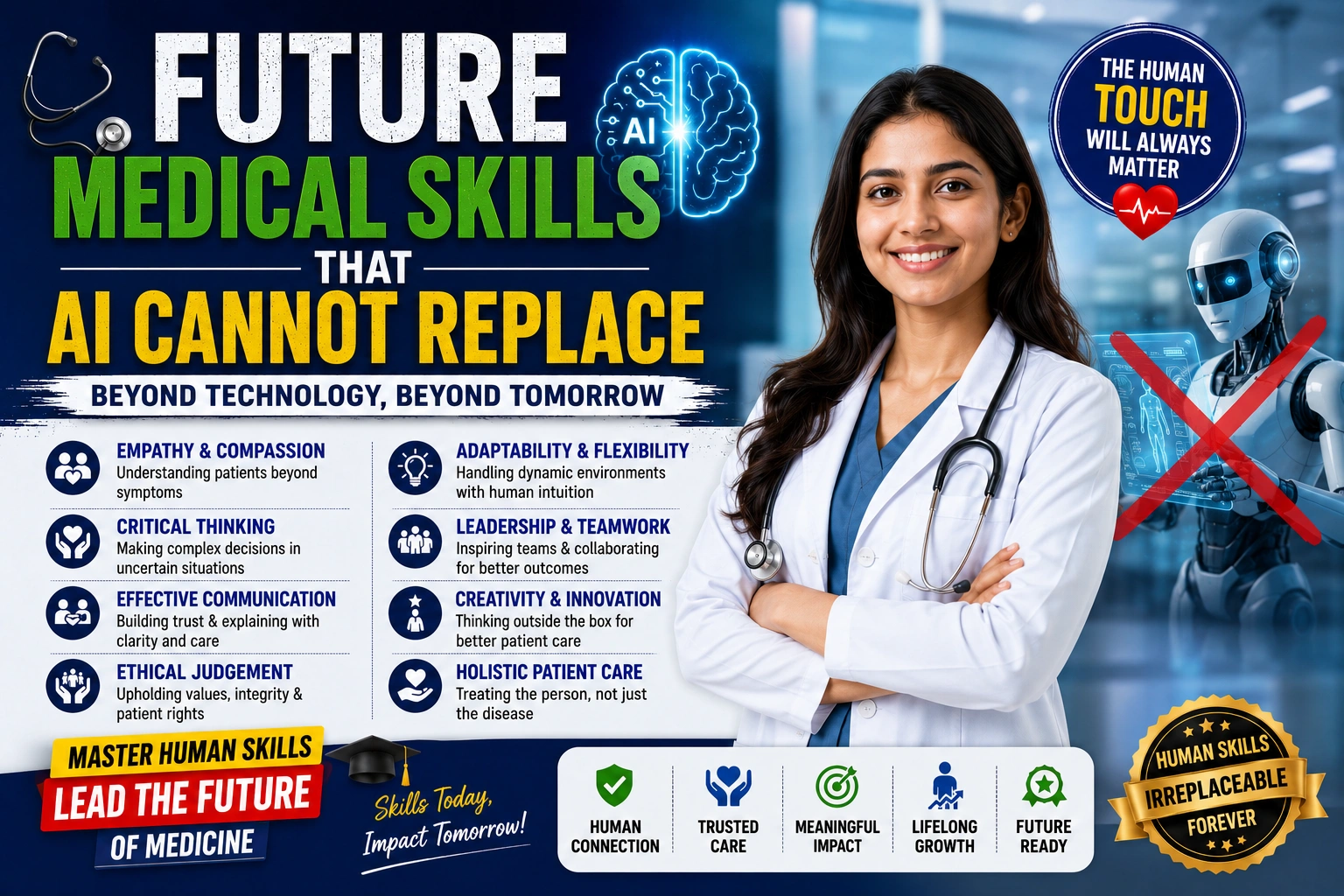
AI is revolutionizing healthcare in real time. He currently assists with diagnosis, interprets images, and predicts the effectiveness of various medical treatments. Many medical students and aspiring doctors wonder if AI retrieves the need for a professional medical practitioner altogether with the advancements on the assistant. Although AI is a useful and a growing tool to aid the healthcare system, there are a number of medical skills which are fundamental and are not replaceable.
If you are an aspiring medical professional and you are using MBBS Advisor, or if you want to Study MBBS Abroad, you will need to know what skills will not be replaceable by means of AI. Finally, doctors of the future who will combine their medical knowledge with empathy, communication, and a robust ethical framework and excellent clinical judgment will continue to be needed and will be very much in demand.
The Impact of AI on Today’s Healthcare System
Healthcare systems around the world are using AI to improve patient outcomes and reduce errors in diagnosis. AI can analyze countless medical records, find new and hidden patterns of diseases and suggest various treatment pathways to assist the doctor in making an informed and expedient diagnosis. It is common practice for hospitals to incorporate AI/ML technology in Radiology, Pathology, Robotic Surgery, Drug Discovery, Patient Monitoring, and Administrative Tasks.
The AI in healthcare revolution has been endorsed by the World Health Organization (WHO). While AI reduces efficiency in healthcare, AI lacks ethical reasoning and the human element in a medical practice.
Healthcare professionals and aspiring doctors preparing for NEET need to understand the dynamics of the future of healthcare, which will integrate both human skills and technology.
AI Will Assist Doctors, Not Replace Them
Most people think AI will make doctors obsolete. On the contrary, AI works optimally when paired with experienced and trained healthcare workers. Machines are outstanding at data processing and analysis. Data is only a fraction of healthcare.
Healthcare workers take into account a myriad of variables such as the patients’ psychological and social situations which are critical when making treatment decisions. Machines are inherently limited to data and cannot process the complexities of a person’s social situation or value.
There is an ongoing revolution in medical training as well. Some institutions have incorporated AI into their teaching and have continued to prioritize the teaching of clinical examination and ethical reasoning as well as the human aspects of healthcare.
The Future of Medical Skills AI Will Not Compete With
Emotional Intelligence and Empathy
Empathy is one of the most important attributes a doctor can have. Being in the hospital is a difficult experience for patients and their friends and families. What patients want most are care and support, not simply the prescribing of a medication.
AI is capable of generating sympathetic sounding responses, but AI is not capable of being empathetic. Emotional intelligence, such as comforting a family after a serious diagnosis or supporting a terminal patient, is beyond the scope of AI.
This bond between a doctor and a patient builds trust and improves compliance while also reducing the patient’s anxiety.
Critical Thinking in Complex Situations
The field of medicine is complex and the practice of medicine is even more so. It is highly unlikely that a clinician will encounter a case that is perfectly textbook. It is normal to find a patient presenting with multiple concurrent conditions.
The best doctors are able to combine many elements for an accurate diagnosis (i.e., past cases, physical exams, intuition, etc.).
Artificial Intelligence relies on available data, so it will rarely provide an accurate diagnosis on uncommon diseases. In most cases, doctors use experience and critical thinking to diagnose those problems.
One of the most essential of those skills is judgement.
Good Communication Skills
The foundation of the practice of medicine is communication.
Doctors have to explain what they found, how they are going to treat it, and what the patient will have to do to change their lifestyle. Doctors have to talk to nurses, specialists, and family members in an emergency.
Good communication requires:
- the ability and willingness to listen,
- emotional awareness,
- patience,
- flexibility
- possess the ability to explain things differently to children, the elderly, and the educated professionals.
AI is unable to interpret things like body language and the unsaid.
Ethical Decision-Making
Healthcare has many unsolvable dilemmas.
Doctors have to make many ethical decisions, such as:
- how to provide end-of-life care,
- transplant decisions,
- maintaining patient privacy,
- how best to utilize limited resources,
- who to keep on life-support,
- who gave consent, and
- who has the right to withdraw support.
The NMC backbone of the practice of medicine is ethics.
These decisions require a balance of science and compassion. AI has a grave lack of both.
Leadership During Medical Emergencies
During emergencies, doctors often lead multidisciplinary teams under extreme pressure.
When dealing with trauma, cardiac arrest, natural disaster and even pandemic cases, physicians have to be able to:
- Quickly assess and value their patients.
- Make swift decisions.
- Form and maintain healthcare teams.
- Explain things to, and help ease the minds of, the patients’ families.
- Acquiesce to unforeseen circumstances.
AI will give recommendations, but to assume leadership, one must be human, and so the accountability.
Building Long-Term Doctor-Patient Relationships
Patients are accustomed to following up with the same physician for extended periods of time; family physicians even know about the patients’ and their families’ psychological and social histories.
This prolonged relationship allows physicians to know and even detect the patients’ subtle negativity, and it even helps with the patients’ preventative healthcare and the patients’ personal compliance.
Trust is built through constant and repeated human interaction over time, something machines are unable to facilitate.
Practical Skills and Clinical Experience
Physicians also need to have numerous skills, both practical and clinical. These skills cannot be taught, and even when they are, a great part of the learning process is through constant and repeated personal experience.
While the field of robotics and robotic surgery is improving, Humans will still be needed to plan procedures and deal with complications and even make decisions in real time.
Creativity and Problem Solving
There are many medical problems that do not have an answer; even when looking at a patient’s unique needs, an answer can be difficult to impossible to find. Conventional problem solving still gives ways to formulate and implement new strategies for treatment.
Unlike AI, which relies on following data and set patterns, it is human imagination which helps create many of the treatment strategies that we view as breakthroughs.
Creative and critical problem solving are important at the same time and a great deal of healthcare decisions depend on many varying and often conflicting factors as well as thoughtful consideration of culture and value systems.
Cultural Awareness
Doctors should have an awareness of:
- Religious beliefs
- Dietary practices
- Language barriers
- Family dynamics
- Social customs
Providing culturally sensitive care requires an understanding of humanity that AI cannot replicate.
Lifelong Learning and Adaptability
With the introduction of new research and therapies, medicine will always be a developing field.
Successful doctors are lifelong learners who:
- Read updated medical journals
- Attend and/or participate in medical conferences
- Keep updated on clinical guidelines
- Learn new techniques/procedures
- Learn about new and/or emerging diseases
While AI can summarize new medical information, it is up to physicians to determine how new information impacts a particular patient.
How AI Is Going to Change the Future of the Role of Doctors
AI won’t replace doctors; AI will change the practice of medicine.
In the future, the practice of medicine will require much more collaboration between humans and AI technologies that will assist in:
- The interpretation of medical images
- The management of electronic health records
- Prediction of diseases
- Clinical documentation
- Drug interactions and personalized treatment
- Remote monitoring of patients
The doctors who understand AI tools will be able to offer more precise and accurate care in a timelier manner. Patient safety and ethical care will always be the responsibility of a human.
Why MBBS Students Should Learn Both AI and Clinical Skills
Medical students who are doing an MBBS today will be working in an AI-based health care system. Digital literacy will be as important as learning anatomy, physiology, and pharmacology. It is important for students to learn the:
- Basics of AI and its use in the health care field
- Communication skills
- Clinical skills
- Medical ethics
- Leadership skills
- Evidence based medicine
- Clinical skills
- Patience centered practices
After the NEET exam, students can use the NEET Rank Predictor tool to predict their admission chances. Students doing research on international education are encouraged to look into MBBS Abroad to learn more about globally recognized universities, admission criteria, eligibility, and future career prospects.
Before picking a medical university, students should ensure recognition in the World Directory of Medical Schools (WDOMS) and check for the most recent recommendations given by the National Medical Commission (NMC). It is just as important to keep track of official announcements regarding the NEET exam since the NEET exam is still a requirement for Indians looking to pursue MBBS in India as well as abroad.
Conclusion
AI is transforming the landscape of healthcare, but it is not replacing doctors. It will, however, improve doctors' clinical decision-making, efficiency, and, indirectly, outcomes. There are many important factors that define great doctors, such as empathy, ethics, communication, leadership, clinical judgment, creativity, and compassion, all of which are highly valued and will always be beyond the reach of algorithms.
Rather than a threat, aspiring doctors should see AI as an opportunity. The future of healthcare will belong to those who possess advanced technology along with the ability to integrate clinical skills and reason with compassion. It does not matter the stage of your planning, whether it is the MBBS Advisor, MBBS Abroad, or NEET preparation, there are always skills you can develop that will be highly valued and in demand in the future.