 Russia
 Belarus
 Georgia
 Kazakhstan
 Kyrgyzstan
 Uzbekistan
 China
China Nepal
Nepal Bangladesh
 Poland
 Romania
 Slovakia
 Hungary
 N. Macedonia
 Vietnam
 Canada
 Armenia
 UK
UK Australia
 USA
USA Ireland
 Germany
 New Zealand
 Italy
Italy France
 Singapore
 Netherlands
 Sweden
 Switzerland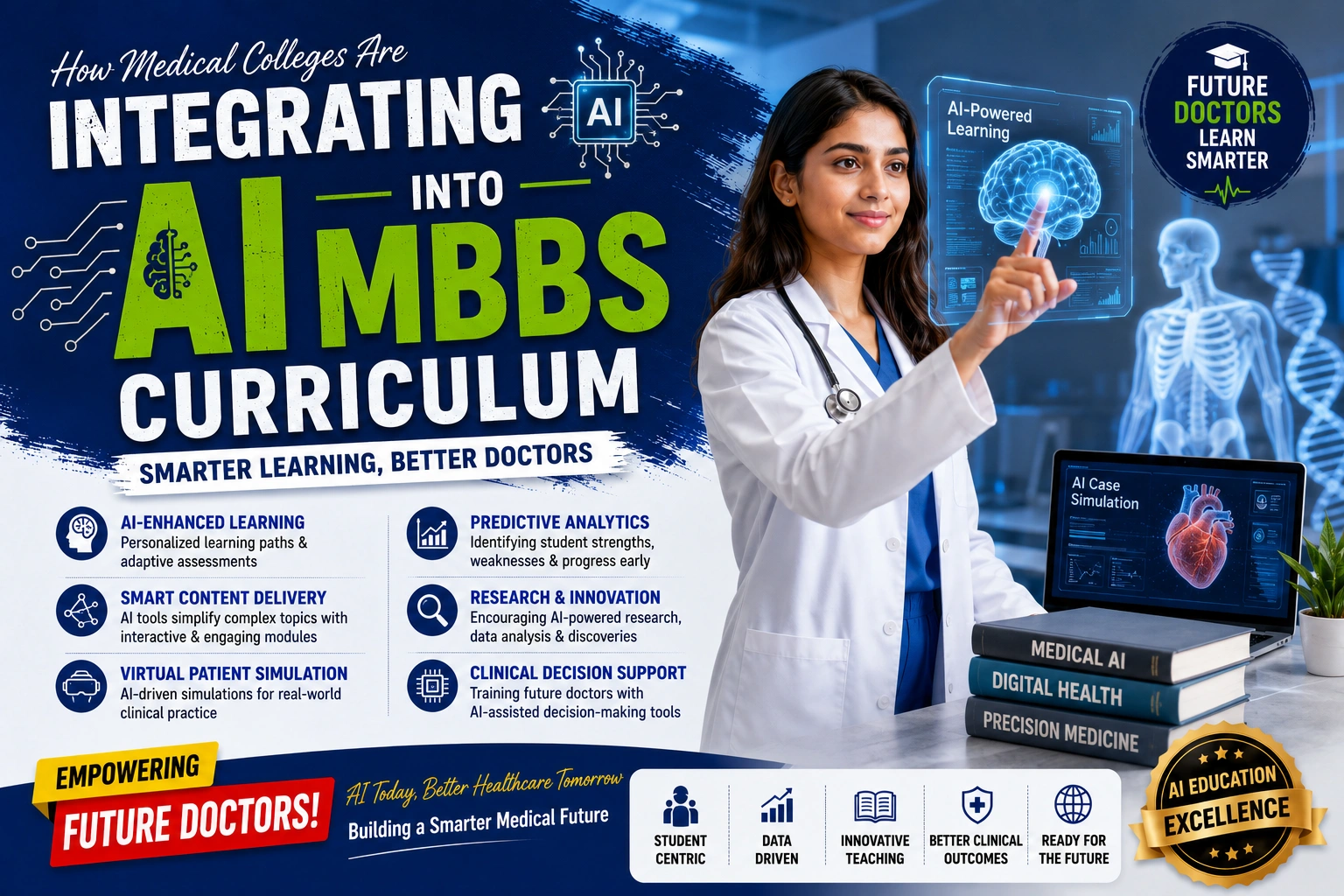
With AI rapidly advancing, so does its place in modern healthcare. AI-powered diagnostic systems, virtual patient simulations, and a multitude of other technologies are becoming integrated into medical learning frameworks. Medical colleges are trying to equip their students to become practitioners in a healthcare system driven by new technologies. AI might not substitute the need for human doctors; however, it can play a significant role in enhancing the quality of clinical decisions, medical research, and improving the management of medical conditions.
An influx of digital healthcare, CBME and tech innovations have catalyzed the infusion of AI in the medical education framework of India. This is showcased by the presence of AI in workshops, electives, simulation labs, research, and trans-disciplinary education. In India, AI is not a standalone compulsory subject yet at the MBBS level. However, there are a lot of discussions and pilot projects on the integration of AI.
Those who are preparing to sit the NEET for MBBS should also be aware of changes AI is expected to bring to healthcare. MBBS Advisor is an online platform that gives access to the latest information about medical education, medical career paths, and current updates. Students can predict their NEET rank and assess their chances of admission before they undergo counseling.
Importance of AI in Medical Education
Daily, healthcare services produce an overwhelming amount of clinical data. Doctors are beginning to depend on AI-based systems to analyze the plethora of medical data that drive clinical services. Medical colleges realize the need to teach AI to future doctors and are beginning to incorporate the teaching of AI as a core part of medical education.
AI complements medical knowledge and enables the recognition of disease patterns to assist in the diagnostic process and to make decisions in a timely manner.
Prior to beginning clinical practice, it is important for medical students to understand the strengths and weaknesses of AI. Recent studies on medical education indicate that students support the inclusion of AI in their experiential learning during undergraduate studies.
Applications of AI in Medical School Curriculum
1. AI-Based Learning Systems
Most medical schools are abandoning traditional forms of schooling for learning that employs intelligent digital systems to customize education. AI is able to assess how students are doing and struggling, and provide learning materials and create adaptive quizzes.
2. Virtual Patients and Clinical Simulations
One of the most significant advances in education is the ability to use AI for virtual patient models.
Students are able to interact with virtual patients who are able to represent and respond to a wide variety of clinically relevant symptoms. Students may pose clinical questions, create and order clinical tests, and make and practice clinical diagnoses with no harm to any actual patient.
Simulated learning is an excellent way for students to practice clinical reasoning in a safe environment. AI virtual patient models are able to expand clinical instruction for early years of medical education when there is limited time and access to clinical practice.
3. AI in Radiology Training
One specialty that AI is rapidly transforming and improving is Radiology. Medical education is introducing students to AI in the interpretation of clinical images including:
- X-ray
- CT
- MRI
- Mammography
- Lung Imaging
- Brain Imaging
Students are taught to understand how AI serves to enhance the visibility of concerning findings while recognizing that the responsibility of a clinical decision and diagnosis rests solely with the physician.
4. Digital Pathology and Image Analysis
Traditionally, learning clinical pathology required hours of examining and learning from microscopic pathology slides.
AI-Enhanced Digital Pathology
AI-enabled digital pathology is rapidly emerging in contemporary medical schools. Here software identifies abnormal tissue patterns and aids students in differentiating normal and diseased samples.
Pathology education is advanced, and diagnostic accuracy is enhanced significantly.
AI-Enhanced Learning of Anatomy
AI is further enhancing the interactivity of medical school anatomy classes.
Students are no longer limited to learning from cadavers and textbooks. They now have access to:
- 3D anatomical images
- AI-enabled virtual dissections
- Interactive organ maps
- Mixed reality labs
- Smart anatomy software
These innovations greatly further understanding and retention of anatomy.
AI and Clinical Decision Making
Medical schools are now teaching students about Clinical Decision Support Systems (CDSS).
CDSS:
- Evaluates patient data
- Suggests diagnoses
- Suggests medications
- Suggests treatment options
- Assesses risks
- Supports prevention
AI systems suggest courses of action, but the final decision is always in the hands of the medical professional. Medical training, judgment, and ethics are still pivotal roles when considering recommendations.
Introduction of AI for Medical Research
AI has enabled new avenues of medical research for undergraduates.
MBBS students are getting involved in research projects that:
- Build predictive models
- Analyze medical imaging
- Conduct research on medical records
- Discover new medications
- Surveil public health
- Practice predictive epidemiology
AI enabled collaborative research with engineering and computer science has provided students an advantage in their lateral and future academic pursuits.
AI and Medical Skills Labs
AI is taking medical simulation labs to an entirely new level.
Labs utilize smart mannequins that respond to clinical skills sessions and practice areas such as emergency scenarios.
AI also assesses the quality of interventions and skills demonstrated.
This greatly enhances the confidence of students when they do finally meet the clinical requirement to treat real patients.
Responsible Use of Technology in Medical Education
Medical schools have a responsibility to educate students on the responsible applications of AI.
Students are encouraged to appreciate the importance of:
- Patient confidentiality
- Safety and protection of data
- Bias in algorithms
- Accountability in a clinical context
- Consent in a clinical context
- Decision-making in a clinical context
- Medical ethics
The use of AI in medical education has to be aligned with the ethical responsibility to promote the welfare of the patient. The use of technology should never supplant the empathy and compassion that a medical practitioner must provide. The ethics of AI has already been recognized as an important element of the medical education system.
AI and Competency Based Medical Education (CBME)
In India, Competency Based Medical Education (CBME) has been designed to produce medical practitioners that are clinically competent and prepared for the application of technology with a strong ethical foundation.
Although there is no mandatory AI course as of yet, the current framework of CBME promotes digital education, simulation based learning, skill and competency based education and assessment. There are a number of initiatives that seek to introduce AI literacy courses in the foundation courses of MBBS.
Students have the opportunity to keep abreast of the advances taking place in AI in the field of medicine and health care by regularly visiting the NMC website.
AI in Healthcare and WHO
The WHO advocates for the ethical and responsible application of AI in Health to ensure safe, ethical, transparent, and AI systems that are aligned with the interests of patients.
WHO advocates for the use of AI in Health Systems to enhance the function of Health Systems and the protection of the rights of patients, privacy and confidentiality in an equitable Health System.
WDOMS
Students intending to study for the MBBS abroad must check if their preferred university is included in the WDOMS.
Recognition in the WDOMS is essential as it increases the international standing of the medical school and may qualify the graduates for other medical licensing examinations, based on the laws of that country.
Advantages AI Brings to MBBS Students
There are certain educational benefits of AI that will be present during a medical student’s training.
The following are some of the benefits:
- Access to medical literature will be faster
- Improved clinical reasoning
- Enhanced learning experience
- Better understanding of diagnostics
- Engaging practical training
- Better readiness for contemporary hospitals
- Increased opportunities for research
- Increased skills for evidence-based medicine
- Introduction to digital healthcare
- Improved collaboration skills
Most of these benefits will be useful to medical students during the training on the use of AI in healthcare.
Problems Caused by AI
Despite the advantages, some issues are associated with the integration of AI.
Most medical schools will need to upgrade their digital infrastructure, train faculty, improve the quality of their data, build simulation labs, and employ standardized AI teaching modules. Faculty will also need to teach students to recognize instances when AI results should be trusted and when clinical judgment should prevail.
The medical education community emphasizes that the use of AI will be a supplement to the physician-patient relationship, not a replacement.
MBBS Education with AI
For the upcoming decade, it will likely be commonplace to find AI incorporated into undergraduate medical education. Concepts of machine learning, the AI of clinical medicine, digital diagnostics, health informatics, smart forecasting in healthcare, and the controlled use of AI, will be taught.
Across the globe, many institutions are implementing AI-specific teaching modules for medical students.
For students who are in the preparation phase of their careers, it is essential to remain current and informed about these advancements. MBBS Advisor assists students and prospective medical students by providing news and guidance about MBBS admissions in India and abroad and providing tips on NEET, enabling students to gain relevant information about medical school admissions.
Prior to the counseling session, individuals can utilize the NEET Rank Predictor to approximate the likelihood of their admission and select appropriate medical colleges.
Conclusion
Artificial intelligence has been portrayed as a thing of the future, however, its presence is steadily being integrated to develop medical education and clinical practices. Through Virtual Simulations, Digital Pathology, simulations in Radiology, Adaptive Learning, research, and Competency-Based Medical Education, the medical colleges are including AI in their programs. The medical practitioners of the future will be required to have an extensive knowledge of medicine and an ability to use technologically advanced medical tools.
Developments in AI will impact the incorporation of new teaching methodologies in the MBBS programs. NEET students can understand the significance of these trends. Safer, quicker, and more tailored medical care is the aim of tomorrow’s doctors who will have the ability to integrate clinical practice with advanced technologies.