 Russia
 Belarus
 Georgia
 Kazakhstan
 Kyrgyzstan
 Uzbekistan
 China
China Nepal
Nepal Bangladesh
 Poland
 Romania
 Slovakia
 Hungary
 N. Macedonia
 Vietnam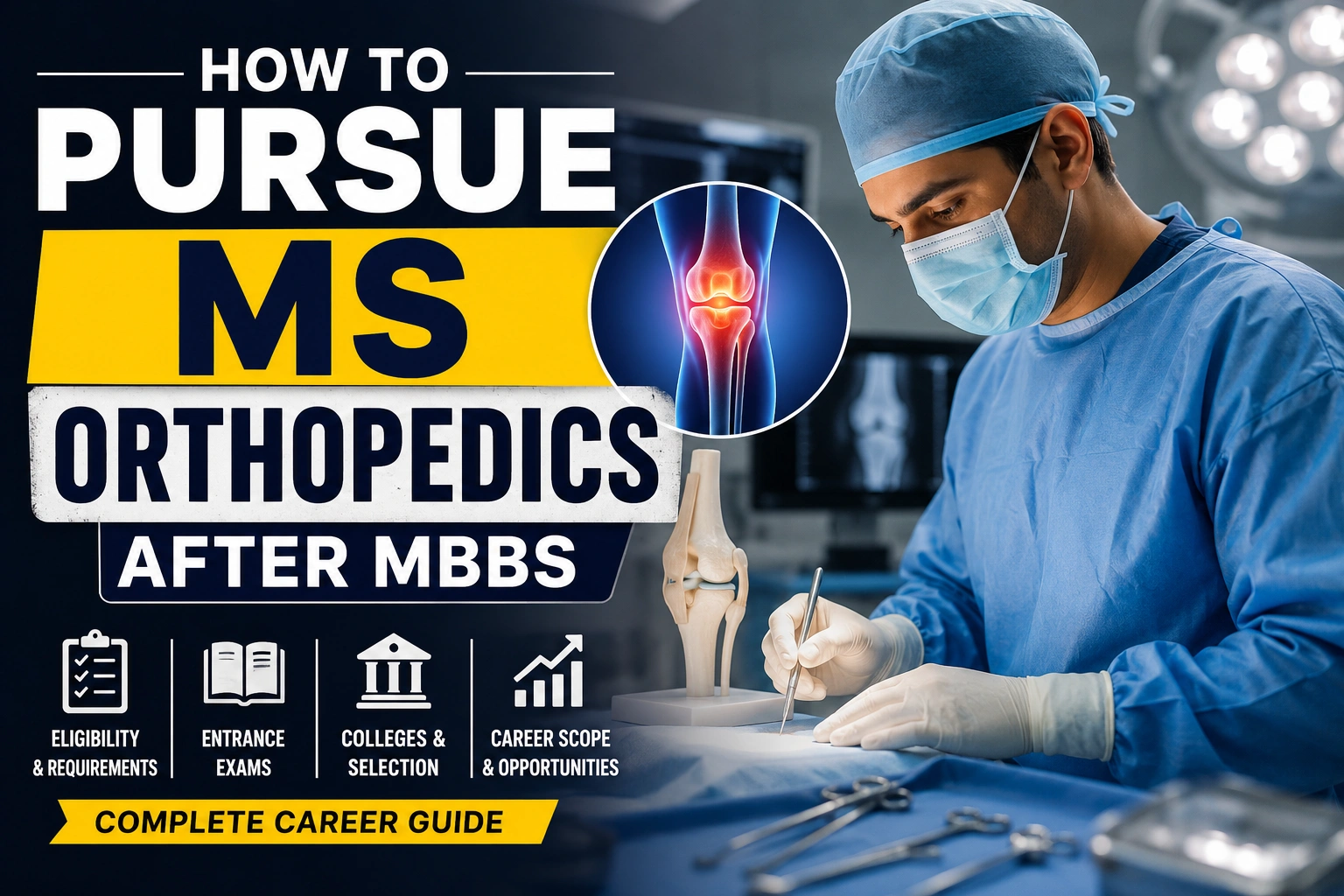
Orthopedic surgery is recognized as an elite and highly rewarding specialization in the Indian medical field. An increasing number of MBBS graduates aspire to MS Orthopedics in India right from their clinical postings. The increased demand for orthopedic surgeons has mainly come from the increasing number of cases related to trauma, sports injuries, and the demand for joint replacement and surgeries due to the aging population. These surgeons are in demand by corporate chains and hospitals, as well as private practice. Planning and executing a career in orthopedics is an elaborate task. It requires advanced planning, scoring in the top percentile in the NEET PG exam, and knowledge of the Admission procedures on the very first day of the Final MBBS.
This guide contains all the information related to MS Orthopedics that every MBBS graduate must be aware of, starting from eligibility, entrance examinations, and all the way to top institutions, course structures, and future prospects in terms of career opportunities. Before making a shortlist of interested colleges, check your predicted rank in NEET using an authentic NEET Rank Predictor. You should also consult an experienced admission counselor through MBBS Advisor to provide you with information on possible orthopedic PG seats based on your predicted NEET rank.
What is MS Orthopedics and Why Choose This Specialization?
An MS in Orthopedics is a three-year postgraduate degree that helps MBBS graduates understand how to identify and treat issues related to the musculoskeletal system. This includes the bones, joints, muscles, and ligaments, as well as the spine. The primary system of this specialty is trauma and fracture management, but this specialty also focuses on trauma and fracture management and pediatric orthopedics and spine surgery. This means that those in this residency can expect to perform both elective and unexpected surgery during their training.
Since procedural work is a major component of orthopedics, students who pursue this specialty can expect to spend a great deal of time in the operating room, as well as experience a high level of satisfaction from being able to help patients regain their mobility. Furthermore, this specialty provides students with many diverse career opportunities. This includes:
- A career in private practice
- Sports medicine consultancy
- Surgery
Eligibility Criteria for MS Orthopedics After MBBS
To be eligible for an MS in Orthopedics, students must have an MBBS degree from an NMC-approved medical college with the required one-year rotating internship. Postgraduate students should have a 50% pass mark for all the MBBS professional examinations. This may be relaxed for some reserved categories as per the government regulations.
Equally important as provisional or permanent registration with the State Medical Council or the National Medical Commission (NMC) before counseling, is the complete registration. Incomplete registration is the most common reason for last-minute disqualification during document verification. Aspirants should also keep other documents such as the internship completion certificate, MBBS mark sheets, and category certificates (if applicable), ready. Seats are confirmed after verification of all these documents.
NMC Registration and Recognition
Every stage of the career for an orthopedic surgeon in India is tied to the NMC, National Medical Commission. The NMC not only approves MS Orthopedics programs, but also controls the standards of the teaching faculty and the facility, and the infrastructure of the teaching hospitals, and how many seats they are permitted to have. Before applying to any college, it is better to see if it is currently approved by the NMC, to avoid situations where accredited colleges lose the approval for the NMC and result in the college of their choice being degreed and accredited, but worthless in practice.
Even beyond admission, NMC registration is what allows an orthopedic surgeon to legally practice medicine, prescribe, and perform surgery throughout India, once they have completed the MS. This registration and licensure must be renewed, and is the foundation of all professional activity an orthopedic surgeon will do throughout their career. Because of these reasons, one should never choose a college simply because it is easier to gain admission and has lower fees, at the expense of the college's recognition.
NEET PG: Accessing MS Orthopedics Through NEET PG
To enroll in MS Orthopedics in any medical college across India, be it a government establishment or a private entity, you will be required to sit for the NEET PG, a national-level postgraduate entrance examination conducted by the National Board of Examinations. Only a handful of autonomous bodies, for example, AIIMS New Delhi, and JIPMER Puducherry, have their own entrance examinations, the INI-CET. The rest of the country’s orthopedic seats, including deemed and government universities, will be available through the NEET PG and its subsequent counseling.
For candidates of NEET PG, orthopedics, being one of the most sought surgical branches, will have significantly higher cutoffs over several other MS and MD branches for the same college. For these reasons, the advisor will be required to offer their services to an applicant as soon as the NEET results are out, to assist the prospective student in determining whether they stand a realistic chance of obtaining a seat for MS in orthopedics from their college of choice or whether they should consider other colleges or other quota categories.
Step-by-Step Admission Process for MS Orthopedics
The journey to an MS in Orthopedics usually starts with NEET-PG registration for counseling after the results. Then, the options for preferred institutions and specializations in order of preference is done. After, the medical counseling committee and each state counseling authority conducts rounds of seat allotments at the All India Quota with several opportunities for contestants to improve their seat with preference during the allotment rounds.
After allotment, candidates get a provisional seat and must report to the institution within the given time, complete a verification of documents and pay the fees for confirmed admission. If candidates fail to report at the given time, the seat would be forfeited. MBBS Advisors provides the scheduling and rounds of the counseling which is helpful in conceding and confirming the orthopedics seat the fastest.
Top Colleges Offering MS Orthopedics in India
The high volume of surgical cases, experienced faculty, and good placement after residency are some of the main reasons for the preference of the candidates for the top institutions offering MS Orthopedics. These factors also justify their ranking among the consistently top institutions.
AIIMS, New Delhi, and PGIMER, Chandigarh
Public orthopedic surgery in India has two standards, and these two are arguably the best. They have solid trauma services and a decent amount of surgical exposure. The seats are fiercely contested, and only the absolute top scorers of the NEET PG or INI-CET can expect to gain admission.
Maulana Azad Medical College and Lady Hardinge Medical College, Delhi
These two state medical colleges provide good orthopedic training and decent trauma services and are good options for candidates with decent All India Quota ranks.
King George's Medical University, Lucknow
KGMU is one of the largest tertiary medical institutions in North India and provides good exposure to trauma and joint replacement for orthopedic residents.
Christian Medical College, Vellore
CMC Vellore offers a good balance between quality training and lower fees providing students with an excellent surgical training option with an affordable fee.
Kasturba Medical College, Manipal
KMC Manipal has a good orthopedics department thanks to good infrastructure, has a good training curriculum, and has a mix of management and state quota seats.
Madras Medical College, Chennai, and Government Medical College, Nagpur
These two medical schools have high case loads, high quality orthopedic education, and structured residencies but have accessible state-quota tuition.
MS Orthopedics Course Structure and Curriculum
The MS Orthopedics program spans 3 years and is divided into 3 phases. During the first phase, residents gain the essential concepts and skills required in the field of orthopedics. The first phase is characterized by intensive training in the areas of anatomy and biomechanics and basic principles of orthopedic surgery and theater skills. Residents begin assisting surgeons in the operating room but only under the direct supervision of the senior surgeon. By the end of phase 1, residents will have developed the requisite skills to begin functioning more autonomously during clinical postings.
By the third and final phase of the program, residents are expected to have developed sufficient competencies to perform all the major surgical procedures in the subspecialties of orthopedics, including pediatric orthopedics and sports medicine, and to carry out research. Residents are also expected to conduct research during the third phase. Residents are also evaluated based on their participation in academic rounds, presentation of clinical cases, and participation in formative assessments. Residents are required to pass the summative assessment in order to qualify for the MS degree.
WHO, WDOMS and Global Recognition for Orthopedic Surgeons
For orthopedic surgeons who may wish to pursue fellowships abroad, appear for international licensing examinations, or simply ensure their qualifications are globally recognized, institutional listing in the WDOMS database carries significant weight. The World Directory of Medical Schools is the internationally accepted reference used by licensing bodies in countries such as the United States, the United Kingdom, Canada, and several Gulf nations to verify that a medical degree originates from a legitimately recognized institution.
This directory function is rooted in standards that trace back to the WHO. The WHO historically kept all global medical school records in order to keep health workforce standards in check, until the responsibility was handed to FAIMER and the World Federation for Medical Education. For MBBS graduates aiming to potentially practice orthopedics internationally, enrolling in a college that is both NMC approved and WDOMS listed provides the assurance that their MS degree will be respected and will be verifiable, regardless of the country they choose to practice in.
Career and Salary Prospects after MS in Orthopedics
In India, qualified orthopaedic surgeons have an extensive variety of career pathways open to them. These pathways include full-time consultant roles within the government or the private/corporate hospital sectors, as well as practicing orthopaedics privately. Surgeons may also establish specialised clinics in sports medicine. Government roles within state Health Departments, Defence Medical Services, or Railway Hospitals typically provide job security, guaranteed promotions and pensions, and opportunities to work in rural or urban postings.
In contrast, private and corporate hospital roles typically include significantly better pay, especially for orthopaedic surgeons who develop a high level of expertise in increased demand surgical procedures, particularly joint replacement and arthroscopic surgery. Recently graduated MS Orthopaedics students can anticipate salaries in the several lakh range/year. The earnings of highly sought after private practicing orthopaedic consultants and surgeons typically also increase significantly over that time.
Super-Specialization Options After MS in Orthopedics
Once you have your MS in Orthopedics, further expertise can be sought by applying for super-specialization tracks via NEET SS, India's Super Specialty entrance examination. Popular choices can be seen with those wishing to undertake fellowships or pursue M.Ch or DNB programs in spine surgery, joint replacement surgery, pediatric orthopedics, hand surgery, and sports medicine. Each option helps produce an even finer practitioner to certain segments of the musculoskeletal system.
A considerable number of surgeons also undertake international fellowships in arthroscopic surgery, trauma surgery, and robotic joint replacement surgery. These fellowships enhance the competencies of surgeons and considerably strengthen their professional profile to obtain senior consultant roles or positions in academia. Those interested in a consulting role combine their work with a role in a medical college, engaging in research as well as shaping future orthopedic surgeons.
Tips to Crack the NEET PG Exam for Orthopedics
The field of orthopedics is arguably one of the most competitive of all the surgical branches during NEET PG counselling. A solid and well-timed preparation strategy matters as much as knowledge of the subject. Begin your preparation during your internship and focus on high-yield topics on orthopedics and also revise other surgical subjects, as the NEET PG exam is not orthopedics centric.
Once you receive your results, for a realistic appraisal as to which colleges and quota categories you are likely to secure an orthopedics seat at, based on your rank, use a data-based NEET Rank Predictor rather than looking at last years' cutoff trends as those might not be applicable for this admission cycle. During the counseling process, registering for both the All India Quota and your home state’s counseling simultaneously increases your chances of success. MBBS Advisor can help you avoid the common mistake of panic registering for a lower preference seat by tracking multiple rounds of counseling and comparing colleges to help you make an informed preference choice.
Conclusion
Becoming an MS in Orthopedics after MBBS is a challenging but extremely rewarding career choice as it combines a high level of skill and intellect, while also offering a good long-term income from both government and private practice. The major factor to achieve this career choice is informed and early planning. This consists of understanding all the eligibility criteria, checking prior to the application if the college is recognized by the NMC and approaching the NEET PG counseling with a rank-based planning as opposed to a guess-tackle approach. With early planning, BMBS Advisors and a good NEET Rank Predictor, you have a good chance of getting into a highly desired MS in Orthopedics.