 Russia
 Belarus
 Georgia
 Kazakhstan
 Kyrgyzstan
 Uzbekistan
 China
China Nepal
Nepal Bangladesh
 Poland
 Romania
 Slovakia
 Hungary
 N. Macedonia
 Vietnam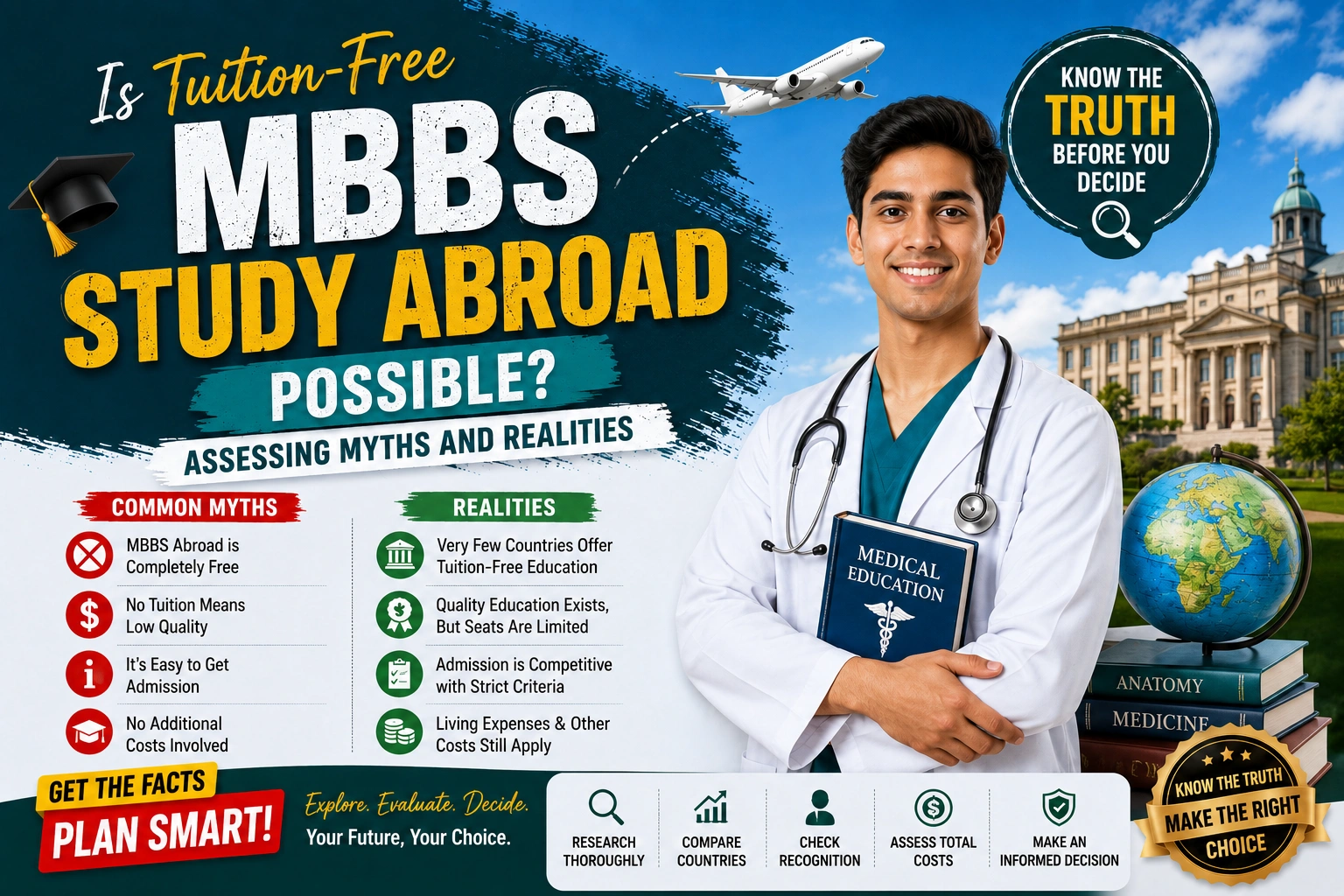
Many Indian students look for the cheapest ways to do MBBS abroad. There is a very alluring online advertisement that reads: “Study MBBS Abroad Without Fees.” Unverified agents and poorly motivated blogs post online that there are ways to do medical studies abroad for free. This claim seems very just for families that are worried about the financial investment of getting a medical seat after months of taking the NEET. Sadly, this claim is very misleading and believing such a claim can lead to financial loss, loss of time, and worse, getting enrolled in a university that has no recognition.
This article is going to walk through the evidence and explain the truths behind the claim of doing MBBS abroad for free, and give you the tools to differentiate between legitimate scholarship opportunities and manipulative marketing. We are going to walk through the factors that contribute to the price of going to study medicine abroad. We are also going to discuss the value of recognition from medical bodies like the National Medical Commission (NMC), the World Directory of Medical Schools (WDOMS), and your NEET score, over any claims of “zero fee."
Origin of the 'No Fees MBBS Abroad' Myth
The phenomenon of tuition-free medical education did not just happen. Some countries, especially parts of Europe, have real tuition waivers for locals or for students who fall under state-funded education systems. Germany, Norway, and a few others, offer free or subsidized higher education (including medicine); however, this offer is usually for residents, EU citizens, or students who are under strict eligibility criteria that are extremely tough for an international applicant to meet. Real, but very limited exceptions are adopted by marketing agencies and utilized to attract Indian students, stating similar free education is available everywhere, which is very inaccurate for most of the destinations Indian aspirants actually apply to, which are Russia, Georgia, Kazakhstan, Uzbekistan, Kyrgyzstan, and the Philippines.
This myth also prevails because of the confusion between "low fee" and "no fee." Some of the popular MBBS abroad destinations may provide MBBS schooling at a significantly lower tuition than private medical colleges in India, with tuition costing only two to four lakh rupees in a year. When compared to the range of fifteen to twenty-five lakh rupees per year in private medical colleges in India, the cost differential makes it seem to students the schooling is "almost free." In a game of broken telephone or from intense sales pressure, "almost free" morphs into "very low fee" and then, ultimately, "zero fee." It is important to understand and correct the exaggeration and the irrational decisions that you are using to base your entire medical career on completely false assumptions, as it will mislead you and your career before it has even started.
What Real "Fee Waiver" and "Scholarship" Programs Are
There are real scholarships available, unlike the myths that surround them. Some of the universities in Russia, Kyrgyzstan, and the Philippines have "scholarship" programs that provide partial fee waivers for students who show meritorious scholarship for the admission exam, or who perform well in the first year of their medical studies. In general, these programs provide waivers of ten to fifty percent of the tuition costs and are very unlikely to provide full tuition for the entire program. It is also common for students to be offered a tuition waiver for the first year of studies as part of the admission offer, and then have to pay full and possibly substantial fees for subsequent years, if they do not meet certain scholarship criteria.
Government-to-government scholarship schemes are real, though more limited than people expect. There are some educational pacts or scholarships with quotas that are bilateral, but seats are extremely limited and highly competitive. They may only fill slots for a particular subject or area of research, not for a generic MBBS program. It is possible that a scholarship is available for a given university and one country, but it is inaccurate to say that "MBBS abroad has no fees” or really mean it. It is necessary to look at each case individually, preferably on the university's site or on the ministry's site. Never rely on third-party, promotional, or agent material.
Concealed Costs Agents Don't Mention
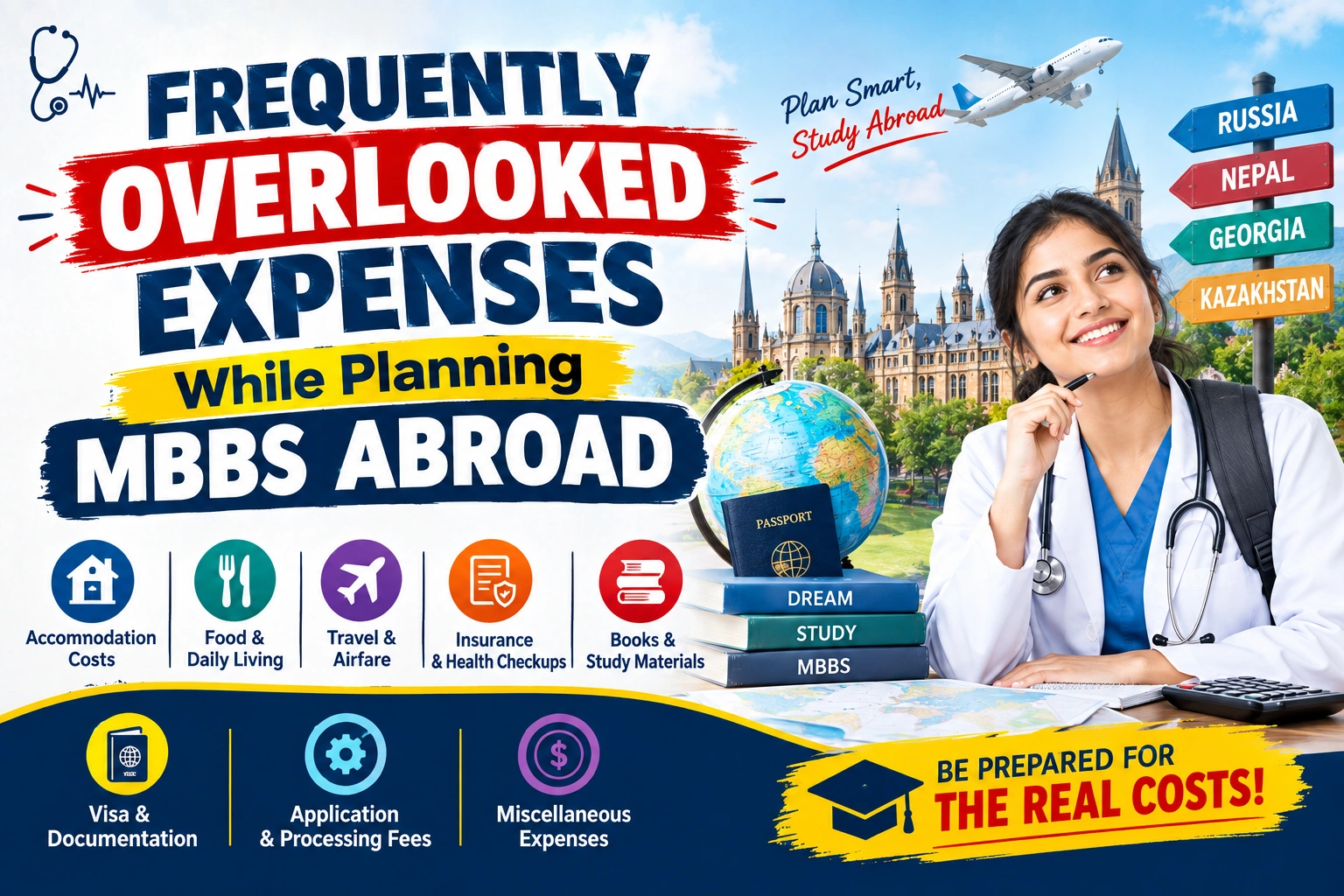
Tuition for a partial scholarship is only one part of the expense for studying medicine abroad. Families with the "no fee" scholarship narrative end up covering a significant amount of costs for:
- Lodging
- Meals
- Health insurance
- Miscellaneous visa costs
- Embassy fees
- Travel costs
These costs can begin to add up quickly for a program that lasts six years.
Some education-associated costs are often overlooked, such as the price of books and supplies, gear, and fees charged per exam. In the course’s later years, students preparing to sit the licensing exam back in India, the NExT exam, which replaces the prior FMGE exam, usually spend extra funds for coaching and exam prep courses, which is additional out-of-pocket funding unrelated to the university’s fees to be able to practice medicine in India post graduation. When you assess any MBBS international offer, it is more pertinent to request a full, detailed description of expenses for six years rather than be concerned with the tuition amount being advertised.
Why "Free" Offers Indicate Recognition Problems
Aside from the financial aspect, there is another reason to be worried about agents and universities that aggressively market 'no fee' offers. This is often used as a marketing gimmick by universities that are not recognized or accredited. Legitimate medical universities, no matter the country, have real costs and expenses. This includes paying their faculty and staff, developing relationships with hospitals and clinics to conduct medical training and practice, maintaining laboratories, and fulfilling legal and other obligations. Therefore, it is highly improbable that a medical university will provide an unconditional medical degree to international students for free and without a credible source of funding. Offers that sound too good to be true, deserve a reevaluation where you should at least verify if the university is listed in the World Directory of Medical Schools, which is the only database that exists to validate medical schools and provides assurance that a medical school is recognized and exists.
There should be no trust in admission offers, with or without a fee, without validating if the medical school is listed in the World Directory of Medical Schools, and if the degree is recognized by the National Medical Commission while ensuring the student can practice in India. Those who fail to validate it because they are distracted by a headline that promotes "free MBBS," will likely end up with a medical degree that cannot be used to practice in India. The risk of obtaining a degree that isn't recognized by the Indian medical authorities is greater than any savings.
How to Verify a University Before Trusting Any Fee Claim
What follows are several things you can do to protect yourself from scams that advertise “MBBS abroad with zero tuition.”
Step 1
Do not rely on agents’ screenshots or PDFs of WDOMS. Search for the university in WDOMS for yourself, as the agents can change the documents as they wish.
Step 2
You are able to check if the country’s ministry of health or education has authorized the university’s medical program to accept international students.
Step 3
Ask for a form of contact that is not provided by the agent and is listed on the official website of the university. From there, contact the university and ask for the tuition for the entire duration of the program in a signed official document.
When universities cite “global health-related standards and licensing frameworks,” they are usually referring to the World Health Organization (WHO). While it is true that the WHO no longer accredits any medical college, some of these universities still use them in their marketing. If there is a claim of “WHO approval” in conjunction with a “no fee” offer, you should take it as a signal that you should investigate further. The WHO also no longer keeps the directory of medical schools. It has been left to the World Federation for Medical Education and the Foundation for Advancement of International Medical Education and Research, and who also are the co-founders of WDOMS.
The Truth About the Cost of MBBS Programs Abroad
Before setting your heart on a program with no tuition, it is prudent to gain an understanding of the cost ranges of fee programs in the most popular destinations, and set your budget accordingly. Total tuition of an entire MBBS program (five to six years) spread across different countries and universities, can cost between fifteen to forty lakh rupees. This is significantly less than the cost of private medical colleges in India. Factor in hostel, food, and other living expenses, and the total cost of the program can go up to twenty-five to fifty lakh rupees. This amount is still lower than what most private Indian colleges in India would charge for a single MBBS seat for the management/NRI quota.
It is crucial that families understand this range so that they can accurately estimate educational expenses and costs in order to procure the required funding without being subject to unrealistic cost estimates. Should an educational agent provide a significantly lower estimate, or claim that the program is free, that variance should be reason to be more skeptical, as it would be more likely that the program is of exceptionally poor quality.
Understanding the Role of NEET and Ranking in This Choice
Some students have the incorrect notion that NEET is not relevant for MBBS abroad options, as Indian government medical college admissions are tied to a rank-based counselling system and, therefore, make the exam relevant. This notion is incorrect. Students who wish to pursue MBBS abroad, and eventually intend to sit for the National Medical Commission in India to practise medicine, must clear the NEET exam with a passing score. The degree from a foreign institution, however, cannot be leveraged to sit for the licensure exam in India, regardless of the institution's rank, reputation, or the costs involved.
Although students pursuing programs to study MBBS abroad chiefly use NEET Rank Predictor to help gauge Indian medical counselling options, instead of qualifying cut-offs, to make financially and academically viable decisions, such as determining if an international option is a more viable choice, we find that there are students who use NEET Rank Predictor to help determine if their rank will qualify them to make a MBBS abroad decision in Indian counselling before opting for an international choice.
Cost-cutting Strategies for MBBS Abroad
Students should not waste time deciding to study abroad based on a completely fictitious "zero-tuition" MBBS option as advertised in "free MBBS abroad programs". Instead, there are much better options, such as choosing less expensive universities with no hidden costs that other universities have. Avoiding the cheapest universities also gives students much more opportunities to choose a university that has world-class faculty and university standards. Choosing the best option for a student's chosen specialty is much better than blindly following the first university/school options presented to them.
Another option to consider are education loans for MBBS abroad. Some Indian banks have developed this loan product for students who wish to pursue MBBS abroad. These banks offer loans at low interest if the selected university is listed in the WDOMS. Some students even employ flexible payment strategies, where they pay tuition in installments throughout the academic year, rather than pay an entire year’s tuition at once. This strategy not only alleviates the burden on a student to secure funding via a scholarship, but also significantly relieves the financial pressure of an entire payment. The intention of your family to collaborate in creating a realistic six-year financial plan for your education is far more likely to result in a more effective and realistic plan than an expectation that no financing will be required for the duration of the education.
Making an Informed, Scam Free Decision
If you are a student considering MBBS abroad, the safest, most self-protective option is to assume that every offer for ‘free education’ or education at suspiciously low cost is a scam.
The first, most important step is to carry out personal research using:
These resources are far more reliable than anything an agent will claim.
If you must use an agent:
- Request a full accounting of all anticipated costs in writing.
- Request a copy of the agent’s current references.
- Ensure the references are Indian students currently enrolled at the institution.
Lastly, if there are no costs or no comparative costs in the advertising materials you are receiving, and you are not in possession of current, credible references, you are not acting in your best interest if you make a payment to secure placement, as it is highly unlikely that you will be enrolled by this agent due to an advertisement they are currently circulating.
It is good to read sites such as MBBS Advisor, as it offers the page on the NEET, MBBS abroad, and foreign admissions. It lets you compare what agents say to a more complete, organized set of information.
Conclusion
Claiming that Indian students can study MBBS abroad for free is a fantasy. There is a realistic chance to pay less for tuition than private Indian colleges, get a more limited scholarship, and use payment plans that can make studying abroad more affordable. The most important part of the MBBS abroad process is taking the time to confirm that the universities are real and the recognition is real, confirm your NEET status, and calculate the costs for all six years, not just the most attractive one.