 Russia
 Belarus
 Georgia
 Kazakhstan
 Kyrgyzstan
 Uzbekistan
 China
China Nepal
Nepal Bangladesh
 Poland
 Romania
 Slovakia
 Hungary
 N. Macedonia
 Vietnam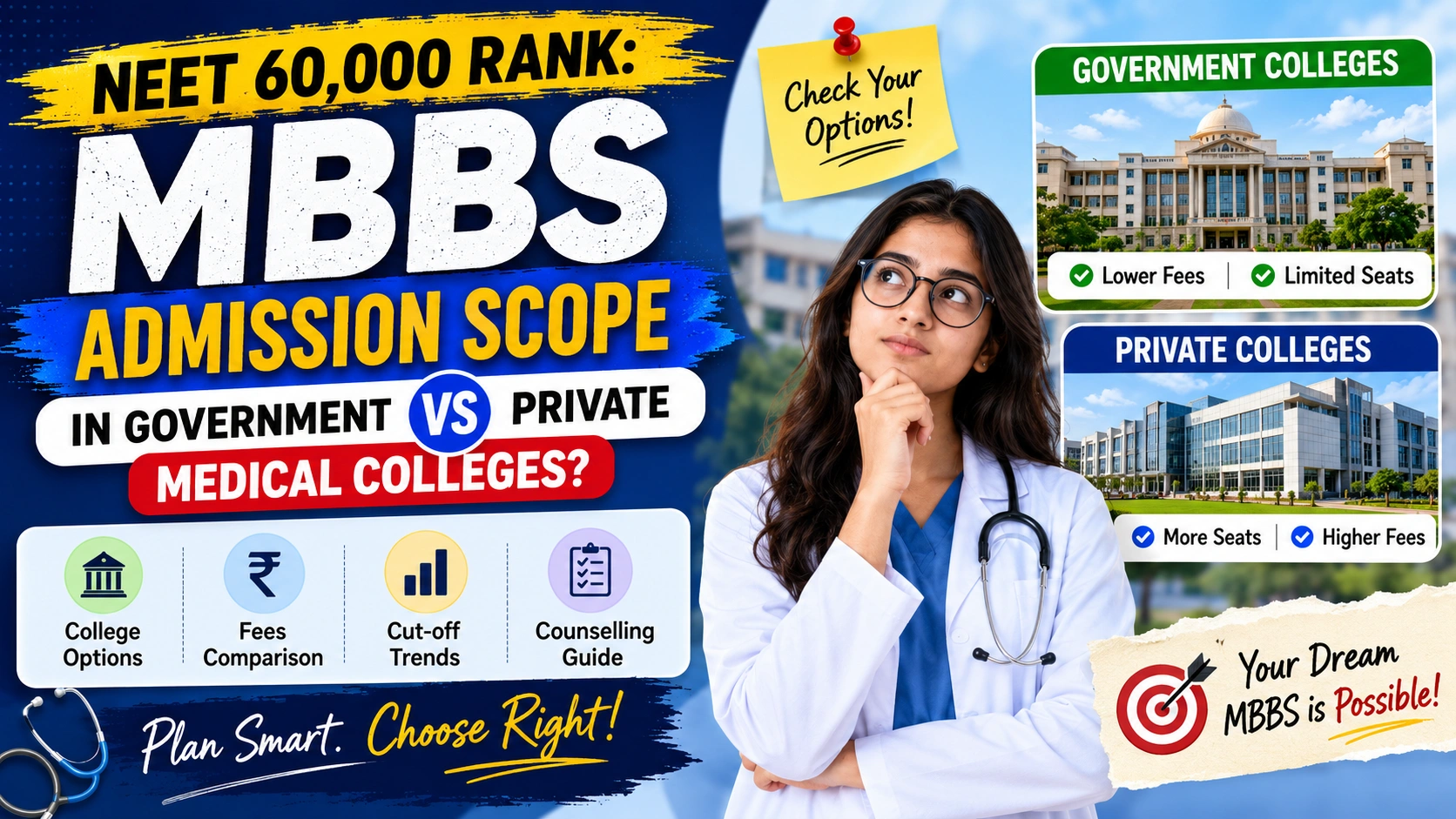
NEET Rank 60,000 can hardly secure admission in government medical colleges in the General/OBC categories. However, it is likely to get admission in private medical colleges and deemed universities. It can also secure admission in good government medical colleges offering courses like BAMS, BHMS, BDS and allied medical courses.
The following information explains the National Medical Commission (NMC) regulations, the NEET eligibility and the recognition by the World Directory of Medical Schools (WDOMS), and other practical aspects to help you understand your options. It will also help you make better decisions based on NEET Rank Predictor and MBBS Advisor, among other tools.
Understanding NEET Rank 60,000
Recently, a NEET rank of 60,000 corresponds to around 580 and above (it varies each year) and you are likely to be excluded from most government MBBS seat closing ranks for the All India Quota and the state MBBS ranks under the General/OBC categories. In fact, the closing MBBS ranks for the state government MBBS seats (2024) were around 590 and above, translating to a competitive rank substantially better than 60,000.
It must be noted that there is still an MBBS pathway. What it means is,
- For General/OBC, government MBBS via the All India Quota or the state quota is almost impossible.
- The progressive MBBS pathway is admission to private and deemed universities, provided you can pay the higher fees and you are willing to compromise on the college tier and the location.
- Seats for government BAMS, BHMS, BDS, BPT, BSc Nursing, and allied health courses become more accessible and are good options at this rank.
- For members of reserved categories (SC/ST/EWS), or those with strong state quotas and lower competition, the situation improves slightly, but even then, government MBBS at 60k is out of reach across most states.
Government vs Private MBBS: Reality Check for 60k Rank
Government MBBS Colleges
Government medical colleges attract a lot of interest due to the low fees, excellent clinical exposure, and the college’s brand value. However, they are highly competitive. With a 60,000 rank:
- For the All India Quota (15% seats), it is practically impossible to get a government MBBS seat for General/OBC at 60,000 rank.
- For the 85% State Quota, in the majority of the states, the General/OBC MBBS cutoffs fall well before 60k, though a few of the less competitive or far-off colleges may have a lower cutoff in later rounds.
- Members of reserved categories are at an advantage, but even then, 60k is most often insufficient for government MBBS in the popular states.
In conclusion, at this rank, government MBBS should be viewed as having an extremely low chance and should be planned accordingly.
Private and Deemed MBBS Colleges
Private and Deemed universities have larger seat pools, but higher fees, and their cutoffs are not as competitive as others. Thus, at 60,000:
- MBBS seats should be of no concern in states like Karnataka, Tamil Nadu, Maharashtra, Uttar Pradesh, Telangana, and Rajasthan, especially in management, NRI quota, and in later rounds (mop-up, stray vacancy).
- Deemed universities may have different thresholds for entry. Many of the top deemed universities and colleges will most likely have better rank requirements.
- Several colleges will quote better rank requirements, but the fees will be even more. Private colleges in the country charge upwards of ?10-25 lakhs per year and that fee is more for deemed universities.
- If you are clear that you specifically want MBBS and you have the funds, the deemed MBBS option is the primary route at this rank. Private colleges may also fit this criteria. MBBS Advisor and the NEET Rank Predictor are good tools for this option. They also help short list colleges that have not deviated in closing ranks and haven’t lowered the standards for entry.
How do you consider the NMC, NEET, and WDOMS while you make your choices?
Regulatory frameworks will streamline your choices and help you not fall for the bait of bad colleges or programs that are unrecognized.
NMC (National Medical Commission)
As India’s top regulator for the medical education and practice, the NMC has the following requirements for MBBS admission:
- Only candidates who have qualified NEET will be able to get admissions to MBBS programs in India.
- All medical colleges will adhere to the NMC approved seat matrix, eligibility criteria and admission procedures and will follow designated counseling authorities.
- The NEET-UG minimum qualifying percentile for the general category is the 50th percentile, other categories will have lower thresholds as per the prescribed norms.
Having cleared NEET makes you eligible for MBBS counseling. However, there are state quotas and reservations that are also a consideration for determining if you will be given a seat.
While considering colleges, you should check their NMC recognition status with the NMC or reliable sites like MBBS Advisor.
NEET (National Eligibility cum Entrance Test)
NEET is the only MBBS, BDS, AYUSH and other related entrance exam in India. At 60,000 rank:
- You are NEET qualified, hence you can apply for courses in which NEET is the entry exam.
- Your rank is your place on the merit list generated by MCC for AIQ/deemed/central and state counseling.
- A NEET rank predictor can estimate which colleges and courses are available to you, based on your rank and category.
- NEET also covers the structure of the 15% All India quota and the 85% State quota, as well as other counselling for deemed/central universities and management/NRI seats. Your plan should cover this structure.
WDOMS (World Directory of Medical Schools)
WDOMS is a directory of all accredited medical programs and schools globally. It is important if you are:
- Searching for an overseas MBBS program and want to ensure the school is accredited and you will be able to practice medicine and complete further training internationally.
- Thinking of relocating (USMLE, PLAB, etc.) where graduating from a WDOMS accredited program is one of the basic requirements.
- For Indian MBBS, recognition from NMC is the priority. If you later consider global opportunities, WDOMS will then be important. When using MBBS Advisor you can check both NMC status in India and WDOMS listing of other countries.
Realistic Colleges and Courses Around 60,000 Rank
Here’s what you can expect from private/deemed MBBS programs at this rank:
- Private medical colleges that have comparatively lower closing ranks include those in the states of Karnataka, Tamil Nadu, Maharashtra, UP, Telangana, Rajasthan, and a few others. Also consider:
- Deemed universities that have available seats during the mop-up and stray rounds.
- Management and NRI quota seats that have closing ranks lower than general merit seats, but also have significantly higher fees.
- In the last several years, many private/deemed MBBS colleges have been using management/NRI quota seats with ranks between 50,000 and 75,000. Examples include colleges like Dr. D. Y. Patil Medical College in Pune/Navi Mumbai and Sri Siddhartha Institute of Medical Sciences in Bangalore. There are many similar colleges, and these closing ranks may vary from year to year.
What you need to do:
- Use the NEET Rank Predictor tool to see which colleges are likely based on your estimated score.
- Closely monitor the closing ranks and fee structures on a state basis.
- Be prepared to fill the seats as soon as the mop-up and stray rounds begin, which is when most of the private seats are taken.
If it’s financially unfeasible to pursue pure MBBS at an acceptable private college, or if you are flexible to other medical career options, this rank range is good for the following:
- BAMS (Ayurveda): Many government Ayurvedic colleges close at ranks between 50,000-60,000 and even lower. In recent years, those colleges have been in Karnataka, Andhra Pradesh, Telangana, Maharashtra, and many other states.
- BHMS (Homeopathy): Similar situation. Government and well-known private BHMS offer admission for this rank range.
- BDS (Dental): Admission into Government BDS is tough, but at 60k, some state and private BDS colleges become attainable, particularly in the later rounds or in less competitive states.
- BSc Nursing, BPT, BOT, and other allied health: Most of the other allied health programs have good government options for this rank and use NEET in most states.
For many, a government BAMS/BHMS/BDS at this rank is a more sensible long-term option than a very low-quality, expensive, private MBBS, particularly if you are not sure you can handle the financial burden.
Category, State Quota, and Domicile: How They Change the Picture
Your category and domicile state can shift your options significantly.
- General/OBC: As mentioned, 60k government MBBS is most likely not going to happen in most states. The realistic options become government AYUSH/BDS and private/deemed MBBS.
- EWS/SC/ST: Reserved categories have lower cutoffs and separate quotas. Although 60k still poses a challenge for government MBBS, some states have reserved category MBBS seats closing deeper in the rank list. Checking the previous years’ cutoffs for your specific state is extremely important.
- State Quota Advantages: If your domicile state has less competition, or more seats, your chances improve, even if only slightly. Some states have historically lower cutoffs for their own residents due to private colleges under state quota.
Always check your state’s closing ranks and seat matrices from the last 3–5 years. There are tools and counselling platforms such as the MBBS Advisor that can help you interpret these and make informed decisions.
Step-by-Step Strategy For 60,000 Rank
Step 1: Clarify Your Priority—MBBS vs Medical Career
Ask yourself the following:
- If you are more interested in your goal being “MBBS, regardless of college or fee” then you need to plan and have enough finances for Private/Deemed MBBS.
- If you are more interested in a good medical career that is respected and has a good fee structure, you should look at Government BAMS, BHMS, BDS, or other allied courses.
- Choosing BAMS/BHMS/BDS has no shame, especially since they are full-fledged medical degrees with full practice rights, PG degrees, and great career prospects.
Step 2: Data Over Guesswork
- Using NEET Rank Predictor input your score, select your category, and state then look at the colleges you potentially have a higher chance of getting into.
- Check last year's cutoffs for both your state quota and for AIQ.
- On realistic grounds, what are your dream, realistic, and safe colleges?
- Going off social media or “last year my friend was able to get...” stories is not smart at all. Trustable data and official counseling will beat anything you find on social media.
Step 3: Rounds of Counseling are Important
NEET counseling happens in multiple rounds:
- Round 1 & 2: Most Gov. and top private seats get filled in these rounds; at 60k, you will not get MBBS in these rounds but you may get a good BAMS/BHMS/BDS seat.
- Mop-Up Round: In this round, many private/deemed MBBS seats become available as the candidates choose better options therefore it is an important round for 60k rank MBBS aspirants.
- Stray Vacancy: Last round of counseling where seats become available at very high fees but chances of getting admission for MBBS are very high.
Register with all relevant counselling authorities (MCC for AIQ/deemed/central and your state counselling and deemed university counselling). Have your documents ready and track timelines as per the NEET information bulletin.
Step 4: Do a Proper Financial Calculation
For private/deemed MBBS:
- Total the cost of tuition + hostel + mess + exam fee + all other costs for 5.5 years.
- Find out if the college has scholarships, installments, or educational loan tie up options.
- Consider: Is this financially feasible for my family? If yes, is it worth it to choose a government option of BAMS/BHMS/BDS with this a very expensive average tier MBBS?
- Be aware a substantial educational loan will limit your career opportunities.
Step 5: Check NMC and WDOMS Before Finalizing Any College
- Ensure NMC recognises the college for the current academic year before you pay an admission fee.
- If you are looking at MBBS abroad, check the WHO, NMC and WDOMS, and the NMC requirements for foreign graduates.
- For MBBS, avoid misleading agents and unrecognized universities. Only use trusted sites.
- Never just rely on brochures or what agents' say, always verify on official sites.
Common Errors for Students with a 60k Rank
These common errors can cost you a year, money, and other opportunities:
- Overestimating Government MBBS Seats: Students will spend the earlier rounds of counselling pursuing an unachievable government MBBS seat and will lose opportunities in BAMS/BHMS/BDS.
- Overlooking the Financial Implications: People who choose expensive private MBBS programs will make no clear repayment plan, will have mental stress on borrowings and will limit future career options as a result.
- Falling for Dubious Agents: Unreliable consultants may lure students into non-NMC recognized colleges, or into scams with “management seats.” Confirm through official channels and resources like MBBS Advisor.
- Not Using Rank Predictors and Data: Estimating which colleges you might end up at is inferior to employing a NEET Rank Predictor and previous year cut-off data.
- All-or-Nothing Mindset: Viewing anything short of MBBS as a “failure” closes students off to worthwhile careers in AYUSH, dentistry, nursing, physiotherapy and other fields that open up at this rank.
Here, a data-driven model saves you from these errors.
If You’re Ready to Drop a Year: Should You?
Some students with a rank 60,000 decide to drop for a better rank. If you do decide to drop, consider the following:
- Improvement is possible, but many people see little to no improvement, or may even have a negative score improvement. There is a real chance that this could negatively impact mental health.
- Consider what caused the rank drop and if you are able to identify and fix the gaps in preparation.
- A drop year is justifiable if you have the support, a great plan, and the endurance to handle the difficulties that lie ahead.
- Alternatively, consider enrolling into a good BAMS/BHMS/BDS program and then preparing again for NEET (if you are allowed to) or focusing on the PG entrance later.
- Moving forward with the available options to enroll in a good course greatly outweighs the unknown goals of dropping a year to improve rank.
How MBBS Advisor, NEET Pages, and Rank Predictor Can Help
MBBS Advisors and similar platforms were developed for cases such as yours, where candidates have decent NEET scores, and instead, they need expert advice to know what is feasible and possible.
From the main site, MBBS Advisors can navigate you to the best possible options for MBBS Colleges, both in India and overseas, based on the scores you have provided, as well as your rank and cutoff trends.
The MBBS Advisors NEET section has numerous updates on patterns for the exam, eligibility for the exam, and counseling as well as the NEET admissions process.
With the NEET Rank Predictor, you can gain an estimate on the rank you will achieve, as well as colleges you will be able to choose from during the admissions process, making your options list more practical.
While looking at options outside of the country, WDOMS info will give you the assurance that the foreign medical institutions you are looking at are recognized all over the world.
Combining all the resources MBBS Advisors provides, you will be able to gain a clearer roadmap as opposed to watching random YouTube videos or relying on WhatsApp forwards.
Conclusion: What Should You Do With a 60,000 Rank?
The current expectation at a NEET rank of approximately 60,000 is:
- For the majority of the states, General/OBC candidates are unlikely to gain a Government MBBS seat, so it should be considered a bonus and not a guarantee.
- Private / deemed MBBS seats are likely to be gained in the subsequent rounds as long as you can afford the fees and you are willing to be flexible to the tiers as well as the locations of the colleges.
- Among the many options available, gaining a Government seat in courses in BAMS, BHMS, BDS, and allied courses is a great option as they are all affordable and many students at this rank successfully gain them as seats during counseling.
- Your options should be based on NMC Guidelines, NEET counseling guidelines, and WDOMS recognition for options abroad. These should be used to evaluate your options as opposed to what agents offer or their guarantees.
- With tools like the NEET Rank Predictor and the structured guidance by MBBS Advisor, following a 60,000 rank is easy, and so is the admission strategy to pursue MBBS or any other alternative medical career.