 Russia
 Belarus
 Georgia
 Kazakhstan
 Kyrgyzstan
 Uzbekistan
 China
China Nepal
Nepal Bangladesh
 Poland
 Romania
 Slovakia
 Hungary
 N. Macedonia
 Vietnam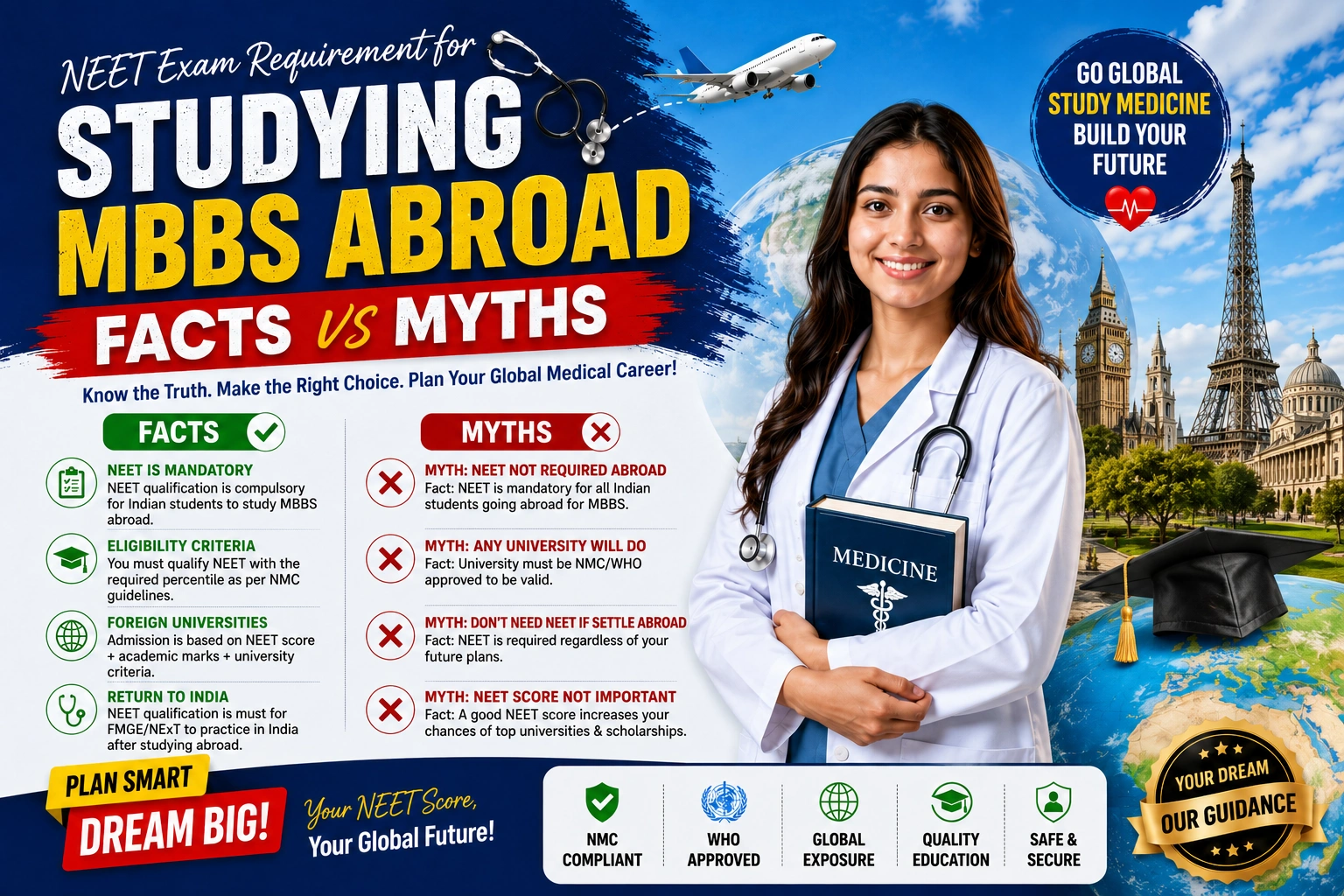
Every year, many Indian students continue to pursue their dreams to study MBBS abroad as a result of limited seats and high competitive examinations in India. One of the requirements for studying medical courses abroad, that is most misunderstood, is the NEET exam. Students and parents become the victims of this misinformation, and face financial loss as a result. This guide will assist you in separating the facts from the myths. It will also explain the roles of the NMC and WHO, and will aid you in understanding the importance of the MBBS Advisor, NEET, and the NEET Rank Predictor.
Understanding the NEET Mandate for MBBS Abroad
The Legal Framework: NMC Regulations
The National Medical Commission (NMC) has been clear that it is necessary for an Indian citizen or an Overseas Citizen of India (OCI) to clear the NEET-UG in order to be eligible to study the MBBS or an equivalent course abroad. This regulation has been in place since 2018, and is applicable regardless of the country chosen, be it Russia, Georgia, Kazakhstan, the Philippines or any other country.
The NMC has taken a stand to regulate medical education abroad to those students who, in their opinion, meet a basic threshold standard at the national level. This is more than a formality, as it is a legal essential for the future practice of medicine in India. Without qualifying the NEET, a student’s foreign medical degree will be deemed useless, and they will never be able to take the FMGE (Foreign Medical Graduate Exam) or the NExT.
Who Does This Apply To?
Any of the following are subject to this rule:
- Indian nationals who began studying MBBS abroad from 2018.
- OCIs who began studying MBBS outside of India.
- Individuals who wish to practice medicine in India after acquiring their degree from a foreign country.
If a foreign university offers admission without the need to take the NEET, this admission is worthless in terms of Indian licensure. The NMC does not support any foreign medical institutions, and it is students' responsibility to check the status of foreign medical programs with respect to Indian laws.
Observing the Facts
NEET Qualification vs NEET High Scores
One common misconception among students is the idea that they should have an over the top, exceptional score in the NEET exam in order to study MBBS abroad. However, this actually is not true at all. In fact, to study MBBS abroad, students are only required to qualify the exam and fall within the required cut-off percentiles.
- General Category: 50th percentile (approx. 137+ marks in the recent years).
- OBC/SC/ST: 40th percentile (approx. 107+ marks).
- PwD: 45th percentile (approx. 121+ marks).
These score requirements are generally lower than the scores required to get into the top Indian government colleges. For MBBS abroad, a “safe” qualifying score is typically viewed to be anything in the range of 150–200+, which is a score that is looked upon as an achievable score by most students who may not end up securing admission to an MBBS program in India.
Validity of NEET Scores
For MBBS admissions overseas, NEET scores remain valid for three years. For instance, take a student who takes NEET in 2026. That student will be able to take MBBS admission(s) in 2026, 2027, and 2028, using the same score. There are many ways a student can take advantage of this. For instance, a student will be able to take up to three years to prepare and/or accumulate funds for their international admission(s).
The three-year validity of a NEET score means a student can perform their international admission(s) at their convenience without the added pressure of having to take the NEET exam every year. That said, NEET scores should be treated as the de facto “Eligibility Certificate” from the NMC as stipulated in the 2002 regulations.
Age and Academic Requirements
All aspiring MBBS students need to meet certain age and academic requirements.
- The mandatory academic requirement is the completion of 10+2 in the Science stream, with at least 50% aggregate marks in PCB for the General category (40% for the reserved categories).
- The mandatory age requirement is 17 years of age by 31st December of the year of admission.
The requirements in this section are the NMC’s requirements for the recognition of the NMC’s Graduate Medical Education Regulations, 1997.
Debunking Myths of NEET
Myth 1: “NEET Is Not Required for MBBS Abroad”
Fact: This is perhaps the most insidious myth because there are plenty of agents and even some foreign universities that misrepresent the mandatory nature of NEET. This is categorically false. The NMC has consistently maintained that qualification of NEET is mandatory for all Indian/OCI students seeking MBBS abroad after the year 2018.
Without NEET, a student can't:
- Get provisional or permanent registration with the NMC or with any State Medical Council.
- Be eligible for FMGE/NExT.
- Be able to practice in India.
Myth 2: “Studying Abroad is Only for the Higher NEET Scorers”
Fact: Studying abroad is more about qualification and less about scoring big on NEET. A lot of students with average NEET scores (150-200) get admission to internationally reputed medical colleges. Hence, the focus should be on scoring cut-off and not on a high score.
Myth 3: “Any Foreign University is Good”
Fact: NMC does not have a list of approved foreign medical universities. However, for a degree to be validated in India, the university has to:
- Get recognition from the local medical council of the respective country.
- Have a minimum of 54 months (4.5 years) of academic work with a complete mandatory internship.
- Conduct all MBBS courses in the English language.
- Have a no transfer and no split programs policy (the entire MBBS program must be completed at that one university).
Since the NMC will not recognize degrees awarded by foreign medical universities if the above stipulations are not met, students are advised to do their due diligence.
Myth 4: “NEET is for Admission to Indian Colleges Only”
Fact: NEET is a national eligibility test and not an admission test for Indian colleges only. It is meant to check the minimum level of competency of a medical aspirant, irrespective of where that student is going to pursue medical studies.
The Role of WHO and WDOMS
WHO Recognition: What It Really Means
Some students think that World Health Organization(WHO) acknowledging a university equates to getting the thumbs up from the NMC. This is not true. The WHO does not “recognize” medical schools; instead, it controls the World Directory of Medical Schools (WDOMS), which is a catalog.
A WDOMS listing means that the medical school is verified by the country’s local medical board. It does not guarantee that the NMC will recognize the school. Students will still need to check the university against the NMC’s requirements and see if the course’s length, teaching language, and the internship meet the NMC guidelines.
How to Verify WDOMS Listing
Students can go to the official WDOMS site to see if a university is listed. However, this should be one of the many ways to validate a university. The NMC’s guidelines will always be more important than the listing in WDOMS for Indian licensure.
NMC Guidelines: Requirements That Must Be Met
Course Structure and Duration
- A minimum of 54 months (4.5 years) of full-time classroom medical education.
- A mandatory internship in the country or institution where the medical education was pursued.
- No online or distance education for medical subjects.
Language of Instruction
- The medical program must be fully taught in English.
- Medical schools that offer programs in the local language (e.g. Russian, Chinese) with no English option are not recognized by the NMC.
Single Institution Rule
- All of the MBBS programs must be completed in a single institution.
- For the purposes of recognition, transfers, credit transfers and split programs, where a student completes part of their studies in one country and part in another, are not accepted.
Eligibility for the Licensing Exam
Graduates should have the right to practice in the country in which the university is situated.
This will mean that the degree awarded will be a ‘primary medical qualification’ in the terms of the NMC.
What Do Students in Need of an MBBS Degree Get? MBBS Advisors and NEET Rank Predictor.
Students have the right to expect reliable, accurate advice to assist in what is a major investment of their time and resources. MBBS Advisors assist students by providing extensive information on the NMC, university selection and admissions.
NEET Preparation and Planning
MBBS Advisors’ NEET section provides essential, current information regarding examination structure and syllabi and preparation which aid students in clearing NEET with the lowest scoring target.
NEET Rank Predictor: A Useful Tool
An excellent feature is the NEET Rank Predictor which allows students to see an estimated All India Rank for their NEET score using prior year statistics and trends. This feature assists students in:
- Selecting colleges prior to announcement of results
- Evaluating probability of studying MBBS abroad vs. India
- Deciding on counseling and admission options
For instance, a student scoring 160 in NEET will likely end up with a rank of approximately 10 to 12 lakhs, which is inadequate for consideration of admission into Indian government medical colleges, but sufficiently competitive for a number of good medical schools abroad.
Country Specific Insights
Russia
- Popular option due to low tuition and presence of NMC compliant universities.
- NEET is mandatory, however, many top universities are approved by WDOMS.
- Course length is 6 years (internship included).
Georgia
- Programs are easily available in English.
- Fees are reasonable, with a focus on developing strong clinical skills.
- NEET is compulsory for Indian students.
Kazakhstan & Kyrgyzstan
- Inexpensive countries with NMC recognized universities.
- Gaining popularity due to similar culture and proximity.
Philippines
- Pre-Med + MD coupled with an American style curriculum.
- Programs are completely in English, with NEET mandatory.
Regardless of country, students should confirm that the university satisfies NMC’s stipulation of 54 months.
Step-by-Step Roadmap for MBBS Abroad
Step 1: Qualify NEET
- Take NEET-UG and achieve the designated category minimum percentile.
- You can use the NEET Rank Predictor to forecast your expected rank.
Step 2: Research Universities
- Look for NMC compliant universities with a WDOMS listing.
- Check program length and language, and internship prerequisites.
Step 3: Confirm University Eligibility
- Confirm academic (10+2 with PCB, 50%+) and age (17+) requirements.
- Check that the university is accepting Indian students with the targeted NEET Score.
Step 4: Apply
Complete the application processes for selected universities and ensure the offer states admission is granted with NEET qualification.
Step 5: NEET and Eligibility Certificate
As of 2018, NEET in itself is the Eligibility Certificate in India. No application is required when you have a valid NEET Score.
Step 6
Finish your entire MBBS course from one college.
Complete your mandatory internship according to the NMC stipulations.
Step 7: Take the FMGE/NExT
Post MBBS, take the FMGE (or NExT when it comes into play) to practice medicine in India.
Financial Considerations
Cost of MBBS Abroad
While MBBS in other countries (leading to lower tuition than Indian private colleges) still requires budgeting for:
- Tuition ($3,000–$8,000/year depending on country).
- Cost of living, transportation, insurance.
- Cost of FMGE/NExT prep post return to India.
Return of Investment
Those who complete NMC-aligned MBBS abroad and pass FMGE/NExT will have the right to practice in India like Indian MBBS graduates. Consider the FMGE pass rate of 20–25% while making your decision.
What to Avoid
Not Following NMC Regulations
If you attend a university without checking their NMC compliance, you will receive a degree of no value.
‘No NEET’ Claims
If agents say that completing NEET is not a requirement, they are either ignorant or lying. Always verify with NMC.
Ignoring Language Barriers
If a university says they provide English courses, verify with students or alumni of the university.
Assuming WDOMS is NMC Approval
Just being listed in WDOMS does not mean compliance with NMC.
Conclusion
One of the most essential and largest investments you will make in life is for your future and education. If you don't take NEET, which is an avenue for students who are serious and fully committed wanting to help people around the world, you will not be able to devote your talents and skills to the profession you love. There are many myths that surround NEET but, with the help of MBBS Advisor, NEET, and the NEET rank predictor, we are sure that we will be able to select our options with our futures in mind.
Keep in mind that NEET is compulsory, the NMC is of the utmost importance, and the research you do is of the utmost importance. With everything in mind, we are sure that MBBS abroad is the best option to fulfill your dreams in the medical career.