MBBS Advisor
MBBS Advisor Your Study Abroad Partner
Study Destinations
🏥
MBBS Abroad
16+ countries available
Exams & Prep
📋
NEET UG 2026 Hot
Exam, Counselling, Result
🩺
NEET PG 2026
PG Medical Entrance
Discover
🧮
Galery
🧮
Neet Rank Predictor
✍️
Blogs
📰
News
ℹ️
About Us
🏢
City
🗺️
Top Destination
🎓
University

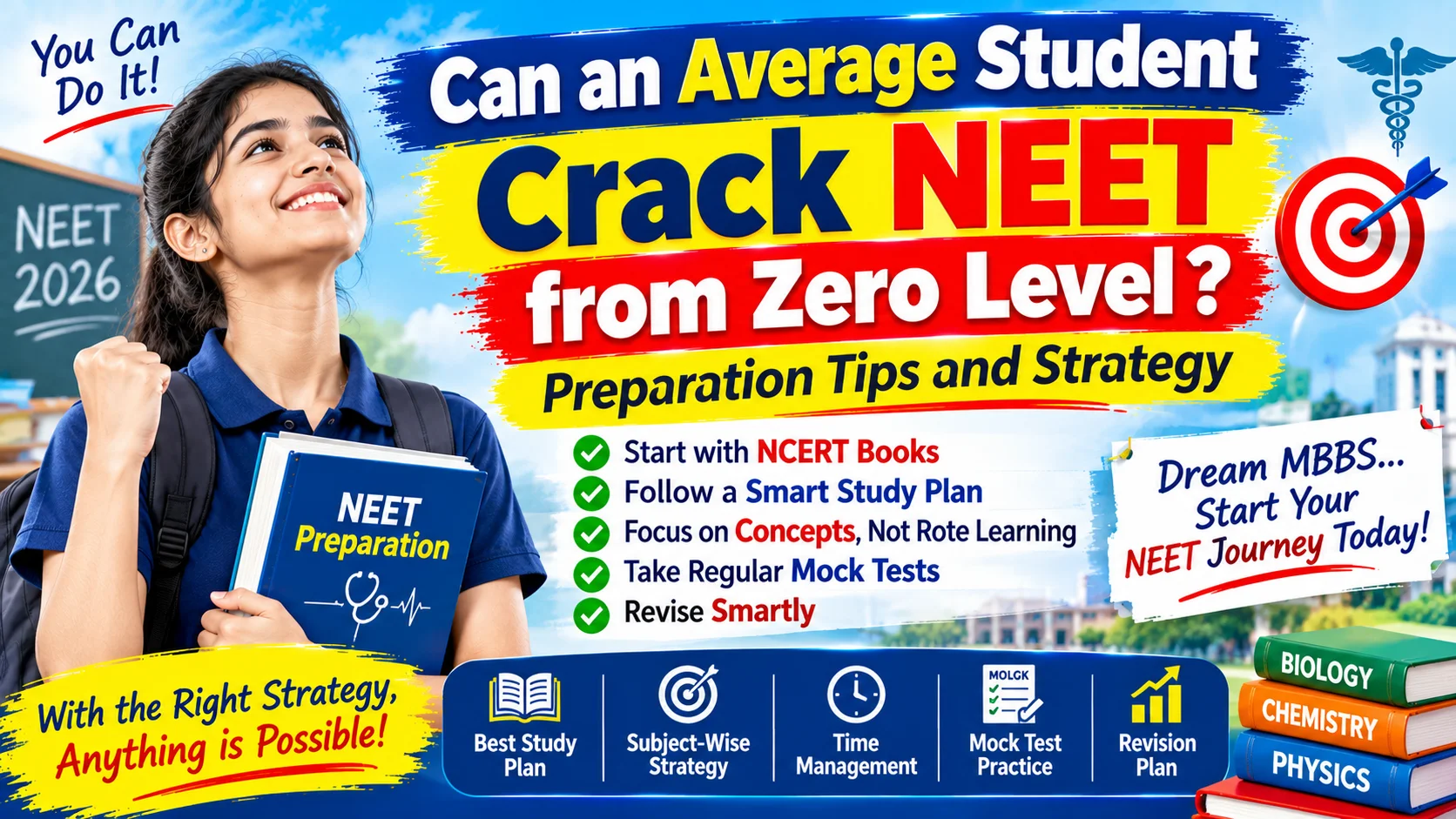
Can an Average Student Crack NEET from Zero Level? Preparation Tips and Strategy

Published on : 16 Nov 2026 Views: 2013

Can an Average Student Crack NEET from Zero Level? Preparation Tips and Strategy

Introduction

Cracking the National Eligibility cum Entrance Test (NEET UG) is a major goal for students who want to pursue MBBS, BDS and other medical courses in India. Every year, lakhs of candidates appear for this examination. Due to the high level of competition, many students believe that only academically brilliant students can achieve a good NEET score.However, this is not necessarily true. An average student can also prepare for NEET from the basics and work towards a competitive score by following a structured study plan, practising regularly and revising consistently.Students who have weak academic foundations may need additional time to understand Physics, Chemistry and Biology. But starting from zero does not mean that success is impossible. What matters is how effectively you use your preparation time, understand concepts and learn from mistakes.In this guide, we explain whether an average student can crack NEET from zero level, how to begin preparation, which subjects to prioritise and what strategies can help improve performance.

Can an Average Student Crack NEET from Zero Level?

Yes, an average student can crack NEET by building strong fundamentals and following a consistent preparation strategy. You do not need to be a topper in school to perform well in a competitive examination.However, NEET requires more than simply reading textbooks. Students must understand concepts, remember important information, solve MCQs accurately and manage their time during the examination.

If you are starting from the basics, focus on the following activities:

  • Understand fundamental concepts in Physics, Chemistry and Biology.
  • Download and follow the latest official NEET syllabus.
  • Study relevant NCERT textbooks carefully.
  • Practise chapter-wise MCQs.
  • Solve previous years' question papers.
  • Take regular mock tests.
  • Identify weak topics and work on them.
  • Revise completed chapters consistently.

Students may initially struggle with numerical problems in Physics and conceptual topics in Chemistry. Instead of becoming discouraged, divide difficult chapters into smaller topics and improve your understanding step by step. The most important factor is consistency rather than comparing your preparation with that of other students.

1. Understand the NEET UG Exam Pattern and Syllabus

Before beginning your preparation, understand the examination pattern and syllabus. This will help you organise your studies and avoid wasting time on irrelevant topics. NEET UG is conducted by the National Testing Agency (NTA) for admission to undergraduate medical courses in India.

The examination covers three main subjects:

  1. Physics
  2. Chemistry
  3. Biology, including Botany and Zoology

The commonly followed marking scheme awards four marks for every correct answer and deducts one mark for every incorrect answer. Unanswered questions receive no marks. Students should always verify the final examination pattern through the official NTA NEET website and the information bulletin for their examination year.

Why Is Understanding the Syllabus Important?

Students starting from zero should avoid studying random topics from multiple books and online sources.

Instead, download the latest official NEET syllabus and divide it into individual chapters. This will help you:

  • Identify all the topics included in the examination.
  • Prioritise important and difficult chapters.
  • Allocate sufficient time to each subject.
  • Track your syllabus completion.
  • Plan revision more effectively.

A clear understanding of the syllabus makes preparation more organised and manageable.

2. Start Your Preparation with NCERT Books

NCERT textbooks are an important foundation for NEET preparation, particularly in Biology and several areas of Chemistry.Students who have weak fundamentals should begin with NCERT rather than immediately moving towards advanced reference books.

Biology Preparation Strategy

Biology carries the largest share of marks in NEET, so students should give it consistent attention.

Follow these preparation methods:

  • Read the relevant NCERT Biology chapters carefully, including important lines.
  • Understand definitions and scientific terminology.
  • Study diagrams, tables and examples.
  • Prepare short notes for difficult concepts.
  • Practise chapter-wise MCQs.
  • Revise previously completed chapters regularly.

Give particular attention to topics such as:

  • Human Physiology
  • Genetics and Evolution
  • Ecology
  • Reproduction
  • Biotechnology
  • Plant Physiology

Do not leave Biology revision until the final months. Regular reading and repeated revision can help improve retention.

Chemistry Preparation Strategy

Chemistry is divided into three main sections: Physical, Organic and Inorganic Chemistry. Each requires a different preparation method.

Physical Chemistry

  • Understand basic concepts and formulas.
  • Practise numerical problems regularly.
  • Learn how to apply formulas correctly.
  • Pay attention to units and calculations.
  • Start with simple questions before attempting difficult ones.

Organic Chemistry

  • Build a strong understanding of fundamental concepts.
  • Learn reaction mechanisms.
  • Prepare notes on named reactions and conversions.
  • Understand how different reactions are connected.
  • Practise topic-wise questions.

Inorganic Chemistry

  • Study the relevant NCERT content carefully.
  • Prepare short notes on important facts.
  • Revise chemical properties and periodic trends.
  • Practise MCQs to improve accuracy.

Physics Preparation Strategy

Physics can be challenging for students who are starting from zero because it requires conceptual understanding and numerical practice. Do not begin with complicated questions. Build your foundation gradually.

Follow these steps:

  1. Improve basic mathematical skills required for Physics.
  2. Understand the concepts behind each chapter.
  3. Prepare a formula notebook.
  4. Study solved examples.
  5. Practise easy numerical questions.
  6. Gradually move towards moderate and difficult MCQs.
  7. Analyse incorrect answers.

Important areas to revise include Mechanics, Current Electricity, Electrostatics, Optics and Modern Physics. However, follow the complete official syllabus rather than depending only on selected topics.

3. Create a Realistic NEET Preparation Timetable

A realistic timetable helps students remain consistent and organise their daily preparation.Your study schedule should depend on your school timings, coaching classes, current academic level and available preparation time.For example, a student with sufficient daily study time may follow this schedule:

Subject or Activity

Daily Time

Biology

2 hours

Physics

2 hours

Chemistry

2 hours

MCQ Practice

1 hour

Revision

1 hour

Total

8 hours

This is only an example, not a compulsory requirement. Students should adjust their timetable according to their individual needs.

Tips for Creating an Effective Timetable

  • Study difficult subjects when your concentration is highest.
  • Divide long study sessions into smaller blocks.
  • Set daily chapter-wise or topic-wise targets.
  • Take short breaks between sessions.
  • Include MCQ practice and revision every day.
  • Review your progress before ending the day.

Avoid creating an unrealistic timetable that becomes difficult to follow. Studying consistently for a manageable number of hours is generally more useful than following an exhausting schedule for a few days and then losing motivation.

4. Follow a Subject-Wise Revision Strategy

Each NEET subject requires a different approach. Identify your strengths and weaknesses before deciding how much time to allocate to each one.

Biology

Biology requires careful reading, conceptual understanding and repeated revision.

You should:

  • Read relevant NCERT chapters thoroughly.
  • Highlight important concepts and definitions.
  • Practise diagrams and scientific terminology.
  • Solve topic-wise MCQs.
  • Revise completed chapters every week.
  • Maintain a list of facts and concepts you frequently forget.

Since Biology carries a significant portion of the NEET examination, avoid postponing its preparation.

Chemistry

Chemistry requires a combination of understanding, memorisation and problem-solving.

Divide your preparation into three sections:

  • Physical Chemistry: Focus on formulas, concepts and numerical practice.
  • Organic Chemistry: Understand reaction mechanisms, conversions and important reactions.
  • Inorganic Chemistry: Revise relevant NCERT facts, properties and trends.

Practising questions regularly will help you identify areas where your understanding needs improvement.

Physics

Students who find Physics difficult should begin with fundamental concepts instead of immediately attempting advanced questions.

A suitable approach is:

  • Understand the basic concept.
  • Learn the relevant formulas.
  • Study solved examples.
  • Attempt easy numerical questions.
  • Progress towards moderate and difficult MCQs.
  • Analyse conceptual and calculation errors.

Regular practice is more effective than studying Physics only occasionally.

5. Practise Previous Years' NEET Questions

Solving previous years' questions is an important part of NEET preparation. It helps students understand the examination format and become familiar with different question types.

Benefits of Solving Previous Years' Questions

  • Understand the style of questions asked in NEET.
  • Identify frequently tested concepts.
  • Improve problem-solving speed.
  • Recognise weak chapters.
  • Learn how to apply formulas.
  • Become more familiar with examination difficulty.

After completing a chapter, practise relevant previous years' questions. Do not simply memorise the answers. Understand why an option is correct and why the other options are incorrect. This approach will help you develop the ability to solve unfamiliar questions based on the same concepts.

6. Take Regular NEET Mock Tests

Mock tests are essential because they help students understand how effectively they can apply their knowledge under examination conditions.Students starting from zero may initially receive low scores. This is normal during the learning process. A mock test should be treated as a tool for identifying weaknesses rather than judging your ability.

How to Start Taking Mock Tests

Follow a gradual approach:

  1. Begin with chapter-wise tests after completing individual topics.
  2. Attempt subject-wise tests after covering several chapters.
  3. Move towards full-length mock examinations.
  4. Follow the prescribed examination time.
  5. Avoid checking answers while attempting the test.
  6. Analyse your performance after completing each mock.

Maintain a Mistake Notebook

Whenever you answer a question incorrectly, record the reason.

Most mistakes can be divided into three categories:

Mistake Type

Meaning

How to Improve

Conceptual

You did not understand the topic properly.

Revise the concept and study solved examples.

Calculation

You understood the question but made a calculation error.

Practise numerical questions carefully.

Careless

You misread the question or selected the wrong option.

Improve concentration and question-reading habits.

Review your mistake notebook regularly. This will help prevent repeated errors and make your preparation more effective.

7. Make Daily Revision a Habit

Completing the syllabus once does not guarantee that you will remember everything during the examination.Many students forget previously studied concepts because they do not revise regularly.

To improve retention, follow a simple revision routine:

  • Revise the topics studied the previous day.
  • Review formulas every few days.
  • Revisit completed Biology chapters.
  • Practise important Chemistry reactions.
  • Solve Physics questions from previously completed chapters.
  • Take weekly revision tests.

You can also follow a spaced-revision approach by reviewing topics after one day, one week and one month. Adjust the schedule according to how well you remember the material.

8. Avoid Using Too Many Study Resources

Students sometimes collect multiple books, notes, question banks, video lectures and online courses. Using too many resources can create confusion and reduce the time available for actual preparation.Instead, choose a limited number of reliable resources.

Your preparation materials can include:

  • NCERT textbooks for relevant subjects.
  • One reliable question-practice resource per subject.
  • Previous years' NEET questions.
  • A suitable mock-test series.
  • Your own short notes and formula notebook.

Focus on completing and revising the resources you have selected instead of constantly searching for new materials.For students exploring medical education and admission-related guidance, MBBS Advisor can also be used as an additional information resource. However, always verify examination and admission rules through the relevant official authorities.

9. How Long Does an Average Student Need to Prepare for NEET?

There is no fixed preparation period that guarantees success in NEET. The time required depends on your current academic level, understanding of basic concepts, available study hours and target score.Students with weak fundamentals may need additional time to build their understanding before moving towards intensive question practice.A practical preparation structure can be divided into the following stages:

Preparation Stage

Main Focus

Initial Stage

Understand the syllabus and basic concepts.

Foundation Stage

Study NCERT chapters and strengthen fundamentals.

Practice Stage

Solve MCQs and previous years' questions.

Improvement Stage

Attempt mock tests and improve weak areas.

Final Revision Stage

Revise important concepts, formulas and mistakes.

If you are preparing for NEET 2027, follow the official examination schedule once it is announced by the NTA. Do not rely on unverified dates or unofficial announcements.

10. Common NEET Preparation Mistakes to Avoid

Even hardworking students can lose valuable preparation time if they follow ineffective study habits.

Avoid these common mistakes:

Comparing Yourself with Toppers

Every student begins preparation with a different level of understanding. Comparing your progress with someone who has already completed the syllabus can create unnecessary pressure. Focus on your own improvement and set realistic weekly targets.

Ignoring NCERT

Some students spend too much time studying advanced reference books while neglecting NCERT.Build your foundation with the relevant NCERT content before moving towards additional resources.

Avoiding Difficult Subjects

Do not ignore Physics or Chemistry simply because they seem difficult.Identify the chapters causing problems and spend additional time improving your understanding.

Skipping Revision

Completing a chapter once does not mean you will remember it during NEET. regularly and solve questions from previously completed chapters.

Taking Mock Tests Without Analysis

Attempting several mock tests without reviewing mistakes is not an effective strategy.Spend enough time understanding incorrect answers and identifying topics that need improvement.

Neglecting Sleep and Health

Insufficient sleep and continuous study without breaks can affect concentration and memory.Maintain a healthy routine, get adequate sleep and take short breaks during long study sessions.

11. Stay Motivated During NEET Preparation

Preparing for NEET can be challenging, particularly when you are starting with weak fundamentals. You may initially feel that your progress is slow or that your mock-test scores are not improving.Remember that preparation is a gradual process.

You can maintain motivation by following these habits:

  • Set small and achievable weekly goals.
  • Track the chapters you have completed.
  • Appreciate improvements in your test scores.
  • Ask teachers or mentors for help with difficult concepts.
  • Avoid unnecessary distractions.
  • Take breaks when you feel mentally tired.
  • Focus on improving your own performance.

You do not need to understand every topic perfectly on the first attempt. Consistent practice and revision will gradually improve your confidence.

12. Understand Medical Education and NEET Requirements

NEET preparation is the first important step for students seeking admission to undergraduate medical courses in India. However, students should also understand the medical education regulations and admission requirements that apply after qualifying. The National Medical Commission (NMC) provides information about medical education regulations and standards in India. Students researching medical education internationally can also consult the World Health Organization (WHO) for general health and medical education-related information. The World Directory of Medical Schools (WDOMS) can help students check whether a medical school is listed in its directory. However, WDOMS listing alone does not guarantee recognition, eligibility or permission to practise medicine in India. Students considering an overseas medical degree must check the applicable NMC regulations and requirements for their admission year.

Conclusion

An average student can work towards cracking NEET from zero level by following a structured preparation plan, strengthening basic concepts and maintaining consistency. Your school performance does not automatically determine your NEET result. Your preparation strategy, understanding, accuracy, revision habits and examination performance all matter. Start with the official syllabus and relevant NCERT textbooks. Create a realistic timetable and give sufficient attention to Physics, Chemistry and Biology. Practise previous years' questions, attempt mock tests and analyse your mistakes regularly. Most importantly, do not lose confidence because of your starting level. Set achievable goals, track your progress and improve gradually. For the latest examination notifications, syllabus updates and information bulletins, visit the official NTA NEET website. For medical education regulations in India, refer to the National Medical Commission website. With consistent effort and the right preparation methods, you can work towards your NEET goals with greater confidence.

Frequently Asked Questions (FAQs)

1. Can an average student crack NEET from zero level?

Yes. An average student can prepare for NEET from the basics by strengthening fundamental concepts, studying NCERT textbooks, practising MCQs and revising consistently. Success depends on preparation quality and examination performance, not simply school grades.

2. How many hours should an average student study for NEET?

There is no fixed number of hours suitable for every student. A timetable involving around 6–8 hours of focused study may work for some candidates, depending on their school or coaching schedule, preparation level and available time.

3. Can I crack NEET without coaching?

Yes. Students can prepare through self-study using NCERT textbooks, previous years' questions, mock tests and reliable learning resources. However, they should maintain discipline and seek guidance whenever they struggle with difficult concepts.

4. Is NCERT enough for NEET preparation?

NCERT textbooks are particularly important for Biology and several areas of Chemistry. Students should study the relevant content thoroughly and supplement it with MCQs, numerical practice and previous years' questions.

5. Which subject should I study first for NEET?

You should consider your strengths and weaknesses when planning your preparation. Biology carries a significant share of the examination, while Physics and Chemistry also require regular practice. All three subjects should receive consistent attention.

6. Can a weak student score well in NEET?

Yes. Students with weak academic foundations can improve through structured learning, regular question practice, revision and mock-test analysis. However, the final score depends on individual preparation, accuracy and performance on examination day.

7. How can I improve my Physics score in NEET?

Start with basic concepts and understand the relevant formulas. Practise solved examples and easy numerical questions before moving towards more challenging MCQs. Maintain a formula notebook and analyse calculation and conceptual mistakes.

8. How many mock tests should I take for NEET?

There is no compulsory number of mock tests. Begin with chapter-wise tests, move towards subject-wise tests and eventually attempt full-length examinations. Analysing mistakes after each test is more important than simply increasing the number of tests.

9. Can I prepare for NEET while attending school?

Yes. Create a realistic timetable around your school schedule. Revise topics covered in class, complete relevant NCERT chapters and practise MCQs regularly. Consistency is important when balancing school and NEET preparation.

10. What is the best way to start NEET preparation from zero?

Begin by understanding the latest official syllabus and strengthening your basic concepts. Study NCERT textbooks, divide the syllabus into manageable chapters, practise previous years' questions and take mock tests as your preparation improves. Revise regularly and focus on weak areas.


Enquiry Form

Recent blogs

WhatsApp Call Now

Can an Average Student Crack NEET from Zero Level? Preparation Tips and Strategy

Published on : 16 Nov 2026 Views: 2013

Can an Average Student Crack NEET from Zero Level? Preparation Tips and Strategy

Introduction

Cracking the National Eligibility cum Entrance Test (NEET UG) is a major goal for students who want to pursue MBBS, BDS and other medical courses in India. Every year, lakhs of candidates appear for this examination. Due to the high level of competition, many students believe that only academically brilliant students can achieve a good NEET score.However, this is not necessarily true. An average student can also prepare for NEET from the basics and work towards a competitive score by following a structured study plan, practising regularly and revising consistently.Students who have weak academic foundations may need additional time to understand Physics, Chemistry and Biology. But starting from zero does not mean that success is impossible. What matters is how effectively you use your preparation time, understand concepts and learn from mistakes.In this guide, we explain whether an average student can crack NEET from zero level, how to begin preparation, which subjects to prioritise and what strategies can help improve performance.

Can an Average Student Crack NEET from Zero Level?

Yes, an average student can crack NEET by building strong fundamentals and following a consistent preparation strategy. You do not need to be a topper in school to perform well in a competitive examination.However, NEET requires more than simply reading textbooks. Students must understand concepts, remember important information, solve MCQs accurately and manage their time during the examination.

If you are starting from the basics, focus on the following activities:

  • Understand fundamental concepts in Physics, Chemistry and Biology.
  • Download and follow the latest official NEET syllabus.
  • Study relevant NCERT textbooks carefully.
  • Practise chapter-wise MCQs.
  • Solve previous years' question papers.
  • Take regular mock tests.
  • Identify weak topics and work on them.
  • Revise completed chapters consistently.

Students may initially struggle with numerical problems in Physics and conceptual topics in Chemistry. Instead of becoming discouraged, divide difficult chapters into smaller topics and improve your understanding step by step. The most important factor is consistency rather than comparing your preparation with that of other students.

1. Understand the NEET UG Exam Pattern and Syllabus

Before beginning your preparation, understand the examination pattern and syllabus. This will help you organise your studies and avoid wasting time on irrelevant topics. NEET UG is conducted by the National Testing Agency (NTA) for admission to undergraduate medical courses in India.

The examination covers three main subjects:

  1. Physics
  2. Chemistry
  3. Biology, including Botany and Zoology

The commonly followed marking scheme awards four marks for every correct answer and deducts one mark for every incorrect answer. Unanswered questions receive no marks. Students should always verify the final examination pattern through the official NTA NEET website and the information bulletin for their examination year.

Why Is Understanding the Syllabus Important?

Students starting from zero should avoid studying random topics from multiple books and online sources.

Instead, download the latest official NEET syllabus and divide it into individual chapters. This will help you:

  • Identify all the topics included in the examination.
  • Prioritise important and difficult chapters.
  • Allocate sufficient time to each subject.
  • Track your syllabus completion.
  • Plan revision more effectively.

A clear understanding of the syllabus makes preparation more organised and manageable.

2. Start Your Preparation with NCERT Books

NCERT textbooks are an important foundation for NEET preparation, particularly in Biology and several areas of Chemistry.Students who have weak fundamentals should begin with NCERT rather than immediately moving towards advanced reference books.

Biology Preparation Strategy

Biology carries the largest share of marks in NEET, so students should give it consistent attention.

Follow these preparation methods:

  • Read the relevant NCERT Biology chapters carefully, including important lines.
  • Understand definitions and scientific terminology.
  • Study diagrams, tables and examples.
  • Prepare short notes for difficult concepts.
  • Practise chapter-wise MCQs.
  • Revise previously completed chapters regularly.

Give particular attention to topics such as:

  • Human Physiology
  • Genetics and Evolution
  • Ecology
  • Reproduction
  • Biotechnology
  • Plant Physiology

Do not leave Biology revision until the final months. Regular reading and repeated revision can help improve retention.

Chemistry Preparation Strategy

Chemistry is divided into three main sections: Physical, Organic and Inorganic Chemistry. Each requires a different preparation method.

Physical Chemistry

  • Understand basic concepts and formulas.
  • Practise numerical problems regularly.
  • Learn how to apply formulas correctly.
  • Pay attention to units and calculations.
  • Start with simple questions before attempting difficult ones.

Organic Chemistry

  • Build a strong understanding of fundamental concepts.
  • Learn reaction mechanisms.
  • Prepare notes on named reactions and conversions.
  • Understand how different reactions are connected.
  • Practise topic-wise questions.

Inorganic Chemistry

  • Study the relevant NCERT content carefully.
  • Prepare short notes on important facts.
  • Revise chemical properties and periodic trends.
  • Practise MCQs to improve accuracy.

Physics Preparation Strategy

Physics can be challenging for students who are starting from zero because it requires conceptual understanding and numerical practice. Do not begin with complicated questions. Build your foundation gradually.

Follow these steps:

  1. Improve basic mathematical skills required for Physics.
  2. Understand the concepts behind each chapter.
  3. Prepare a formula notebook.
  4. Study solved examples.
  5. Practise easy numerical questions.
  6. Gradually move towards moderate and difficult MCQs.
  7. Analyse incorrect answers.

Important areas to revise include Mechanics, Current Electricity, Electrostatics, Optics and Modern Physics. However, follow the complete official syllabus rather than depending only on selected topics.

3. Create a Realistic NEET Preparation Timetable

A realistic timetable helps students remain consistent and organise their daily preparation.Your study schedule should depend on your school timings, coaching classes, current academic level and available preparation time.For example, a student with sufficient daily study time may follow this schedule:

Subject or Activity

Daily Time

Biology

2 hours

Physics

2 hours

Chemistry

2 hours

MCQ Practice

1 hour

Revision

1 hour

Total

8 hours

This is only an example, not a compulsory requirement. Students should adjust their timetable according to their individual needs.

Tips for Creating an Effective Timetable

  • Study difficult subjects when your concentration is highest.
  • Divide long study sessions into smaller blocks.
  • Set daily chapter-wise or topic-wise targets.
  • Take short breaks between sessions.
  • Include MCQ practice and revision every day.
  • Review your progress before ending the day.

Avoid creating an unrealistic timetable that becomes difficult to follow. Studying consistently for a manageable number of hours is generally more useful than following an exhausting schedule for a few days and then losing motivation.

4. Follow a Subject-Wise Revision Strategy

Each NEET subject requires a different approach. Identify your strengths and weaknesses before deciding how much time to allocate to each one.

Biology

Biology requires careful reading, conceptual understanding and repeated revision.

You should:

  • Read relevant NCERT chapters thoroughly.
  • Highlight important concepts and definitions.
  • Practise diagrams and scientific terminology.
  • Solve topic-wise MCQs.
  • Revise completed chapters every week.
  • Maintain a list of facts and concepts you frequently forget.

Since Biology carries a significant portion of the NEET examination, avoid postponing its preparation.

Chemistry

Chemistry requires a combination of understanding, memorisation and problem-solving.

Divide your preparation into three sections:

  • Physical Chemistry: Focus on formulas, concepts and numerical practice.
  • Organic Chemistry: Understand reaction mechanisms, conversions and important reactions.
  • Inorganic Chemistry: Revise relevant NCERT facts, properties and trends.

Practising questions regularly will help you identify areas where your understanding needs improvement.

Physics

Students who find Physics difficult should begin with fundamental concepts instead of immediately attempting advanced questions.

A suitable approach is:

  • Understand the basic concept.
  • Learn the relevant formulas.
  • Study solved examples.
  • Attempt easy numerical questions.
  • Progress towards moderate and difficult MCQs.
  • Analyse conceptual and calculation errors.

Regular practice is more effective than studying Physics only occasionally.

5. Practise Previous Years' NEET Questions

Solving previous years' questions is an important part of NEET preparation. It helps students understand the examination format and become familiar with different question types.

Benefits of Solving Previous Years' Questions

  • Understand the style of questions asked in NEET.
  • Identify frequently tested concepts.
  • Improve problem-solving speed.
  • Recognise weak chapters.
  • Learn how to apply formulas.
  • Become more familiar with examination difficulty.

After completing a chapter, practise relevant previous years' questions. Do not simply memorise the answers. Understand why an option is correct and why the other options are incorrect. This approach will help you develop the ability to solve unfamiliar questions based on the same concepts.

6. Take Regular NEET Mock Tests

Mock tests are essential because they help students understand how effectively they can apply their knowledge under examination conditions.Students starting from zero may initially receive low scores. This is normal during the learning process. A mock test should be treated as a tool for identifying weaknesses rather than judging your ability.

How to Start Taking Mock Tests

Follow a gradual approach:

  1. Begin with chapter-wise tests after completing individual topics.
  2. Attempt subject-wise tests after covering several chapters.
  3. Move towards full-length mock examinations.
  4. Follow the prescribed examination time.
  5. Avoid checking answers while attempting the test.
  6. Analyse your performance after completing each mock.

Maintain a Mistake Notebook

Whenever you answer a question incorrectly, record the reason.

Most mistakes can be divided into three categories:

Mistake Type

Meaning

How to Improve

Conceptual

You did not understand the topic properly.

Revise the concept and study solved examples.

Calculation

You understood the question but made a calculation error.

Practise numerical questions carefully.

Careless

You misread the question or selected the wrong option.

Improve concentration and question-reading habits.

Review your mistake notebook regularly. This will help prevent repeated errors and make your preparation more effective.

7. Make Daily Revision a Habit

Completing the syllabus once does not guarantee that you will remember everything during the examination.Many students forget previously studied concepts because they do not revise regularly.

To improve retention, follow a simple revision routine:

  • Revise the topics studied the previous day.
  • Review formulas every few days.
  • Revisit completed Biology chapters.
  • Practise important Chemistry reactions.
  • Solve Physics questions from previously completed chapters.
  • Take weekly revision tests.

You can also follow a spaced-revision approach by reviewing topics after one day, one week and one month. Adjust the schedule according to how well you remember the material.

8. Avoid Using Too Many Study Resources

Students sometimes collect multiple books, notes, question banks, video lectures and online courses. Using too many resources can create confusion and reduce the time available for actual preparation.Instead, choose a limited number of reliable resources.

Your preparation materials can include:

  • NCERT textbooks for relevant subjects.
  • One reliable question-practice resource per subject.
  • Previous years' NEET questions.
  • A suitable mock-test series.
  • Your own short notes and formula notebook.

Focus on completing and revising the resources you have selected instead of constantly searching for new materials.For students exploring medical education and admission-related guidance, MBBS Advisor can also be used as an additional information resource. However, always verify examination and admission rules through the relevant official authorities.

9. How Long Does an Average Student Need to Prepare for NEET?

There is no fixed preparation period that guarantees success in NEET. The time required depends on your current academic level, understanding of basic concepts, available study hours and target score.Students with weak fundamentals may need additional time to build their understanding before moving towards intensive question practice.A practical preparation structure can be divided into the following stages:

Preparation Stage

Main Focus

Initial Stage

Understand the syllabus and basic concepts.

Foundation Stage

Study NCERT chapters and strengthen fundamentals.

Practice Stage

Solve MCQs and previous years' questions.

Improvement Stage

Attempt mock tests and improve weak areas.

Final Revision Stage

Revise important concepts, formulas and mistakes.

If you are preparing for NEET 2027, follow the official examination schedule once it is announced by the NTA. Do not rely on unverified dates or unofficial announcements.

10. Common NEET Preparation Mistakes to Avoid

Even hardworking students can lose valuable preparation time if they follow ineffective study habits.

Avoid these common mistakes:

Comparing Yourself with Toppers

Every student begins preparation with a different level of understanding. Comparing your progress with someone who has already completed the syllabus can create unnecessary pressure. Focus on your own improvement and set realistic weekly targets.

Ignoring NCERT

Some students spend too much time studying advanced reference books while neglecting NCERT.Build your foundation with the relevant NCERT content before moving towards additional resources.

Avoiding Difficult Subjects

Do not ignore Physics or Chemistry simply because they seem difficult.Identify the chapters causing problems and spend additional time improving your understanding.

Skipping Revision

Completing a chapter once does not mean you will remember it during NEET. regularly and solve questions from previously completed chapters.

Taking Mock Tests Without Analysis

Attempting several mock tests without reviewing mistakes is not an effective strategy.Spend enough time understanding incorrect answers and identifying topics that need improvement.

Neglecting Sleep and Health

Insufficient sleep and continuous study without breaks can affect concentration and memory.Maintain a healthy routine, get adequate sleep and take short breaks during long study sessions.

11. Stay Motivated During NEET Preparation

Preparing for NEET can be challenging, particularly when you are starting with weak fundamentals. You may initially feel that your progress is slow or that your mock-test scores are not improving.Remember that preparation is a gradual process.

You can maintain motivation by following these habits:

  • Set small and achievable weekly goals.
  • Track the chapters you have completed.
  • Appreciate improvements in your test scores.
  • Ask teachers or mentors for help with difficult concepts.
  • Avoid unnecessary distractions.
  • Take breaks when you feel mentally tired.
  • Focus on improving your own performance.

You do not need to understand every topic perfectly on the first attempt. Consistent practice and revision will gradually improve your confidence.

12. Understand Medical Education and NEET Requirements

NEET preparation is the first important step for students seeking admission to undergraduate medical courses in India. However, students should also understand the medical education regulations and admission requirements that apply after qualifying. The National Medical Commission (NMC) provides information about medical education regulations and standards in India. Students researching medical education internationally can also consult the World Health Organization (WHO) for general health and medical education-related information. The World Directory of Medical Schools (WDOMS) can help students check whether a medical school is listed in its directory. However, WDOMS listing alone does not guarantee recognition, eligibility or permission to practise medicine in India. Students considering an overseas medical degree must check the applicable NMC regulations and requirements for their admission year.

Conclusion

An average student can work towards cracking NEET from zero level by following a structured preparation plan, strengthening basic concepts and maintaining consistency. Your school performance does not automatically determine your NEET result. Your preparation strategy, understanding, accuracy, revision habits and examination performance all matter. Start with the official syllabus and relevant NCERT textbooks. Create a realistic timetable and give sufficient attention to Physics, Chemistry and Biology. Practise previous years' questions, attempt mock tests and analyse your mistakes regularly. Most importantly, do not lose confidence because of your starting level. Set achievable goals, track your progress and improve gradually. For the latest examination notifications, syllabus updates and information bulletins, visit the official NTA NEET website. For medical education regulations in India, refer to the National Medical Commission website. With consistent effort and the right preparation methods, you can work towards your NEET goals with greater confidence.

Frequently Asked Questions (FAQs)

1. Can an average student crack NEET from zero level?

Yes. An average student can prepare for NEET from the basics by strengthening fundamental concepts, studying NCERT textbooks, practising MCQs and revising consistently. Success depends on preparation quality and examination performance, not simply school grades.

2. How many hours should an average student study for NEET?

There is no fixed number of hours suitable for every student. A timetable involving around 6–8 hours of focused study may work for some candidates, depending on their school or coaching schedule, preparation level and available time.

3. Can I crack NEET without coaching?

Yes. Students can prepare through self-study using NCERT textbooks, previous years' questions, mock tests and reliable learning resources. However, they should maintain discipline and seek guidance whenever they struggle with difficult concepts.

4. Is NCERT enough for NEET preparation?

NCERT textbooks are particularly important for Biology and several areas of Chemistry. Students should study the relevant content thoroughly and supplement it with MCQs, numerical practice and previous years' questions.

5. Which subject should I study first for NEET?

You should consider your strengths and weaknesses when planning your preparation. Biology carries a significant share of the examination, while Physics and Chemistry also require regular practice. All three subjects should receive consistent attention.

6. Can a weak student score well in NEET?

Yes. Students with weak academic foundations can improve through structured learning, regular question practice, revision and mock-test analysis. However, the final score depends on individual preparation, accuracy and performance on examination day.

7. How can I improve my Physics score in NEET?

Start with basic concepts and understand the relevant formulas. Practise solved examples and easy numerical questions before moving towards more challenging MCQs. Maintain a formula notebook and analyse calculation and conceptual mistakes.

8. How many mock tests should I take for NEET?

There is no compulsory number of mock tests. Begin with chapter-wise tests, move towards subject-wise tests and eventually attempt full-length examinations. Analysing mistakes after each test is more important than simply increasing the number of tests.

9. Can I prepare for NEET while attending school?

Yes. Create a realistic timetable around your school schedule. Revise topics covered in class, complete relevant NCERT chapters and practise MCQs regularly. Consistency is important when balancing school and NEET preparation.

10. What is the best way to start NEET preparation from zero?

Begin by understanding the latest official syllabus and strengthening your basic concepts. Study NCERT textbooks, divide the syllabus into manageable chapters, practise previous years' questions and take mock tests as your preparation improves. Revise regularly and focus on weak areas.

WhatsApp Call Now