 Russia
 Belarus
 Georgia
 Kazakhstan
 Kyrgyzstan
 Uzbekistan
 China
 Nepal
 Bangladesh
 Poland
 Romania
 Slovakia
 Hungary
 N. Macedonia
 Vietnam
Introduction
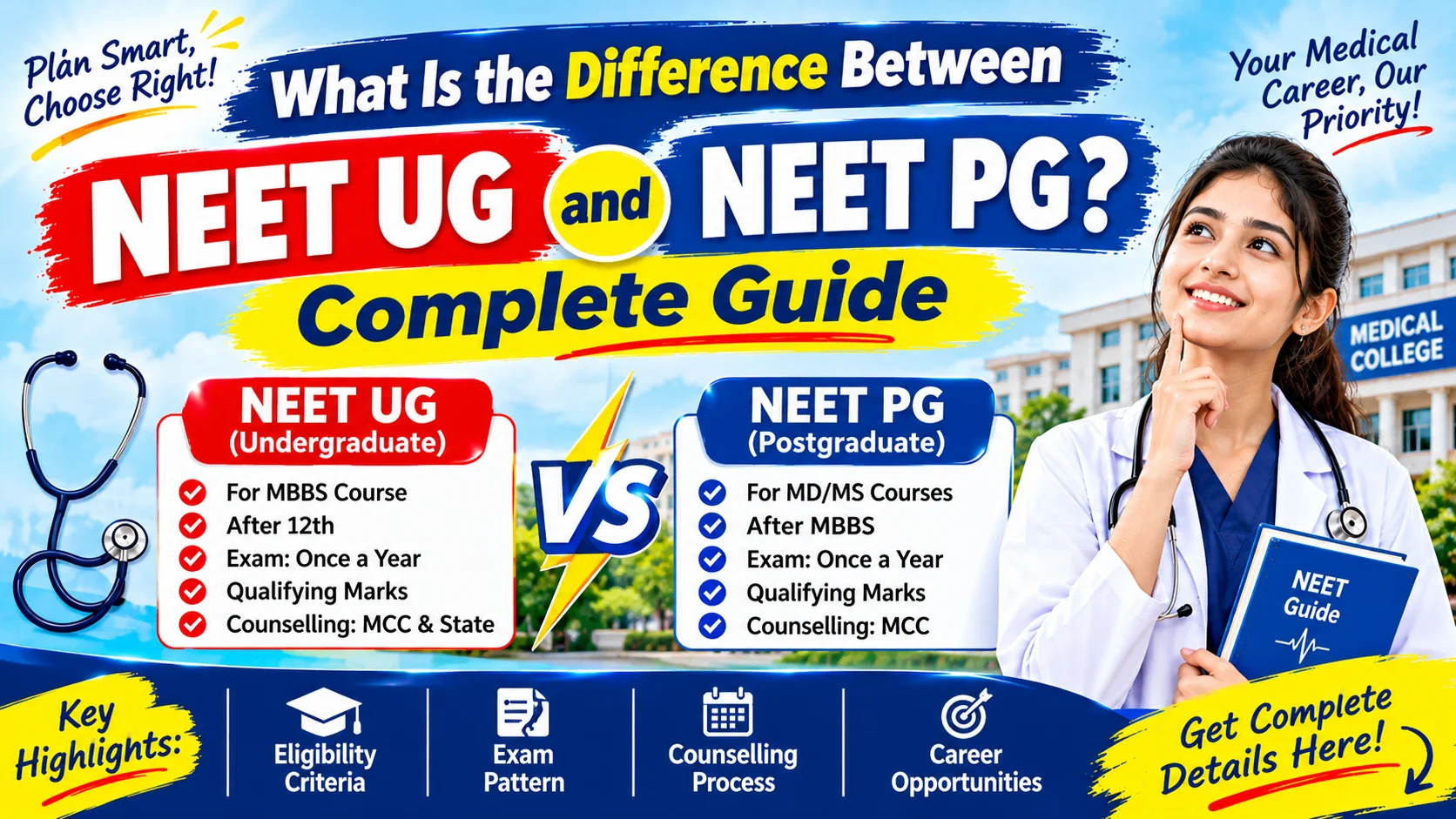
Medical education in India offers several career opportunities. However, students must qualify for the relevant entrance examinations to get admission to medical colleges.Two important medical entrance examinations in India are NEET UG and NEET PG.Although both exams are related to medical education, they serve different purposes. NEET UG is conducted for students who want to pursue undergraduate medical courses after Class 12, whereas NEET PG is for eligible MBBS graduates who want to pursue postgraduate medical education.Many students and parents are often confused about the differences between these examinations, including their eligibility criteria, subjects, exam patterns, admission processes and career opportunities.In this complete guide, we will explain everything you need to know about NEET UG and NEET PG, including their major differences and educational requirements.
1. What Is NEET UG?
NEET UG stands for National Eligibility cum Entrance Test (Undergraduate). It is a national-level medical entrance examination conducted by the National Testing Agency (NTA). Students who want to pursue undergraduate medical courses in India generally need to qualify for this examination.Students who have completed or are appearing for their Class 12 examinations with the required subjects can apply, provided they meet the eligibility conditions.The main purpose of NEET UG is to provide a common entrance examination for admission to various undergraduate medical courses.
Courses Offered Through NEET UG
Some of the major courses include:
- MBBS: Bachelor of Medicine and Bachelor of Surgery.
- BDS: Bachelor of Dental Surgery.
- BAMS: Bachelor of Ayurvedic Medicine and Surgery.
- BHMS: Bachelor of Homeopathic Medicine and Surgery.
- BSMS: Bachelor of Siddha Medicine and Surgery.
- BUMS: Bachelor of Unani Medicine and Surgery.
Admission depends on the applicable regulations, eligibility requirements, counselling process and availability of seats.
Who Can Apply for NEET UG?
Students generally need to:
- Complete or appear for Class 12 or an equivalent examination.
- Study Physics, Chemistry and Biology/Biotechnology with the required subjects.
- Meet the applicable age and eligibility requirements.
- Fulfil the conditions mentioned in the official information bulletin.
For the latest notifications, eligibility criteria and examination updates, visit the official NEET UG website.
2. What Is NEET PG?
NEET PG stands for National Eligibility cum Entrance Test (Postgraduate). It is a national-level entrance examination for eligible medical graduates who want to pursue postgraduate medical courses in India.Unlike NEET UG, NEET PG is generally taken after completing an MBBS degree and fulfilling the applicable internship and medical registration requirements.The examination is conducted by the National Board of Examinations in Medical Sciences (NBEMS).
Courses Offered Through NEET PG
NEET PG is used for admission to eligible postgraduate medical courses, including:
- MD: Doctor of Medicine.
- MS: Master of Surgery.
- PG Diploma: Eligible postgraduate diploma courses, where applicable.
These courses allow medical graduates to develop advanced knowledge and skills in specific medical fields.
Who Can Apply for NEET PG?
Applicants generally need to:
- Hold an MBBS degree or an eligible provisional pass certificate.
- Complete their compulsory internship by the prescribed deadline.
- Meet the applicable medical registration requirements.
- Fulfil all conditions mentioned in the official information bulletin.
For examination notifications and eligibility details, visit the National Board of Examinations in Medical Sciences website.
3. Key Differences Between NEET UG and NEET PG
Although both examinations are important for medical education, they differ in several ways.
The following table highlights their major differences.
|
Comparison |
NEET UG |
NEET PG |
|
Full Name |
National Eligibility cum Entrance Test (Undergraduate) |
National Eligibility cum Entrance Test (Postgraduate) |
|
Purpose |
Admission to undergraduate medical courses |
Admission to postgraduate medical courses |
|
Conducting Body |
NTA |
NBEMS |
|
Eligibility |
Class 12 with required subjects |
MBBS qualification and other requirements |
|
Main Subjects |
Physics, Chemistry and Biology |
MBBS medical subjects |
|
Education Level |
Undergraduate |
Postgraduate |
|
Main Courses |
MBBS, BDS and other eligible courses |
MD, MS and eligible PG Diploma courses |
|
Exam Taken After |
Class 12 |
MBBS |
|
Counselling |
Applicable undergraduate counselling authorities |
Applicable postgraduate counselling authorities |
|
Main Goal |
Begin medical education |
Pursue postgraduate medical specialisation |
Important: Examination patterns, eligibility requirements and admission procedures may change. Always check the latest official information bulletin before applying.
4. Eligibility Criteria for NEET UG and NEET PG
One of the biggest differences between these examinations is their eligibility criteria.
NEET UG Eligibility
Students applying for NEET UG generally need to:
- Complete Class 12 or an equivalent examination.
- Study Physics, Chemistry and Biology/Biotechnology with the required subjects.
- Meet the prescribed age requirements.
- Fulfil the applicable educational and category-related conditions.
Students should carefully check the latest official NTA information bulletin before submitting their applications. You can find the latest examination details on the NEET UG official website.
NEET PG Eligibility
Candidates applying for NEET PG generally need to:
- Possess an eligible MBBS qualification.
- Complete the compulsory rotating internship by the prescribed deadline.
- Meet the applicable medical registration requirements.
- Fulfil the eligibility conditions mentioned in the NBEMS information bulletin.
Therefore, NEET UG is intended for students beginning their medical education, whereas NEET PG is for eligible medical graduates pursuing further education.
5. Subjects Covered in NEET UG and NEET PG
Another major difference between NEET UG and NEET PG is their syllabus.
NEET UG Subjects
NEET UG mainly covers three subjects:
1. Physics
Important topics include:
- Mechanics
- Electricity
- Magnetism
- Optics
- Modern Physics
2. Chemistry
The subject is divided into three major areas:
- Physical Chemistry
- Organic Chemistry
- Inorganic Chemistry
3. Biology
Important topics include:
- Botany
- Zoology
- Genetics
- Ecology
- Human Physiology
The syllabus is based on the applicable Class 11 and Class 12 curriculum.
NEET PG Subjects
NEET PG tests the medical knowledge gained during MBBS.
Some important subjects include:
- Anatomy
- Physiology
- Biochemistry
- Pathology
- Pharmacology
- Microbiology
- Forensic Medicine
- Community Medicine
- General Medicine
- General Surgery
- Obstetrics and Gynaecology
- Paediatrics
- Orthopaedics
- Ophthalmology
- ENT
The examination assesses candidates' understanding of medical concepts across different areas of undergraduate medical education.
6. Exam Pattern of NEET UG and NEET PG
Both examinations use multiple-choice questions (MCQs), but their examination formats and requirements are different.
NEET UG Exam Pattern
NEET UG generally:
- Is conducted as a written examination.
- Covers Physics, Chemistry and Biology.
- Uses multiple-choice questions.
- Follows the marking scheme announced by NTA.
The exact number of questions, examination duration and marking scheme should be checked in the latest official notification.
NEET PG Exam Pattern
NEET PG generally:
- Is conducted as a computer-based examination.
- Covers subjects from the MBBS curriculum.
- Uses multiple-choice questions.
- Tests medical knowledge and clinical understanding.
Candidates should check the latest NBEMS information bulletin for the current examination format, duration and marking scheme.
7. Difficulty Level: NEET UG vs NEET PG
Both examinations are competitive, but their difficulty levels depend on the knowledge and preparation required.
NEET UG Difficulty
NEET UG tests students' understanding of Physics, Chemistry and Biology.
Candidates need:
- Strong conceptual knowledge.
- Good problem-solving skills.
- Regular practice of MCQs.
- Proper time management.
- Consistent revision.
Since many students compete for limited medical seats, preparation and examination strategy are important.
NEET PG Difficulty
NEET PG requires knowledge of multiple medical subjects studied during MBBS.
Candidates need to understand:
- Medical concepts.
- Clinical scenarios.
- Diagnosis-related topics.
- Treatment principles.
- Different medical specialities.
The syllabus covers a large portion of undergraduate medical education, so candidates generally need a different preparation strategy from NEET UG.
8. What Happens After Qualifying NEET UG?
Students who qualify for NEET UG and meet the applicable admission requirements can participate in the counselling process.
Admission depends on factors such as:
- NEET rank.
- Eligibility.
- Category.
- College preferences.
- Availability of seats.
General Admission Process
- NEET UG results are announced.
- Eligible candidates register for counselling.
- Candidates fill in their preferred colleges and courses.
- Seats are allocated according to the applicable counselling rules.
- Document verification takes place.
- Candidates complete admission formalities at the allotted college.
Students applying for MBBS seats may participate in counselling conducted by the relevant central or state authorities.
Duration of MBBS
The MBBS programme generally includes:
- Approximately 4.5 years of academic education.
- One year of compulsory rotating internship.
After completing the course and fulfilling the applicable requirements, graduates can proceed towards medical registration and professional practice. For information about medical education regulations in India, visit the National Medical Commission (NMC).
9. What Happens After Qualifying NEET PG?
Candidates who qualify for NEET PG and meet the admission requirements can participate in postgraduate medical counselling. They can select their preferred specialisation and medical colleges according to their rank, eligibility and available seats.
General Admission Process
- NEET PG results are announced.
- Eligible candidates register for postgraduate counselling.
- Candidates select their preferred courses and colleges.
- Seats are allocated according to the applicable rules.
- Document verification is completed.
- Candidates report to their allotted medical colleges.
Duration of Postgraduate Courses
MD and MS courses are generally three years long. After completing postgraduate education, doctors may explore further training, fellowships, research opportunities or specialist medical practice, subject to applicable requirements.
10. Career Opportunities After NEET UG and NEET PG
Both examinations provide opportunities at different stages of medical education.
Career Opportunities After NEET UG
Students who qualify for NEET UG and successfully complete their selected courses can explore different healthcare careers.
Examples include:
- MBBS: Graduates can pursue medical practice after fulfilling the applicable registration and licensing requirements.
- BDS: Graduates can pursue careers in dentistry.
- BAMS: Graduates can pursue careers in Ayurveda.
- BHMS: Graduates can pursue careers in homeopathic medicine.
- BSMS and BUMS: Graduates can pursue careers in their respective systems of medicine.
Career opportunities depend on the qualification and applicable professional regulations.
Career Opportunities After NEET PG
Doctors who complete postgraduate medical education can develop specialist knowledge in different areas.
Some popular specialisations include:
- General Medicine
- General Surgery
- Paediatrics
- Dermatology
- Radiology
- Anaesthesiology
- Orthopaedics
- Obstetrics and Gynaecology
Postgraduate education helps doctors gain advanced medical knowledge and develop specialist skills.
11. Which Exam Should You Choose: NEET UG or NEET PG?
Neither examination is better than the other because both serve different purposes.
The right examination depends on your current educational qualification and career goals.
Choose NEET UG If:
- You are completing or have completed Class 12.
- You want to begin your medical education.
- You are interested in studying MBBS, BDS or another eligible undergraduate course.
Choose NEET PG If:
- You have completed an eligible MBBS qualification.
- You want to pursue postgraduate medical education.
- You want to specialise in a particular medical field.
Both examinations are important steps in India's medical education system.
12. Useful Websites for Medical Students
Students preparing for medical entrance examinations should always use reliable and official sources.
Here are some useful websites:
Useful for NEET UG notifications, application details, examination updates and official information.
2. National Medical Commission (NMC)
Provides information about medical education regulations, recognised qualifications and medical institutions in India.
3. National Board of Examinations in Medical Sciences (NBEMS)
Useful for NEET PG notifications, examination information and postgraduate medical examination updates.
4. World Directory of Medical Schools (WDOMS)
Provides a directory of medical schools around the world. Students can use it to check information about listed medical schools.
5. World Health Organization (WHO)
Provides global health information, medical research, health guidelines and public health resources.
6. MBBS Advisor
Provides medical education-related information and resources that may help students understand medical courses and admission-related topics.
Conclusion
NEET UG and NEET PG are two important entrance examinations in India's medical education system.NEET UG provides eligible students with an opportunity to pursue undergraduate medical courses after Class 12. On the other hand, NEET PG allows eligible MBBS graduates to pursue postgraduate medical education and develop specialist knowledge.The biggest differences between these examinations are their purpose, eligibility criteria, syllabus, examination pattern and level of education.If you want to become a doctor, it is important to understand your educational goals and prepare for the examination that matches your current qualification.Remember, NEET UG is a gateway to undergraduate medical education, while NEET PG is a pathway towards postgraduate medical specialisation.With proper guidance, reliable information and consistent preparation, students can take informed steps towards building a career in healthcare.