MBBS Advisor
MBBS Advisor Your Study Abroad Partner
Study Destinations
🏥
MBBS Abroad
16+ countries available
Exams & Prep
📋
NEET UG 2026 Hot
Exam, Counselling, Result
🩺
NEET PG 2026
PG Medical Entrance
Discover
🧮
Galery
🧮
Neet Rank Predictor
✍️
Blogs
📰
News
ℹ️
About Us
🏢
City
🗺️
Top Destination
🎓
University

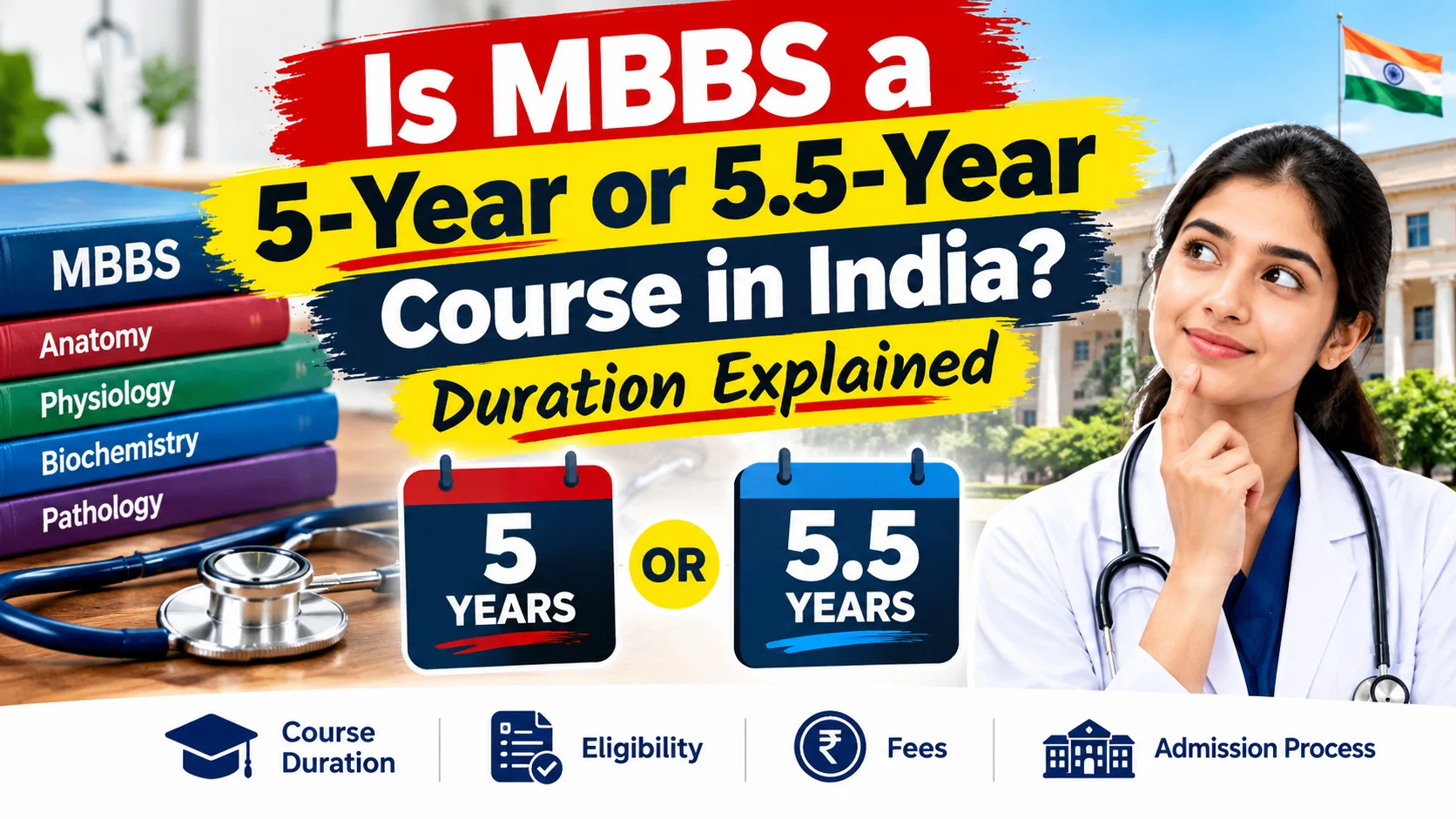
Is MBBS a 5-Year or 5.5-Year Course in India? Duration Explained

Published on : 16 Nov 2026 Views: 2014

Is MBBS a 5-Year or 5.5-Year Course in India? Duration Explained

Introduction

An MBBS course in India takes 5.5 years to complete, including a mandatory one-year rotating medical internship. However, the actual academic study period is 4.5 years, equivalent to 54 months.The National Medical Commission (NMC) has outlined that an MBBS course consists of 4.5 years of academic study followed by a compulsory one-year rotating medical internship. This structure is explained under its Competency-Based Medical Education (CBME) framework.Furthermore, in a public notice dated 7 April 2026, the NMC clarified that MBBS course fees should be charged for the prescribed 4.5-year academic study period. Students should understand the difference between academic education and the compulsory internship when planning their medical studies.For students wishing to pursue medicine as a career, understanding the complete course duration is important. It helps them plan their education, finances, internship and future medical registration.

Is MBBS a 5-Year or 5.5-Year Course in India?

The standard MBBS programme in India takes a total of 5.5 years to complete. It includes two main components:

  • Academic study: 4.5 years, equivalent to 54 months.
  • Mandatory rotating medical internship: 1 year, equivalent to 12 months.

Students spend 4.5 years studying medical subjects, attending practical lessons and gaining clinical knowledge. After passing the required final MBBS examinations, they must complete their compulsory internship.The internship is an important part of medical education because students gain supervised, hands-on experience in hospitals.

MBBS Course Duration at a Glance

Course component

Duration

Academic study

4.5 years

Mandatory rotating medical internship

1 year

Total course duration

5.5 years

Therefore, it is not accurate to describe the standard MBBS programme as only a five-year course. It normally takes 5.5 years, provided students do not face academic delays or require additional examination attempts.

Why Is MBBS Divided Into 4.5 Years of Study and One Year of Internship?

Medical education is not limited to classroom teaching and written examinations. Students need to understand human anatomy, identify diseases, learn diagnostic methods and develop practical skills.The first 4.5 years are dedicated to academic learning and clinical education. Students study medical subjects, attend lectures, participate in laboratory sessions and gain supervised clinical exposure.The final one-year internship allows them to apply their knowledge in a hospital environment.

The two parts have different purposes:

  • Academic study: Develops medical knowledge, theoretical understanding and clinical skills.
  • Internship: Provides practical hospital experience and supervised patient-care training.

Both stages are essential for completing undergraduate medical education.

How Long Is an MBBS Course in India? Year-by-Year Explanation

The 4.5-year academic programme is organised into professional phases. Students begin with basic medical sciences and gradually progress towards clinical subjects and practical patient care.

1. First Professional Phase – 12 Months

The first professional phase introduces students to the basic sciences that form the foundation of medical education.

Main subjects:

  • Anatomy
  • Physiology
  • Biochemistry

Students learn about the human body, how different organs function and the chemical processes needed to maintain good health.

What will students learn?

  • Anatomy explains the structure of the human body, including organs, tissues, bones and muscles.
  • Physiology teaches how different body systems function.
  • Biochemistry covers the chemical processes that support normal bodily activities.

Students are also introduced to communication skills, medical ethics and professional responsibilities.

2. Second Professional Phase – 12 Months

The second professional phase focuses on diseases, microorganisms, medicines and their effects on the human body.

Main subjects:

  • Pathology
  • Pharmacology
  • Microbiology

Students develop an understanding of how diseases develop, how infections spread and how medicines work.

What will students learn?

  • Pathology explains the causes and effects of diseases.
  • Pharmacology covers medicines, their actions and potential side effects.
  • Microbiology introduces microorganisms such as bacteria, viruses, fungi and parasites.

Students also begin developing a stronger understanding of clinical subjects and their application in patient care.

3. Third Professional Phase – Part I (12 Months)

This phase introduces students to more advanced medical subjects and clinical learning.

Key subjects and clinical areas include:

  • Community Medicine
  • Forensic Medicine and Toxicology
  • General Medicine and allied subjects
  • General Surgery and allied subjects
  • Paediatrics
  • Obstetrics and Gynaecology

Students learn about public health, disease prevention, legal aspects of medicine and the diagnosis and management of common medical conditions.Clinical exposure becomes increasingly important during this phase. Students may attend hospital postings, observe patient examinations and understand how doctors communicate with patients.

4. Third Professional Phase – Part II (18 Months)

The final academic phase is the longest part of the MBBS study programme. It focuses on clinical subjects and the development of practical medical knowledge.

Main subjects and clinical areas include:

  • General Medicine
  • General Surgery
  • Paediatrics
  • Obstetrics and Gynaecology
  • Orthopaedics
  • Ophthalmology
  • Otorhinolaryngology (ENT)
  • Dermatology
  • Psychiatry
  • Respiratory Medicine
  • Anaesthesiology
  • Radiodiagnosis

Students gain further clinical experience and learn how to assess patients, understand symptoms, interpret investigations and participate in treatment planning under supervision.After completing the academic programme, students must pass the relevant university examinations and meet the required academic criteria before progressing to the compulsory internship.

What Is a Mandatory Rotating Medical Internship?

A Compulsory Rotating Medical Internship (CRMI) is a one-year practical training period that students must complete after passing the final MBBS examination.During this period, medical graduates work in approved hospitals under the supervision of qualified doctors.The main purpose of the internship is to provide practical experience and help students apply their academic knowledge in real clinical situations.

Which Departments Will Students Rotate Through?

Students rotate through various medical departments as prescribed by the applicable regulations and training requirements.

These may include:

  • General Medicine
  • General Surgery
  • Obstetrics and Gynaecology
  • Paediatrics
  • Community Medicine
  • Orthopaedics
  • Emergency Medicine
  • Ophthalmology
  • ENT
  • Other prescribed clinical departments

The rotation schedule must follow the relevant NMC requirements and institutional arrangements.

What Will Students Do During Their Internship?

Students gain supervised experience of everyday hospital activities. Their responsibilities depend on the department, training requirements and level of supervision.

Typical activities may include:

  1. Observing and assisting with patient examinations.
  2. Recording patient histories and clinical information.
  3. Learning how to assess common medical conditions.
  4. Participating in ward rounds under supervision.
  5. Understanding diagnostic investigations.
  6. Assisting with appropriate clinical procedures.
  7. Learning about emergency care and patient communication.

This experience helps students connect the medical knowledge they have gained during their academic studies with real-life clinical situations.The internship is not another year of classroom learning. It is a practical training period that forms an essential part of medical education.

Can Students Get Their MBBS Without Completing an Internship?

No. Students cannot choose to skip the compulsory internship.The rotating medical internship is an essential part of undergraduate medical education. Simply passing the required university examinations does not exempt students from completing this training.According to the NMC's Compulsory Rotating Medical Internship Regulations, students must complete the prescribed 12-month internship according to the applicable requirements and under appropriate supervision.Students should check their university guidelines and the latest NMC regulations for the rules applicable to their admission batch.

For official information, visit the National Medical Commission (NMC) website.

Can an MBBS Course Last Longer Than 5.5 Years?

Although the standard MBBS programme lasts 5.5 years, some students may take longer to complete it.The overall duration can increase because of academic, personal or administrative circumstances.

Possible reasons include:

  • Failing a professional examination and needing another attempt.
  • Not meeting the required attendance criteria.
  • Having to repeat a subject or academic phase.
  • Delays in starting or completing the internship.
  • Changes to university examination schedules.
  • Medical or personal circumstances affecting academic progress.

Students should understand that 5.5 years is the standard programme duration, not a guarantee that every student will finish within exactly that period.Examination attempts, academic progression and course completion depend on the applicable NMC and university regulations.

How Much Does a 5.5-Year MBBS Course Cost?

The total cost of MBBS depends on the medical college, state, admission category and approved fee structure.Government medical colleges generally have lower tuition fees than private medical colleges. Private institutions may charge considerably higher fees depending on their approved fee structure.

Students should consider the following expenses:

Expense

What it covers

Tuition fees

Academic teaching and institutional charges

Hostel fees

Accommodation, where applicable

Food expenses

Mess charges or personal food costs

Books and study materials

Textbooks, reference materials and supplies

Examination fees

University and examination-related charges

Personal expenses

Transport, clothing and daily requirements

Students and parents should request a complete written fee structure before accepting admission.

Important NMC Guidelines on MBBS Fees in 2026

In a public notice dated 7 April 2026, the NMC addressed complaints about medical colleges charging students for the full five or 5.5-year MBBS period.The Commission clarified that the prescribed programme consists of 4.5 years of academic study followed by one year of compulsory internship. It instructed medical colleges, institutions and universities under its purview to charge MBBS course fees for the prescribed 4.5-year academic period. Students should be aware of this clarification when reviewing their admission letters and fee schedules.

Before paying fees, students should:

  1. Request a complete written copy of the fee structure.
  2. Check that academic tuition charges are clearly identified.
  3. Review hostel and mess charges separately.
  4. Ask for clarification about any internship-related charges.
  5. Keep copies of payment receipts and admission documents.
  6. Check the latest NMC notices and applicable institutional rules.

Students should not assume that all expenses are included in tuition fees or that every medical college follows an identical fee structure.

Is the Duration of MBBS in India Different From MBBS Abroad?

Students sometimes compare the duration of MBBS in India with medical programmes offered in countries such as Kazakhstan, Kyrgyzstan, Russia and Georgia.The total duration of medical education abroad varies according to the country's education system, university curriculum and internship arrangements.Some international medical programmes are advertised as six-year courses, while others may have different academic and clinical training structures.However, students should not compare medical programmes only by their duration.Indian students who plan to study medicine abroad and return to practise in India must carefully check the applicable Foreign Medical Graduate Licentiate Regulations and other NMC requirements.

Important factors to check include:

  • Total course duration.
  • Medium of instruction.
  • Clinical training and hospital exposure.
  • Internship requirements.
  • Eligibility for medical registration in the country of study.
  • Compliance with applicable Indian regulations.

A medical degree from another country does not automatically make a student eligible to practise in India.Students can use the World Directory of Medical Schools (WDOMS) to check whether a medical school is listed. However, a WDOMS listing alone does not guarantee NMC recognition or eligibility for medical registration in India.For general international health information, students can also refer to the World Health Organization (WHO).Those exploring medical education options can visit MBBS Advisor for general information about MBBS admissions, medical universities and study opportunities.

Why Is It Important to Know How Long an MBBS Course Lasts?

Choosing to study MBBS is a major academic and financial commitment. Understanding the complete course duration helps students and families plan more effectively.

1. Financial Planning

Knowing the course duration helps families estimate tuition fees, accommodation, food, books and other expenses.

2. Career Planning

Students can understand when they are likely to complete their academic examinations and compulsory internship.

3. Academic Preparation

Knowing the professional phases helps students prepare for different subjects, examinations and clinical responsibilities.

4. Internship Planning

Understanding the course structure helps students prepare for the compulsory hospital training period.

5. Medical Registration

Students can plan for the applicable registration requirements after completing their academic studies and internship. Students should always refer to official college documents and NMC regulations rather than relying only on information from unofficial websites or admission agents.

Conclusion

An MBBS course in India takes 5.5 years to complete. This includes 4.5 years of academic study and one year of compulsory rotating medical internship. The academic period is divided into professional phases. Students study basic medical sciences, clinical subjects and practical medical skills. After passing the required examinations, they must complete their internship in approved hospitals under supervision. In its public notice dated 7 April 2026, the NMC clarified that MBBS course fees should be charged for the prescribed 4.5-year academic period. Students should consider this clarification when reviewing admission documents and fee arrangements. If you are planning to pursue medicine, understanding the course structure is important for making informed decisions about your education, finances and future career. Always refer to the latest NMC regulations and university guidelines.

Frequently Asked Questions (FAQs)

1. Is MBBS a 5-Year or 5.5-Year Course in India?

MBBS is a 5.5-year programme in India. It includes 4.5 years of academic study and one year of compulsory rotating medical internship.

2. Why Is MBBS a 5.5-Year Course?

The standard programme takes 5.5 years because students complete 54 months of academic study followed by 12 months of compulsory internship.

3. Is the Internship Included in the Duration of MBBS?

Yes. The one-year compulsory rotating medical internship is an integral part of the overall MBBS programme.

4. How Many Years Do Students Study Before Their Internship?

Students complete 4.5 years, or 54 months, of academic study before beginning their one-year compulsory internship.

5. Can Students Become Doctors Immediately After Passing Their Final MBBS Examinations?

No. Students must still complete their compulsory internship and satisfy the applicable medical registration requirements before obtaining the relevant permission to practise independently.

6. What Subjects Are Taught in the First Year of MBBS?

The main subjects in the first professional phase are Anatomy, Physiology and Biochemistry. Students are also introduced to medical ethics, communication skills and professionalism.

7. Is an MBBS Internship Mandatory in India?

Yes. Students must complete the compulsory rotating medical internship according to the applicable NMC regulations. It is an essential part of undergraduate medical education.

8. Can an MBBS Course Take Longer Than 5.5 Years?

Yes. Students may take longer if they need additional examination attempts, have attendance issues or experience delays in completing academic requirements or internship.

9. Can Medical Colleges Charge MBBS Fees for the Full 5.5 Years?

In its public notice dated 7 April 2026, the NMC clarified that MBBS course fees should be charged for the prescribed 4.5-year academic period. Students should check the notice and applicable fee rules when reviewing their college's fee structure.

10. Is MBBS Abroad Also a 5.5-Year Course?

Not necessarily. Medical course duration varies between countries and universities. Some programmes may take six years or follow different academic and internship structures. Indian students should check the applicable NMC requirements before choosing a foreign medical university.


Enquiry Form

Recent blogs

WhatsApp Call Now

Is MBBS a 5-Year or 5.5-Year Course in India? Duration Explained

Published on : 16 Nov 2026 Views: 2014

Is MBBS a 5-Year or 5.5-Year Course in India? Duration Explained

Introduction

An MBBS course in India takes 5.5 years to complete, including a mandatory one-year rotating medical internship. However, the actual academic study period is 4.5 years, equivalent to 54 months.The National Medical Commission (NMC) has outlined that an MBBS course consists of 4.5 years of academic study followed by a compulsory one-year rotating medical internship. This structure is explained under its Competency-Based Medical Education (CBME) framework.Furthermore, in a public notice dated 7 April 2026, the NMC clarified that MBBS course fees should be charged for the prescribed 4.5-year academic study period. Students should understand the difference between academic education and the compulsory internship when planning their medical studies.For students wishing to pursue medicine as a career, understanding the complete course duration is important. It helps them plan their education, finances, internship and future medical registration.

Is MBBS a 5-Year or 5.5-Year Course in India?

The standard MBBS programme in India takes a total of 5.5 years to complete. It includes two main components:

  • Academic study: 4.5 years, equivalent to 54 months.
  • Mandatory rotating medical internship: 1 year, equivalent to 12 months.

Students spend 4.5 years studying medical subjects, attending practical lessons and gaining clinical knowledge. After passing the required final MBBS examinations, they must complete their compulsory internship.The internship is an important part of medical education because students gain supervised, hands-on experience in hospitals.

MBBS Course Duration at a Glance

Course component

Duration

Academic study

4.5 years

Mandatory rotating medical internship

1 year

Total course duration

5.5 years

Therefore, it is not accurate to describe the standard MBBS programme as only a five-year course. It normally takes 5.5 years, provided students do not face academic delays or require additional examination attempts.

Why Is MBBS Divided Into 4.5 Years of Study and One Year of Internship?

Medical education is not limited to classroom teaching and written examinations. Students need to understand human anatomy, identify diseases, learn diagnostic methods and develop practical skills.The first 4.5 years are dedicated to academic learning and clinical education. Students study medical subjects, attend lectures, participate in laboratory sessions and gain supervised clinical exposure.The final one-year internship allows them to apply their knowledge in a hospital environment.

The two parts have different purposes:

  • Academic study: Develops medical knowledge, theoretical understanding and clinical skills.
  • Internship: Provides practical hospital experience and supervised patient-care training.

Both stages are essential for completing undergraduate medical education.

How Long Is an MBBS Course in India? Year-by-Year Explanation

The 4.5-year academic programme is organised into professional phases. Students begin with basic medical sciences and gradually progress towards clinical subjects and practical patient care.

1. First Professional Phase – 12 Months

The first professional phase introduces students to the basic sciences that form the foundation of medical education.

Main subjects:

  • Anatomy
  • Physiology
  • Biochemistry

Students learn about the human body, how different organs function and the chemical processes needed to maintain good health.

What will students learn?

  • Anatomy explains the structure of the human body, including organs, tissues, bones and muscles.
  • Physiology teaches how different body systems function.
  • Biochemistry covers the chemical processes that support normal bodily activities.

Students are also introduced to communication skills, medical ethics and professional responsibilities.

2. Second Professional Phase – 12 Months

The second professional phase focuses on diseases, microorganisms, medicines and their effects on the human body.

Main subjects:

  • Pathology
  • Pharmacology
  • Microbiology

Students develop an understanding of how diseases develop, how infections spread and how medicines work.

What will students learn?

  • Pathology explains the causes and effects of diseases.
  • Pharmacology covers medicines, their actions and potential side effects.
  • Microbiology introduces microorganisms such as bacteria, viruses, fungi and parasites.

Students also begin developing a stronger understanding of clinical subjects and their application in patient care.

3. Third Professional Phase – Part I (12 Months)

This phase introduces students to more advanced medical subjects and clinical learning.

Key subjects and clinical areas include:

  • Community Medicine
  • Forensic Medicine and Toxicology
  • General Medicine and allied subjects
  • General Surgery and allied subjects
  • Paediatrics
  • Obstetrics and Gynaecology

Students learn about public health, disease prevention, legal aspects of medicine and the diagnosis and management of common medical conditions.Clinical exposure becomes increasingly important during this phase. Students may attend hospital postings, observe patient examinations and understand how doctors communicate with patients.

4. Third Professional Phase – Part II (18 Months)

The final academic phase is the longest part of the MBBS study programme. It focuses on clinical subjects and the development of practical medical knowledge.

Main subjects and clinical areas include:

  • General Medicine
  • General Surgery
  • Paediatrics
  • Obstetrics and Gynaecology
  • Orthopaedics
  • Ophthalmology
  • Otorhinolaryngology (ENT)
  • Dermatology
  • Psychiatry
  • Respiratory Medicine
  • Anaesthesiology
  • Radiodiagnosis

Students gain further clinical experience and learn how to assess patients, understand symptoms, interpret investigations and participate in treatment planning under supervision.After completing the academic programme, students must pass the relevant university examinations and meet the required academic criteria before progressing to the compulsory internship.

What Is a Mandatory Rotating Medical Internship?

A Compulsory Rotating Medical Internship (CRMI) is a one-year practical training period that students must complete after passing the final MBBS examination.During this period, medical graduates work in approved hospitals under the supervision of qualified doctors.The main purpose of the internship is to provide practical experience and help students apply their academic knowledge in real clinical situations.

Which Departments Will Students Rotate Through?

Students rotate through various medical departments as prescribed by the applicable regulations and training requirements.

These may include:

  • General Medicine
  • General Surgery
  • Obstetrics and Gynaecology
  • Paediatrics
  • Community Medicine
  • Orthopaedics
  • Emergency Medicine
  • Ophthalmology
  • ENT
  • Other prescribed clinical departments

The rotation schedule must follow the relevant NMC requirements and institutional arrangements.

What Will Students Do During Their Internship?

Students gain supervised experience of everyday hospital activities. Their responsibilities depend on the department, training requirements and level of supervision.

Typical activities may include:

  1. Observing and assisting with patient examinations.
  2. Recording patient histories and clinical information.
  3. Learning how to assess common medical conditions.
  4. Participating in ward rounds under supervision.
  5. Understanding diagnostic investigations.
  6. Assisting with appropriate clinical procedures.
  7. Learning about emergency care and patient communication.

This experience helps students connect the medical knowledge they have gained during their academic studies with real-life clinical situations.The internship is not another year of classroom learning. It is a practical training period that forms an essential part of medical education.

Can Students Get Their MBBS Without Completing an Internship?

No. Students cannot choose to skip the compulsory internship.The rotating medical internship is an essential part of undergraduate medical education. Simply passing the required university examinations does not exempt students from completing this training.According to the NMC's Compulsory Rotating Medical Internship Regulations, students must complete the prescribed 12-month internship according to the applicable requirements and under appropriate supervision.Students should check their university guidelines and the latest NMC regulations for the rules applicable to their admission batch.

For official information, visit the National Medical Commission (NMC) website.

Can an MBBS Course Last Longer Than 5.5 Years?

Although the standard MBBS programme lasts 5.5 years, some students may take longer to complete it.The overall duration can increase because of academic, personal or administrative circumstances.

Possible reasons include:

  • Failing a professional examination and needing another attempt.
  • Not meeting the required attendance criteria.
  • Having to repeat a subject or academic phase.
  • Delays in starting or completing the internship.
  • Changes to university examination schedules.
  • Medical or personal circumstances affecting academic progress.

Students should understand that 5.5 years is the standard programme duration, not a guarantee that every student will finish within exactly that period.Examination attempts, academic progression and course completion depend on the applicable NMC and university regulations.

How Much Does a 5.5-Year MBBS Course Cost?

The total cost of MBBS depends on the medical college, state, admission category and approved fee structure.Government medical colleges generally have lower tuition fees than private medical colleges. Private institutions may charge considerably higher fees depending on their approved fee structure.

Students should consider the following expenses:

Expense

What it covers

Tuition fees

Academic teaching and institutional charges

Hostel fees

Accommodation, where applicable

Food expenses

Mess charges or personal food costs

Books and study materials

Textbooks, reference materials and supplies

Examination fees

University and examination-related charges

Personal expenses

Transport, clothing and daily requirements

Students and parents should request a complete written fee structure before accepting admission.

Important NMC Guidelines on MBBS Fees in 2026

In a public notice dated 7 April 2026, the NMC addressed complaints about medical colleges charging students for the full five or 5.5-year MBBS period.The Commission clarified that the prescribed programme consists of 4.5 years of academic study followed by one year of compulsory internship. It instructed medical colleges, institutions and universities under its purview to charge MBBS course fees for the prescribed 4.5-year academic period. Students should be aware of this clarification when reviewing their admission letters and fee schedules.

Before paying fees, students should:

  1. Request a complete written copy of the fee structure.
  2. Check that academic tuition charges are clearly identified.
  3. Review hostel and mess charges separately.
  4. Ask for clarification about any internship-related charges.
  5. Keep copies of payment receipts and admission documents.
  6. Check the latest NMC notices and applicable institutional rules.

Students should not assume that all expenses are included in tuition fees or that every medical college follows an identical fee structure.

Is the Duration of MBBS in India Different From MBBS Abroad?

Students sometimes compare the duration of MBBS in India with medical programmes offered in countries such as Kazakhstan, Kyrgyzstan, Russia and Georgia.The total duration of medical education abroad varies according to the country's education system, university curriculum and internship arrangements.Some international medical programmes are advertised as six-year courses, while others may have different academic and clinical training structures.However, students should not compare medical programmes only by their duration.Indian students who plan to study medicine abroad and return to practise in India must carefully check the applicable Foreign Medical Graduate Licentiate Regulations and other NMC requirements.

Important factors to check include:

  • Total course duration.
  • Medium of instruction.
  • Clinical training and hospital exposure.
  • Internship requirements.
  • Eligibility for medical registration in the country of study.
  • Compliance with applicable Indian regulations.

A medical degree from another country does not automatically make a student eligible to practise in India.Students can use the World Directory of Medical Schools (WDOMS) to check whether a medical school is listed. However, a WDOMS listing alone does not guarantee NMC recognition or eligibility for medical registration in India.For general international health information, students can also refer to the World Health Organization (WHO).Those exploring medical education options can visit MBBS Advisor for general information about MBBS admissions, medical universities and study opportunities.

Why Is It Important to Know How Long an MBBS Course Lasts?

Choosing to study MBBS is a major academic and financial commitment. Understanding the complete course duration helps students and families plan more effectively.

1. Financial Planning

Knowing the course duration helps families estimate tuition fees, accommodation, food, books and other expenses.

2. Career Planning

Students can understand when they are likely to complete their academic examinations and compulsory internship.

3. Academic Preparation

Knowing the professional phases helps students prepare for different subjects, examinations and clinical responsibilities.

4. Internship Planning

Understanding the course structure helps students prepare for the compulsory hospital training period.

5. Medical Registration

Students can plan for the applicable registration requirements after completing their academic studies and internship. Students should always refer to official college documents and NMC regulations rather than relying only on information from unofficial websites or admission agents.

Conclusion

An MBBS course in India takes 5.5 years to complete. This includes 4.5 years of academic study and one year of compulsory rotating medical internship. The academic period is divided into professional phases. Students study basic medical sciences, clinical subjects and practical medical skills. After passing the required examinations, they must complete their internship in approved hospitals under supervision. In its public notice dated 7 April 2026, the NMC clarified that MBBS course fees should be charged for the prescribed 4.5-year academic period. Students should consider this clarification when reviewing admission documents and fee arrangements. If you are planning to pursue medicine, understanding the course structure is important for making informed decisions about your education, finances and future career. Always refer to the latest NMC regulations and university guidelines.

Frequently Asked Questions (FAQs)

1. Is MBBS a 5-Year or 5.5-Year Course in India?

MBBS is a 5.5-year programme in India. It includes 4.5 years of academic study and one year of compulsory rotating medical internship.

2. Why Is MBBS a 5.5-Year Course?

The standard programme takes 5.5 years because students complete 54 months of academic study followed by 12 months of compulsory internship.

3. Is the Internship Included in the Duration of MBBS?

Yes. The one-year compulsory rotating medical internship is an integral part of the overall MBBS programme.

4. How Many Years Do Students Study Before Their Internship?

Students complete 4.5 years, or 54 months, of academic study before beginning their one-year compulsory internship.

5. Can Students Become Doctors Immediately After Passing Their Final MBBS Examinations?

No. Students must still complete their compulsory internship and satisfy the applicable medical registration requirements before obtaining the relevant permission to practise independently.

6. What Subjects Are Taught in the First Year of MBBS?

The main subjects in the first professional phase are Anatomy, Physiology and Biochemistry. Students are also introduced to medical ethics, communication skills and professionalism.

7. Is an MBBS Internship Mandatory in India?

Yes. Students must complete the compulsory rotating medical internship according to the applicable NMC regulations. It is an essential part of undergraduate medical education.

8. Can an MBBS Course Take Longer Than 5.5 Years?

Yes. Students may take longer if they need additional examination attempts, have attendance issues or experience delays in completing academic requirements or internship.

9. Can Medical Colleges Charge MBBS Fees for the Full 5.5 Years?

In its public notice dated 7 April 2026, the NMC clarified that MBBS course fees should be charged for the prescribed 4.5-year academic period. Students should check the notice and applicable fee rules when reviewing their college's fee structure.

10. Is MBBS Abroad Also a 5.5-Year Course?

Not necessarily. Medical course duration varies between countries and universities. Some programmes may take six years or follow different academic and internship structures. Indian students should check the applicable NMC requirements before choosing a foreign medical university.
WhatsApp Call Now