 Russia
 Belarus
 Georgia
 Kazakhstan
 Kyrgyzstan
 Uzbekistan
 China
China Nepal
Nepal Bangladesh
 Poland
 Romania
 Slovakia
 Hungary
 N. Macedonia
 Vietnam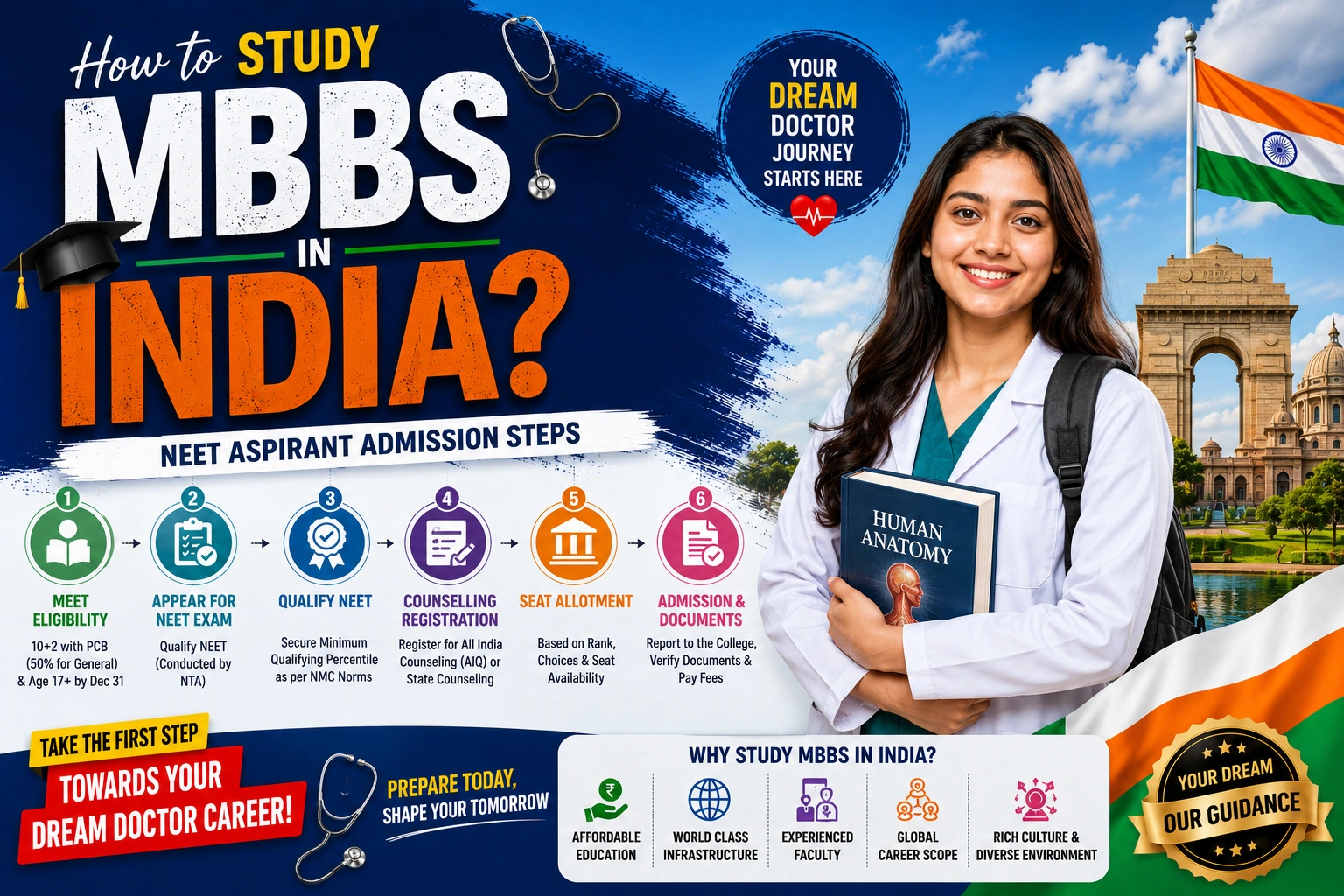
MBBS in India attracts millions of applicants every year. The combination of fierce competition, limited seats in public medical programs, and a formalized system of student placement means most applicants don’t know where to start. Knowing about all the steps from NEET preparations to placement and allotment to the final college is very important for these aspirants.
This guide provides you with all the steps and the most current info regarding MBBS admission in India, the qualifications required, and the counselling process, along with the documents required and professional tricks you can employ to have an edge over others in this race for a seat in a medical college. This guide will be useful for you whether you are a first-time NEET candidate or have attempted the exam multiple times.
MBBS Advisor is the perfect site for applicants in search of the most recent admission updates. MBBS Advisor shares counsel, updates on medical colleges, and provides comparisons and career guidance.
What is MBBS?
MBBS is an undergraduate medical degree which enables students to be licensed practitioners. The program lasts 5.5 years with a compulsory 1-year internship.
Core subjects are:
- Community Medicine
- Surgery
- Medicine
- Pediatrics
- Obstetrics & Gynecology
- Orthopedics
- Psychiatry
- Pathology
- Microbiology
- Pharmacology
- Physiology
- Biochemistry
- Anatomy
Post MBBS and internship, students become eligible to practice medicine in India after being registered with the NMC (National Medical Commission).
Why Choose MBBS in India?
India has one of the largest medical education systems in the world. As a developing nation, India has a lot of medical schools, and aspiring students compete to get into private and government medical schools, AIIMS, JIPMER, and deemed universities through the NEET examinations.
Some compelling advantages are:
- Medical education of global recognition and standard.
- Advanced clinical exposure.
- Economical government medical college fees.
- Well-equipped modern teaching hospitals.
- High patient inflow promotes engaging learning.
- Ample job prospects post-graduation.
- Qualification for post-graduation studies both in India and abroad.
Step 1: Know Your MBBS Eligibility
Before applying to a medical school, you should confirm your eligibility.
Typically, this means students must:
- Complete their 12th grade with the requisite subjects.
- Attain the minimum qualifying percentage set forth by the admission norms.
- Pass the NEET examination.
- Comply with the age and eligibility requirements for the admission year.
Eligibility norms are prone to changes; thus, confirm the standards before applying.
Step 2: Prepare for the NEET
NEET is the sole Entrance Test for admission to MBBS programs in India.
An excellent preparation plan must include the following:
- Complete knowledge and understanding of the syllabus.
- Practice and thorough study of NCERT textbooks.
- Solve previous years question papers.
- Attend regular timed mock exams for practice.
- Speed and accuracy with mock exams must be targeted.
- Mistakes should be noted and corrected.
Rather than focusing on the number of hours, students must create a flexible, well-structured study plan. Consistency and study flexibility is the key to success.
Step 3: Estimate Your Chances of Admission
Widespread confusion often comes over aspiring students post the NEET exams as to the medical schools where they are likely to gain admission when predicting their NEET score.
Instead of making an uneducated guess, aspirants will be able to make a realistic counselling strategy after estimating their expected rank using the NEET Rank Predictor.
Coming up with rank predictions early on will be useful in making your college preferences before the official counselling process.
Step 4: Understand the NEET Result
When the results are published, candidates receive the following:
- Total marks
- Percentile
- All India Rank
- Category Rank
- Qualifying status
During the counselling process, the scorecard will be the prime document.
Counselling will proceed without any errors in the scorecard.
Step 5: Participate in NEET Counselling
Passing NEET is essential but not sufficient for MBBS admission. Candidates need to take further steps.
Various quotas have counselling divisions:
- All India Quota (AIQ)
- State Quota
- Deemed Universities
- Central Universities
- AIIMS
- ESIC Institutions
Counselling requires candidates to:
- Register
- Select their college preferences
- Lock choices
- Wait for allotment
- Report to the allotted college
- Fulfil admission requirements
During counselling, student preferences are the most critical.
Documents Required During Admission
Candidates have to present the following:
- NEET Admit Card
- NEET Scorecard
- Class 10 Marksheet
- Class 12 Marksheet
- Passing Certificate
- Identity Proof
- Passport Size Photographs
- Category Certificate (if applicable)
- Domicile Certificate (if applicable)
- PwD Certificate (where applicable)
Both original and photocopies should be ready prior to counselling.
Government vs Private Medical Colleges
Rank, budget, location and career goals are examples of factors that will influence the choice between government and private medical colleges.
Public medical colleges and private medical colleges have their pros and cons. Public medical colleges have a highly qualified faculty, have a good reputation and have low tuition costs. Private medical colleges have a newer infrastructure, have an advanced college campus and have a higher tuition. Private medical colleges have more seats compared to public medical colleges. Students need to examine medical colleges before deciding on their college preference.
The Consequences of Poor College Decision Making
It is not enough to merely secure a medical seat. The quality of medical college is also important.
Factors that need to be evaluated include the following:
- Faculty
- Patient Load
- Clinical Exposure
- Internships
- College Infrastructure
- Hostels
- Research
- Support
Even a single good medical college is contributing to your long-term career.
The Role of the NMC in Medical College
The NMC is the governing body for medical colleges in India. They are responsible for college recognition, the medical curriculum, regulations on medical faculty, and medical education reforms. They are also involved in the ethics of the medical profession and the registration of medical practitioners.
Before deciding on an admission, students need to ensure that the medical college is recognized by the NMC.
The Significance of the WHO and the WDOMS
The aspirants of the NEET exam need to understand the global medical directories. WHO is the governing body for medical services and public health. While they are involved in the global assessment of medical colleges, the assessment of medical colleges is done at the national level and in the WDOMS listings.
Students that are aware of these resources will understand the pathways for the internationalization of medical education.
Unforgivable Mistakes of the NEET Aspirants
These mistakes cost students highly valued opportunities.
Some mistakes we see often:
- Missing deadlines for counselling registration
- Submitting wrong documents
- Filling strategies poorly
- Not considering state counselling
- Relying on only one counselling round
- Not researching colleges
- Listening to unsourced information
Correcting these problems can increase the chances of admissions.
MBBS Career Opportunities
Completing the MBBS opens up a range of career choices.
The options that are most frequently chosen are:
- Medical Officer
- Government Doctor
- Clinical Practice in Private Hospitals
- Clinical Research
- Public Health
- Medical Teaching
- Hospital Administration
- Armed Forces Medical Services
- Postgraduate MD/MS
- Super Speciality Courses
- International Licensing Examinations
The MBBS Graduate having Multiple Opportunities means the Full Range of Opportunities both in India and in Other Countries.
Importance of Expert Guidance
MBBS admissions have many counselling bodies and unpredictable regulations. There are also verification of documents and reservation policies and selection of colleges. For these reasons many students rely on educational guidance to avoid making a bad decision.
The MBBS Advisor is a helpful tool since it contains the latest MBBS admission news, counselling steps, college comparisons, NEET updates, and admission planning. There is also a NEET section with related news and a NEET Rank Predictor to assess the chances of admission before counselling.
Conclusion
To gain an MBBS in India it is not enough to just qualify in the NEET exam. Students need to know the requirements related to the registration and counselling and also verify the recognition of the college and are systematic while filling documents and choosing a college. The chances of being selected in a college increase if this is done.
Information from trusted sources like the NMC, WHO, WDOMS, and learning guidance portals can clear the confusion some applicants experience during the admission process and allow them to proceed without reservations. Enrollment is possible with the right structure, the correct tools, and preparation, as NEET applicants are aware.