 Russia
 Belarus
 Georgia
 Kazakhstan
 Kyrgyzstan
 Uzbekistan
 China
China Nepal
Nepal Bangladesh
 Poland
 Romania
 Slovakia
 Hungary
 N. Macedonia
 Vietnam
 Canada
 Armenia
 UK
UK Australia
 USA
USA Ireland
 Germany
 New Zealand
 Italy
Italy France
 Singapore
 Netherlands
 Sweden
 Switzerland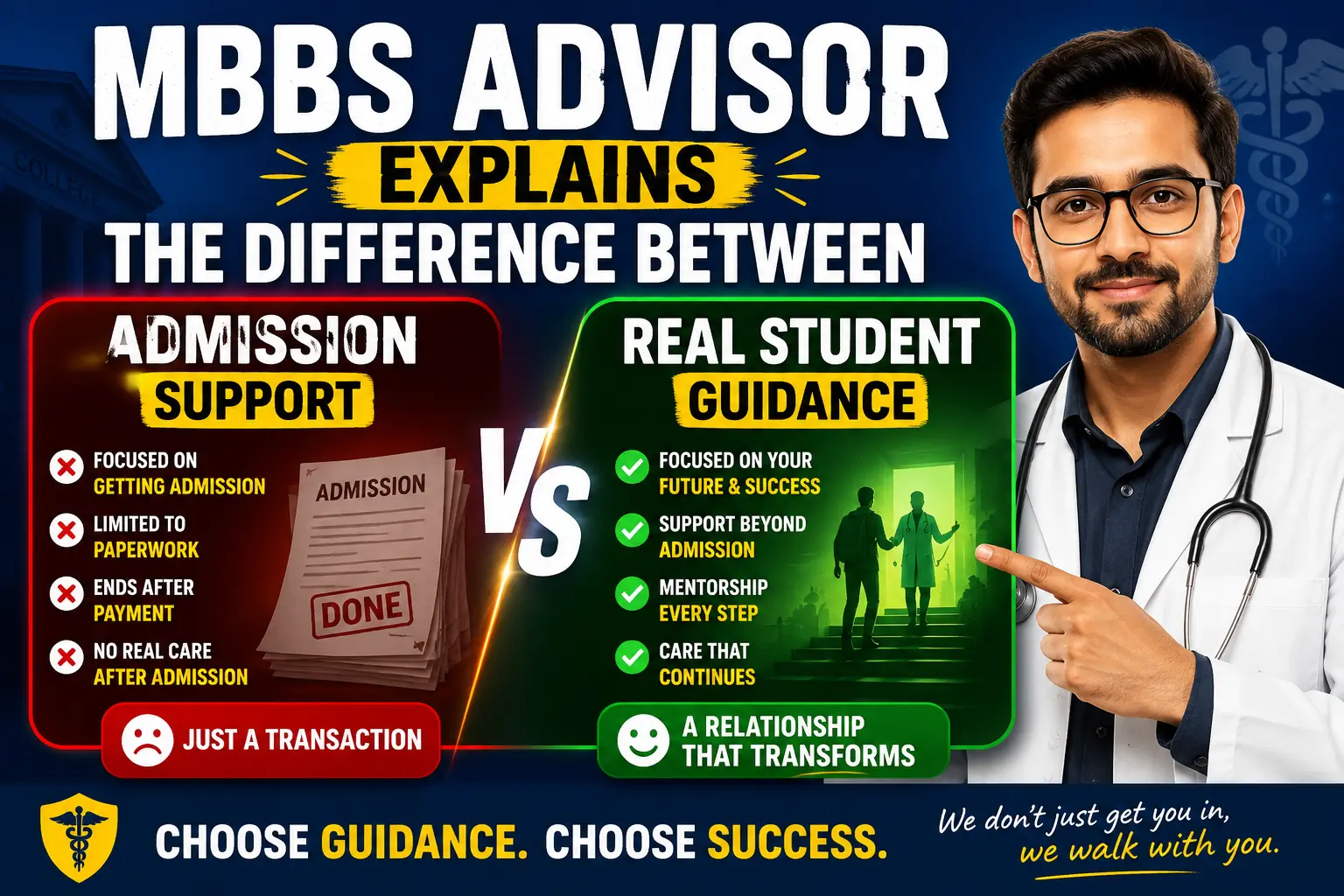
As advisors with deep expertise in the Indian MBBS application sector, I have worked with a large number of local medical applicants. Most of them, after passing the NEET exam, become trapped in a chaotic cycle spanning from school selection to successful enrollment: misinformation is rampant, and they face constant, extreme stress throughout the process.
Worse, the vast majority of families cannot distinguish between two services that have long been used interchangeably in the industry: "admission support" and "genuine student guidance". Clarifying the fundamental differences between these two services is not only critical to whether a student can enroll smoothly, but also shapes the entire trajectory of their medical career.
What is Admission Support?
Admission support, which is often marketed as "professional guidance", is at its core a one-off transaction-focused process service.
It specifically covers seven tasks:
- Assisting with organizing application materials
- Submitting compliance documents required by the NMC
- Liaising with university admissions offices
- Tracking application status
- Coordinating deposit payments
- Confirming accommodation spots
- Completing enrollment registration
Its limitations are very clear: it only covers pre-enrollment milestones and does not address any of students’ subsequent development needs.
What is Genuine Student Guidance?
In contrast, genuine student guidance is a full-cycle tailored service centered on each student’s individual circumstances.
It covers eight components:
- Matching suitable universities based on test scores, budget, and career plans
- Interpreting the latest NMC compliance requirements
- Connecting students with preparatory study resources
- Tracking in-school academic progress
- Coordinating internship placements
- Planning postgraduate entrance exam preparation
- Outlining professional licensing registration procedures
- Answering all types of questions across every stage
Key Difference Between the Two Services
The two types of advisors can be intuitively distinguished by the questions they ask:
- Advisors who only provide admission support will only ask: “Which universities do you plan to apply to?”
- Genuine guidance advisors will first ask: “Which clinical specialty do you want to work in after graduation?”
This full-cycle service covers the entire 5.5-year MBBS academic program, clinical internships, postgraduate study and entrance exams, and even the full process of obtaining medical practice credentials.
Why Families Confuse These Services
The core reasons why most families confuse the two are twofold:
- Many agencies market teams that only offer admission support as providers of professional guidance to turn a profit
- Students’ parents lack knowledge of the service classification system in the application field, leaving them vulnerable to misleading marketing
Risk of Relying Only on Admission Support
Test-takers who rely solely on admission application support face four typical risks:
- Selecting schools only based on availability, ignoring better-matched options with stronger academics, reasonable tuition costs, and richer clinical resources
- Neglecting long-term financial planning, underestimating total education costs including tuition, accommodation, and examination fees
- Making decisions without career orientation, leading to misaligned specialization goals
- Misunderstanding complex admission rules in India’s medical education ecosystem, including quota systems and eligibility variations
What Effective Student Guidance Includes
Truly effective student advising includes four core modules:
1. Personalized Profiling
Integration of key variables such as NEET score, category, budget, location preference, and career goals.
2. Full School Comparison
Comparison of public medical colleges, private medical colleges, Deemed Universities, NRI quota options, and overseas MBBS programs supported through global medical recognition frameworks such as the World Directory of Medical Schools (WDOMS).
3. Admission Strategy Planning
Structured application planning, including prioritization of universities and timing strategies to improve admission outcomes.
4. Real-Time Transparent Information
Provision of accurate, updated information instead of unrealistic promises commonly seen in the market.
Evolving Role of MBBS Advisory Platforms
Currently, platforms like MBBS Advisor adopt a student-first model, offering both standardized admission application support and comprehensive consulting services.
Modern educational advising platforms now extend beyond enrollment processing to include:
- Personalized application consulting
- Full-process fee transparency
- Targeted admission guidance
- Global medical university evaluations verified through bodies like the World Health Organization (WHO)
The core principle is that securing an admission offer is not the end of the journey, but only its starting point.
How to Evaluate a Reliable MBBS Advisory Platform
Applicants can evaluate platforms using five core indicators:
- Transparency of the full service process
- Level of personalized attention
- Professional expertise of the consulting team
- Availability of university evaluation support
- Long-term service coverage throughout the study period
Why Admission Support Is Still Necessary
Many people incorrectly believe that enrollment procedure support constitutes unethical gray-market services. In reality, standardized enrollment support plays an essential role in managing complex international documentation and administrative procedures.
Ideal Service Model for MBBS Students
The ideal model is the coordinated operation of two pillars:
- Enrollment Procedure Support: Handles documentation, applications, and administrative compliance linked with regulatory frameworks such as the National Medical Commission (NMC)
- Student Guidance: Provides long-term academic planning, career direction, and adaptation support
Final Insight on MBBS Admission Success
The complexity of selecting a school for MBBS applications extends far beyond receiving an admission letter.
Applicants must consider recognition status, internship availability, teaching quality, and long-term licensing outcomes.
Ultimately, success in medical admissions is not just about securing a seat, but about choosing the right development pathway to become a qualified physician.