 Russia
 Belarus
 Georgia
 Kazakhstan
 Kyrgyzstan
 Uzbekistan
 China
China Nepal
Nepal Bangladesh
 Poland
 Romania
 Slovakia
 Hungary
 N. Macedonia
 Vietnam
 Canada
 Armenia
 UK
UK Australia
 USA
USA Ireland
 Germany
 New Zealand
 Italy
Italy France
 Singapore
 Netherlands
 Sweden
 Switzerland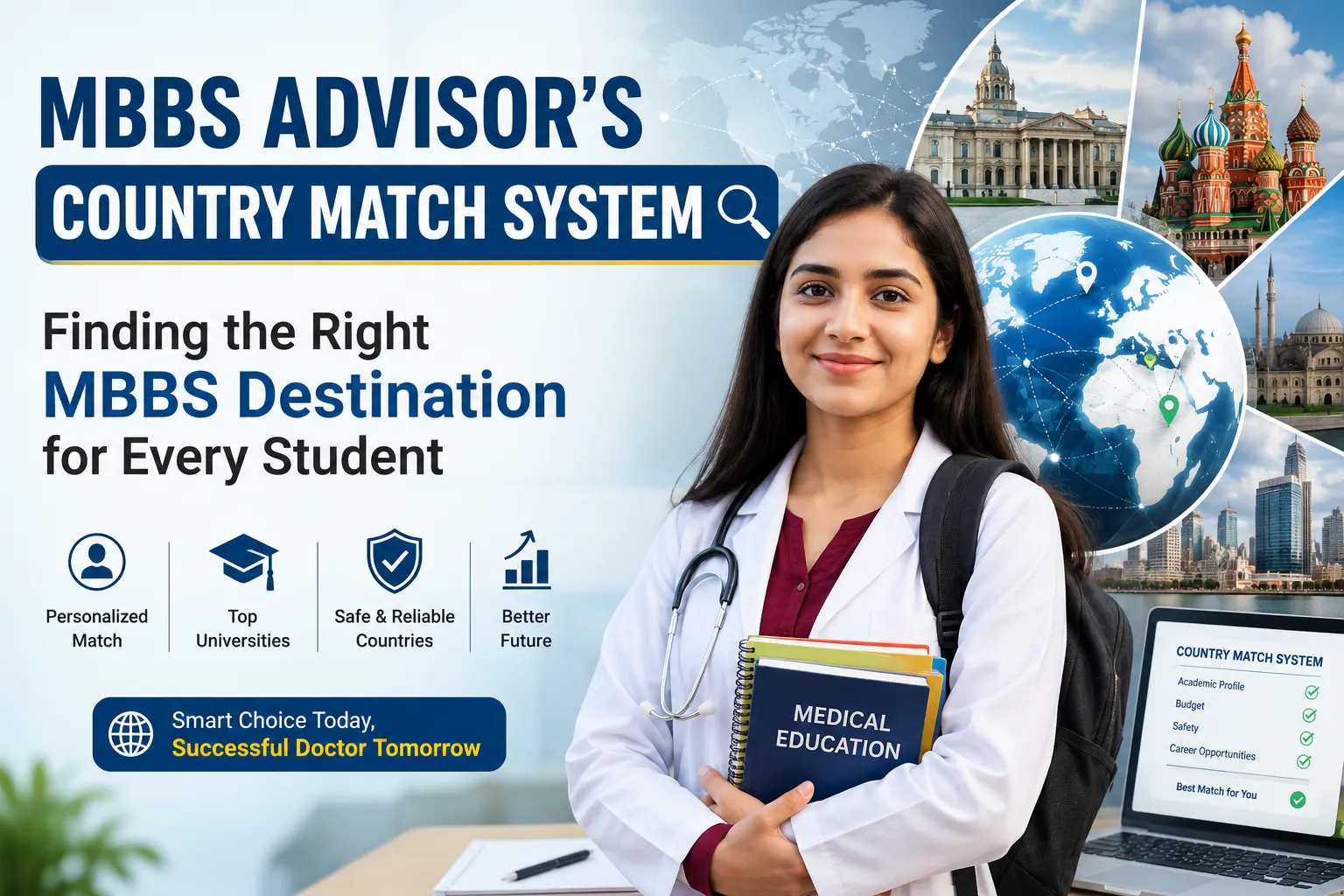
India faces a severe shortage of seats in its domestic public medical colleges, while private medical institutions maintain persistently exorbitant tuition fees.
Every year, thousands of medical students who pass the NEET exam choose to pursue MBBS degrees overseas.
However, many students only select their study destination based on low tuition or a country’s general popularity, and often encounter a range of subsequent problems, including poor academic articulation, unplanned excess financial burdens, and restricted career development.
To address this core pain point of blind school and country selection, MBBS Advisor launched the Country Match System for overseas medical study.
This structured matching tool differs from the homogeneous logic of generic study abroad guidance available on the market.
Instead of pushing the same set of popular countries to all students, it develops customized study destination recommendation plans tailored to each student’s personal circumstances.
The system pre-sorts core dimensions of difference across all eligible countries, covering:
- Tuition fees
- Cost of living
- Clinical resources
- Language environment
- Degree recognition
- Medical practice licensing requirements
- Internship systems
It also sets core assessment dimensions for student users, including:
- Academic qualifications
- Budget range
- Career goals
- Language preferences
- Future licensing application goals
- Family expectations
Academic Background Assessment
The first step of the matching process is academic background assessment.
The system verifies a student’s NEET eligibility and their 12th-grade scores in Physics, Chemistry, and Biology (PCB), maps out the student’s academic strengths and gaps against the entry requirements of target countries, and fully complies with the hard mandate set by India’s NMC that all Indian students studying MBBS overseas must pass the NEET UG exam.
Budget-Aligned Country Screening
The second step is budget-aligned screening.
The system releases a list of eligible countries including:
- Nepal
- Kazakhstan
- Kyrgyzstan
- Uzbekistan
- Georgia
- Russia
- Bangladesh
It breaks down the tuition and cost of living structures for each country and reminds students in line with industry consensus that they cannot focus solely on low tuition and must make comprehensive judgments that integrate academic quality and degree recognition.
Career Goal Matching
Next, we will introduce in detail one of the system’s core modules: career goal matching.
This paper introduces the Country Match System, a tool developed exclusively for Indian medical students applying to overseas MBBS programs.
The system first organizes the five core demands of Indian medical students pursuing overseas medical education:
- Preparing for India’s domestic postgraduate (PG) medical examinations
- Participating in India’s local clinical practice
- Obtaining international medical licensing qualifications
- Pursuing a research-focused career path
- Settling abroad long-term
Centering on these demands, the system breaks down seven core full-process assessment service modules while also identifying multiple common pitfalls that Indian medical students encounter when selecting schools.
Seven Core Assessment Service Modules
1. Pre-Aligned Goal Matching
The first module is pre-aligned goal matching.
It assesses students’ specific demands first before recommending study-abroad destinations and reminds students planning to return to India to practice medicine that they must comply with regulations set by the NMC of India.
2. Institutional Accreditation and Degree Validity Assessment
The second module is institutional accreditation and degree validity assessment.
It verifies:
- Whether a target school is listed in the WDOMS
- Whether its programs meet global medical education standards
- Whether graduates can retain their future practice qualifications
This assessment is grounded in the WHO global framework for medical education and addresses the common pitfall where many students only focus on tuition costs while ignoring institutional accreditation.
3. Language and Learning Environment Assessment
The third module is language and learning environment assessment.
It verifies:
- Availability of full English-medium instruction
- Local language requirements for clinical training
- Communication barriers
- Student suitability to the environment
A suitable environment can effectively improve students’ academic performance and quality of life.
4. Clinical Resource Assessment
The fourth module is clinical resource assessment.
It verifies practical resources including:
- Quality of teaching hospitals
- Patient volume
- Access to internships
- Clinical rotations
This helps match students who need strong hospital training with destinations that provide sufficient clinical resources.
5. Lifestyle and Cultural Adaptability Assessment
The fifth module is lifestyle and cultural adaptability assessment.
It verifies:
- Climate conditions
- Availability of Indian cuisine
- Cultural familiarity
- Student safety
- Support from local Indian diaspora communities
Cultural adaptability directly impacts Indian students’ academic comfort and mental health.
6. Long-Term Licensing Planning Assessment
The sixth module is long-term licensing planning assessment.
It verifies:
- National medical licensing examination requirements
- Internship regulations
- Advanced study opportunities
- Conditions for obtaining local practice qualifications
This module again reminds students to meet NMC requirements and corrects the pitfall of focusing only on admission thresholds while ignoring long-term career trajectories.
7. Mismatch Risk Prevention and Control
The seventh module is mismatch risk prevention and control.
It highlights the core pain point of widespread misinformation plaguing the current overseas MBBS application industry, leaving space for the expansion of subsequent content.
Addressing Misleading Marketing Practices
The overseas medical study abroad consulting industry is plagued by four types of false and misleading marketing irregularities:
- Incomplete information
- False promises
- Undisclosed costs
- Misleading career outcomes
A core consensus has long been established in the education consulting sector:
When choosing an MBBS study abroad destination, students must be supported by transparent consulting services and structured information rather than being swept along by marketing content.
Full-Link Service Framework of the Country Match System
To this end, MBBS Advisor has launched the Country Match System, whose core positioning is to simplify the study abroad decision-making process for students and their families.
The system has built a full-link service module.
Personalized Country Recommendations
First, it provides students with personalized country recommendations that reject the one-size-fits-all approach, matching study abroad destinations suited to each student’s individual circumstances across five compatibility dimensions.
Comprehensive Evaluation of Popular Destinations
Second, it organizes seven popular MBBS study abroad destinations that can be comprehensively evaluated, clearly marking each destination’s distinct advantages in terms of:
- Study abroad costs
- Academic systems
- Qualification accreditation
- Clinical training arrangements
Structured Assessment Tools for Parents
Meanwhile, to address the four core concerns of greatest concern to parent groups, the system is equipped with exclusive structured assessment tools, replacing the irrational practice of making decisions based solely on scattered information from commercial advertisements and social media.
Compliance-Based MBBS School Selection
The system also clarifies the core principles for MBBS school selection, requiring all applicant students to meet the official compliance requirements of:
- NEET UG
- NMC
- WDOMS
- WHO
- Other relevant official authorities
To help students make truly informed study abroad decisions.
Conclusion
Choosing the right country for MBBS abroad is not simply a matter of selecting the cheapest option or following current trends.
Students must evaluate academic eligibility, budget, accreditation status, licensing pathways, language environment, clinical exposure, and long-term career objectives before making a final decision.
Through its structured Country Match System, MBBS Advisor helps students and families navigate these complexities and select study destinations that align with both immediate educational needs and long-term professional goals.