
 Russia
 Belarus
 Georgia
 Kazakhstan
 Kyrgyzstan
 Uzbekistan
 China
 Nepal
 Bangladesh
 Poland
 Romania
 Slovakia
 Hungary
 N. Macedonia
 Vietnam
Introduction
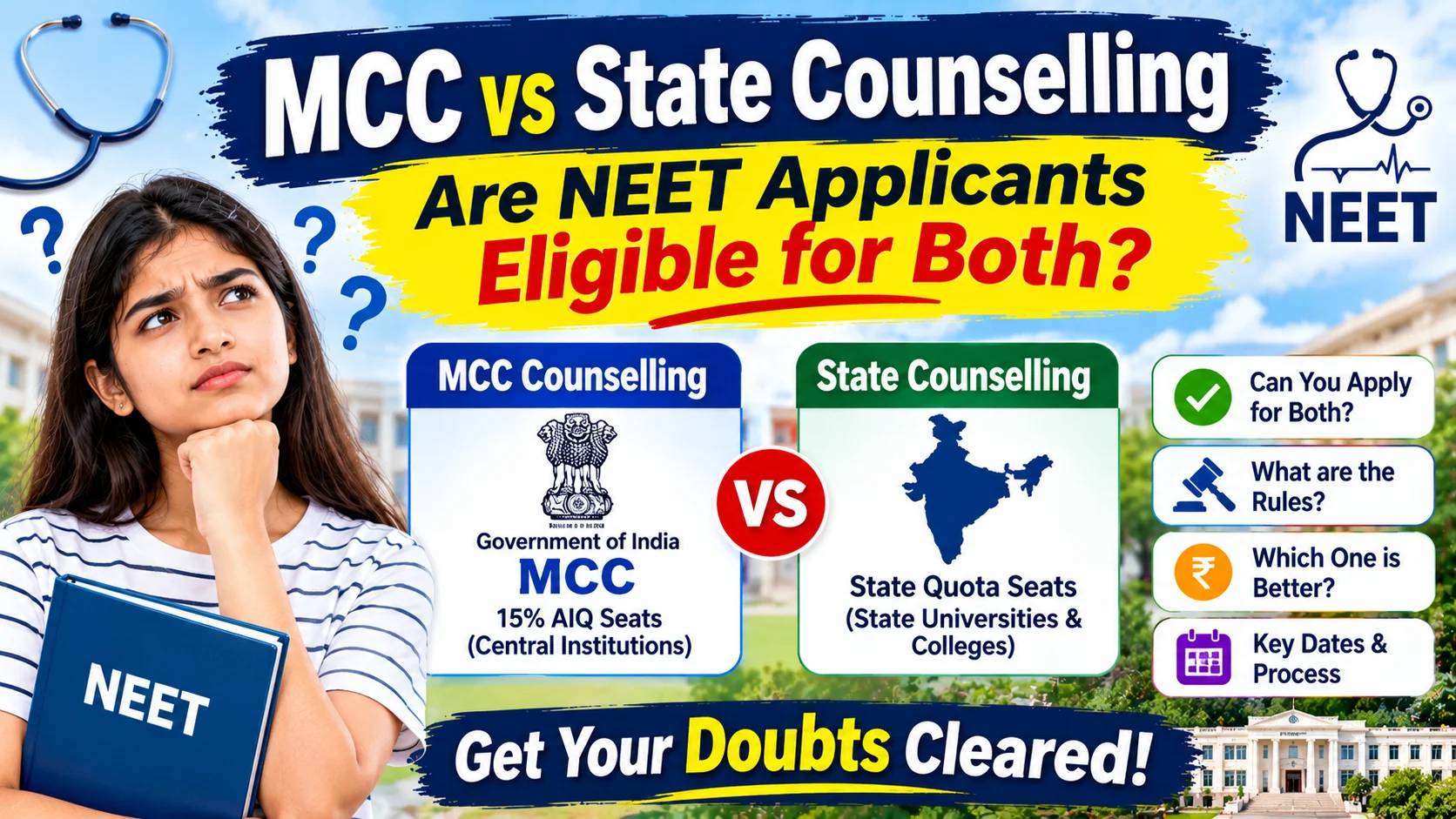
Every year, lakhs of students appear for the NEET UG examination to secure admission to undergraduate medical and dental courses in India. After qualifying for NEET UG, students need to participate in the medical admission counselling process to secure a seat in government or private medical college.One of the most common dilemmas among NEET aspirants is: Can I opt for both MCC and State counselling in the same year?NEET aspirants can definitely opt for both MCC and State counselling, subject to their eligibility for each process.Both counselling processes are different from each other. Their registration procedures, seat categories, fee structures, rules and admission processes also differ.The Medical Counselling Committee (MCC) conducts counselling for All India Quota and other specified seats, while the respective state counselling authorities conduct counselling for State Quota and other eligible seats.MCC and State counselling have their own eligibility requirements.Understanding both counselling processes is important because participating in both can increase a student's chances of securing admission to a medical college.MCC counselling is an important topic among NEET aspirants. In this article, we answer important questions about MCC and State counselling, including eligibility, registration, fees and other information relevant to NEET applicants for 2026.
1. What Is MCC NEET UG Counselling?
The Medical Counselling Committee (MCC) conducts centralised counselling for NEET-qualified candidates seeking admission to specified medical and dental seats across India.Candidates eligible for NEET UG can register on the official MCC website to participate in the respective counselling processes.
MCC counselling covers various medical seats, including:
- 15% All India Quota (AIQ) seats in government medical and dental colleges.
- Central Universities and institutions.
- Deemed Universities.
- AIIMS and JIPMER institutions.
- ESIC medical colleges in applicable seat categories.
- Other seat categories and institutions covered under the MCC counselling process.
Through MCC counselling, candidates can compete for medical seats in different participating institutions across various states. For example, a candidate from Uttar Pradesh can participate in MCC counselling and seek admission to an eligible medical college in Maharashtra, Karnataka, Rajasthan, Delhi or other states.Whether a candidate is eligible for a particular seat depends on the admission policy of the respective institution and the applicable counselling rules.Candidates can visit the official MCC website to check registration notifications, seat matrices, counselling schedules and other admission-related information.
2. What Is State NEET Counselling?
State NEET counselling is the process through which candidates compete for medical and dental seats within a state through its respective counselling authority.
Generally, State NEET counselling covers the following seats:
- 85% State Quota seats in government medical colleges.
- State quota seats in private medical colleges.
- Management quota seats, wherever applicable.
- Other institutional and state-specific seat categories.
Different states have different policies regarding counselling fees, eligibility criteria, domicile requirements and admission procedures.
State Counselling Authorities: Karnataka, Maharashtra and Rajasthan
Some examples of state counselling authorities are:
- Karnataka: The Karnataka Examinations Authority (KEA) conducts medical counselling.
- Maharashtra: The State Common Entrance Test Cell conducts the counselling process.
- Rajasthan: The designated state medical education counselling authority conducts the counselling process.
State counselling is especially important for students wishing to secure admission to government medical colleges in their home states.Students who do not belong to the home state may also be eligible for private, management and other specified seats, depending on the admission rules of that state.Students must go through the respective state counselling notifications to confirm whether they are eligible to register for the process.
3. Can NEET Candidates Apply for Both MCC and State Counselling?
Yes. NEET-qualified candidates can apply for both MCC and State counselling in the same admission year.Candidates are generally free to register for both counselling processes, provided they fulfil the eligibility requirements of each authority.In fact, registering for both processes increases the number of medical colleges and seat categories for which a candidate may be eligible.Consider a candidate from Uttar Pradesh who has qualified NEET UG 2026.
The candidate can:
- Register for MCC counselling to compete for eligible All India Quota seats.
- Register for Uttar Pradesh State counselling to compete for eligible Uttar Pradesh State Quota seats.
- Explore other seats available through other state counselling authorities, wherever eligible.
- Participate in the available counselling rounds according to the applicable rules.
Therefore, the candidate has several opportunities to secure an MBBS seat.However, it must be noted that a candidate cannot take admission in two different MBBS colleges simultaneously by registering for both MCC and State counselling.After accepting and joining a seat, candidates must follow the applicable resignation, reporting and admission rules if they wish to move to another institution.
Important: MCC and State counselling processes have separate registration portals, payment procedures, choice-filling processes and deadlines. Completing registration in one process does not automatically complete registration in the other.
4. MCC vs State Counselling: Key Differences
Although both counselling processes use NEET UG scores and ranks for medical seat allotment, several other aspects of the processes differ.
The following table illustrates the key differences between MCC and State counselling.
|
Key Differences |
MCC Counselling |
State Counselling |
|
Conducting Authority |
Medical Counselling Committee |
Respective State Counselling Authority |
|
Main Seats |
15% All India Quota and institution-specific seats |
State quota and state-controlled seats |
|
Government Colleges |
Generally 15% AIQ seats |
Generally 85% State Quota seats |
|
Private Medical Colleges |
Deemed and specified institutional seats |
Eligible private medical college seats |
|
Eligibility |
NEET and institution-specific eligibility |
NEET and state-specific eligibility |
|
Domicile Requirement |
Generally not applicable for regular AIQ seats |
Applicable for eligible State Quota seats |
|
Registration Portal |
MCC official website |
Respective state counselling portal |
|
Reservation Policy |
Applicable central/institutional reservation rules |
Applicable state reservation rules |
|
Fee Structure |
MCC-prescribed fee structure |
State-specific fee structure |
|
Choice Filling |
Colleges covered under MCC counselling |
Colleges covered under State counselling |
Which Is Better: MCC or State Counselling?
Nobody can say for sure which counselling process is better for every candidate.In general, MCC provides wider opportunities to compete for eligible medical college seats across India, while State counselling provides opportunities through home-state quota and other state-specific categories.Therefore, instead of focusing on only one counselling process, candidates should explore the options available through both processes.
5. Eligibility Criteria for MCC and State Counselling
Although candidates can apply for both types of counselling, they must fulfil the eligibility conditions separately.
Eligibility for MCC Counselling
Candidates generally need to satisfy the following conditions:
- Qualify NEET UG 2026.
- Fulfil the minimum eligibility conditions for MBBS/BDS admission.
- Meet the applicable age and educational qualification requirements.
- Complete the registration process on the official MCC portal.
- Fulfil any additional eligibility conditions stipulated by the respective institution or seat category.
Admission to institution-specific seats may involve additional eligibility conditions.
Eligibility for State Counselling
The eligibility conditions for State counselling vary from state to state, depending on the respective state admission policy.
Some common eligibility conditions include:
- Qualifying NEET UG 2026.
- Meeting the required educational qualifications.
- Fulfilling the state's domicile conditions for State Quota seats.
- Submitting a valid category certificate, wherever applicable.
- Completing the registration process on the official state counselling website.
- Meeting other conditions mentioned in the state admission brochure.
Some states allow non-domicile candidates to apply for private, management and other eligible seats.Hence, candidates should not assume that domicile is necessary for every type of admission through State counselling.
6. Can Students From One State Apply for Counselling in Another State?
Yes. Students can apply for counselling processes in other states if they fulfil the eligibility conditions specified by those states.
For example, a candidate belonging to Uttar Pradesh can explore counselling opportunities in other states.
The student can:
- Apply for Uttar Pradesh State counselling to secure a seat under the eligible State Quota.
- Register for MCC counselling to compete for eligible All India Quota seats.
- Explore admission opportunities in private medical colleges in other states, if permitted under their admission rules.
However, the student may not be eligible for government State Quota seats in other states because of domicile or residential requirements.Other states have their own rules for admission to private medical colleges, which may include educational qualifications, domicile conditions and other eligibility requirements.Thus, candidates should carefully check the state-wise NEET counselling brochure before applying.
7. How to Register for Both MCC and State Counselling?
Students wishing to participate in both counselling processes need to complete separate registrations.
Registering for MCC Counselling
Follow these steps to register for MCC counselling:
- Visit the official MCC website.
- Open the UG Medical Counselling section.
- Click on the registration link for NEET UG 2026.
- Enter your NEET UG details.
- Fill in the required information in the registration form.
- Pay the applicable registration fee and security deposit.
- Select the medical colleges you wish to apply to.
- Submit and lock your preferences before the deadline.
Registering With the State Counselling Authority
Follow these steps to register for State counselling:
- Visit the official website of the respective State Counselling Authority.
- Open the NEET UG 2026 counselling section.
- Complete the online registration.
- Enter your personal details and other required information.
- Upload the necessary documents.
- Pay the applicable State counselling registration fee and security deposit.
- Select the medical colleges you wish to apply to.
- Lock your choices before the deadline.
Candidates must remember that MCC registration does not automatically complete State counselling registration.Similarly, registering for State counselling does not automatically make a candidate eligible for MCC seat allotment.
8. What Happens If You Get Seats Through Both MCC and State Counselling?
This is one of the most important questions for candidates participating in both counselling processes.A candidate may receive seat allotments through MCC and State counselling based on their NEET rank, preferences, eligibility and availability of seats.However, a candidate cannot take admission in two colleges simultaneously. They must make a choice according to the applicable reporting, joining, resignation and withdrawal rules.
Consider an example:A candidate receives an MBBS seat in a government medical college through MCC counselling and another seat through Uttar Pradesh State counselling.The candidate must carefully compare both options before making a final decision.
Some important factors to consider include:
- Annual tuition fees.
- Reputation and facilities of the college.
- Clinical exposure and hospital facilities.
- Hostel and accommodation expenses.
- Distance from home.
- Bond and compulsory service conditions.
- Resignation and refund policies.
Candidates should also check the reporting deadlines and resignation rules before leaving an allotted seat.
9. Important Rules During MCC and State Counselling
Candidates must be aware of the following rules when participating in both counselling processes.
Separate Registration Is Mandatory
Both counselling processes are conducted by different authorities and require separate registrations and fee payments.
Different Choice-Filling Processes
The choices filled by candidates for medical colleges and seats will be different for both processes.
Different Domicile Rules
MCC's regular AIQ counselling generally does not require state domicile. Therefore, candidates are not required to produce a domicile certificate for regular AIQ eligibility.However, state domicile may be required for State Quota seats during State counselling.
Different Reservation Rules
MCC and State counselling provide reservation benefits according to their respective applicable policies.A category certificate accepted by one authority may not automatically satisfy the requirements of another authority.
Separate Security Deposits
Candidates may be required to pay separate security deposits during MCC and State counselling.Refund and forfeiture rules depend on the respective counselling authority.
Reporting and Resignation Are Mandatory
Candidates must report to their allotted colleges within the stipulated time and follow the applicable rules if they wish to resign or upgrade their seats.MCC releases its counselling rules and schedules on its official UG counselling website. Applicants are advised to read the latest state counselling brochure as well.
10. Common Mistakes During MCC and State Counselling
Many candidates lose admission opportunities because they do not properly understand the two counselling procedures.
Some common mistakes are listed below.
- Registering for only one process: Candidates eligible for both counselling processes should consider registering for both to increase their admission opportunities.
- Missing registration deadlines: MCC and State counselling may have different schedules. Candidates should keep track of both processes.
- Ignoring domicile requirements: Check the eligibility conditions before applying for State Quota seats.
- Filling incorrect college preferences: Evaluate the college, clinical exposure, fees and facilities before locking your choices.
- Failing to understand security deposit rules: Refund and forfeiture conditions may differ between counselling authorities.
- Not checking seat allotment results: Always keep track of seat allotment results on both portals.
- Joining a college without comparing fees: Compare tuition fees, location and facilities before taking admission.
- Not resigning from an allotted seat: If a candidate wishes to leave a seat allotted by one authority, they must follow the prescribed resignation procedure within the applicable deadline.
- Assuming both portals are connected: MCC and State counselling registrations are separate, and candidates must manage both independently.
11. MCC and State Counselling Official Websites
Candidates should visit the official counselling websites for the latest notifications, seat matrices, eligibility criteria and other admission updates.
The following websites are useful for NEET UG aspirants.
|
Counselling Authority |
Official Website |
|
MCC NEET UG Counselling |
|
|
NEET UG Examination (NTA) |
|
|
Uttar Pradesh NEET Counselling |
Additional Medical Education Resources
Apart from counselling portals, candidates can also refer to the following websites for medical education and regulatory information:
- MBBS Advisor: Information and guidance related to MBBS admissions and medical education.
- World Health Organization (WHO): Global health information, research and medical resources.
- World Directory of Medical Schools (WDOMS): Information about medical schools worldwide.
- National Medical Commission (NMC): Indian medical education regulations, guidelines and updates.
- NEET UG Official Website: NEET examination notifications, information bulletins and candidate updates.
Candidates should always refer to the official MCC and respective state counselling websites for admission-related decisions.
Conclusion
NEET-qualified candidates can apply for both MCC and State counselling in the same admission year, provided they fulfil the eligibility requirements of both counselling authorities.MCC counselling provides opportunities for admission through 15% All India Quota seats, Deemed Universities, Central Universities, AIIMS, JIPMER and other specified institutions. On the other hand, State counselling provides admission opportunities through 85% government college State Quota seats and other eligible state-level seats.Participating in both counselling processes can increase a candidate's chances of securing an MBBS seat. However, candidates must complete separate registrations, pay the applicable fees, understand domicile requirements and follow the respective seat allotment and resignation rules.Before making any admission decision, students should carefully compare college fees, facilities, clinical training, location and future opportunities.The best approach is to participate in every counselling process for which they are eligible and follow the official MCC and State counselling guidelines throughout the admission process.