 Russia
 Belarus
 Georgia
 Kazakhstan
 Kyrgyzstan
 Uzbekistan
 China
China Nepal
Nepal Bangladesh
 Poland
 Romania
 Slovakia
 Hungary
 N. Macedonia
 Vietnam
 Canada
 Armenia
 UK
UK Australia
 USA
USA Ireland
 Germany
 New Zealand
 Italy
Italy France
 Singapore
 Netherlands
 Sweden
 Switzerland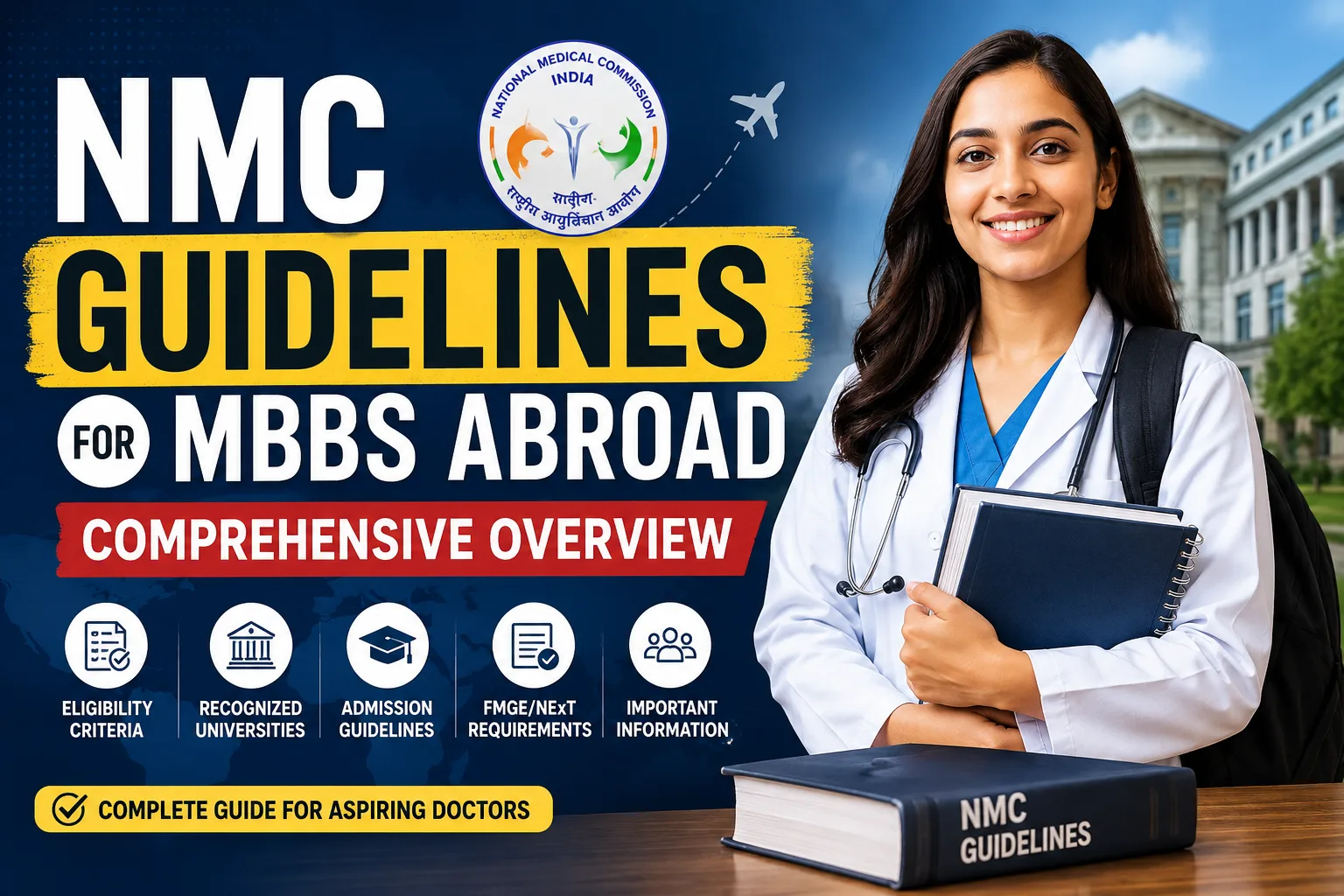
Due to the large number of students who take the National Eligibility Entrance Test (NEET), getting an MBBS seat in India has become increasingly difficult. For this reason, Indian students have started looking for options abroad. Many look to medical schools in Russia, Georgia, Kazakhstan, Uzbekistan, Kyrgyzstan, Nepal, Bangladesh, and other countries. But before enrolling in medical schools abroad, students should familiarize themselves with the guidelines of the National Medical Commission (NMC).
In an attempt to improve the quality of medical education for Indians studying abroad, the NMC has refined its guidelines to make sure that students are taught quality medical education and are allowed to practice medicine in India. Failure to comply with the guidelines can create significant issues when students attempt to practice medicine in India.
This guide will help you become acquainted with the new NMC guidelines for MBBS abroad, the eligibility criteria, the standards for medical courses, and various other elements that are important for a prospective medical student.
The National Medical Commission (NMC) is the highest central medical regulatory body in India. NMC is responsible for setting the benchmarks for medical education and allied services.
MBBS graduates of foreign medical schools must abide by the NMC’s stipulations in order to be credentialed in India. The NMC is active in refining its policies in attempts to create parity between education provided in Indian medical schools and the medical schools abroad.
The NMC collaborates with various international medical education standards and considers the recommendations issued by the World Health Organization (WHO). The World Directory of Medical Schools (WDOMS) allows students to cross-check international medical schools and is a valuable tool for students and medical schools worldwide.
The Importance of NMC Guidelines for MBBS Abroad
A sizable number of students focus on the tuition costs and the admission details of the foreign medical university. Choosing a foreign medical university that does not comply with NMC guidelines may have potential implications.
First, the NMC guidelines ensure that the students:
- Are provided medical education of a good standard.
- Have the curriculum of the medical school at par with that of the other countries.
- Are provided with adequate clinical exposure.
- Are eligible to take the licensing examinations.
- Are able to practice medicine in India.
The absence of such guidelines may have implications for the students for medical registration and practicing medicine.
NEET Qualification is Mandatory
One of the major NMC guidelines for MBBS Abroad is that students should qualify the NEET.
The students are required to qualify the NEET before getting admission to the foreign medical university. Students may face difficulties in getting the eligibility and the registration to practice in India, after completing the medical studies, without the NEET qualification.
The students who are preparing for NEET may get the latest updates with the help of the NEET Guide.
Students can also estimate their position with the NEET Rank Predictor, which helps them understand their admission prospects both in India and overseas, before counseling and admission procedures.
Eligibility for the MBBS Abroad
The students must meet the following criteria before applying for MBBS Abroad:
Age Requirement
Students should be at least 17 years of age by the specified date of admission.
Academic Qualification
Students must have completed Physics, Chemistry, Biology, and English in Class 12 from a recognized Board.
Minimum Marks
General category students need to have a minimum of 50% marks in PCB subjects. The minimum required marks for students from reserved categories are determined as per the regulations applicable from time to time.
NEET Qualification
For Indian students, clearing the NEET remains an essential requirement to study Medicine Abroad.
Foreign Medical Graduate Regulations Explained
The modifications made by the NMC in Foreign Medical Graduate Regulations have transformed the overseas Medical Education system.
The NMC is trying to ensure that the training of students who go abroad to study Medicine is of a level that is comparable to the MBBS training in India.
The NMC is now asking students to ensure, before joining any foreign University, that the University meets their requirements.
Duration of MBBS Course Abroad
The NMC has stated its requirements with respect to the minimum duration of Medical Education.
The Medical program should offer:
- 54 months of Medical Education.
- A mandatory internship or period of clinical training.
- Adequate instruction in the theory and practice of Medicine.
Students must not go to a foreign University that offers a fast-tracked Medical Course. The Medical Course is not likely to meet the requirements of NMC.
Medium of Instruction Must Be English
One of the primary requirements of the NMC for providing permission to study Medicine Abroad is that the entire Medical Course is conducted in English.
Many countries conduct a part of Medical Education in a local language. Students must ensure that:
- The entire course is conducted in English.
- There is no communication gap in the Clinical training, which may affect the learning outcomes.
Students may adversely affect their Medical education by failing to understand patients during Clinical training.
Internship Requirements Under NMC Guidelines
NMC stipulates a student’s internship as a part of their foreign medical program.
An internship must:
- Occur within the country issuing the medical degree.
- Be endorsed by a local medical authority.
- Provide direct clinical contact.
- Be comprehensive of the major disciplines of medicine.
Students must look into prospective medical schools’ internship policies as many complications arise during registration in India due to issues with the medical school’s internship program.
Importance of Clinical Exposure
Clinical exposure is one of the most undervalued features of the MBBS programs overseas.
Most students concentrate on the cost of tuition while ignoring essential aspects of clinical exposure like patient flow and the hospital’s infrastructure.
An excellent medical school will provide:
- Affiliated teaching hospitals
- A high patient flow
- Opportunities for clinical practice
- Exposure to varied medical specialties
- Learning opportunities for clinical skills at the bedside
Strong clinical training is an integral part of medical school that is aimed to improve not only the student’s competence but also their employability once they graduate and enter the workforce.
Recognition of Medical Universities
Recognition will hold a significant value for students when selecting a foreign medical school.
Medical students must check the inclusion of the medical school in the World Directory of Medical Schools (WDOMS).
Medical schools listed in WDOMS have met a certain standard to improve the transparency of the listing.
However, the listing of a school in WDOMS does not mean that the school is compliant with all of the NMC’s requirements.
WHO and Medical Education
The World Health Organization (WHO) does not accredit medical schools, but its influence in the international healthcare system and its set of standards for medical education help define the framework in which medical schools will operate.
Information on global health systems and medical education standards can be found on the WHO Official Website.
Soon-to-be medical students often have the misconception that WHO recognition of their program guarantees their eligibility to practice medicine in India. In actuality, the recognition of the National Medical Commission is what needs to be sought.
Countries Where Many Indian Students are Going to Study Medicine
There are a few leading countries where Indian students have been traveling to study medicine in Russia, Georgia, Kazakhstan, Kyrgyzstan, Uzbekistan, and Bangladesh.
Russia
Russia also has well-established medical universities. Russia has the well-established medical universities that have adequate clinical exposure coupled with modern infrastructure and affordable tuition.
Georgia
Georgia has also become a popular choice due to its European-style curriculum and the option of education in English.
Kazakhstan
Kazakhstan has also attracted students due to its affordable program and easy access.
Uzbekistan
Uzbekistan has affordable medical universities and has a growing population of international students.
Kyrgyzstan
Kyrgyzstan is also a favored destination for students looking for low-cost options to study medicine.
Bangladesh
Bangladesh has also become very student favorable because its medical programs are aligned with the Indian medical programs.
What Students Typically Do When They Decide to Study Medicine Overseas
The majority of students base their decision to study medicine overseas on the recommendation of an agent.
The list below contains all the mistakes made when students decide which country to study medicine.
- Neglecting the regulations of the National Medical Commission
- Choosing unrecognized medical schools
- Failing to check the structure of the internship
- Focusing on the medical schools with the lowest fees
- Choosing schools with poor clinical exposure
- Ignoring barriers of the language
- Not verifying the eligibility to license
Not doing the safety checks to insure eligibility will be met is bound to create a mess later.
What to Look For When You Want to Study Medicine Overseas
There are a few things students should look into to guarantee that there will be no complications later.
Follow National Medical Commission Procedures
See if the medical school you will be attending is following any of the National Medical Commission regulations pertaining to the length of the course and the length of the internship and what they have decided the curriculum will be.
WDOMS Listing Verification
Students must check whether the medical school is listed on the WDOMS.
Assess Clinical Infrastructure
Assess the medical school’s teaching hospitals, patient flow, laboratories, and clinical facilities.
Interview Current Students
Current students are generally the most reliable source of information regarding academic and campus life.
Confirm Licensing Eligibility
Check if the medical school graduates are eligible to take the licensing exams.
MBBS from Foreign Medical Universities
There are multiple pathways available for students who have completed their MBBS from a foreign medical university.
These include:
- Practicing medicine in India after meeting the eligibility criteria.
- Pursuing further postgraduate studies in medicine.
- Engaging in clinical research.
- Venturing into public health.
- Hospital administration.
- Various international healthcare jobs.
Future prospects will depend on the medical school’s reputation and the quality of education.
MBBS From Abroad Cost
One of the primary factors influencing the selection of the medical school is cost.
Students need to factor in:
- Tuition fees
- Accommodation costs
- Daily expenses
- Food
- Transport costs
- Health insurance
- Cost of the licensing exam
A financial plan will help manage expenditure during the length of the medical studies.
Professional Admission Counseling
The changing regulatory environment and the Admission process for international medical schools would require students to get professional counseling in order to make an informed choice.
Right advice will help students to:
- Evaluate medical schools.
- Understand NMC regulations.
- Plan finances.
- Check recognition status.
- Complete the admission processes.
Students can get resources related to MBBS, admission, and expert counseling from MBBS Advisor.
NMC Regulations Medical Students Must Know
Students must ensure the following criteria are met before confirming admission to a foreign medical school.
- NEET qualification is valid.
- The university is compliant with NMC regulations.
- The course duration is as per traditional standards.
- English must be the primary language of instruction.
- Sufficient clinical exposure.
- Internship requirements fulfilled.
- The university is listed on WDOMS.
- Future licensing eligibility is ensured.
Adopting these principles can minimize risk and maximize potential of long-term career prospects.
Conclusion
Studying abroad for an MBBS program is a very good option for Indian students who want to study medicine because they offer a decent quality of medical education. However, an MBBS program should not be chosen only because it is affordable or due to other claims based on marketing strategies. For the protection of the medical career of Indian students, it is very important to understand and adhere to the guidelines provided by the NMC.
Before making the payment to an MBBS program, the students must do a thorough research about the recognition status of the university, evaluate the availability of clinical training, and verify that the program completely adheres to the guidelines provided by the NMC.
Completing the NEET, verifying university information on WDOMS, and understanding the standards of international care promoted by the WHO and other reliable sources of information, can help students in making informed decisions.
By following the NMC guidelines during the MBBS studies, Indian students can protect their eligibility to participate in the practice of medicine in India after they finish their studies and will also be able to achieve their dreams of becoming a physician.