 Russia
 Belarus
 Georgia
 Kazakhstan
 Kyrgyzstan
 Uzbekistan
 China
China Nepal
Nepal Bangladesh
 Poland
 Romania
 Slovakia
 Hungary
 N. Macedonia
 Vietnam
 Canada
 Armenia
 UK
UK Australia
 USA
USA Ireland
 Germany
 New Zealand
 Italy
Italy France
 Singapore
 Netherlands
 Sweden
 Switzerland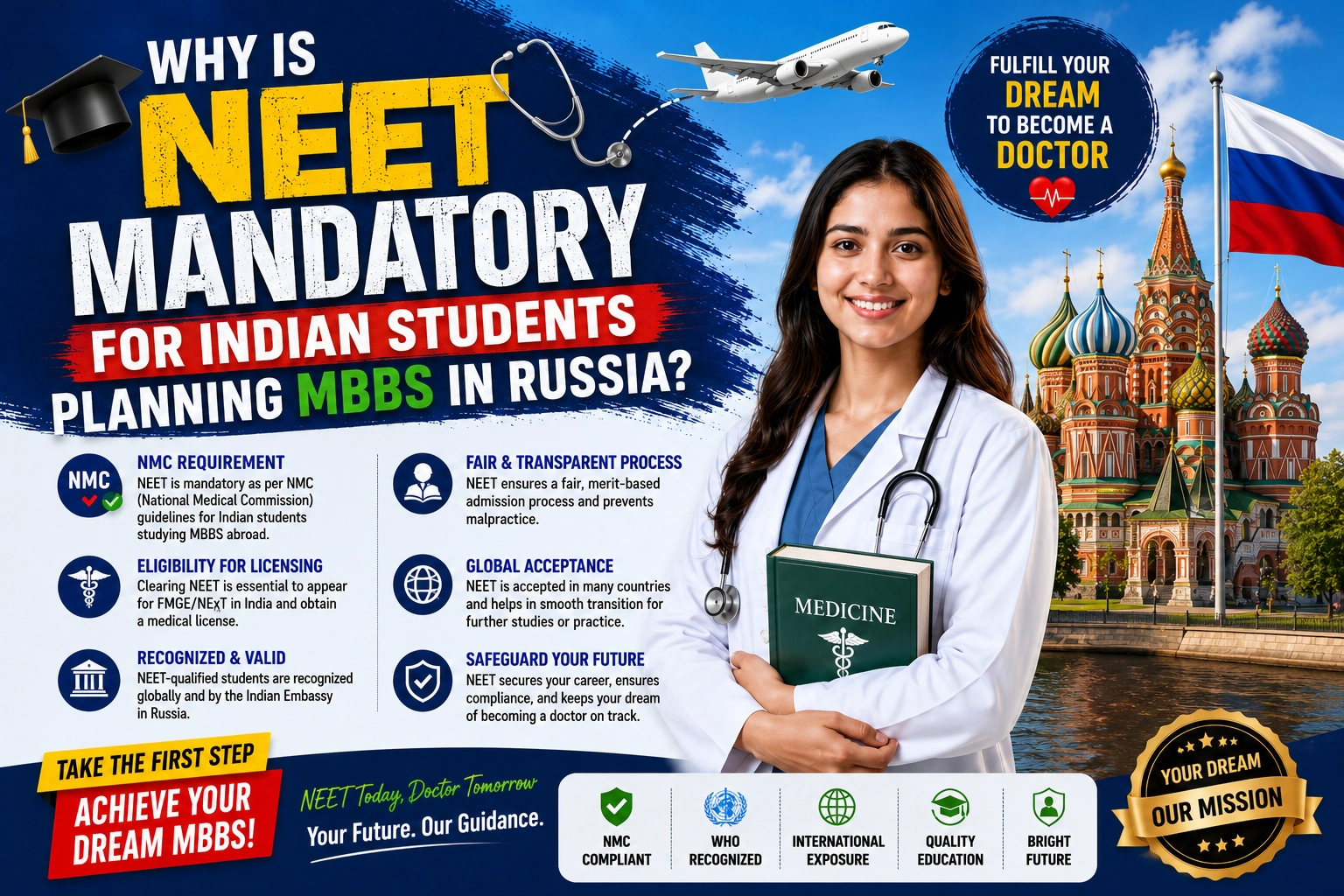
Medical education in Russia is very appealing to Indian students who want to study medicine abroad. Candidates who wish to take the NEET are exploring options in Russian medical universities due to the longstanding Russian infrastructure and the presence of a large number of international students. However, one important question that must be clarified first is: Why is NEET compulsory for Indian students who plan to do MBBS in Russia?
Answering this question requires an understanding of what governs foreign medical schools’ admission policies and Indian medical practice regulations. Though a Russian medical school may have its own policy for admitting international students, Indian students must fulfill Indian medical practice regulations.
Indian students must not think that getting admission in a foreign medical school makes them eligible to practice medicine in India. For Indian students intending to study medicine in foreign countries, qualifying NEET is a prerequisite to making a claim for the right to register and practice medicine in India, subject to the other applicable regulations.
This is the reason why NEET is more than an entrance exam for Indian medical colleges. For students who plan to pursue MBBS abroad, it is also a critical part of the eligibility process.
This requirement is independent of the admission conditions of a Russian university.
It is important for the student to know that qualifying NEET does not guarantee admission to a Russian medical university. Qualifying NEET fulfills one of the important Indian eligibility conditions, but the student has to meet other criteria such as academic standards and other admission requirements of the respective university and stay updated with the latest provisions related to foreign medical graduates.
NEET Is Mandatory Because Indian Law is Applicable to Indian Medical Students
One of the most important reasons for the confusion is the tendency of the students to intermingle the two separate systems.
The first is the foreign university admission system. A Russian university has full autonomy in determining its requirements related to academic qualifications, documentation, application processes, and admission deadlines.
The second is the Indian regulatory system. Indian students wanting to get their primary medical qualification from abroad are required to comply with the Indian laws and medical education regulations.
These two systems are absolutely independent of each other. A university may be willing to offer admission to a student, but it does not mean that the student has met every requirement for his/her medical practice in India.
NEET continues to play its part. It provides a common eligibility benchmark for Indian medical aspirants including those who study medicine abroad.
NEET Clearing and University Admission Are Not the Same Thing
Students who have cleared NEET should not consider that admission to Russia is a given. NEET clearing is one of the admission requirements.
The university may, among other things, independently assess the student's.
- Class 12 qualifications
- Physics, Chemistry, and Biology backgrounds
- Age criteria
- Passport and identification
- Medical fitness
- Application to enroll
- Evidence of study
- Visa matters
The requirements differ across universities and programs. Therefore, it is critical for students to know that qualifying NEET allows foreign medical education, but it doesn't substitute the admission procedures of a particular university.
This is especially important for students who are trying to differentiate between the multiple options they have across countries and universities. A university that allows students to gain admission easily shouldn't be considered the best option available.
Importance of NEET, Even When Russia Has Its Own Medical Admission Tests
While Russia has its own system of higher education, and different universities might have their own procedures to select international students, an Indian student continues to be bound by the eligibility requirements for Indian citizens.
The purpose of the NEET is to ensure that the student has at least passed the national level entrance test before the student commences the medical education pathway. This serves the purpose of creating a unified standard for students aspiring to enter medical education from India as well as those who are planning to go abroad.
For example, both students are admitted to different countries to pursue a degree in medicine. One of them is in India and the other is in Russia. While the education system of India and Russia is different, the student who studies in Russia still has to ensure that the study system in Russia meets the requirements of the system of India in respect of his professional career.
Thus, while a foreign university may not conduct NEET, Indian students are still bound to appear for NEET.
The NMC Has an Important Role in the Foreign Medical Education Pathway
The National Medical Commission (NMC) is one of the most important parameters for Indian students planning foreign medical education.
Students with medical degrees from outside India may still be required to fulfill certain conditions before being eligible for the registration and medical practice in India. These may pertain to the qualification, duration, clinical training, intern, and other regulatory dicta.
Students must not evaluate a Russian medical university by considering only the fees or ease of admission. Students must also check whether the course complies with the most recent rules and regulations applicable to Indian students.
The rules and regulations applicable to foreign medical graduates are subject to change. For this reason, students must verify new and recent regulations from the original sources and not rely on old brochures or oral promises.
Why Students Must Check WDOMS Before Choosing a Medical University
One of the many resources available for students to do their research on medical institutions is the World Directory of Medical Schools (WDOMS). Students are able to find and locate medical schools and the details about the schools of their interest.
It’s important to clarify a point: that a medical school listed in the WDOMS cannot be seen as automatic proof that the school is recognized or accredited for any purpose.
Wider research must be done. Students should analyze all official information provided by the university, all relevant laws and regulations in India, the course and its structure, the system of clinical training, and the most recent updates concerning foreign medical education.
WDOMS should be considered a valuable resource tool, but the sole basis for university selection should never be WDOMS.
Why Medical Study in Russia is Attractive to Indians:
With its long history in the field, Russia has many established medical schools catering to foreign students. It is an attractive destination for Indian students as it has a welcoming environment with established programs that support an international student body.
Moreover, a variety of medical education opportunities are available throughout the different cities in Russia.
Nevertheless, students should review individual schools, as the schools’ quality of teaching, infrastructure, clinical education, housing, and support services all vary.
Students should also keep in mind that the following should not influence their decision to attend the school:
- Low tuition
- Claim of fast admission
- Social media claims
- Verbal guarantees from an agent
- Claim that NEET is not necessary
Although the admission process may be easy, it is far more important to evaluate the academic and professional pathway.
What Does It Mean for a Student to Qualify for NEET?
Qualifying NEET indicates that students meet a major criterion for undertaking undergraduate medical education in India. Yet students must understand that NEET does not guarantee students:
- Admission to any specific university
- An assured medical license
- Automatic acknowledgment of all foreign medical degrees
- Assured possession of future licensing
- Future success in the related legal processes for obtaining licenses
For this reason, students must appreciate NEET as a crucial threshold requirement, not as the final confirmation of admission. Students are required to choose a university and ensure that the entire degree is aligned to the currently applicable requirements.
Is it Possible to Enroll in MBBS in Russia without NEET?
Indian students should be careful of assertions that they can pursue a foreign primary medical qualification and skip NEET. While foreign institutions may have their own admission requirements, Indian medical licensing regulations will still be applicable. Students ignoring this may put themselves in a situation in which they cannot register to practice in India.
It is, therefore, of utmost importance that students ascertain the original requirements of a university and obtain course, degree, and admission condition validation documents to make an informed decision, before any financial commitments or signed admission agreements.
What Should Be Assured Prior to Indian Students Enrolling in MBBS Courses in Russia?
Choosing a medical school is a long-term, major decision as it affects students for the several years they must spend completing their medical education and training.
Before applying, a candidate must perform an ample amount of investigation.
Analyze the Entire Course Setup
Partaking students must evaluate the course's overall length and its constituent parts (subject, clinical, and internship), and the course's end award.
Look at the Clinical Training
Training in hospitals is a crucial element of medical education. Hence, students must evaluate clinical training locations and if the students obtain sufficient exposure to various hospital departments and patient cases.
Know the Language Instruction Policy
Even though the medical program may be conducted in English, students may still be required to learn the local language to communicate with patients during their clinical training. This is a vital point to be considered prior to confirming admission.
Assess the Actual Study Expenses
The overall cost to study in Russia may include tuition, accommodation, meals, travel, insurance, visas, and other personal expenses. Students must draft a sensible financial budget, rather than a financial budget based on just the tuition costs.
Look at the New Updates
The regulations set for foreign medical graduates may change. Hence students in the final phase of their university selection must check the most recent updates with the NMC.
How MBBS Advisor Can Assist Students with the Options Available
While students plan their medical education, the most challenging aspect is obtaining the right information on NEET, foreign medical studies, university choice, and admission processes, and MBBS Advisor assists students in searching for medical studies and the options available to them.
Post NEET students must study the various MBBS Abroad options and the NEET resources to assess their post NEET options.
To assist in this process, NEET Rank Predictors may be used by students to estimate their rank.
However, tools and counseling resources available online, should supplement official verification, rather than substitute it.
What if a Student Qualifies for NEET, but Does Not Get an MBBS Seat in India?
It is important to note that qualifying for NEET, does not guarantee students an MBBS seat in India. Due to the highly competitive nature of medical seat allotment in India, many students are opting for overseas medical education.
For these students, Russia may be an attractive option. This, however, should only be considered if the decision is based on proper research and is aligned with career plans. Students should take into consideration the following before making a decision.
- Cost of education
- Educational standards
- Clinical exposure
- Infrastructure of the university
- Living conditions
- Language
- Compliance to medical regulations
- Career plans
The focus should not be aimed at securing admission to the university, but rather at obtaining a medical education which aligns with the student’s professional aspirations.
NEET is the First Step in the Medical Education Process
In the case of students who wish to pursue an MBBS in Russia, NEET should be viewed as the first step in the medical education process, and not as a needless exercise.
This examination is one of the eligibility criteria in India, and the university admission process is one of the eligibility criteria in the Russian Federation. Following the admission, a student is required to complete the medical education and fulfill the requirements of the profession.
Thus, the education process should be planned adequately from the outset. Admission should not be the only goal, as this may complicate the process in future.
Conclusion
NEET is a requirement for Indian students who wish to pursue an MBBS in Russia. This is because Indian students are required to comply with the Indian eligibility criteria for medical education, even when they choose to pursue medical education in another country.
Although a Russian university is permitted to set its own admission policies, these policies neither negate nor modify the stipulations of the Indian medical education system.
It is necessary to qualify NEET, but this is partial. A student has to pick a university and perform a number of tasks including checking the structure of the course offered, amount of clinical exposure, and potential language barriers along with the most recent NMC guidelines, and engaging in research. Only then should they proceed to pay the fees.
Russia is one of the countries where Indian students considering MBBS Abroad may go to, but this should happen only after a lot of research and considering the implications on their future. A lot of resources can be used to check university options and students should check the latest information of WHO, NMC, NEET, and WDOMS.
Changes to NEET and foreign medical education and entry criteria will happen, so check out the official information before students apply.