 Russia
 Belarus
 Georgia
 Kazakhstan
 Kyrgyzstan
 Uzbekistan
 China
China Nepal
Nepal Bangladesh
 Poland
 Romania
 Slovakia
 Hungary
 N. Macedonia
 Vietnam
 Canada
 Armenia
 UK
UK Australia
 USA
USA Ireland
 Germany
 New Zealand
 Italy
Italy France
 Singapore
 Netherlands
 Sweden
 Switzerland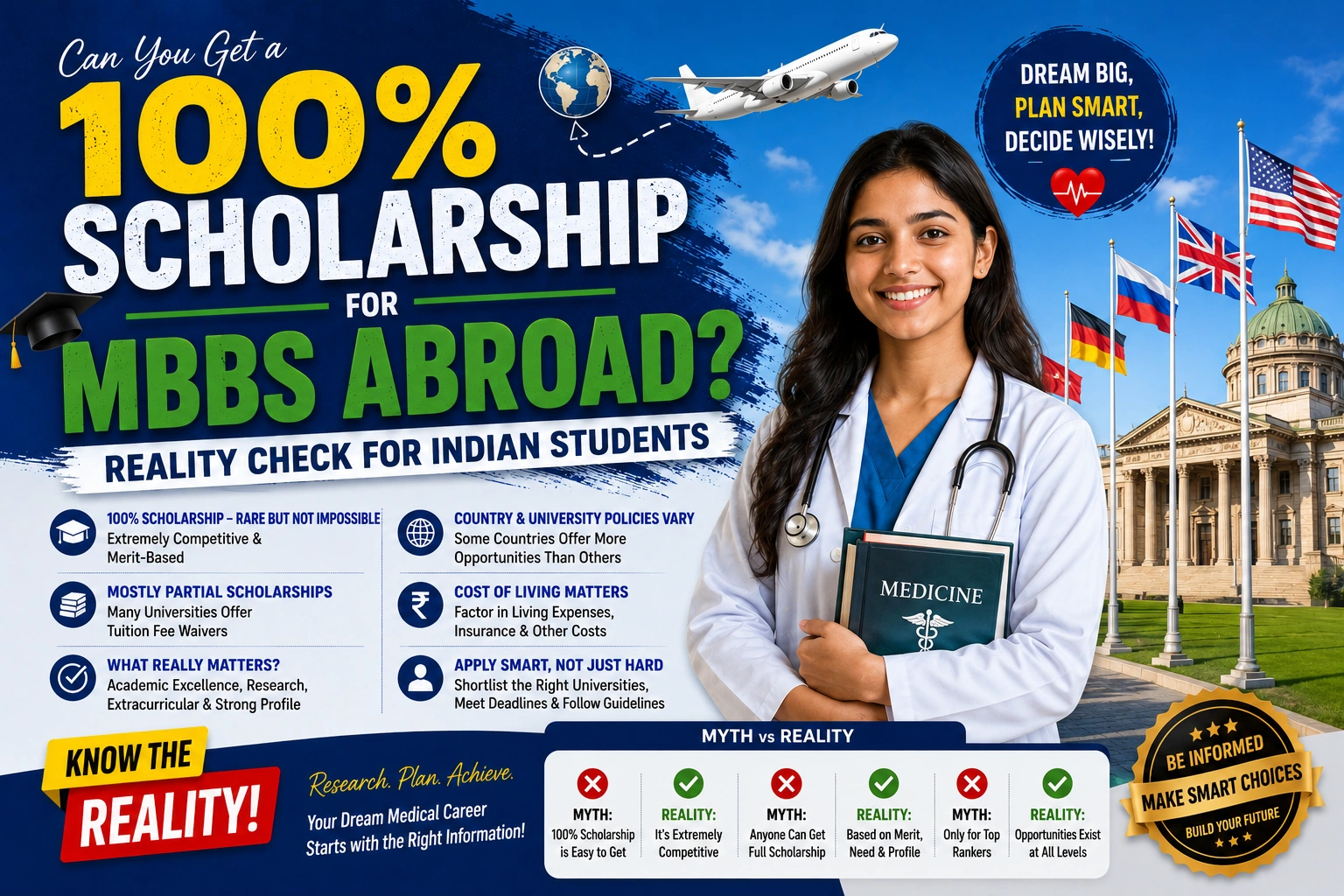
There is a lot of chatter on social media, the work of educational consultants, and university agents about fully funded MBBS programs that provide free tuition, hostels, and even food. How much of this is true and how much is fake? Because there is a lot of marketing that is done to get more applicants.
This article hopes to provide an honest and research-based reality check on the availability of MBBS scholarships abroad so that students do not fall to extreme marketing tricks and are able to make an informed choice.
Understand MBBS Abroad Before Applying
Before you fall for any marketing gimmicks, you should understand how MBBS abroad works. This includes the workings of NEET, NMC, WHO, and WDOMS.
If you still have not found a good source of information, you can check our comprehensive guide on MBBS abroad at MBBS Advisor that provides all the information Indian students need to know about pursuing their medical degree abroad.
The Truth About 100% MBBS Scholarships
Court cases about “100% scholarships” for MBBS abroad might sound really appealing to students but, in most cases, they are really only covering the full tuition waivers, and the students still have to cover all of their accommodation and living expenses.
These added expenses can quickly accumulate every year and become significant, even with free tuition.
Some universities offer partial funding from their merit-based scholarships (10% to 100% funding), which students earn through their performance in academics, NEET scores, or entrance exams.
Nevertheless, real 100% tuition waivers are typically only extended to a handful of students, and are not offered to all applicants who are represented by the agent or the consultancy.
If a guarantee of 100% scholarship, regardless of the academic background, is advertised, the scholarship should be considered with caution.
Why Scholarship Claims Are Often Misleading
Common Marketing Practices
The admission of MBBS abroad is very competitive, and private consultancies are usually aggressive and do not hesitate to use pushy marketing to gain clientele.
It is common practice to use the terms:
- “100% scholarship”
- “Free MBBS”
- “No donation”
to generate leads and close deals.
In reality, a lot of these “scholarships” are just a typical fee that a university is “selling.” An example of that is when a university advertises that their normal tuition fee is lower than that of other universities, and agents sell that fee as a scholarship.
Another common practice is that a scholarship is advertised, but is only offered for the first year of the program, and is understood to be lost in subsequent years of the program.
Uninformed students may enroll under the assumption that they will get a full scholarship for their MBBS, only to discover by the second or third year that they will need to pay the full fees from that point onwards.
It is, therefore, crucial to examine the university scholarship policy, rather than rely on what third parties and agents say.
Countries with Real Scholarships
Fully subsidized MBBS programs are rare, although several countries have genuine and reliable scholarship programs for international students (including Indians).
These include:
- Russia
- Kazakhstan
- Kyrgyzstan
- Georgia
- The Philippines
These countries have universities that provide scholarships in the form of fee reductions to students with meritorious credentials.
In some cases, fee reductions are significant for students who perform well in qualifying examinations and/or in entrance examinations conducted by the concerned universities.
Other genuine and transparent opportunities worth considering are government scholarship programs including bilateral education agreements between India and several other countries and international scholarship programs of organizations that focus on global health education.
Admittedly, these scholarship programs are few and highly competitive, but they are genuine and transparent compared to the many informal offers promoted by unscrupulous agents.
Students should also check the recognition of the university and the MBBS program before making a choice, as it is futile to have a scholarship for a degree that is not recognized.
You can verify whether a university is accredited from the World Directory of Medical Schools (WDOMS), which maintains a global database of recognized medical schools.
The Role of NEET in Scholarship Eligibility
To study MBBS abroad, Indian students must clear the NEET as it is also a prerequisite for obtaining a scholarship for many universities.
Several overseas medical universities provide financial incentives and concessions as part of their tuition fee structure for students with high NEET scores, as they are considered to have a higher academic potential.
To understand how NEET scores determine scholarship eligibility and rank, students can make use of the NEET Rank Predictor to get a clear picture of their score and rank abroad.
It is important to note that the minimum qualifying score in the NEET exam is not a guarantee for obtaining a scholarship.
Many universities have their own internal eligibility scores, and students must score above those internal cut-off scores to be considered for scholarship opportunities.
The complete NEET process, eligibility criteria, exam structure, and counseling process is covered in our dedicated NEET page for medical aspirants willing to study MBBS abroad.
How to Identify a Genuine Scholarship Offer
Due to the prevalence of fake scholarship offers and advertisements, there is an urgent need for Indian students to have a clear and practical way to filter out real scholarship opportunities from fake offers.
Step 1: Verify Through the University
The first step is to check the scholarship offer directly on the university’s official website instead of solely depending on the agent or third-party portal.
A lot of official university websites post the detailed fee structure and the scholarship terms and conditions.
This should be consistent with what the agent is offering.
Step 2: Verify Recognition
The second step is to check the university’s recognition status from the appropriate authorities.
The regulatory body of Medical Education in India is the National Medical Commission.
They set the criteria for the foreign Medical Graduates to practice in India.
The official NMC website provides the latest updates and regulations for Indian students who wish to pursue the MBBS abroad.
The WDOMS listing of the particular university and relevant documents and guidance of the World Health Organization (WHO) will further assist in verifying the international standards of medical education set by the concerned institution.
It’s also advisable to directly ask the university, through official emailing, whether the scholarship is awarded for the entire duration of the course or for a limited period.
Written Confirmation from a university is far more reliable than a verbal commitment of an agent, and can act as evidence in the circumstances of a future fee dispute.
Unforeseen Costs Not Covered by Scholarships
Even if a scholarship completely waives the tuition fee, students tend to underestimate the other costs incurred while studying MBBS abroad.
It is rare for tuition-based scholarships to cover hostel or accommodation charges.
If they are covered, these costs vary depending on the country and city.
Food expenses will also add up to the costs when considering a six-year program with hostel food or food arranged separately.
In most countries, international students are required to have health insurance, which is an additional recurring cost that scholarship programs usually do not cover.
Visa fees, residence permit renewals, and transportation within a city are some of the additional costs that families must plan for.
Especially during semester breaks, flight tickets to and from India can also be a significant cost.
Students and parents must consider all these costs to arrive at an accurate total cost, as scholarships do not mean that all education costs will be covered.
Merit-Based vs. Marketing-Based Scholarships
When considering options for studying medicine abroad, knowing the difference between merit-based and marketing-based scholarships is helpful.
Merit-Based Scholarships
Merit-based scholarships consider certain measurable academic criteria, which can be:
- A minimum NEET score
- A certain score on an entrance exam
- A specific percentage in previous academics
These scholarships are usually found in university brochures and are awarded as part of a transparent process.
Marketing-Based Scholarships
Marketing-based scholarships are used as a sales technique by the consultancies to promote something that is not actually as favorable.
The advertised discounts, labeled a “scholarship,” are often just the international rate for students, and no actual discount is offered.
Developing the ability to recognize false discounts will reduce the potential for disappointment for students and families due to a false expectation of a scholarship reward.
Steps for the Correct Way to Apply for a Scholarship
Treating the application for a scholarship as a shortcut to achieving an objective is incorrect.
It is a time-consuming process that requires the applicant to prepare and submit a number of documents.
Researched universities will have a consistent history of providing legitimate scholarship opportunities and will have openly published their scholarship details.
Recommended Process
- Contact the university’s international admission office.
- Request a written explanation detailing the scholarship policy.
- Validate any claims made by a local agent or consulting firm.
- Confirm the university’s status using the WDOMS directory.
- Evaluate the policy of the NMC to ensure the degree would be recognized to practice medicine in India.
It is also important to evaluate two to three university offers before choosing a university as the first offer to do so may be most appealing.
An evaluation of the tuition fees, the duration of tuition waiver, any potential hidden costs and the recognition of the university will also add to this clarity.
For advice on identifying genuine scholarship offers and evaluating university options, admission contracts, and more, parents and students can use verified education services, like MBBS Advisor.
Warning Signs of Fake Scholarship Offers
Urgency to pay by an agent without any official university scholarship documentation is a cause for concern.
It is also a cause for concern if an agent outlines scholarship opportunities in a phone call or meeting, and these opportunities are never documented by the university.
Another warning sign is if the percentage offered is far higher than what is offered by a university that is considered reputable in the same country.
There are some universities that offer high fee waivers for high-achieving students; however, if there is a high offer with no justification, it is most likely a false offer.
It is also a warning sign if a consultancy discourages students from communicating with the university.
Usually, universities that are transparent in their operation and offers, welcome communication with students.
Conclusion
Deciding to study MBBS abroad is a huge financial and academic decision.
Scholarships are of course a great way to subsidize the cost.
However, an offer of a fully funded scholarship should not be the driving reason to choose a university.
Students should pay more attention to:
- The quality of the medical education on offer.
- The recognition of the institution.
- The potential career opportunities that the institution will open up for students.
Based on these, students should consider the scholarship to be a small extra consideration.
Students should validate all information about a university in official sources such as the NMC, WHO, and WDOMS, and check NEET eligibility using resources such as the NEET guide and the NEET Rank Predictor.
Admission to a university should be based on verifiable eligibility requirements, as focusing on scholarships can lead to financial and professional losses.
Visit the MBBS Advisor for personalized guidance for selecting a university, scholarship verification, and the entire MBBS abroad admission process.
The MBBS Advisor provides resources to help Indian students make informed decisions about their future.