 Russia
 Belarus
 Georgia
 Kazakhstan
 Kyrgyzstan
 Uzbekistan
 China
China Nepal
Nepal Bangladesh
 Poland
 Romania
 Slovakia
 Hungary
 N. Macedonia
 Vietnam
 Canada
 Armenia
 UK
UK Australia
 USA
USA Ireland
 Germany
 New Zealand
 Italy
Italy France
 Singapore
 Netherlands
 Sweden
 Switzerland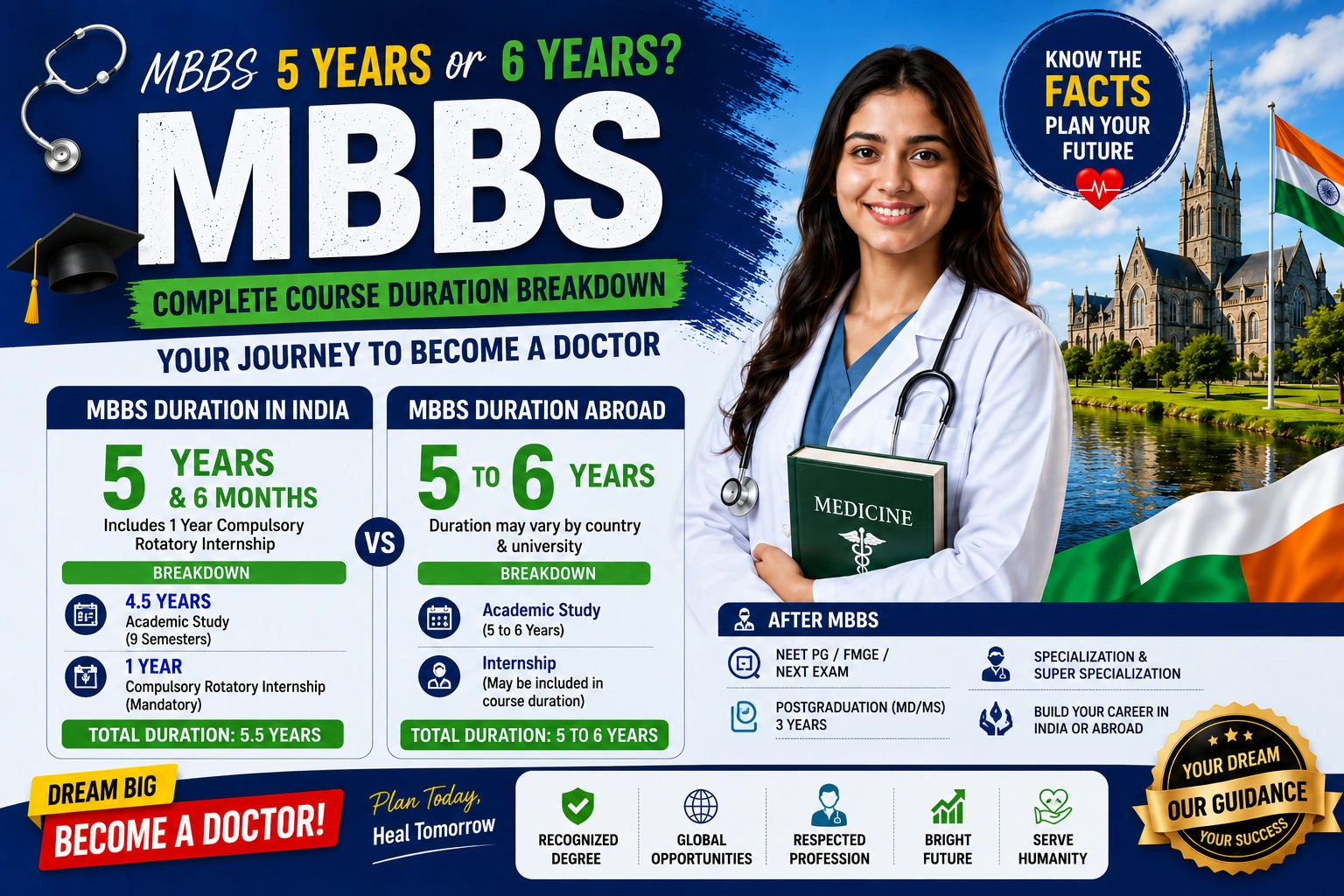
The duration of MBBS programs is a hot topic when it comes to medical admissions. The research country is important here since there is no universal answer to the number of years for an MBBS program. This is because of the structure of the internship and medical education regulations in that country. In India, the MBBS program lasts for 5.5 years, while many other countries abroad, including 6-year MBBS programs, include the foundation or pre-clinical training in the duration of the program.
If you are an Indian and are planning to pursue medicine post your NEET, it is important to know the MBBS program duration since it will overlap with your internship, licensing, and post-graduation. If you choose to study medicine in India or abroad, know the MBBS program duration and plan accordingly.
If you are looking at the best medical colleges in India and abroad, MBBS Advisor shares the latest information on admissions, eligibility, universities, scholarships, and counseling.
Why Is There Confusion About MBBS Course Duration?
Five, 5.5 and 6-year programs, where do these durations come from? This confusion is the result of the different medical education systems of different countries.
In India, the NMC is the regulating body for MBBS. In Indian universities, there is classroom training along with a compulsory internship, hence the total duration of the program is 5.5 years.
In contrast, other countries such as Russia, Kazakhstan, Uzbekistan, Kyrgyzstan, Georgia, etc. provide a 6-year MBBS program, where theoretical studies are complemented by practical training and clinical rotations that are built into the curriculum.
Students should not judge a university based on just the number of years.
They should take into account:
- Curriculum
- Clinical contacts
- Recognition
- Placements
- NMC compliance
MBBS Duration in India
In India, the MBBS course is officially 5.5 years.
The structure generally contains:
Academic Study
The first 4.5 years incorporate teaching in the basic medical sciences and clinical training. Students learn about anatomy, physiology, pathology, pharmacology, microbiology, surgery, medicine, pediatrics, obstetrics and gynecology, community medicine, and many more.
There is a combination of lectures, laboratory work, and postings in hospitals and interaction with patients in the early years.
Compulsory Rotating Internship
In the following, students complete a 1-year compulsory internship in all the departments of the hospital.
During this period of training, students acquire clinical experience under supervision in the following areas:
- General Medicine
- Surgery
- Pediatrics
- Orthopedics
- Obstetrics & Gynecology
- Community Medicine
- Emergency Medicine
The compulsory internship must be completed for the MBBS degree to be awarded.
MBBS Duration Abroad
The most preferred countries for Indians pursuing MBBS offer a 6-year course.
The extended duration generally includes language, foundation sciences, or some extended clinical training depending on the nation.
Countries with a 6-year MBBS program include:
- Russia
- Kazakhstan
- Uzbekistan
- Kyrgyzstan
- Georgia
- Belarus
- Armenia
- Tajikistan
Many universities offer accreditation and compliance with the international standards of medical education.
Students are advised to check if the university is listed in the WDOMS and is compliant with the latest NMC eligibility requirements before admission.
Why Do Some Countries Offer a 6-Year MBBS Program?
The additional time is not due to the increased difficulty of the course.
To create a more holistic healthcare professional, universities include all of the following in their curricula:
- Research
- Basic sciences
- Pre Clinical and Clinical Education
- Hospital Rotations
- Hands-On Learning
- Practical Learning
Students are exposed to research as well.
Some universities start exposure to patients in Year 3, as the majority of students are more adept at handling Clinical skills by the time they get there.
MBBS Course Structure Year-Wise
First Year
The scaffolding and fundamental sciences of medicine are studied in Year 1. These include:
- Anatomy
- Physiology
- Biochemistry
This year, students study the basic functions of the human body systems and spend a significant amount of time in laboratories and in the halls of anatomy dissection.
Second Year
The focus of the medical sciences shifts to disease. Students learn:
- Pathology
- Microbiology
- Pharmacology
- Forensic medicine
This year acts as a link to the clinical side of medicine.
Third Year
Clinical exposure increases even more. Students learn:
- Community Medicine
- Ophthalmology
- ENT
Hospital visits become more routine and students engage in their first contact with patients.
Fourth Year
Students learn all the major clinical specialties including:
- Medicine
- Surgery
- Pediatrics
- Psychiatry
- Orthopedics
- Dermatology
This year, clinical postings take a large portion of students' time.
Final Year
The focus of the final year is:
- Obstetrics
- Gynecology
- Emergency Medicine
Final Year students engage in the assessment of clinical subjects and practical examinations. Students also refine their clinical skills and prepare for the final summative assessment of the University.
Internship
The MBBS internship is one of the most important experiences of a medical student.
Students are placed in different hospitals to function as the medical staff under the supervision of doctors.
They experience first-hand the realities and challenges of the medical profession.
Some of the skills and attributes the MBBS students learn and refine during their medical internship are:
- Clinical skills
- Ethics
- Emergency medicine
- Management of patients
- Communication skills
Does a 6-Year MBBS Delay the Start of a Medical Career?
MBBS students have a total of 6 years to study medicine. Does this delay the start of their career as a physician?
Not at all.
Many students worry that pursuing six-year MBBS programs means they will enter the profession six years later. This is not the case. Usually, the difference is a few months, compared with programs in other countries with different internship structures.
What students should be most concerned about is:
- Quality of Education
- Clinical Exposure
- International Recognition
- Licensing Eligibility
- Hospital Infrastructure
A university that is well recognized, has high training standards, and is better at providing practical training will offer a greater long-term utility compared to the opportunity cost of an earlier graduation.
Does NMC Accept 6-Year MBBS Programs?
The answer is yes.
The National Medical Commission accepts foreign medical qualifications if students meet the criteria of eligibility and the most recent regulations.
Students should make sure that:
- The university adheres to NMC Guidelines
- The degree is recognized in the country of the award
- The university is listed in WDOMS
- Clinical Training meets standards
- Internship meets the required standards
When choosing a foreign medical university, pay close attention to the most recent updates published by NMC.
Significance of WHO and WDOMS Recognition
Many students think that the WHO ‘approves’ medical colleges. This is not true. The World Health Organization does not evaluate medical universities.
The WHO, in collaboration with the World Directory of Medical Schools (WDOMS), provides an internationally recognized database of medical schools.
To check the official standing and international recognition of a medical university, students should look at its listing in WDOMS.
How NEET Affects Duration of MBBS Programs
The length of the MBBS course does not change based on NEET scores.
However, clearing NEET is compulsory for Indian students wanting to pursue MBBS in India, as well as for those wanting to study MBBS abroad, based on the existing regulations.
An improved NEET Score offers an advantage to students wishing to join a prestigious government medical college or a reputed foreign university. For students who are not sure about their chances of getting admission, the NEET Rank Predictor offers the opportunity to estimate their rank during counseling.
Is a 5.5 Year MBBS Better than a 6 Year MBBS?
The duration of the course is not the only thing that needs to be considered. The quality of medical education is important and includes aspects like:
- Recognition of the university
- Clinical exposure
- Faculty
- Patient contact
- Hospital facilities
- Research
- Quality of the internship
- Licensing
- Cost
- Safety and support for the students
A six-year course with good clinical exposure may be better than a five-year course with no patient contact.
Things to Consider When Choosing an MBBS Program
Students should not make decisions to join a university based on the promotions or social media statements.
You need to check:
- NMC Compliance
- Listing on WDOMS
- Quality of Clinical Training
- Language of Instruction
- Availability of Internships
- Tuition and Hostel Fees
- Prep Support for FMG/NExT
- Rank and Reviews of the University
Contacting an education expert to guide you is highly recommended to avoid a wrong decision that can be financially costly.
MBBS Admission Guidance
Choosing the right university involves more than just comparing the duration of courses. You need to have a clear understanding of the admission criteria, recognition of the university, cost, internships, licensing, and the career options before you make a decision.
MBBS Advisor provides expert counseling, support, and admission related document services for medical students wishing to pursue MBBS from India or abroad.
You can also keep track of the recent changes in NEET, and using the NEET Rank Predictor, you can analyze your chances of getting admitted and plan your counseling accordingly.
Conclusion
To answer "Is MBBS 5 years or 6 years?" one needs to consider the country in which one intends to study medicine. In India, an MBBS degree requires 5.5 years, including a 1-year compulsory internship. The MBBS degree in many popular study destinations abroad usually takes 6 years to complete, considering the extensive training in the field of medicine and clinical work that is interspersed through the course and the academic sessions.
Rather than only course duration, students need to consider the medical university’s recognition, the quality of education, and the availability of clinical exposure, as well as NMC compliance. An internationally accepted, recognized medical university with excellent clinical experience will provide a much better foundation for a long-lasting medical career than a university with a shorter program. With the right MBBS pathway, chosen with the help of MBBS Advisor, students can successfully approach their dreams of entering the medical profession.