 Russia
 Belarus
 Georgia
 Kazakhstan
 Kyrgyzstan
 Uzbekistan
 China
China Nepal
Nepal Bangladesh
 Poland
 Romania
 Slovakia
 Hungary
 N. Macedonia
 Vietnam
 Canada
 Armenia
 UK
UK Australia
 USA
USA Ireland
 Germany
 New Zealand
 Italy
Italy France
 Singapore
 Netherlands
 Sweden
 Switzerland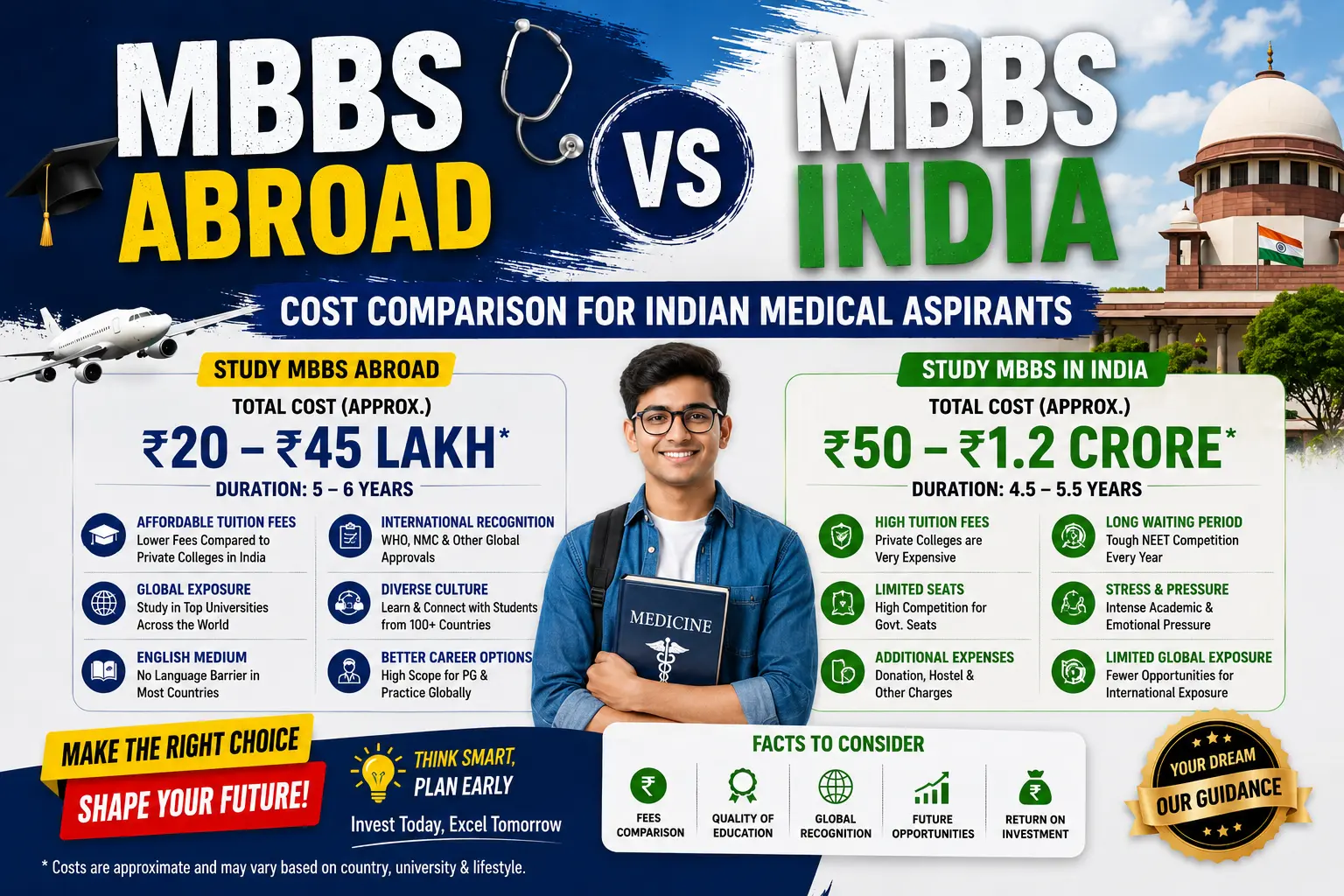
MBBS is by far the most popular career choice among Indian students, and for good reason. With the competition in the National Eligibility cum Entrance Test (NEET) reaching new heights, students must make difficult decisions when it comes to their careers. Is it better to study medicine in India, or does it make more sense to choose an option abroad? Various parameters like seat availability, education standards, the ease of getting sufficient clinical exposure, and the financial cost involved come into play. This is a cost focused research piece that strives to provide a balanced perspective.
MBBS Advisor makes other options easily available for guidance on NEET, MBBS Admission, and Preparation. Their NEET Rank Predictor and other tools help students evaluate their admission chances and advise them accordingly.
NEET and Dreams of Studying Medicine
NEET is the only route for Indian students to secure an MBBS seat. With so many students taking this exam, it’s no secret getting a seat is a competitive struggle. Many students go to great lengths to secure a spot in a government-funded medical college with affordable fees. This leaves the rest with private colleges and foreign options. A NEET Rank Predictor is essential to get an early grasp of these options.
The NEET-induced stress at times makes international MBBS programs appealing for students. This may be especially true for students whose scores do not meet the government college cut-off restrictions domestically but are still eligible for international programs. Also, some seat allocation rules may not apply and some institutions offer direct admission to students who meet the NEET eligibility, age, and score criteria.
What are the NMC, WHO and WDOMS?
The first thing to consider when looking at an international program is the cost. The thing to consider prior to the actual expenses is the legal and regulatory oversight. The NMC is India’s regulator for the practice and education of medicine. For foreign medical graduates, qualifying the Foreign Medical Graduate Examination (FMGE) or the National Exit Test (NEXT) will be mandatory to practice in India. While the NMC does not endorse any foreign institution, they suggest the degree must be in compliance with WDOMS and fulfill the requirements of at least 54 months with 12 months of an internship.
With recognition from the WHO through the WDOMS, foreign institutions also earn credibility. Prior to enrollment, students have to ensure the chosen university does appear in the WDOMS, meets the NMC guidelines and does provide opportunities for the student to take licensure examinations. There are no shortcuts, as leading consultants share this emphasis, since the qualification must be valued and must be recognized.
MBBS Fees in India
The duration of an MBBS in India is 5.5 years and costs depend on whether the degree is obtained from a government or private institution.
Government Medical Colleges
Government Medical Colleges are the least expensive option. The annual tuition can range from ?6,000 to ?2.5 lakhs, resulting in a total course cost of about ?30,000 to ?15 lakhs (includes hostel and other charges in some cases). These colleges are subsidized heavily, making admission highly competitive. The low fees at AIIMS, for example, come with the requirement of high NEET scores (600+ for general category in a competitive state).
Hostel charges, mess fees, books, and equipment also result in additional costs. Nevertheless, the total expenditure on a government seat does not exceed ?10–20 lakhs for most students.
Private Medical Colleges
Private Medical Colleges have a high financial cost. Tuition fees in the management or NRI quota range from ?10 lakhs to ?25 lakhs or more annually. The full course can cost 50 lakhs to 1 crore or more. This does not include donation/capitation fees (often several crores in some cases), hostel and other charges which are mandatory. Many private colleges charge ?15–30 lakhs for tuition each year, with total course fees exceeding ?80 lakhs to ?1.5 crores.
Private Indian colleges have hidden costs like higher annual fees and increased urban living costs. For students with lower NEET scores (between 300 and 500), private colleges are the main option domestically. However, taking out loans to pay for these colleges places a burden on the middle class.
The repayment pressure from many post-graduate loans alters the cost consideration, especially if the quality and quantity of the clinical exposure are comparable, and you are aiming for a lower-cost college.
An Affordable and Global Option: Studying MBBS Abroad
Studying MBBS abroad has become a popular option for Indian students because it offers lower costs, fewer barriers for post-NEET admission (English taught), and the opportunity to gain International exposure. Popular International destinations are Kyrgyzstan, Kazakhstan, and the Philippines. Russia, Georgia, and China have become popular too. Most MBBS programs abroad include a 6 year education with an integrated internship.
The estimated total cost packages to study MBBS abroad are from ?15 to 40 lakhs and depend on the country, college, and personal lifestyle. There are many colleges abroad that offer an annual fee from ?3 to 8 lakhs.
To give an example from the countries of choice:
- In Russia, total cost packages from ?15 to 40 lakhs are fairly common.
- Georgia places an emphasis on safety and modern building and offers an educational total cost of ?20 to 35 lakhs for medical education that meets European standards.
- Kyrgyzstan and Kazakhstan have become popular low cost locations and their total cost packages for living and studying can be under ?25 to 35 lakhs.
- Philippines has English curricula priced between ?20–30 lakhs incorporating a strong emphasis on clinical education.
Living abroad incurs monthly living costs of ?15,000–?50,000 (approximately) on food, lodging, transportation, and utilities. This depends on the choice of city and lifestyle. There are also hostels provided by many universities. These have Indian mess and help to eliminate food costs and enable students to adapt to the new culture.
The absence of enormous donation or capitation fees common to private Indian colleges is a major advantage. Furthermore, reduced financial burden is provided by scholarships and subsidized seats in Russia. Students also need to anticipate one-time expenses which are Medical Insurance, Visa, Air Travel and Initial Expenses (around ?2–5 lakhs).
Cost Comparison (India Vs. Abroad)
Realistically comparing for a typical middle-class Indian family:
- Government MBBS in India: Costs of Total ?5–20 lakhs. Financially Low Risk but Extremely High Competition (this is ideal if the candidate has a good NEET score).
- Private MBBS in India: Costs of Total ?50 lakhs–?1.5 crores+. High EMI on loans and potentially stressful for family finances.
- MBBS ABROAD (Reputed NMC / WDOMS Listed Universities): Costs of Total ?15–45 lakhs. More Predictable Budgeting. More Opportunity for a Return on Investment as the cost of the MBBS degree is lower and there are more opportunities abroad.
The cost differential abroad also results in MBBS students focusing on their studies instead of financial woes. Many MBBS students go back to India, take and pass the FMGE / NEXT, and begin medical practice. Others consider exploring the options available in the host country or others, taking advantage of their MBBS degree.
Expenses abroad may also include travel (?50,000–?1 lakh), holidays, and currency exchange. As an overall trend, it is favorable to the savings of sending a student to a private Indian college. It is common for parents to find that the overseas monthly expenses are on par with the costs of a student enrolled in a private Indian college located in a metropolitan area.
Beyond costs, the benefits of studying MBBS in India
Benefits
- It is possible to avoid the 'new country' adjustment period.
- You can speak the language (except when it comes to a few regional dialects).
- The curriculum aligns with the Indian medical program and NEET-PG.
- There is a high volume of patients, which provides clinical exposure.
- There are social ties to family and friends.
Costs
- The number of students seeking admission is significantly greater than the available seats, and the fees of private colleges are high.
Benefits of studying MBBS abroad
Benefits
- The cost of studying MBBS abroad is affordable and most universities are well-equipped.
- You can get early clinical exposure and there are many labs with research opportunities.
- You are exposed to international medical systems and peers.
- The process of applying is often less complicated after you have qualified NEET.
Costs
- You will have to adjust to a new country and culture, there may be language barriers (especially in non-English clinical programs, but many of these programs are in English), and you must clear FMGE/NEXT to practice in India. The food and climate can be a challenge, but there are many Indian students in most of the popular countries.
- There can be a variance in the clinical exposure you will get in an overseas MBBS program, as some programs offer excellent clinical training and others may not offer early clinical training. You should research thoroughly.
These are some of the factors you should consider when making decisions
While cost is the most important factor, students must also determine:
- University Recognition: Check both the WDOMS and the NMC compliance listing to ensure you will have a clear pathway to FMGE.
- Consider FMGE pass rates, infrastructure, faculty, and alumni opinions for quality and outcomes.
- Budgeting: Determine total costs including hidden expenses, inflation, and interest on loans. Studying abroad means smaller international loans.
- Career Goals: Would you like to practice in India or study PG abroad?
- Are you personally ready: can you live on your own abroad?
You can use the NEET Rank Predictor on MBBS Advisor to analyze your odds of getting a private seat and help you decide if you need to study abroad.
For students who qualify for foreign programs but do not qualify for the Government programs, studying abroad is a reasonable and quality option. Especially in countries with established support for Indian students.
Consider ROI: Return on Investment
A lower total cost when studying abroad can give a better ROI. Graduates can clear licensing exams, pursue PG in India or abroad, and start earning sooner. Debt will not be as large compared to Indian private medical schools. Financial independence is delayed due to heavy loans.
MBBS abroad can lead to a successful career with the right planning. Accredited programs that you prepare for will allow a smooth transition and successful career.
Conclusion
The decision really comes down to how you performed on the NEET, your families finances, and your goals. The best seats in India are the Government seats due to the cost and prestige. For the majority of aspiring medical students, the cost and quality of MBBS abroad programs is a strong and reasonable option.
Thorough research, verification of NMC/WDOMS compliance, and engaging with trusted advisors is essential. MBBS Advisor and their NEET resources as well as extensive expertise provide excellent support to meet these goals.
Choosing to pursue medical education domestically or internationally, treating patients and studying hard will always be essential to a fulfilling medical career path. With evolving opportunities and an enhanced mindset, students pursuing their medical career outside of India have more options available to make their dreams a reality. Plan accordingly, perceive and compare the costs fully, and choose the option that speaks to your inner desires and fulfills them in the most realistic way.