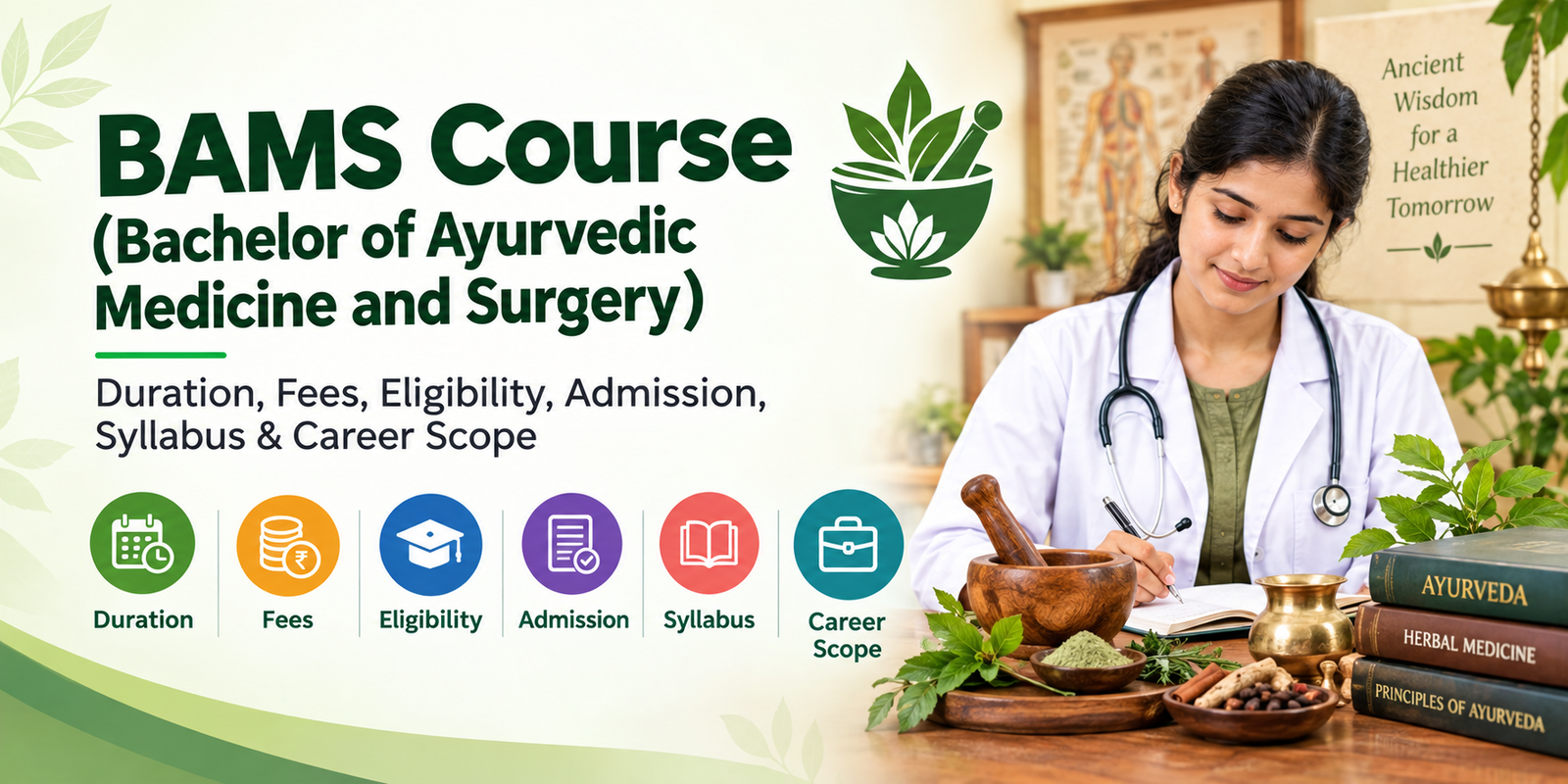
BAMS (Bachelor of Ayurvedic Medicine and Surgery) is an undergraduate medical programme based on Ayurveda principles and modern medicine. The course encompasses classical Ayurvedic concepts with medical education, clinical training and practical learning.
For students interested in healthcare but looking beyond conventional MBBS, BAMS is one of the major undergraduate options in the AYUSH system. Admission to BAMS programmes in India is linked to NEET-UG, followed by counselling conducted by the appropriate authorities. For All India Quota seats under government, government-aided, central institutions, national institutes and deemed universities, counselling is conducted through the Ayush Admissions Central Counseling Committee (AACCC).
The BAMS course generally includes subjects such as Sanskrit and Ayurvedic fundamentals, anatomy, physiology, pharmacology-related Ayurveda subjects, pathology, medicine, surgery, Panchakarma, Shalya Tantra, Shalakya Tantra, Prasuti and Stri Roga, Kaumarbhritya and other clinical disciplines.
If you are planning to pursue a career in Ayurveda, this guide covers BAMS course duration, fees, eligibility, NEET requirements, admission process, syllabus, internship, career opportunities, salary and higher studies.
What is BAMS?
BAMS stands for Bachelor of Ayurvedic Medicine and Surgery. It is an undergraduate degree programme designed to provide education and clinical training in Ayurveda along with relevant aspects of contemporary medical science.
The programme introduces students to the fundamental concepts of Ayurveda, including the understanding of the human body, health, disease, diet, lifestyle, medicinal substances and therapeutic approaches described in Ayurvedic literature.
At the same time, students study modern subjects such as anatomy, physiology, pathology, pharmacology-related concepts and clinical methods. This combination helps students understand both the traditional Ayurvedic framework and the requirements of modern healthcare education.
The BAMS degree is regulated under the framework of the National Commission for Indian System of Medicine (NCISM). The curriculum and academic structure are therefore not simply based on individual college preferences but follow the applicable regulatory standards.
BAMS Course Highlights
|
Particular |
Details |
|
Full Form |
Bachelor of Ayurvedic Medicine and Surgery |
|
Degree Level |
Undergraduate |
|
Course Type |
Medical/AYUSH |
|
Duration |
Generally 5.5 years including internship |
|
Admission |
NEET-UG based |
|
Eligibility |
Class 12 with Physics, Chemistry, Biology and English |
|
Entrance Exam |
NEET-UG |
|
Internship |
Compulsory internship component |
|
Regulatory Body |
National Commission for Indian System of Medicine (NCISM) |
|
Admission Counselling |
AACCC and respective State/UT authorities |
|
Major Study Areas |
Ayurveda, Anatomy, Physiology, Medicine, Surgery and Clinical subjects |
|
Higher Studies |
MD/MS in Ayurveda and other relevant programmes |
The current BAMS academic calendar published by NCISM illustrates the professional structure of the programme, including an 18-month first professional phase, followed by subsequent professional training and examinations.
BAMS Course Duration
The BAMS course duration is generally 5.5 years, consisting of academic education followed by a one-year internship.
The programme is divided into professional phases. Students gradually move from foundational Ayurvedic concepts and basic medical sciences to clinical subjects and supervised practical training.
A simplified structure is:
- Initial professional education and foundational subjects
- Intermediate professional training
- Advanced clinical education
- Practical and hospital-based exposure
- Compulsory internship
The internship is an important part of BAMS education because it allows students to apply theoretical knowledge in a clinical environment.
During clinical training, students may get exposure to areas such as general medicine, surgery, Panchakarma, paediatrics, gynaecology, ENT and ophthalmology, depending on the institution and applicable curriculum.
BAMS Course Fees in India
The BAMS fees depend on the type of college, state, management category and admission quota.
Government Ayurveda colleges generally have significantly lower tuition fees than private or deemed universities. Private colleges may charge considerably higher fees, while hostel, examination, registration and other institutional charges can be additional.
Approximate BAMS Fee Structure
|
College Type |
Approximate Tuition Fee Range |
|
Government BAMS College |
₹10,000 – ₹1.5 lakh per year |
|
Government-Aided College |
₹30,000 – ₹2 lakh per year |
|
Private BAMS College |
₹2 lakh – ₹5 lakh+ per year |
|
Deemed University |
May be considerably higher |
Note: These are broad indicative ranges for understanding the difference between institution types. Actual fees can vary by college, state, quota, category and academic year. Students should always verify the latest fee structure from the concerned college and counselling authority before taking admission.
The total cost may also include:
- Tuition fee
- Hostel charges
- Mess charges
- Examination fee
- University fee
- Library charges
- Laboratory charges
- Clinical training-related charges
- Registration and other institutional fees
Therefore, students should calculate the total cost of studying BAMS, rather than considering tuition fees alone.
BAMS Eligibility Criteria
Students seeking admission to BAMS must fulfil the eligibility requirements applicable to the admission year.
For NEET-based AYUSH undergraduate admissions, the qualifying examination requirements include Class 12 or equivalent education with Physics, Chemistry, Biology and English. The NEET-UG information bulletin has specified minimum PCB marks for different categories and an age requirement for admission.
Basic BAMS Eligibility
A candidate generally needs to:
- Pass Class 12 or an equivalent examination from a recognised board.
- Study Physics, Chemistry and Biology as required subjects.
- Have English as a qualifying subject.
- Meet the prescribed minimum qualifying marks.
- Qualify NEET-UG.
- Fulfil the applicable age and other admission requirements.
- Participate in the relevant counselling process.
For the NEET-UG 2025 criteria, the qualifying examination requirement specified at least 50% aggregate marks in Physics, Chemistry and Biology for General category candidates and 40% for SC, ST and OBC candidates, with separate provisions for specified PwBD candidates. The candidate was also required to have attained 17 years of age by 31 December of the admission year. Candidates should check the information bulletin for the particular admission year because requirements can be amended.
Is NEET Required for BAMS?
Yes, NEET-UG is required for admission to BAMS in India.
BAMS is among the AYUSH undergraduate courses covered through NEET-UG. The NEET-UG information bulletin states that admission to undergraduate Ayurveda, Siddha, Unani and Homoeopathy courses is through NEET-UG in accordance with the applicable regulations.
After qualifying NEET, candidates need to participate in counselling.
For the 2026-27 admission cycle, AACCC is conducting online counselling for eligible NEET-UG candidates seeking BAMS and other AYUSH undergraduate courses.
BAMS Admission Process
The BAMS admission process generally starts with NEET-UG registration and examination.
Step 1: Appear for NEET-UG
Students interested in BAMS should register for and appear in NEET-UG.
Step 2: Qualify NEET
Candidates need to meet the applicable NEET qualifying requirements.
Step 3: Register for Counselling
Eligible candidates register for the relevant counselling authority.
AACCC conducts counselling for specified All India Quota seats, including seats in government, government-aided institutions, central universities, national institutes and deemed universities. State and UT authorities conduct counselling for seats under their respective jurisdictions.
Step 4: Choice Filling
Candidates select their preferred BAMS colleges and courses according to the available seat matrix.
Step 5: Seat Allotment
Seats are allotted according to the applicable counselling rules, candidate eligibility, merit, choices, category and seat availability.
Step 6: Reporting to College
After receiving an allotment, the candidate must complete the reporting and admission formalities within the prescribed deadline.
Step 7: Begin BAMS Programme
Once admission is confirmed, students begin their academic programme according to the college's academic schedule.
AACCC's 2026 counselling system includes multiple rounds and stray vacancy rounds for applicable categories of seats.
BAMS Syllabus
The BAMS syllabus covers both traditional Ayurvedic sciences and relevant modern medical sciences.
Students are gradually introduced to fundamental concepts before moving towards clinical subjects.
Major BAMS Subjects
Some of the important areas covered during BAMS education include:
- Sanskrit and Ayurvedic terminology
- Samhita and Siddhanta
- Kriya Sharir
- Rachana Sharir
- Dravyaguna Vigyana
- Rasashastra and Bhaishajya Kalpana
- Roganidana and Vikriti Vigyana
- Swasthavritta
- Agada Tantra
- Charaka Samhita
- Kayachikitsa
- Panchakarma
- Shalya Tantra
- Shalakya Tantra
- Prasuti Tantra and Stri Roga
- Kaumarbhritya
- Research methodology
- Community medicine-related areas
- Clinical training
The exact subject arrangement and professional-phase structure should be checked against the current NCISM curriculum and the university's academic regulations.
BAMS First Year Subjects
The initial phase focuses heavily on foundational concepts.
Students may study areas such as:
- Sanskrit and Ayurvedic terminology
- Padartha Vigyan
- Ayurveda Itihasa
- Samhita-related foundational learning
- Rachana Sharir
- Kriya Sharir
Modern anatomy and physiology form an important part of the foundation because students need a systematic understanding of the human body before moving to clinical subjects.
BAMS Second Year Subjects
The second professional phase generally moves towards subjects related to medicines, pathology, diagnosis and preventive healthcare.
Important areas can include:
- Dravyaguna Vigyana
- Rasashastra and Bhaishajya Kalpana
- Roganidana
- Vikriti Vigyana
- Swasthavritta
- Agada Tantra
- Research-oriented learning
Students begin connecting the fundamental concepts of Ayurveda with disease identification, medicinal substances and therapeutic principles.
BAMS Third Year and Clinical Subjects
As students progress, the programme becomes more clinically oriented.
Major areas include:
- Kayachikitsa
- Panchakarma
- Shalya Tantra
- Shalakya Tantra
- Prasuti Tantra
- Stri Roga
- Kaumarbhritya
- Clinical case-taking
- Hospital-based training
Clinical exposure becomes increasingly important because students learn how theoretical concepts are applied in patient care.
BAMS Internship
The BAMS internship is an essential component of undergraduate training.
During the internship, students receive practical exposure under supervision. The exact rotation and duration of individual postings depend on the applicable regulations and institutional schedule.
Students can receive exposure to departments such as:
- Kayachikitsa
- Panchakarma
- Shalya
- Shalakya
- Prasuti and Stri Roga
- Kaumarbhritya
- Swasthavritta
- Hospital administration and related clinical activities
The internship helps students develop practical skills, patient communication abilities and familiarity with clinical procedures.
Skills Developed During BAMS
BAMS is not limited to memorising Ayurvedic concepts. The course can help students develop several professional skills.
1. Clinical Skills
Students learn how to take patient histories, understand clinical presentations and participate in supervised patient care.
2. Knowledge of Ayurvedic Diagnosis
Students study Ayurvedic approaches to understanding health and disease.
3. Knowledge of Medicinal Plants
Subjects such as Dravyaguna introduce students to medicinal substances and their properties.
4. Patient Communication
Healthcare professionals need strong communication skills. BAMS training provides opportunities to interact with patients during clinical postings.
5. Preventive Healthcare Understanding
Ayurveda places considerable emphasis on lifestyle, diet and preventive approaches, which form an important part of the academic curriculum.
Career Options After BAMS
After completing BAMS and the required internship and registration requirements, graduates can explore several professional pathways.
1. Ayurvedic Physician
Graduates can work in Ayurvedic hospitals, clinics and healthcare organisations according to applicable registration and professional regulations.
2. Government Healthcare Jobs
BAMS graduates can apply for relevant government healthcare positions when vacancies and eligibility criteria permit.
Recruitment may take place through state health departments, government hospitals, AYUSH departments and other public-sector organisations.
3. Private Hospitals
Many private healthcare organisations have departments or facilities offering Ayurvedic services.
4. Ayurvedic Clinic
Graduates may establish or practise in an Ayurvedic clinical setting, subject to applicable registration and legal requirements.
5. Panchakarma Specialist
Panchakarma is an important area within Ayurveda. Graduates may develop professional expertise in this field through suitable training and experience.
6. Research
Students interested in academic and scientific work can explore research opportunities in Ayurveda, medicinal plants, pharmacology, clinical research and related areas.
7. Pharmaceutical Industry
The Ayurvedic pharmaceutical sector offers opportunities in areas such as:
- Production
- Quality control
- Quality assurance
- Research and development
- Product management
- Medical content
- Regulatory affairs
8. Teaching and Academics
BAMS graduates interested in education can pursue postgraduate qualifications and later explore teaching and academic careers.
9. Health and Wellness Sector
The growing interest in preventive health, lifestyle management and wellness has created opportunities in specialised healthcare and wellness settings, subject to professional regulations.
BAMS Salary in India
The salary after BAMS varies according to qualification, experience, employer, location, job role and professional registration.
A fresh BAMS graduate working in a private organisation may start with a relatively modest salary, while earnings can increase with experience, postgraduate education, specialisation, clinical reputation or entrepreneurship.
Broadly, career earnings may come from:
- Hospital employment
- Clinic practice
- Government employment
- Pharmaceutical companies
- Research organisations
- Academic institutions
- Wellness organisations
- Consultancy or professional practice
Instead of choosing BAMS only on the basis of starting salary, students should consider long-term professional interests, postgraduate options, clinical exposure and the type of healthcare practice they want to pursue.
Higher Studies After BAMS
BAMS graduates can pursue higher education to develop specialised knowledge.
One of the major pathways is MD/MS in Ayurveda through the relevant postgraduate admission process.
Possible postgraduate specialisations include areas associated with:
- Kayachikitsa
- Panchakarma
- Shalya Tantra
- Shalakya Tantra
- Dravyaguna
- Rasashastra and Bhaishajya Kalpana
- Kaumarbhritya
- Prasuti Tantra and Stri Roga
- Swasthavritta
- Roganidana and Vikriti Vigyana
Students may also explore research-oriented programmes and other higher-education options depending on eligibility.
For postgraduate AYUSH admissions, AIAPGET is relevant, and AACCC conducts counselling for applicable All India Quota PG seats and specified institutions.
BAMS vs MBBS
BAMS and MBBS are both undergraduate healthcare degrees, but they follow different medical systems and educational frameworks.
|
Feature |
BAMS |
MBBS |
|
Full Form |
Bachelor of Ayurvedic Medicine and Surgery |
Bachelor of Medicine, Bachelor of Surgery |
|
Medical System |
Ayurveda |
Modern medicine |
|
Entrance Exam |
NEET-UG |
NEET-UG |
|
Undergraduate Duration |
Generally 5.5 years including internship |
Generally 5.5 years including internship |
|
Regulatory Framework |
NCISM |
NMC |
|
Core Approach |
Ayurvedic system of medicine with relevant modern medical education |
Modern medical science |
|
Higher Study |
MD/MS Ayurveda and related pathways |
MD/MS and other medical specialisations |
The two programmes should not be treated as interchangeable degrees. Students should understand the scope, curriculum, regulatory framework and professional practice rules associated with each course before selecting one.
Who Should Choose BAMS?
BAMS can be considered by students who:
- Have a strong interest in healthcare
- Are interested in Ayurveda and traditional Indian medicine
- Enjoy studying biology and medical sciences
- Want to work in the healthcare sector
- Are interested in preventive and lifestyle-oriented healthcare
- Are comfortable with both classical Ayurvedic subjects and modern medical sciences
- Want to explore clinical practice, research, teaching or the Ayurvedic pharmaceutical sector
The course requires consistent study because the syllabus combines theoretical concepts, medical sciences, practical learning and clinical training.
Advantages of Studying BAMS
Some of the major features of BAMS include:
Integrated Healthcare Education
Students study Ayurveda along with relevant contemporary medical subjects.
Multiple Career Pathways
Graduates can explore clinical practice, hospitals, government jobs, research, pharmaceuticals, teaching and wellness-related sectors.
Scope for Specialisation
Higher education allows graduates to develop expertise in specific Ayurvedic disciplines.
Growing Interest in Ayurveda
Ayurveda continues to have a significant role within India's AYUSH healthcare framework, creating academic and professional opportunities.
Things to Check Before Choosing a BAMS College
Choosing the college is an important part of the admission process. Students should verify:
- Whether the institution has the required regulatory permission.
- Current recognition/status for the relevant academic session.
- Affiliation with the concerned university.
- Available hospital and clinical facilities.
- Faculty and teaching infrastructure.
- Hostel and other student facilities.
- Total tuition and non-tuition charges.
- Internship and clinical exposure.
- Previous counselling and admission information.
- Current seat availability through the official counselling portal.
AACCC publishes participating institute information and current counselling updates, while its 2026 portal provides the latest UG counselling information and seat-related notices.
Students should also be careful with claims such as "guaranteed admission", "direct BAMS admission without NEET" or unverified recognition claims. Official counselling and regulatory sources should be used to verify admission information.
BAMS Admission Through AACCC
AACCC plays an important role in BAMS counselling.
For applicable All India Quota seats, AACCC conducts counselling for BAMS and other AYUSH UG programmes. This includes specified seats under government and government-aided institutions, central universities, national institutes and deemed universities.
For private AYUSH institutes in states and UTs, counselling is conducted by the respective state or UT counselling authority according to the applicable rules.
Therefore, students should identify the correct counselling authority instead of assuming that every BAMS seat is allotted through one central counselling process.
BAMS Course: Frequently Asked Questions
Is BAMS a medical degree?
Yes. BAMS is an undergraduate degree in the Ayurveda system of medicine and is regulated under the National Commission for Indian System of Medicine framework.
What is the full form of BAMS?
BAMS stands for Bachelor of Ayurvedic Medicine and Surgery.
Is NEET compulsory for BAMS?
Yes. Admission to BAMS is through NEET-UG under the applicable admission framework.
What is the duration of BAMS?
The BAMS programme generally has a duration of 5.5 years including the internship component.
What subjects are required for BAMS?
Students generally need Physics, Chemistry and Biology in Class 12 along with English, subject to the eligibility rules applicable in the admission year.
Can I do BAMS after Class 12?
Yes. Students who fulfil the required Class 12 eligibility criteria and qualify NEET-UG can participate in BAMS counselling.
Is BAMS difficult?
BAMS requires regular study because students learn Ayurvedic theory, Sanskrit terminology, anatomy, physiology, medicines, pathology, clinical subjects and practical skills. The difficulty level depends on a student's academic background, study habits and interest.
What can I do after BAMS?
After BAMS, graduates can explore clinical practice, hospitals, government healthcare opportunities, research, pharmaceutical companies, teaching, wellness and higher education.
Can BAMS graduates pursue postgraduate studies?
Yes. Eligible BAMS graduates can pursue postgraduate education such as MD/MS in Ayurveda through the applicable admission process.
What is the salary after BAMS?
There is no single fixed salary for BAMS graduates. Income depends on job role, experience, location, employer, postgraduate qualification and whether the graduate works in employment or professional practice.
Conclusion
BAMS is a comprehensive undergraduate programme for students who want to build a career in Ayurveda and healthcare. The course combines Ayurvedic knowledge, medical sciences, practical education and clinical exposure over an academic programme that generally spans 5.5 years including internship.
Admission requires careful attention to NEET-UG eligibility, counselling, college recognition, fees and seat availability. For the 2026-27 cycle, AACCC is actively conducting UG counselling for eligible NEET-UG candidates seeking BAMS and other AYUSH courses.
Before taking admission, students should compare colleges on the basis of regulatory status, academic infrastructure, hospital facilities, faculty, clinical exposure, fees, hostel facilities and counselling rules rather than relying only on rankings or promotional claims.
For students genuinely interested in Ayurveda, BAMS can provide a foundation for clinical practice, postgraduate education, research, teaching, pharmaceuticals and other healthcare-related careers.