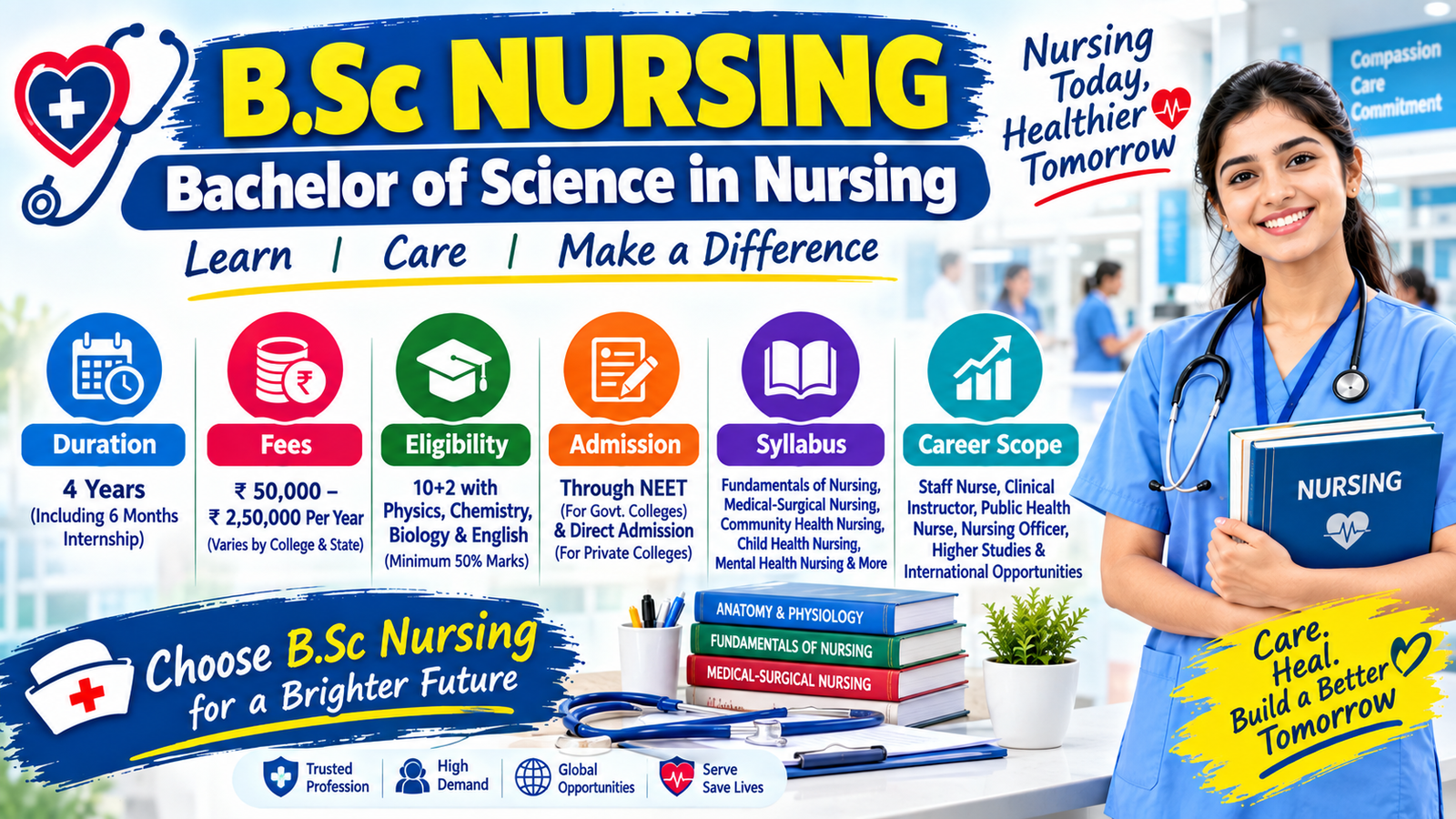
The B.Sc Nursing (Bachelor of Science in Nursing) is a 4-year undergraduate programme designed for aspirants aiming to make a professional career in nursing and healthcare. This course offers a blend of theoretical, lab, clinical and practical education and prepares the students to provide patient care in the hospitals, clinics, community healthcare setups, and other healthcare institutions.
Nursing plays a vital role in the health-ecosystem, and the nursing professionals can work in domains such as medical-surgical nursing, community health, mental health, paediatric nursing, maternity, critical care, and public health. With enhanced experience and higher education, the professionals can also explore career avenues in nursing administration, teaching, research, and specialised clinical domains.
For the students, intending to pursue nursing after Class 12, the knowledge of the B.Sc Nursing course duration, fees, eligibility, admission, syllabus, entrance exam, and career scope is essential before choosing the college.
What is B.Sc Nursing?
B.Sc Nursing, or Bachelor of Science in Nursing, is an undergraduate professional course focusing on nursing science, patient care, healthcare management, community health, and clinical practices.
The programme familiarises the students with the core subjects like anatomy, physiology, microbiology, nutrition, psychology, pharmacology, pathology, and nursing fundamentals. As the programme progresses, the students get expertise in domains like medical-surgical nursing, child health nursing, mental health nursing, community health nursing, and obstetric and gynaecological nursing.
A significant part of the B.Sc Nursing curriculum involves learning through clinical training where the students, under the supervision of faculty, study hospital and community health setups to enhance their understanding of real-world healthcare settings and learn the practical application of nursing concepts.
B.Sc Nursing Course Highlights
|
Particular |
Details |
|
Course Name |
Bachelor of Science in Nursing |
|
Short Name |
B.Sc Nursing / BSc Nursing |
|
Course Level |
Undergraduate |
|
Duration |
4 years |
|
Course Type |
Professional healthcare programme |
|
Eligibility |
Class 12 with required science subjects |
|
Main Subjects |
Physics, Chemistry, Biology and English, as applicable |
|
Admission |
Merit and/or entrance examination, depending on institution/state |
|
Clinical Training |
Included |
|
Internship/Practical Training |
Part of the programme as prescribed by regulations/institution |
|
Career Areas |
Hospitals, clinics, community health, public health, nursing education and research |
|
Higher Studies |
M.Sc Nursing and other relevant postgraduate programmes |
The eligibility, admission procedure, and subject requirements may differ between universities, state counselling authorities, and institutions. Thus, it is essential to check the admission notification for the specific academic year.
B.Sc Nursing Course Duration
The B.Sc Nursing course duration is 4 years.
It is a progressive programme to enhance the students’ theoretical knowledge, practical skills, and clinical expertise. The initial years of the course focus on basic medical sciences and nursing fundamentals, while the latter part of the programme is dedicated to specialising in specific disciplines of nursing and applying the concepts in a clinical setup.
The students, during the course, spend time in the following:
- Classrooms
- Nursing laboratories
- Skill laboratories
- Hospital departments
- Community healthcare centres
- Other approved clinical training settings
Clinical education is particularly vital as nursing is a practice-based profession; the students gain exposure to assess patients, monitor vital signs, administer medication under supervision, maintain records and documentation, and develop other essential nursing competencies.
B.Sc Nursing Fees in India
The B.Sc Nursing fees vary significantly depending on the type of institution, location, and admission category.
The government nursing colleges generally offer comparatively lower tuition fees than private colleges and universities. The private institutions, on the other hand, may charge higher tuition fees, and hostel, examination, laboratory, clinical, and other institutional charges may apply additionally.
Approximate B.Sc Nursing Fee Structure
|
College Type |
Indicative Annual Tuition Fee |
|
Government College |
₹10,000 – ₹75,000 |
|
Government-Aided Institution |
₹25,000 – ₹1 lakh |
|
Private College |
₹80,000 – ₹3 lakh+ |
|
Private University |
₹1 lakh – ₹4 lakh+ |
These figures represent the indicative range; the actual fees may significantly differ between the states, colleges, universities, categories, and academic years.
The students must review the complete fee structure before admission, including the following:
- Tuition fees
- Admission charges
- Examination fees
- Laboratory charges
- Clinical training charges
- Hostel fees
- Mess charges
- Library charges
- Uniform and equipment costs
- Registration or university charges
While comparing the colleges, the students should consider the total cost for the entire four-year programme instead of the tuition fee.
B.Sc Nursing Eligibility Criteria
The students seeking admission to B.Sc Nursing must generally complete Class 12 or an equivalent examination with the required subjects.
The required science background generally includes the following:
- Physics
- Chemistry
- Biology
- English
The exact minimum marks, age criteria, and other requirements depend on the applicable regulatory and institutional rules.
Basic Eligibility for B.Sc Nursing
A candidate generally needs to:
- Pass Class 12 or an equivalent examination from a recognised board.
- Have studied the required science subjects.
- Meet the prescribed minimum marks.
- Fulfil the applicable age requirements.
- Complete any entrance examination requirement where applicable.
- Satisfy the eligibility conditions of the concerned university or counselling authority.
The students must not assume the eligibility is identical for all B.Sc Nursing colleges as some institutions may have specific entrance examinations, minimum marks, or other requirements.
B.Sc Nursing Eligibility After 12th
The students who have passed the Class 12 with PCB (Physics, Chemistry, and Biology) are generally eligible to explore B.Sc Nursing admissions, subject to the applicable rules.
For students currently in Class 12, it is essential to check the admission notification as some institutions prescribe minimum marks in individual subjects or in the aggregate.
English is also commonly a qualifying subject.
Students from recognised boards and equivalent educational systems may be considered according to the rules of the concerned institution.
Is NEET Required for B.Sc Nursing?
The requirement of NEET for B.Sc Nursing depends on the institution and admission authority.
Unlike MBBS and BDS, where NEET-UG serves as the central entrance examination for undergraduate medical and dental admissions, the B.Sc Nursing admissions can follow different routes depending on the institution and applicable regulations.
Some nursing institutions and universities utilise NEET-UG scores, while other colleges or state systems conduct their own entrance examinations or employ merit-based admission.
Thus, the students must review the admission notification of their preferred college before assuming if NEET is or is not required for admission.
This difference is particularly relevant as nursing admission policies differ between states and institutions.
B.Sc Nursing Admission Process
The B.Sc Nursing admission process generally involves eligibility verification, application, entrance examination or merit assessment, and counselling/admission.
Step 1: Complete Class 12
The students must complete their qualifying examination with the required science subjects.
Step 2: Check College Eligibility
Before applying, the candidates must review:
- Required subjects
- Minimum marks
- Age requirements
- Entrance examination
- Domicile requirements, if applicable
- Reservation rules
- Application deadlines
Step 3: Apply for Entrance Examination
If the selected institution or state conducts an entrance examination, the students must apply and appear for the required examination.
Step 4: Merit List or Entrance Result
The candidates are shortlisted according to the applicable admission criteria.
Step 5: Counselling and Choice Filling
Where counselling is conducted, the students may select their preferred colleges and courses based on available seats.
Step 6: Seat Allotment
The seats are allotted according to the applicable merit, eligibility, category, choices, and seat availability.
Step 7: Document Verification
The students generally need documents like:
- Class 10 certificate
- Class 12 marksheet
- Identity proof
- Passport-size photographs
- Entrance examination result, where applicable
- Category certificate, if applicable
- Domicile certificate, where required
- Transfer or migration certificate, where required
Step 8: Fee Payment and Admission
After completing document verification, the students pay the prescribed admission fee and confirm the seat.
B.Sc Nursing Syllabus
The B.Sc Nursing syllabus covers the basic medical sciences, nursing theory, clinical nursing, and community healthcare.
The course is structured to enable the students to understand the human body, diseases, patient care, healthcare communication, nursing procedures, and professional responsibilities.
Major B.Sc Nursing Subjects
The following are common areas of study:
- Anatomy
- Physiology
- Biochemistry
- Nutrition
- Psychology
- Microbiology
- Nursing Foundations
- Pharmacology
- Pathology
- Genetics
- Medical-Surgical Nursing
- Community Health Nursing
- Child Health Nursing
- Mental Health Nursing
- Obstetric and Gynaecological Nursing
- Nursing Research
- Nursing Education
- Nursing Administration
- Professional trends and ethics
The exact subject names and semester-wise distribution vary according to the applicable curriculum.
B.Sc Nursing 1st Year Subjects
The first year introduces the students to fundamental medical and nursing concepts.
Important subjects include the following:
Anatomy
The students learn about the structure of the human body, including the organs, tissues, bones, and body systems.
Physiology
Physiology focuses on understanding how various organs and systems function.
Biochemistry
The students acquire basic biochemical processes essential for human health and disease.
Nutrition
The subject introduces the principles of balanced nutrition, therapeutic diets, and nutritional requirements.
Psychology
The students learn about human behaviour, emotions, development, and psychological factors affecting health.
Nursing Foundations
This subject introduces the core concepts of nursing and basic patient-care procedures.
B.Sc Nursing 2nd Year Subjects
The second year progresses to disease processes, medicines, and clinical nursing.
Subjects include the following:
- Pharmacology
- Pathology
- Genetics
- Medical-Surgical Nursing
- Community Health Nursing
- Communication and educational concepts
- Clinical practical training
The students begin to apply their theoretical knowledge to real-world patient-care situations under supervision through clinical experiences.
B.Sc Nursing 3rd Year Subjects
The third year generally includes specialised areas of nursing.
Important subjects can include the following:
Child Health Nursing
The students learn the healthcare needs of infants, children, and adolescents.
Mental Health Nursing
This area introduces the students to the nursing care of patients with mental health and behavioural conditions.
Medical-Surgical Nursing
The students study nursing care related to various medical and surgical conditions.
Community Health Nursing
The subject focuses on community-level healthcare, including health promotion, disease prevention, and community-based nursing services.
B.Sc Nursing 4th Year Subjects
The final year generally focuses on advanced nursing concepts and professional preparedness.
Areas may include the following:
- Midwifery and obstetric nursing
- Community health nursing
- Nursing research
- Nursing education
- Nursing administration
- Professional development
- Advanced clinical practice
The students also gain further clinical experience before completing the programme.
Clinical Training in B.Sc Nursing
Clinical training is one of the most vital components of the B.Sc Nursing.
The students may study in departments such as:
- Medical wards
- Surgical wards
- Intensive care units
- Paediatric wards
- Obstetrics and gynaecology
- Emergency departments
- Psychiatric units
- Community health centres
- Operation theatres
- Outpatient departments
The exact clinical rotation depends on the institution and affiliated hospitals.
During the clinical training, the students learn to communicate with patients, maintain nursing records, observe patient conditions, assist in treatment, follow infection-control practices, and perform other nursing procedures under supervision.
Skills Developed During B.Sc Nursing
The B.Sc Nursing graduate needs more than theoretical knowledge, as the programme equips the students with practical and professional skills.
Patient Care
The students learn to provide appropriate nursing care based on patient needs and clinical instructions.
Communication
Nurses communicate regularly with patients, families, doctors, and other healthcare professionals, making it an essential skill.
Clinical Observation
Nurses require to identify changes in a patient’s condition and communicate relevant observations to the healthcare team.
Documentation
Accurate nursing records form an important part of professional healthcare practice.
Teamwork
Modern healthcare relies on collaboration between nurses, doctors, technicians, pharmacists, and other professionals.
Patient Education
Nurses often explain healthcare procedures, medication-related instructions, lifestyle measures, and preventive practices to patients and families.
Career Scope After B.Sc Nursing
The career scope after B.Sc Nursing spans across hospitals, government healthcare services, community health, educational institutions, research organisations, and specialised healthcare facilities.
1. Staff Nurse
Staff nurses provide direct patient care in hospitals and healthcare facilities.
2. Clinical Nurse
Graduates can work in specialised clinical departments depending on their training and experience.
3. Community Health Nurse
Community health nurses work in healthcare programmes focused on health promotion, disease prevention, and community-level services.
4. Government Nurse
Government hospitals, health departments, and public healthcare programmes periodically recruit qualified nursing professionals according to applicable recruitment rules.
5. Nursing Officer
Qualified candidates can apply for nursing officer positions when recruitment notifications are issued by eligible government or healthcare institutions.
6. ICU Nurse
With suitable clinical training and experience, nurses can work in intensive care environments.
7. Paediatric Nurse
Nurses interested in child healthcare can work in paediatric departments and hospitals.
8. Psychiatric or Mental Health Nurse
Graduates can explore nursing roles in mental health facilities and psychiatric departments.
9. Nursing Educator
With appropriate higher qualifications and experience, nurses can move into teaching and academic positions.
10. Nursing Administrator
Experienced nursing professionals can progress into administrative and managerial positions.
11. Research
Nursing graduates can participate in healthcare and nursing research after obtaining relevant qualifications or experience.
B.Sc Nursing Salary in India
The B.Sc Nursing salary varies according to experience, employer, location, department, qualification, and job role.
Fresh graduates may start at an entry-level salary, whereas professionals with clinical experience, specialised training, or postgraduate qualifications can access more advanced roles.
The compensation may differ between:
- Government hospitals
- Private hospitals
- Corporate hospitals
- Nursing homes
- Community healthcare organisations
- Research institutions
- Educational institutions
- International healthcare employers
Government positions may offer structured pay scales and benefits according to the applicable recruitment rules. The compensation varies considerably between private-sector employers.
The students should therefore avoid choosing a college based solely on advertised salary figures. Clinical training, accreditation, placement support, practical exposure, and opportunities for professional growth are also vital factors.
Higher Studies After B.Sc Nursing
After completing B.Sc Nursing, students can pursue postgraduate education to develop further knowledge and specialisation in nursing.
M.Sc Nursing
M.Sc Nursing is one of the major postgraduate options after B.Sc Nursing.
Students may specialise in areas such as:
- Medical-Surgical Nursing
- Community Health Nursing
- Child Health Nursing
- Mental Health Nursing
- Obstetrics and Gynaecological Nursing
Specialisation availability depends on the institution.
Other Career Development Options
Depending on eligibility, students can also explore:
- Nursing administration
- Nursing education
- Public health
- Healthcare management
- Research
- Clinical specialisation
- International nursing opportunities
Additional registration, licensing, or examination requirements may apply when working as a nurse in another country.
B.Sc Nursing vs GNM Nursing
B.Sc Nursing and GNM are both nursing-related programmes, but they differ significantly.
|
Feature |
B.Sc Nursing |
GNM |
|
Full Form |
Bachelor of Science in Nursing |
General Nursing and Midwifery |
|
Level |
Undergraduate degree |
Nursing diploma/programme |
|
Duration |
Generally 4 years |
Generally shorter than B.Sc Nursing |
|
Academic Level |
Degree |
Diploma-level qualification |
|
Career Scope |
Clinical, administrative, academic and higher-study pathways |
Nursing and clinical care pathways |
|
Higher Study |
M.Sc Nursing and related programmes |
Can pursue further education subject to eligibility |
The students should check the latest regulatory and admission rules before selecting either programme.
B.Sc Nursing vs ANM
ANM stands for Auxiliary Nurse Midwifery and is different from B.Sc Nursing.
ANM is a shorter nursing and community healthcare programme, and B.Sc Nursing is a 4-year undergraduate degree.
B.Sc Nursing generally provides broader academic and professional training and can offer a direct pathway to postgraduate nursing education.
Is B.Sc Nursing a Good Career Option?
B.Sc Nursing can offer a professional pathway into the healthcare sector for students interested in patient care, clinical work, and community health. However, the students must understand that nursing is a demanding profession, involving shift duties, long working hours, emergency situations, and significant responsibility for patient care.
The students considering the course must have an interest in healthcare and be prepared to develop strong communication, clinical, and interpersonal skills.
How to Choose the Best B.Sc Nursing College
Instead of selecting a college only based on its name or advertisements, the students should consider various factors.
Check Recognition and Approval
Verify if the institution and nursing programme have the required recognition and approvals for the relevant academic session.
Check Hospital Facilities
A nursing college should offer adequate clinical exposure through its own hospital or affiliated healthcare facilities.
Review Faculty
Experienced and qualified faculty can significantly enhance the academic learning experience.
Compare Fees
Look at the complete fee structure and not only tuition fees.
Check Clinical Exposure
Practical training is essential in nursing education, and the students should know where and how clinical postings are conducted.
Review Hostel Facilities
For students moving to another city, hostel, safety, and accommodation facilities are important considerations.
Examine Placement Information
The students should examine if the college provides genuine placement information and if previous graduates obtained employment in recognised healthcare institutions.
Frequently Asked Questions About B.Sc Nursing
What is B.Sc Nursing?
B.Sc Nursing is a 4-year undergraduate programme that prepares students for professional nursing careers through theoretical education, practical training, and clinical experience.
What is the duration of B.Sc Nursing?
The standard B.Sc Nursing programme is generally 4 years.
Can I pursue B.Sc Nursing after Class 12?
Yes. Students who meet the required Class 12 subject, marks, and other eligibility conditions can apply for B.Sc Nursing.
Which subjects are required for B.Sc Nursing?
Physics, Chemistry, and Biology are commonly required, along with English, although exact requirements depend on the applicable admission rules.
Is NEET mandatory for B.Sc Nursing?
NEET requirements vary by institution and admission authority. Some institutions utilise NEET scores, while others may conduct separate entrance examinations or employ merit-based admission.
What is the average B.Sc Nursing fee?
The fees significantly vary between institutions. Government colleges generally offer comparatively lower tuition fees, whereas private colleges and universities may charge substantially more.
What can I do after B.Sc Nursing?
Graduates can work as nurses in hospitals, clinics, community healthcare programmes, and other healthcare organisations. With experience or higher education, they can move into specialised clinical, teaching, administrative, or research roles.
Can I do M.Sc Nursing after B.Sc Nursing?
Yes. B.Sc Nursing graduates can pursue M.Sc Nursing, if they meet the eligibility requirements.
Is B.Sc Nursing better than GNM?
They are different qualifications. B.Sc Nursing is a 4-year undergraduate degree, whereas GNM is a separate nursing programme. Students should compare the duration, academic level, eligibility, and long-term career goals before choosing between them.
Can B.Sc Nursing graduates work abroad?
Yes, nursing graduates may explore international opportunities; however, each country has its own registration, licensing, language, and qualification-recognition requirements.