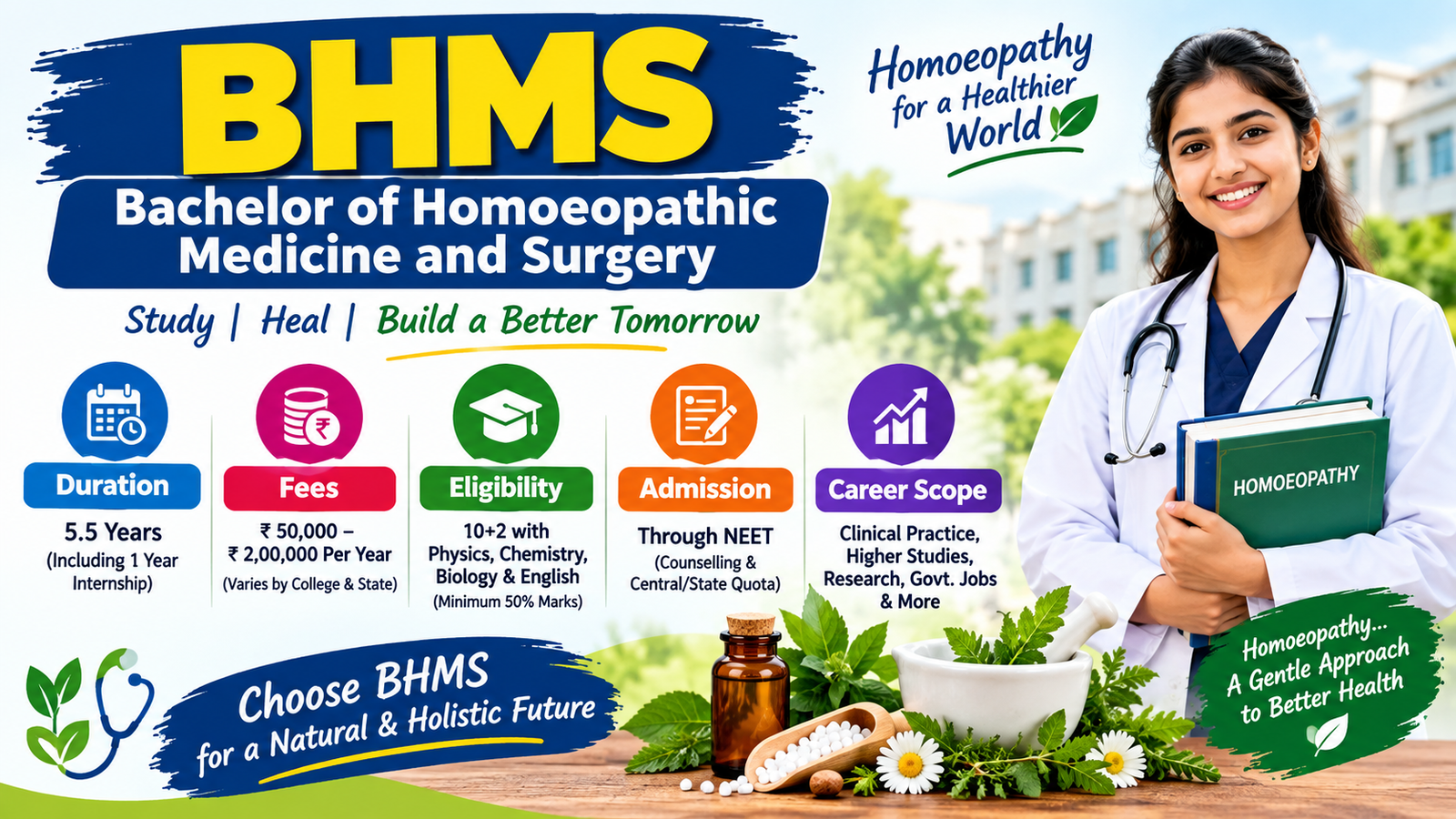
The BHMS course or Bachelor of Homoeopathic Medicine and Surgery is an undergraduate degree programme which prepares students to pursue a career in homoeopathy and holistic healthcare. It covers the study of homoeopathic principles alongside the fields of anatomy, physiology, pathology, pharmacology, medicine, surgery and clinical practice.
For those who are interested in pursuing a medical career but are looking to explore other options besides MBBS, BHMS is one of the undergraduate courses offered within the AYUSH healthcare system. Admission to BHMS in India is linked to NEET-UG followed by counselling through the appropriate authorities.
The National Commission for Homoeopathy (NCH) regulates homoeopathic education and professional standards in India. Under the current BHMS regulations, the programme extends over 5 years and 6 months, including a 12-month rotatory internship.
For 2026–27 admission cycle, AACCC is conducting counselling for eligible NEET candidates for applicable All India Quota BHMS seats, while state counselling authorities manage the relevant state-level seats.
What is BHMS?
BHMS stands for Bachelor of Homoeopathic Medicine and Surgery. It is a professional undergraduate degree in homoeopathy which equips students with theoretical knowledge, laboratory exposure and clinical training.
The course exposes students to the fundamentals of homoeopathic medicine while also educating them in the areas of modern medical sciences. Students are trained on subjects such as anatomy, physiology, pathology, forensic medicine, community medicine, surgery, obstetrics and gynaecology, medicine and homoeopathic materia medica.
The objective of the BHMS programme is to produce graduates with knowledge of homoeopathy, modern health science and practical clinical skills. The NCH's BHMS regulations specifically describe the programme as combining homoeopathic knowledge with contemporary health science and practical training.
After completing the degree and required internship, graduates can pursue professional opportunities in homoeopathic healthcare, hospitals, clinics, research, education, pharmaceutical companies and other related areas, subject to applicable registration and professional regulations.
BHMS Course Highlights
|
Particular |
Details |
|
Full Form |
Bachelor of Homoeopathic Medicine and Surgery |
|
Degree Level |
Undergraduate |
|
Course Duration |
5.5 years including internship |
|
Academic Study |
4.5 years |
|
Internship |
1 year compulsory rotatory internship |
|
Eligibility |
10+2 with Physics, Chemistry and Biology/Biotechnology |
|
Entrance Examination |
NEET-UG |
|
Course Type |
Professional medical/AYUSH programme |
|
Regulatory Body |
National Commission for Homoeopathy (NCH) |
|
Admission Process |
NEET followed by counselling |
|
Career Areas |
Clinics, hospitals, research, teaching, healthcare and industry |
|
Higher Studies |
MD (Homoeopathy) and other relevant postgraduate options |
The duration and internship structure are prescribed under the NCH's BHMS regulations.
BHMS Course Duration
The BHMS course duration is 5 years and 6 months.
This includes 4.5 years of academic education followed by a compulsory one-year rotatory internship. The NCH regulations divide the academic programme into four professional phases.
The structure is:
|
BHMS Professional |
Duration |
|
First Professional BHMS |
18 months |
|
Second Professional BHMS |
12 months |
|
Third Professional BHMS |
12 months |
|
Fourth/Final Professional BHMS |
12 months |
|
Compulsory Rotatory Internship |
12 months |
|
Total |
5.5 years |
The internship is an important part of the programme because it provides practical exposure in clinical settings. Students get the opportunity to apply their academic knowledge while working under appropriate supervision.
A student receives the BHMS degree after successfully completing the prescribed examinations, course requirements and compulsory internship.
BHMS Eligibility Criteria
Students planning to pursue BHMS must meet the prescribed academic and entrance requirements.
According to the NCH's BHMS regulations, candidates should have completed 10+2 or equivalent examination from a recognised board with Physics, Chemistry and Biology/Biotechnology. The regulations specify minimum marks requirements for different categories.
Basic BHMS eligibility requirements
Generally, candidates need to fulfill the following conditions:
- Pass Class 12 or equivalent examination.
- Study Physics, Chemistry and Biology/Biotechnology.
- Meet the prescribed minimum PCB marks.
- Qualify for NEET-UG.
- Fulfill the age requirement prescribed for admission.
- Complete the counselling and admission requirements of the relevant authority.
For the general category, the NCH regulations specify 50% aggregate marks in Physics, Chemistry and Biology/Biotechnology, with specified relaxations for certain categories. Candidates must also attain 17 years of age on or before December 31 of the admission year.
Students should always check the current NEET and counselling information bulletin because admission rules, dates and procedural requirements can change between academic sessions.
Is NEET required for BHMS?
Yes, NEET-UG is required for admission to BHMS in India.
The NCH regulations provide for a uniform entrance examination through National Eligibility-cum-Entrance Test (NEET) for undergraduate homoeopathy medical institutions.
Therefore, students interested in BHMS should prepare for NEET-UG after completing or while completing their Class 12 education.
For the 2026–27 session, AACCC's official counselling information states that eligible candidates who qualify NEET-UG can participate in counselling for applicable undergraduate AYUSH courses, including BHMS.
BHMS Admission Process
The BHMS admission process generally involves a number of stages. Students should carefully follow the official NEET and counselling notifications.
Step 1: Complete Class 12
Candidates should complete their 10+2 education with the required science subjects, including Physics, Chemistry and Biology/Biotechnology.
Step 2: Appear for NEET-UG
Candidates must register for and appear in NEET-UG and obtain a qualifying result according to the applicable admission rules.
Step 3: Register for Counselling
After the NEET result, eligible candidates need to participate in the relevant counselling process.
AACCC conducts counselling for specified All India Quota and other categories of undergraduate AYUSH seats. State and Union Territory counselling authorities conduct counselling for seats falling under their respective jurisdictions.
Step 4: Choice Filling
Candidates select their preferred BHMS colleges and courses according to the options available during counselling.
Step 5: Seat Allotment
Seats are allotted based on applicable counselling rules, NEET performance, candidate preferences, category and availability.
Step 6: Document Verification
Candidates must provide the required documents for verification.
Step 7: Fee Payment and Reporting
After accepting the allotted seat, the candidate generally needs to pay the applicable admission fee and report to the allotted institution within the prescribed timeline.
BHMS Course Fees
The BHMS fees in India vary significantly depending on the type of institution, location, facilities, hostel arrangements and applicable fee regulations.
Government and government-aided colleges generally have lower tuition fees than many private institutions. Private homoeopathic colleges may charge higher fees, while deemed or other institutions can have their own fee structures.
Students should not rely on a single nationwide BHMS fee figure because actual fees differ from college to college.
Major expenses may include:
- Tuition fees
- Admission fees
- University fees
- Examination fees
- Hostel fees
- Mess charges
- Library fees
- Laboratory charges
- Clinical or institutional charges
- Other miscellaneous expenses
Before taking admission, students should verify the latest official fee structure directly from the college or the applicable counselling authority.
The NCH has also published guidelines relating to determination of fees and other charges in private homoeopathic institutions and deemed universities.
BHMS Syllabus
The BHMS syllabus covers both homoeopathic subjects and important areas of modern medical science.
Students gradually move from foundational medical sciences to clinical subjects and practical training.
Major subjects studied during BHMS may include:
- Anatomy
- Physiology
- Biochemistry
- Homoeopathic Pharmacy
- Organon of Medicine
- Homoeopathic Materia Medica
- Homoeopathic Repertory
- Pathology
- Microbiology
- Forensic Medicine
- Community Medicine
- Practice of Medicine
- Surgery
- Obstetrics and Gynaecology
- Paediatrics
- Psychiatry
- Research methodology
- Clinical training
The exact subject structure can vary according to the applicable curriculum and amendments issued by the regulatory authorities.
The NCH maintains regulations covering homoeopathic education, examinations, recognition of qualifications and other professional standards.
BHMS Subjects Explained
Anatomy
Anatomy introduces students to the structure of the human body. Students learn about organs, tissues, bones, muscles, nerves and different body systems.
Physiology
Physiology focuses on how the human body functions. Students learn about processes involving the cardiovascular, respiratory, digestive, nervous and endocrine systems.
Pathology
Pathology helps students understand diseases and the structural and functional changes associated with different conditions.
Pharmacology
Pharmacology introduces students to medicines, their actions, effects and other relevant concepts associated with pharmacological science.
Organon of Medicine
Organon of Medicine is a core area of homoeopathic education. It introduces students to the principles and philosophy underlying homoeopathic practice.
Materia Medica
Homoeopathic Materia Medica deals with the properties and therapeutic profiles of homoeopathic medicines.
Repertory
Repertory teaches students methods used to organise and evaluate symptoms for homoeopathic case analysis.
Practice of Medicine
This subject provides exposure to clinical medicine and the assessment and management of patients within the relevant professional framework.
Surgery and Other Clinical Subjects
Students are also introduced to surgery, obstetrics, gynaecology, paediatrics and other clinical disciplines as part of their professional education.
BHMS Internship
The one-year compulsory rotatory internship is an important component of the BHMS programme.
During the internship, students receive practical clinical exposure and learn how healthcare services operate in real-world settings.
The internship can help students develop skills such as:
- Patient interaction
- Case documentation
- Clinical observation
- History taking
- Basic examination skills
- Understanding healthcare procedures
- Hospital and clinic workflow
- Professional communication
- Practical application of academic knowledge
According to the NCH regulations, the compulsory rotatory internship is 12 months in duration.
Career Scope After BHMS
The career scope after BHMS extends across several areas of homoeopathic healthcare and related sectors.
A graduate can explore opportunities in:
1. Homoeopathic Clinic
Graduates can pursue clinical practice subject to the applicable registration and professional requirements.
2. Homoeopathic Hospitals
Hospitals and healthcare institutions may offer opportunities for homoeopathic graduates in clinical and patient-care roles.
3. Government Healthcare Services
Depending on recruitment rules and vacancies, BHMS graduates may be eligible for positions in government healthcare services.
4. Research
Students interested in research can explore opportunities in homoeopathic research, clinical studies, healthcare research and related areas.
5. Teaching
After acquiring the required postgraduate qualifications and meeting regulatory requirements, graduates can explore academic and teaching careers.
6. Pharmaceutical Industry
BHMS graduates may also explore roles associated with homoeopathic pharmaceutical companies, depending on their qualifications and the requirements of individual positions.
7. Community Healthcare
Homoeopathic graduates can work in community-based healthcare programmes and other health-related initiatives where their qualifications are applicable.
8. Medical Content and Healthcare Communication
Students with strong writing and communication skills can also explore opportunities in healthcare content, medical education, patient education and health communication.
Higher Studies After BHMS
Students who want to continue their education after BHMS can consider postgraduate studies.
One major option is MD in Homoeopathy (MD Hom.), subject to applicable eligibility and entrance requirements.
Higher education can help students develop deeper knowledge in a selected area and may open opportunities in:
- Teaching
- Research
- Specialised clinical work
- Academic institutions
- Healthcare administration
- Research organisations
The NCH maintains regulations for postgraduate homoeopathy education as well.
Students should check the current postgraduate admission rules and entrance requirements before planning their next step.
BHMS Salary in India
The salary after BHMS depends on several factors, including experience, location, job profile, employer, additional qualifications and whether the graduate works in a salaried position or develops an independent practice.
Fresh graduates may begin with entry-level healthcare or clinical roles, while experienced professionals can progress into senior clinical, academic, research, administrative or other specialised positions.
There is no single fixed salary for all BHMS graduates.
Factors affecting income include:
- Professional experience
- City and location
- Type of healthcare institution
- Government or private employment
- Clinical responsibilities
- Additional qualifications
- Postgraduate education
- Research or teaching experience
- Independent practice and patient base
Students should therefore evaluate career opportunities based on long-term professional development rather than salary figures alone.
Skills Required for a Successful BHMS Career
A successful healthcare professional needs more than academic knowledge.
BHMS students can benefit from developing:
- Good communication skills
- Patient-listening skills
- Clinical observation
- Analytical thinking
- Professional ethics
- Empathy and patience
- Documentation skills
- Research awareness
- Teamwork
- Time management
- Continuous learning
Healthcare is an evolving field, so graduates should remain updated with developments in medical science, healthcare regulations and their professional discipline.
BHMS vs MBBS
BHMS and MBBS are both undergraduate healthcare degrees, but they represent different systems of medical education and professional practice.
|
Feature |
BHMS |
MBBS |
|
Full Form |
Bachelor of Homoeopathic Medicine and Surgery |
Bachelor of Medicine, Bachelor of Surgery |
|
Medical System |
Homoeopathy |
Modern medicine |
|
Entrance Exam |
NEET-UG |
NEET-UG |
|
Duration |
5.5 years including internship |
Duration prescribed under current medical education regulations |
|
Regulator |
National Commission for Homoeopathy |
National Medical Commission |
|
Higher Study |
MD (Homoeopathy) and applicable programmes |
MD/MS and other postgraduate programmes |
|
Career Focus |
Homoeopathic healthcare |
Modern medical practice |
The two courses should not be treated as interchangeable. Students should understand the curriculum, regulatory framework, professional scope and registration requirements before selecting a course.
Is BHMS a good career option?
BHMS can be considered by students who have a genuine interest in homoeopathy and want to pursue a structured healthcare education in this field.
Before choosing BHMS, students should understand:
- The course requires NEET-UG.
- The programme involves extensive academic study.
- Clinical training and internship are compulsory.
- The degree is regulated under the National Commission for Homoeopathy.
- Career opportunities depend on qualifications, registration, skills and experience.
- Postgraduate education can provide additional academic and professional opportunities.
The best course choice depends on an individual student's interests, career plans, academic profile and understanding of the healthcare system they want to work in.
Top Factors to Consider Before Choosing a BHMS College
Choosing the right college is an important part of the admission process.
Students should check:
College Recognition
Verify whether the institution is recognised and permitted under the applicable regulatory framework.
Attached Hospital
Clinical exposure is an important part of professional healthcare education. Students should examine the college's attached hospital and clinical facilities.
Faculty
Check the qualifications, experience and availability of teaching faculty.
Infrastructure
Review classrooms, laboratories, library facilities, hostel facilities and other infrastructure.
Internship Facilities
Understand where and how the compulsory internship is conducted.
Fees
Compare the complete fee structure instead of looking only at tuition fees.
Location
Consider travel, accommodation, living expenses and accessibility.
Admission Route
Make sure the college is participating in the appropriate official counselling/admission process.
The NCH publishes regulations and information related to homoeopathic medical institutions and education standards, while AACCC publishes counselling information and seat-related updates for applicable BHMS admissions.
BHMS Admission 2026
For the 2026–27 academic session, students seeking BHMS admission should monitor NEET-UG and official AYUSH counselling updates.
AACCC's current 2026 counselling information confirms that BHMS is included among the undergraduate AYUSH courses covered through its applicable All India Quota counselling process.
The NCH website is also publishing 2026–27 updates related to undergraduate homoeopathy counselling and admission.
Because counselling dates, seat matrices, eligibility conditions and admission instructions can change, students should check the latest official notification before completing the admission process.
Documents Required for BHMS Admission
The exact document list can vary according to the counselling authority and college, but candidates are commonly required to provide documents such as:
- NEET-UG scorecard
- NEET-UG admit card
- Class 10 certificate
- Class 12 mark sheet
- Class 12 certificate
- Date-of-birth proof
- Government-issued identity document
- Category certificate, where applicable
- Domicile certificate, where applicable
- Passport-size photographs
- Migration certificate, where applicable
- Medical fitness documents, where required
- Counselling allotment letter
- Other documents specified by the counselling authority
Candidates should keep both original documents and required copies ready for verification.
Frequently Asked Questions About BHMS
What is the full form of BHMS?
BHMS stands for Bachelor of Homoeopathic Medicine and Surgery.
What is the duration of the BHMS course?
The BHMS programme is 5 years and 6 months, including four-and-a-half years of academic education and a one-year compulsory rotatory internship.
Is NEET compulsory for BHMS?
Yes. NEET-UG is the prescribed entrance examination for undergraduate homoeopathy admissions under the NCH regulations.
What subjects are required for BHMS?
Students generally need Physics, Chemistry and Biology/Biotechnology at the Class 12 level, along with meeting the applicable minimum marks requirements.
Can I pursue BHMS after Class 12?
Yes. Students who meet the prescribed Class 12 eligibility requirements and qualify NEET-UG can participate in the applicable BHMS counselling process.
What is the BHMS course fee?
BHMS fees vary by college and institution type. Government, private and deemed institutions can have different fee structures. Students should verify the latest official fees before admission.
What can I do after BHMS?
After BHMS, graduates can explore clinical practice, hospitals, government services, research, teaching, pharmaceutical companies and other relevant healthcare sectors, subject to applicable qualifications and registration requirements.
Can I do MD after BHMS?
Yes. Eligible BHMS graduates can pursue postgraduate education such as MD in Homoeopathy, subject to the applicable admission and regulatory requirements.
Is BHMS a medical degree?
BHMS is a recognised undergraduate degree in homoeopathy and is regulated under the National Commission for Homoeopathy. It should be understood as a qualification within the homoeopathy healthcare system rather than as the same qualification as MBBS.
Does BHMS include an internship?
Yes. The programme includes a 12-month compulsory rotatory internship.
What is the scope of BHMS after graduation?
The scope can include clinical practice, hospitals, research, education, government healthcare services, pharmaceutical organisations and other related healthcare roles, depending on registration, qualifications and applicable regulations.
Conclusion
The BHMS course offers a structured undergraduate pathway for students interested in homoeopathy and healthcare. With a duration of 5.5 years including a compulsory one-year internship, the programme combines foundational medical sciences, homoeopathic subjects, clinical education and practical training.
For students planning BHMS admission in 2026, NEET-UG is an important requirement, followed by the relevant counselling process. AACCC is currently conducting undergraduate counselling for applicable AYUSH seats, including BHMS, for the 2026–7 session.
Before choosing a college, students should carefully compare recognition, fees, infrastructure, hospital facilities, internship arrangements, faculty and admission procedures. They should also verify the latest information from the National Commission for Homoeopathy, AACCC and the concerned counselling authority.
For students who are genuinely interested in homoeopathy, willing to undergo professional medical education and interested in developing a long-term career in healthcare, BHMS provides a recognised academic route with opportunities for further study and professional development.