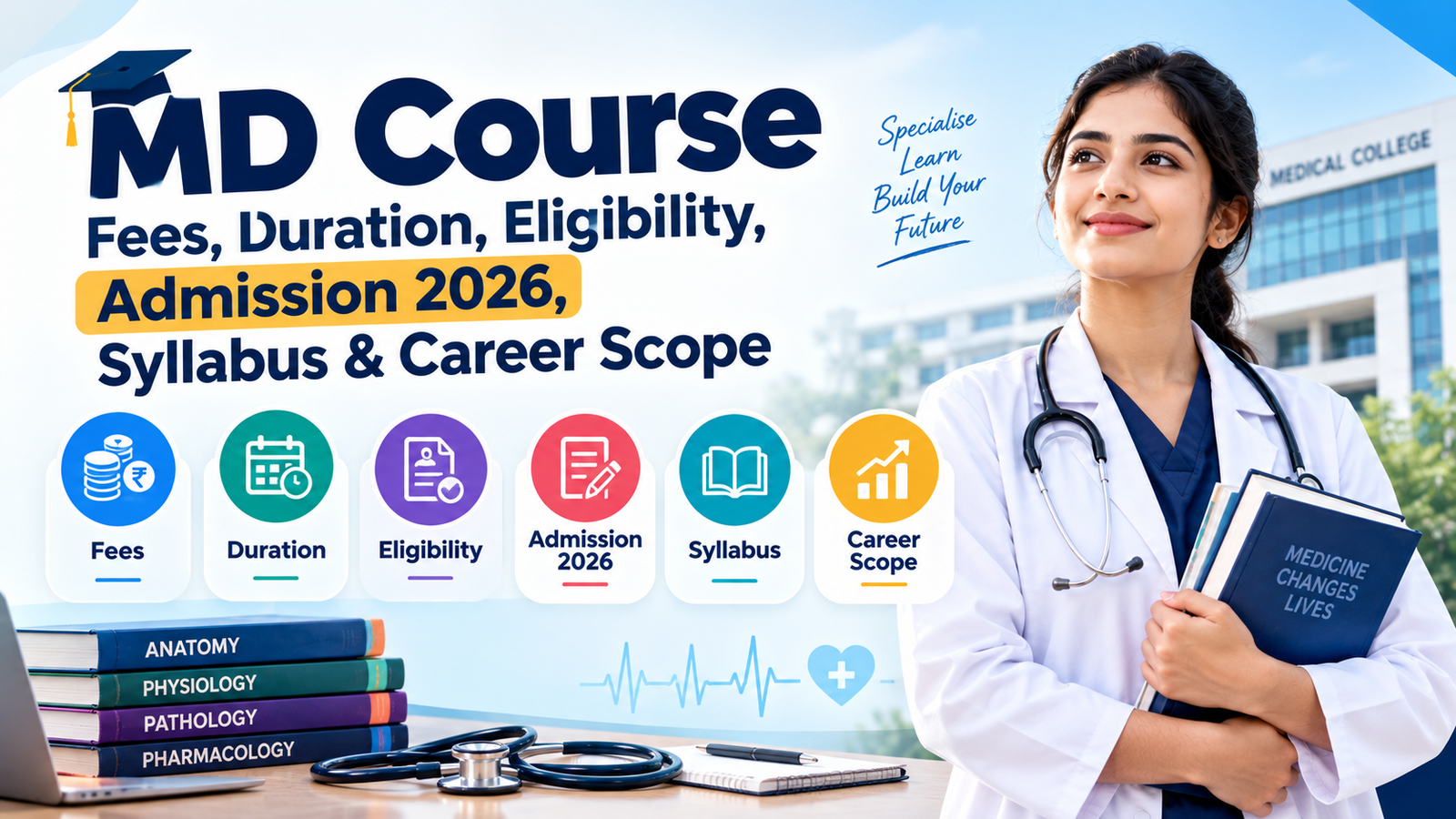
MD, or Doctor of Medicine, is a postgraduate medical degree for students who have completed their MBBS and want to specialise in a particular area of medicine. While MBBS gives students a broad understanding of medical science and patient care, an MD allows them to study one field in much greater depth.
In India, an MD is generally a three-year postgraduate programme. The course involves classroom and academic learning, but a large part of the training takes place in hospitals. Students work with patients under supervision, attend ward rounds, take part in case discussions and develop practical skills related to their chosen speciality.
There are several MD specialisations available, including General Medicine, Pediatrics, Dermatology, Psychiatry, Radiodiagnosis, Anesthesiology, Pathology and others. The speciality a student chooses eventually shapes much of their clinical work and career.
Admission to MD courses is generally based primarily on NEET-PG, followed by the relevant counselling process. Since admission rules, fees and seat availability can change, students should check the latest information from the concerned authorities and medical colleges before applying.
The main difference between MBBS and MD is the level of specialisation. During MBBS, students study different areas of medicine and gain a foundation in clinical practice. During MD, they focus on one particular speciality and receive more advanced training in that field.
For example, a student pursuing MD General Medicine will spend their postgraduate training dealing with adult medical conditions, while an MD Pediatrics student will focus primarily on the health and diseases of children.
MD training is not limited to textbooks and lectures. Students spend considerable time in hospitals and are involved in patient care, clinical discussions, investigations, procedures and other activities related to their speciality.
MD Course Highlights
|
Particular |
Details |
|
Course Name |
Doctor of Medicine |
|
Short Form |
MD |
|
Course Level |
Postgraduate |
|
Course Type |
Medical/Broad Speciality |
|
Duration |
3 years |
|
Eligibility |
Recognised MBBS degree and applicable requirements |
|
Entrance Examination |
NEET-PG |
|
Admission |
Entrance examination followed by counselling |
|
Training |
Academic, clinical and practical training |
|
Study Mode |
Full-time |
|
Career Areas |
Specialist practice, hospitals, teaching, research and public health |
MD Course Duration
|
Component |
Duration |
|
Postgraduate Medical Training |
3 years |
|
Total Duration |
Approximately 3 years |
An MD programme generally takes three years to complete.
These three years are mainly focused on postgraduate training in the chosen speciality. Unlike undergraduate medical education, students at this stage take on greater clinical responsibility and spend a significant amount of time working in hospital departments.
The exact schedule can vary from one speciality and institution to another. Students may have regular academic sessions, seminars, case presentations, clinical postings, examinations and research-related work alongside their day-to-day hospital duties.
MD Eligibility Criteria
Students who want to pursue an MD in India must first complete their MBBS and meet the eligibility conditions applicable to postgraduate medical admission.
Generally, candidates are required to have a recognised MBBS qualification and complete the required internship and registration formalities. They must also qualify for the relevant postgraduate entrance examination and meet the requirements specified for the admission year.
A candidate generally needs to:
- Have a recognised MBBS degree.
- Complete the required internship.
- Fulfil the applicable medical registration requirements.
- Qualify for the relevant postgraduate entrance examination.
- Meet the eligibility requirements for the particular admission cycle.
- Participate in the required counselling process.
Eligibility rules can change, so candidates should always check the latest official requirements before applying.
NEET-PG for MD Admission
NEET-PG is the major entrance examination used for postgraduate medical admissions in India, including MD programmes, subject to the applicable admission rules.
A candidate's NEET-PG rank plays an important role during counselling. It can affect the speciality and college options available to them.
The closing rank for an MD speciality is not fixed. It can change from year to year depending on factors such as:
- Number of available seats
- Number of candidates
- NEET-PG performance
- Speciality
- Category
- College
- State
- Counselling round
- Quota and seat type
It is also important to understand that the qualifying requirement is different from the actual admission cutoff of a particular speciality or college.
MD Admission Process
The MD admission process usually involves an entrance examination followed by counselling.
Step 1: Complete MBBS
The candidate must complete the required MBBS qualification and fulfil the internship and registration requirements.
Step 2: Apply for NEET-PG
Eligible candidates register for the postgraduate entrance examination within the prescribed application period.
Step 3: Appear for the Examination
Candidates take the NEET-PG examination and receive their result and rank.
Step 4: Participate in Counselling
Candidates who meet the applicable requirements can participate in the relevant counselling process.
Step 5: Fill in Choices
During counselling, candidates select their preferred MD specialities and medical colleges based on the options available to them.
Step 6: Seat Allotment
Seats are allotted according to the counselling rules, rank, choices, category and availability.
Step 7: Document Verification
The candidate's educational, registration and other required documents are verified.
Step 8: Complete Admission Formalities
After accepting a seat, the candidate completes the required fee payment and other admission procedures.
Step 9: Start MD Training
Once admitted, the student joins the concerned department and begins their postgraduate training.
MD Course Fees
The cost of an MD course can vary considerably depending on the college, speciality, state, quota and type of institution.
Government medical colleges generally have lower tuition fees, while private medical colleges can charge considerably more. The fee structure may also differ between different categories of seats.
Tuition is not the only expense students need to consider. Other costs may include:
- Hostel fees
- Mess charges
- Examination fees
- University charges
- Registration fees
- Books and study material
- Library charges
- Personal expenses
Since fees can change, students should check the latest official fee structure of the medical college or counselling authority before taking admission.
MD Syllabus
The MD syllabus depends on the speciality a student chooses.
A student pursuing MD General Medicine, for example, will have a very different syllabus from someone pursuing MD Dermatology or MD Pathology.
However, most MD programmes combine advanced theoretical knowledge with clinical training. Students learn how to assess patients, interpret investigations, make clinical decisions and manage conditions related to their speciality.
Major Components of MD Training
|
Area |
What Students Learn |
|
Theory |
Advanced concepts related to the speciality |
|
Clinical Training |
Patient assessment and management |
|
Practical Training |
Speciality-specific procedures and skills |
|
Research |
Research methods and dissertation work |
|
Academic Activities |
Seminars, case discussions and journal clubs |
|
Patient Care |
Diagnosis, treatment and follow-up |
|
Professional Skills |
Communication, ethics and teamwork |
Popular MD Specialisations
There are several MD specialisations available in India. Some commonly pursued options include:
- MD General Medicine
- MD Pediatrics
- MD Dermatology, Venereology and Leprosy
- MD Psychiatry
- MD Radiodiagnosis
- MD Anesthesiology
- MD Pathology
- MD Pharmacology
- MD Microbiology
- MD Community Medicine
- MD Respiratory Medicine
- MD Nuclear Medicine
- MD Emergency Medicine
- MD Radiation Oncology
- MD Forensic Medicine and Toxicology
Not every medical college offers all of these specialisations. The availability of seats depends on the college and its recognised postgraduate programmes.
MD General Medicine
MD General Medicine is one of the major clinical specialisations. It focuses on the diagnosis and treatment of diseases affecting adults.
During the course, students may deal with conditions involving the:
- Heart
- Lungs
- Kidneys
- Liver
- Gastrointestinal system
- Nervous system
- Endocrine system
- Blood
Students also gain experience in managing infections, chronic diseases and medical emergencies.
Because General Medicine covers a wide range of conditions, training usually involves substantial patient interaction and clinical decision-making.
MD Pediatrics
MD Pediatrics focuses on the health and medical conditions of infants, children and adolescents. Students learn about areas such as:
- Growth and development
- Newborn care
- Childhood infections
- Nutrition
- Immunisation
- Pediatric emergencies
- Congenital conditions
- Adolescent health
The course combines clinical training with academic learning and gives students experience in managing patients across different stages of childhood.
MD Dermatology
MD Dermatology deals with diseases affecting the skin, hair and nails, along with related conditions. Students may receive training in:
- Skin infections
- Allergic skin conditions
- Autoimmune disorders
- Hair and nail disorders
- Clinical diagnosis
- Dermatological procedures
- Sexually transmitted infections and related conditions
The speciality combines clinical examination with diagnostic and procedural skills.
MD Psychiatry
MD Psychiatry focuses on the assessment and management of mental and behavioural health conditions.
Training may cover areas such as:
- Mood disorders
- Anxiety disorders
- Psychotic disorders
- Substance-use disorders
- Child and adolescent psychiatry
- Emergency psychiatry
- Community psychiatry
- Psychotherapy concepts
Students learn to assess patients, understand different psychiatric conditions and develop appropriate management plans.
MD Radiodiagnosis
MD Radiodiagnosis focuses on the use of medical imaging to help diagnose diseases and other medical conditions.
Depending on the institution, training may involve:
- X-rays
- Ultrasound
- CT scans
- MRI
- Fluoroscopy
- Other imaging techniques
Students learn how to interpret medical images and work alongside other clinical departments in diagnosing and managing patients.
Clinical Training During MD
Clinical training is one of the most important parts of postgraduate medical education.
MD students spend a considerable amount of time in hospitals and gradually take on greater responsibility in patient care. They work under the supervision of experienced doctors and faculty members.
Depending on the speciality, students may be involved in:
- Taking patient histories
- Performing clinical examinations
- Interpreting investigations
- Discussing possible diagnoses
- Managing patients
- Attending ward rounds
- Participating in emergency care
- Presenting cases
- Performing speciality-specific procedures
- Counselling patients and families
The exact nature of clinical work depends on the speciality and the hospital where the student is undergoing training.
Research and Thesis During MD
Research is another important part of postgraduate medical education.
MD students may undertake a research project or dissertation in their chosen speciality. This gives them an opportunity to explore a specific medical question in a systematic manner.
Students may learn about:
- Research methodology
- Literature review
- Study design
- Data collection
- Data analysis
- Scientific writing
- Presenting research findings
The exact requirements for dissertation or thesis work depend on the applicable university and postgraduate regulations.
MD Examination
MD students are assessed throughout their postgraduate training and must complete the examinations prescribed by their university and the applicable regulatory framework.
Assessment may include:
- Theory examinations
- Clinical examinations
- Practical examinations
- Viva voce
- Dissertation or research requirements
The exact examination pattern can vary according to the speciality and university.
Career Scope After MD
An MD opens up several career possibilities in medicine. Many graduates work as specialists in hospitals, while others choose teaching, research, public health or other healthcare-related roles.
|
Career Option |
Role |
|
Specialist Doctor |
Provides speciality-specific medical care |
|
Consultant |
Provides specialist consultation |
|
Hospital Doctor |
Works in a hospital department |
|
Medical Officer |
Provides medical services in healthcare institutions |
|
Academic Faculty |
Teaching and academic work, subject to eligibility |
|
Clinical Researcher |
Works on clinical studies and research |
|
Medical Researcher |
Conducts research in medical institutions |
|
Public Health Professional |
Works in population and community health |
|
Healthcare Administrator |
Works in healthcare management |
The actual career opportunities available to an MD graduate depend on their speciality, qualifications, experience, registration and place of employment.
Higher Studies After MD
Completing an MD does not necessarily mean the end of medical education. Doctors who want to specialise further can pursue additional training where they meet the required eligibility criteria.
One common pathway is super-speciality training, such as DM.
Depending on the feeder speciality, doctors may pursue areas such as:
- Cardiology
- Neurology
- Nephrology
- Gastroenterology
- Endocrinology
- Medical Oncology
- Critical Care Medicine
- Rheumatology
The available options depend on the MD speciality and the admission requirements of the programme.
MD Salary
There is no single salary that applies to every MD graduate. Income can vary based on several factors, including:
- Medical speciality
- Experience
- Location
- Government or private employment
- Hospital
- Clinical responsibilities
- Additional qualifications
- Type of practice
- Academic position
For example, the career path and earning structure of an MD General Medicine graduate may be quite different from that of an MD Pathology graduate.
For this reason, salary should be considered in relation to a particular speciality, job role, location and level of experience rather than using one figure for all MD graduates.
Government vs Private MD Colleges
|
Factor |
Government College |
Private College |
|
Tuition Fees |
Generally lower |
Generally higher |
|
Admission |
NEET-PG + counselling |
NEET-PG + counselling |
|
Competition |
Can be high |
Varies |
|
Clinical Exposure |
Depends on institution |
Depends on institution |
|
Infrastructure |
Institution-specific |
Institution-specific |
|
Hospital Facilities |
Depends on attached hospital |
Depends on attached hospital |
|
Hostel |
Institution-specific |
Institution-specific |
Both government and private medical colleges can offer postgraduate medical education. Students should look at the individual college, department, hospital facilities and training environment rather than considering only the type of ownership.
How to Choose an MD College
Choosing an MD college is an important decision because the quality and nature of postgraduate training can vary between institutions.
Before taking admission, students should look at:
- NMC recognition and regulatory status
- Number of sanctioned MD seats
- University affiliation
- Faculty and department
- Patient load
- Clinical exposure
- Hospital facilities
- Diagnostic and laboratory facilities
- Academic activities
- Research opportunities
- Hostel facilities
- Stipend and service conditions
- Fee structure
- Location and accessibility
Students should also look beyond the name of the college and understand what the particular department is like, since postgraduate training is closely connected to the department and attached hospital.
Advantages of Pursuing MD
An MD provides an opportunity to build deeper knowledge and practical experience in a chosen medical field.
Some of the major benefits include:
- Specialised medical education
- Advanced clinical training
- Greater exposure to a particular speciality
- Opportunities to work as a specialist
- Hospital and clinical career opportunities
- Teaching and academic opportunities
- Research opportunities
- Public health career options
- Opportunities for further specialisation
Challenges of MD
Postgraduate medical education can be demanding, both academically and professionally. Students may have to manage:
- Long clinical hours
- Emergency duties
- Heavy academic workload
- Regular examinations
- Patient-care responsibilities
- Research and dissertation work
- Clinical decision-making
- A demanding residency schedule
- Continuous learning
The workload can also differ significantly between specialities. Some branches involve frequent emergency duties, while others have a different pattern of clinical and academic work.
Frequently Asked Questions About MD
1. What is the full form of MD?
MD stands for Doctor of Medicine.
2. Is MD a postgraduate course?
Yes. MD is a postgraduate medical degree pursued after MBBS.
3. How long is an MD course?
An MD broad-speciality programme generally takes three years to complete.
4. Is NEET-PG required for MD admission?
NEET-PG is the major entrance examination used for postgraduate medical admissions in India, subject to the applicable admission rules.
5. What is the eligibility for MD?
Candidates generally need a recognised MBBS degree and must fulfil the applicable internship, registration and entrance examination requirements.
6. What specialisations are available in MD?
MD specialisations include General Medicine, Pediatrics, Dermatology, Psychiatry, Radiodiagnosis, Anesthesiology, Pathology, Microbiology, Pharmacology, Community Medicine and several other fields.
7. Can I become a specialist after MD?
Yes. MD is a postgraduate broad-speciality qualification. Doctors can also pursue further super-speciality training if they meet the relevant eligibility requirements.
8. Can an MD graduate work in a government hospital?
Yes. Eligible MD graduates can apply for government medical positions according to the recruitment rules of the relevant organisation.
9. Is MD difficult?
MD involves intensive clinical training, academic study, examinations, research and patient-care responsibilities. The experience can also vary depending on the speciality and institution.
10. What can I do after MD?
After MD, graduates can work as specialists, consultants or hospital doctors. They can also explore teaching, research, public health and healthcare-related careers or pursue further specialisation.
Conclusion
MD, or Doctor of Medicine, is a postgraduate medical programme that allows MBBS graduates to specialise in a particular branch of medicine.
The three-year course combines academic learning with extensive clinical training. Students spend much of their time working in hospitals, managing patients under supervision, attending academic sessions and developing speciality-specific skills.
There are several MD specialisations to choose from, including General Medicine, Pediatrics, Dermatology, Psychiatry, Radiodiagnosis, Anesthesiology and Pathology. Each speciality has its own syllabus, working environment and career path.
After completing MD, graduates can work as specialists in hospitals and other healthcare settings. They can also move into teaching, research, public health or healthcare administration. Those interested in further specialisation can pursue super-speciality training where eligible.
Since MD admission, fees, seat availability and eligibility requirements can change, students should check the latest information from the relevant authorities and medical colleges before making admission decisions.
For an MBBS graduate looking to develop expertise in a particular area of medicine, MD provides a structured path from general medical education to specialised clinical practice.