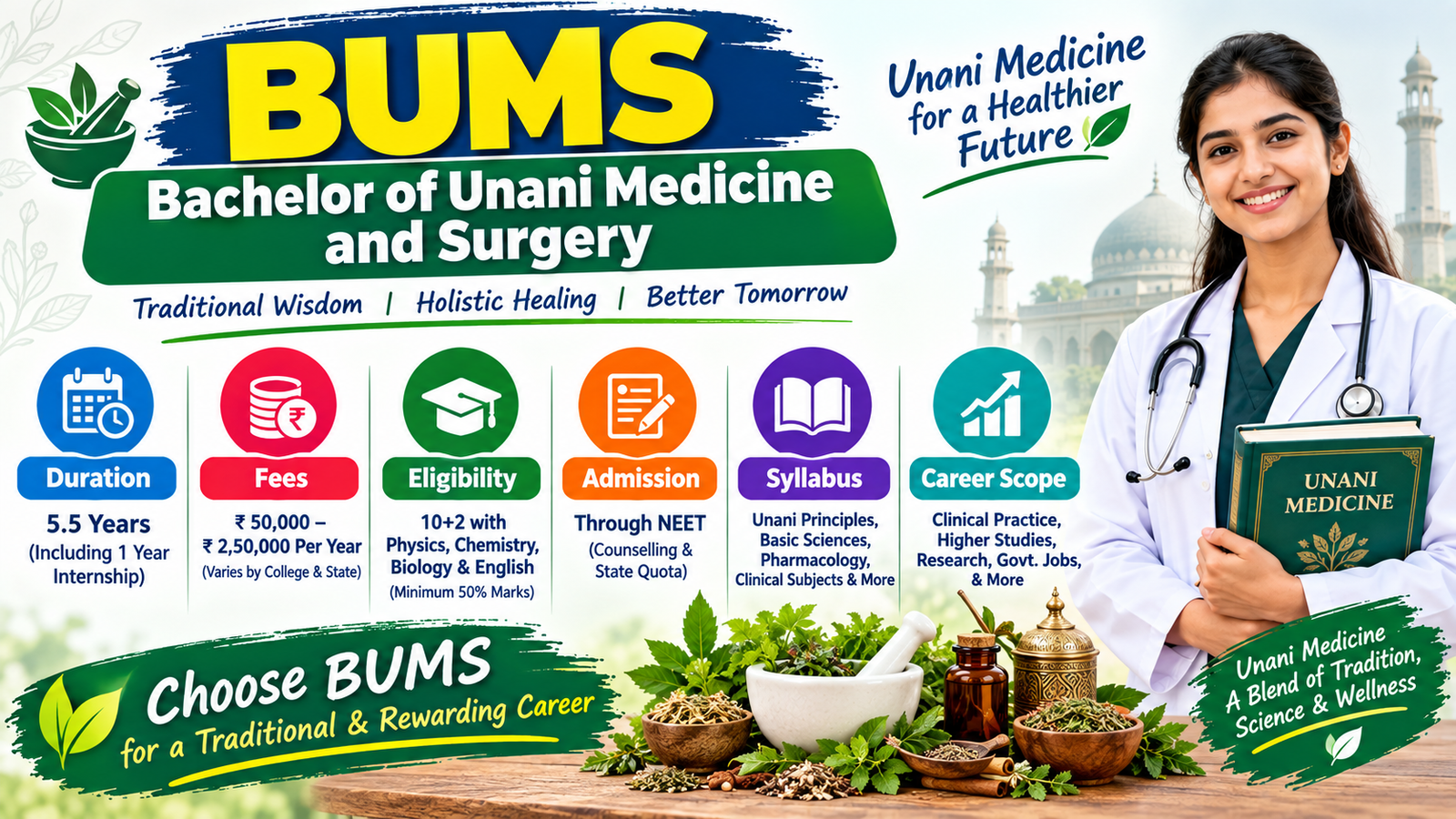
BUMS (Bachelor of Unani Medicine and Surgery) is an undergraduate medical degree that focuses on principles, diagnostic and treatment methods relating to the Unani system of medicine. Placed under the umbrella of Indian System of Medicine, BUMS blends the traditional Unani system with contemporary medical education, clinical training, and hospital exposure.
For those inclined towards studying healthcare but not interested in the conventional MBBS, BUMS can be a viable option. The BUMS admission process takes place through NEET-UG followed by counselling by the relevant central or state-level counselling authority.
The BUMS course curriculum covers Unani philosophy, anatomy, physiology, pharmacology, pathology, medicine, surgery, gynaecology and obstetrics, preventive medicine and other relevant disciplines in addition to practical and clinical training throughout the years of study and internship.
In the following discussion, we will take a detailed look at the BUMS course duration, fees, eligibility, NEET requirements, admission process, syllabus, subjects, career scope, salary, and higher education options.
What is BUMS?
BUMS stands for Bachelor of Unani Medicine and Surgery, and is an undergraduate medical qualification offered under the National Commission for Indian System of Medicine (NCISM). It is a professional course that prepares students in the principles of the Unani system of medicine as well as contemporary medical sciences.
By design, the BUMS programme enables students to understand disease processes and manage patients in a clinical setup while being trained in the Unani system of medicine.
It may be noted that BUMS is not only about traditional Unani studies – the academic curriculum includes modern-day medical sciences such as anatomy, physiology, pathology, pharmacology, and more.
As per the current academic guidelines published by NCISM, the BUMS course is divided into professional phases with the published academic calendar (for reference) indicating three 18-month phases of professional studies, followed by the mandatory internship.
BUMS Course Highlights
|
Particular |
Details |
|
Full Form |
Bachelor of Unani Medicine and Surgery |
|
Course Level |
Undergraduate |
|
Duration |
Approximately 5.5 years including the internship |
|
Eligibility |
Class 12th with Physics, Chemistry, Biology and English |
|
Entrance Exam |
NEET-UG |
|
Main Specialisation |
Unani system of medicine |
|
Regulatory Body |
National Commission for Indian System of Medicine (NCISM) |
|
Admission Process |
NEET-UG followed by counselling |
|
Internship |
Mandatory in accordance with applicable regulations |
|
Other Highlights |
Medical/Ayurveda undergraduate programme; career options in hospitals, corporate healthcare, teaching/research, Unani pharmaceuticals, etc. |
BUMS Course Duration
The duration of the BUMS course is approximately 5.5 years which includes the academic education as well as the mandatory internship. The course structure covers classroom and practical training, laboratory and clinical exposure, and professional phases leading up to the required internship period.
The BUMS course can be broadly divided into the following:
- First Professional BUMS
- Second Professional BUMS
- Third Professional BUMS
- Internship
As per the academic calendar of NCISM, the three professional phases comprise 18 months of study each followed by the 12 month internship period. It may be noted that the internship is a mandatory requirement of the BUMS course which allows students to obtain hands-on experience in a hospital and medical setting.
BUMS Fees in India
The BUMS course fees vary depending on the college, location, management category, hostel facilities, mess charges, and applicable other fees.
It may be noted that there is no uniformity in fees across government, government-aided, private, and deemed institutions.
Approximate BUMS Fee Structure (in INR)
|
College Type |
Approximate Annual Tuition Fee |
|
Government BUMS College |
INR 10,000 – 1,00,000 |
|
Government-Aided College |
INR 50,000 – 2,00,000 |
|
Private BUMS College |
INR 2,00,000 – 5,00,000+ |
|
Deemed/University Institutions |
Varies |
It must be kept in mind that the aforementioned fee structure only pertains to tuition fees. In addition to the tuition fees, students will also be required to pay hostel fees, mess charges, examination fees, registration fees, library fees, lab fees, clinical fees, university fees, security deposit, and other applicable charges.
Therefore, when comparing BUMS colleges, it is recommended to consider the overall cost of studying the course instead of just relying on the tuition fee figures.
BUMS Eligibility Criteria
Students wishing to pursue the BUMS programme need to satisfy the eligibility criteria as prescribed by the relevant authority/college for the applicable admission session.
For BUMS admissions through NEET, the basic eligibility criterion is passing the Class 12th or equivalent examination with Physics, Chemistry, Biology, and English as subjects.
As per the eligibility guidelines published for BAMS/BSMS/BUMS/BHMS admissions, candidates are required to pass the qualifying examination with PCB and English with the specified minimum percentage of marks. For the general category students, the minimum percentage required in PCB (Physics, Chemistry, Biology) is 50%, while for SC/ST/OBC category students, this has been specified at 40%.
In addition to the basic eligibility criteria, students need to qualify for the NEET eligibility exam, satisfy the applicable age criteria, complete the counselling process, and submit the required documents.
It is recommended to refer to the latest NEET-UG guidelines and counselling notification for eligibility-related details pertaining to the admission session of interest.
BUMS Admission Process
Admission to the BUMS course is based on the NEET-UG entrance examination followed by the counselling process conducted by the relevant authority.
The key steps for BUMS admission are discussed below:
Step 1: Appear for NEET-UG
Students interested in pursuing BUMS need to appear for the NEET-UG exam as per the guidelines pertinent to the admission session. It may be noted that the exam is conducted by the National Testing Agency (NTA).
Step 2: Qualify for NEET Counselling
Students need to clear the NEET examination in order to be eligible for the counselling process for BUMS admissions.
Step 3: Register for NEET Counselling
Applicants need to register for counselling with the relevant authority as per their eligibility.
For the 2026-27 admission session, the AACCC (Ayurveda, Yoga & Naturopathy, Unani, Siddha & Sowa Rigpa Admissions Counseling Cum Cell) has been conducting online counselling for BAMS, BSMS, BUMS, BHMS, and other AYUSH undergraduate courses for eligible NEET-UG qualified candidates.
Step 4: Submit College Preferences
Students need to select and submit their college preferences as per the instructions issued during counselling.
Step 5: Seat Allocation
The counselling authority will allocate seats to students based on their NEET rank, college preferences, category, available seats, and other relevant criteria.
Step 6: Complete Admission Formalities
Once the seat has been allocated to the student, they need to complete the admission formalities, including submitting the required documents, within the specified time frame.
The AACCC conducts counselling for All India Quota, Central University, National Institute, Deemed University, and other seats as applicable. It is the responsibility of the students to register and participate in the counselling process as applicable.
BUMS Syllabus
The syllabus for the BUMS course comprises the Unani medicinal system and contemporary medical sciences. The curriculum progresses from the foundational medical sciences to the clinical and practical aspects of the Unani system of medicine.
It may be noted that the distribution of subjects for BUMS professional phases may vary across colleges as per the academic guidelines of NCISM.
BUMS First Professional Syllabus
The first professional course of BUMS introduces students to medicine and allied subjects, including the fundamentals of the Unani medicinal system.
The first professional syllabus consists of the following areas of study:
- Arabic and Medical Terminology
- Unani Philosophy
- Anatomy
- Physiology
- Fundamentals of Unani Medicine
- Practical Orientation
BUMS Second Professional Syllabus
The second professional syllabus builds upon the basic medical sciences and introduces students to pharmacology, pathology, microbiology, pharmacognosia, Ilmul Advia, Tahaffuzi wa Samaji Tib, and other relevant subjects.
The NCISM has published comprehensive user manuals and curriculum for the BUMS course for students’ reference.
BUMS Third Professional Syllabus
The third professional course is focused on clinical medicine and treatment. The syllabus covers the following areas:
- Moalajat
- Ilmul Jarahat
- Niswan wa Qabalat
- Ilmul Atfal
- Ain, Uzn, Anaf, Halaq
- Ilmul Qabalat
- Community Medicine
- Clinical Orientation
- Hospital Orientation
It may be noted that the third professional course is dominated by clinical aspects of medicine.
BUMS Internship
The BUMS internship is an integral part of the course that provides students with the necessary exposure in a clinical or hospital setting. The internship entails observing, assisting, and participating in the management of patients with a variety of diseases and conditions under the guidance of instructors.
The internship also offers students the opportunity to learn the inner workings of a hospital and its departments.
It is mandatory for students to complete the internship requirements prior to obtaining registration or practicing medicine as per the Unani system.
Skill Set Developed during BUMS
The BUMS programme provides students with a wide range of medical, clinical, and professional skills, including:
- Patient communication skills
- Clinical observation skills
- Diagnostic skills
- Knowledge about Unani medicines
- Physiology and Anatomy
- Clinical documentation and record-keeping
- Counselling and patient management skills
- Public health and preventive medicine
- Hospital management skills
- Research skills
- Ethical practices and professional etiquette
It must be noted that developing communication skills is key to interacting with patients, as their medical history and personal habits can often determine a doctor’s diagnosis.
Career Scope after BUMS
The career scope after BUMS goes beyond setting up a private clinic.
BUMS graduates have a wide range of options, including working in the corporate healthcare sector, government jobs, research, pharmaceutical sector, teaching, and more.
The following are the possible career options available to BUMS graduates:
1. Unani Doctor
BUMS graduates can practice as a doctor after completing the relevant formalities pertaining to registration and certification.
A doctor can work in a hospital, clinic, or other relevant institution after completing their BUMS programme.
2. Private Practice
BUMS graduates can set up or work in a private clinic, subject to fulfilling the relevant requirements pertaining to registration and certification.
3. Government Jobs
BUMS graduates can also apply for government jobs in healthcare, subject to fulfilling the eligibility criteria pertaining to job selection exams, if any.
4. Unani Hospitals
Graduates can work in Unani hospitals and institutions to gain experience in diverse areas of Unani medicine and treatment.
5. Research
Students interested in research can pursue avenues relating to Unani pharmacology, medicinal plants, drug development, and more.
6. Unani Pharmaceutical Companies
The career options in the pharmaceutical sector are vast, including medical writing, documentation, quality control, and more.
7. Teaching
BUMS graduates can also consider teaching as a viable career option. They can pursue postgraduate studies to be eligible for teaching positions at Ayurveda colleges/universities.
8. Public Health
BUMS graduates can explore avenues relating to public health.
BUMS Salary in India
The BUMS salary varies greatly depending on experience, specialism, work location, and other relevant factors. With the right expertise and experience, BUMS graduates can earn attractive salaries.
The following is an indicative BUMS career progression:
|
Career Stage |
Approximate Salary in INR |
|
Freshers |
INR 2.5 – 4.5 Lakh per annum |
|
2 – 5 Years of Experience |
INR 4 – 7 Lakh per annum |
|
Experienced Professional |
INR 6 – 12 Lakh+ per annum |
|
Private Practice |
Varies greatly depending on patient base |
It must be noted that the aforementioned figures are only indicative, and the private practice income can vary significantly depending on the number of patients and other relevant factors.
Higher Education after BUMS
BUMS graduates can pursue postgraduate education if they wish to specialise in a particular area of Unani medicine. Postgraduate programmes such as MD/MS can be pursued under the relevant education framework.
BUMS students can also consider specialisations in clinical medicine, pharmacology, surgery, gynaecology, paediatrics, preventive medicine, and more.
PG courses in research, healthcare administration, and related fields can also be viable options for BUMS graduates.
BUMS vs MBBS – Key Differences
While BUMS and MBBS are both undergraduate medical courses, they are different in a number of aspects. The major differences between BUMS and MBBS have been discussed below:
|
Particular |
BUMS |
MBBS |
|
Full Form |
Bachelor of Unani Medicine and Surgery |
Bachelor of Medicine, Bachelor of Surgery |
|
System of Medicine |
Unani system of medicine |
Modern system of medicine |
|
Entrance Exam |
NEET-UG |
NEET-UG |
|
Duration |
Approx. 5.5 years including internship |
Approx. 5.5 years including internship |
|
Regulatory Body |
NCISM |
National Medical Commission |
|
Focus |
Unani medicine and contemporary medical sciences |
Modern medical sciences |
|
Higher Education |
PG in Unani medicine |
PG in Modern medicine |
Is BUMS a Good Career Option?
For students interested in the Unani system of medicine, BUMS can be a good career option. The course provides the required training in the Unani system of medicine as well as contemporary medical sciences. Having said that, it is important to research about the college thoroughly before taking admission as factors such as permission/status, attached hospital, faculty, infrastructure, fees, hostel facilities, counselling guidelines, and more can influence the overall candidate experience.
It must be noted that NCISM publishes information pertaining to Unani colleges, including their permission/status. Therefore, it is important to verify the permission/status of the college before paying any tuition fees.
Things to Consider before Choosing a BUMS College
Before taking admission, it is crucial for students to verify the following:
- Permission/status of the college
- University affiliation
- Number of BUMS seats
- Attached teaching hospital
- Patient load for practical exposure
- Total course fee
- Hostel and mess charges
- Internship provision
- Faculty and infrastructure
- Previous counselling data
- Registration process after BUMS
- Current notifications from NCISM and counselling authorities
Rather than blindly trusting the advertisement or advice of admission consultants, it is always a good idea to independently verify the details from the concerned official website.
Frequently Asked Questions about BUMS
Q. What is the full form of BUMS?
A. The full form of BUMS is Bachelor of Unani Medicine and Surgery.
Q. Is NEET required to pursue BUMS?
A. Yes, NEET is required for BUMS admissions. It may be noted that NEET qualifying students can apply for BUMS admissions as per the guidelines issued by the AACCC.
Q. What is the duration of the BUMS course?
A. The duration of the BUMS course is approximately 5.5 years which includes the mandatory internship period.
Q. What subjects are required to pursue BUMS?
A. Students are required to have studied Physics, Chemistry, Biology, and English in Class 12th, in addition to meeting the qualifying marks criteria.
Q. What is the fee structure for the BUMS course?
A. The BUMS fee structure varies from college to college. It may be noted that government colleges tend to have lower fees as compared to private and deemed institutions.
Q. Can I become a doctor after completing BUMS?
A. Yes, BUMS graduates can become doctors after completing the required formalities pertaining to registration and certification.
Q. Can a BUMS graduate open a private clinic?
A. Yes, a BUMS graduate can open a private clinic if they meet the relevant requirements pertaining to registration and certification.
Q. What are the various career options available after BUMS?
A. After completing BUMS, graduates can explore career options in clinical practice, government jobs, corporate healthcare, research, pharmaceutical sector, teaching, and more.
Q. Can I pursue postgraduate courses after completing BUMS?
A. Yes, BUMS graduates can pursue postgraduate courses if they wish to specialise in a particular area of medicine.