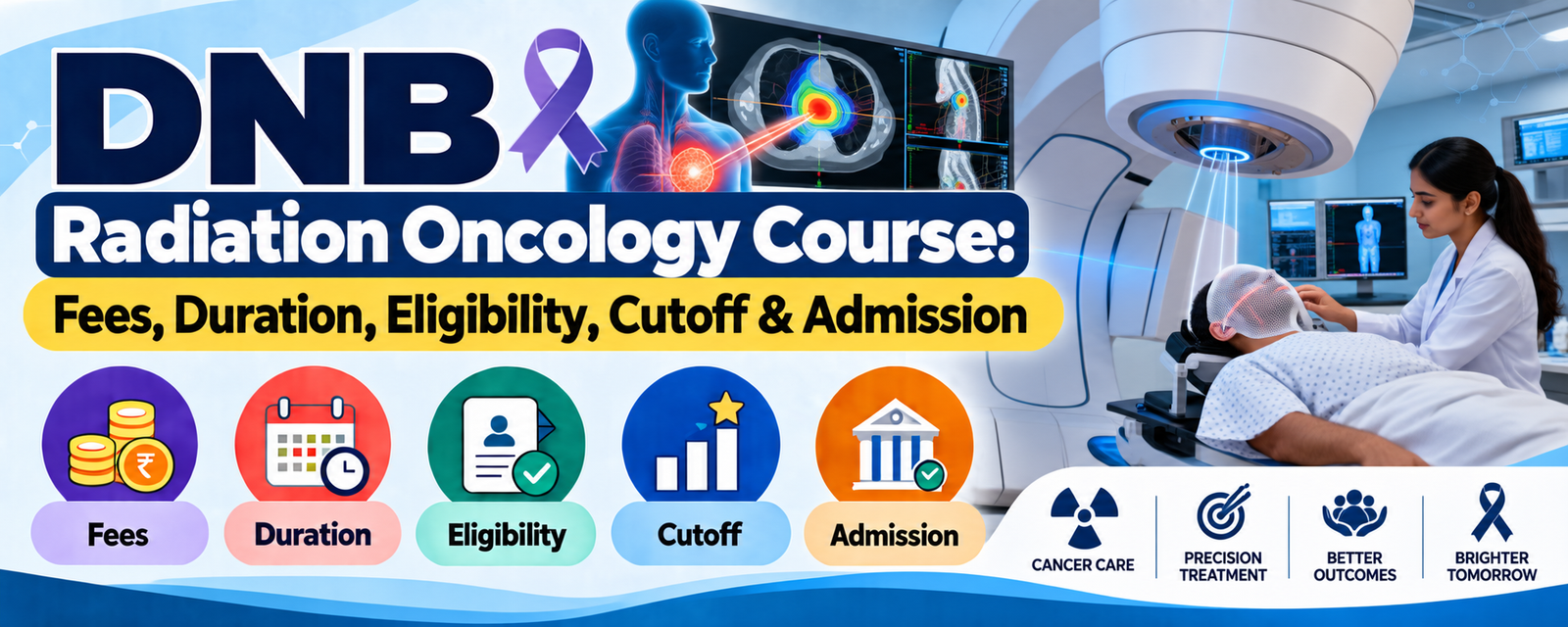
A patient has completed cancer surgery and now needs radiotherapy. The family may imagine a machine delivering the same treatment to everyone. In reality, the doctor first has to understand the cancer, decide whether radiation is appropriate, plan where it should go, protect nearby healthy tissue and review the patient throughout treatment.
DNB Radiation Oncology trains MBBS graduates for that work. MBBS gives a doctor a broad medical foundation; this postgraduate course develops specialist skills in cancer assessment and treatment with radiation. The standard post-MBBS route lasts three years. Admission is through NEET-PG, followed by counselling for a seat at an institution accredited by the National Board of Examinations in Medical Sciences (NBEMS).
A training centre’s name and equipment list are only a starting point. Applicants also need to know which services are running, what cases residents see and how closely treatment planning is supervised. Those differences can shape both the training experience and demand for a seat.
What is DNB Radiation Oncology?
DNB stands for Diplomate of National Board. Radiation oncology is the medical specialty that uses radiotherapy to treat cancer and, in selected situations, other conditions. The specialist assesses patients, works with the cancer team, decides on an appropriate treatment approach and follows patients for response and side effects.
Radiation can be used with surgery or medicines, and the purpose varies. For one patient it may be part of treatment intended to control or cure disease. For another, it may relieve a symptom such as pain. The radiation oncologist must explain that purpose clearly rather than letting a patient assume every course of radiotherapy has the same goal.
Training combines cancer medicine, anatomy, radiation biology, treatment planning, patient care and safety. Graduates may work in cancer centres or hospitals, teach, take part in research or pursue focused training in a particular disease site or technique. Entry to any further programme depends on its own rules. NBEMS lists the specialty as Radiation Oncology, previously called Radio Therapy in its DNB programme information.
Course highlights
|
Particular |
Details |
|
Course Name |
DNB Radiation Oncology |
|
Degree |
Diplomate of National Board |
|
Level |
Postgraduate broad specialty |
|
Duration |
Three years after MBBS; a separate post-diploma route is available to eligible candidates |
|
Basic Qualification |
MBBS for the three-year route |
|
Entrance Exam |
NEET-PG for the post-MBBS route |
|
Admission Process |
Entrance result, counselling registration, choice filling, allotment and reporting |
|
Training Type |
Supervised cancer clinics, treatment planning, radiotherapy services and academic work |
|
Major Focus |
Cancer care using radiotherapy, including treatment decisions, delivery and follow-up |
|
Further Study |
Eligible fellowships and focused training, subject to programme rules |
|
Career Areas |
Cancer centres, hospitals, teaching and research |
Duration: what changes during the three years?
The post-MBBS DNB course lasts three years. There is a separate post-diploma DNB route for candidates who meet its prerequisite qualification and entrance rules. The account below concerns the three-year route. Posting order and access to particular techniques depend on the accredited centre.
Year 1: Understanding patients and plans
New residents learn how a radiotherapy decision is made. They take histories, examine patients, review pathology and imaging, and attend discussions with senior doctors and other cancer specialists. Cancer stage, previous treatment and the patient’s general health all affect the plan.
The first year also introduces radiation physics, biology and safety. Residents observe how treatment areas are defined and how a proposed plan is checked before a patient begins therapy. They follow patients during treatment and learn to recognise common side effects. Good documentation matters: a course of radiotherapy involves decisions and checks spread over time.
Year 2: Taking a larger role in treatment
Residents begin to contribute more actively to case assessment and planning under supervision. They learn why the radiation dose and target must be chosen for the particular disease and patient, and how doctors, medical physicists and radiation therapy staff work together.
Clinical responsibility grows too. A patient may need treatment adjusted because of side effects or a change in condition. Some need urgent assessment; others need help managing symptoms while continuing a planned course. Research and academic work run alongside these duties.
Year 3: Linking the entire course of care
By the final year, residents should be able to present a reasoned treatment recommendation, participate in planning and review patients with greater independence under consultant supervision. They learn to discuss expected benefits, limitations and possible late effects in language a patient can understand.
They also complete applicable academic requirements and prepare for the DNB final examination. The goal is to manage the whole radiotherapy journey: selection, planning, treatment review and follow-up.
Eligibility for DNB Radiation Oncology
For the three-year post-MBBS route, a candidate generally needs to:
- Hold an eligible MBBS degree or provisional pass certificate under the applicable Indian medical education rules.
- Complete the compulsory rotating internship by the deadline set for that admission session.
- Have the required medical registration, provisional or permanent as allowed by the current NEET-PG bulletin.
- Appear for NEET-PG and meet the applicable qualifying requirement.
- Meet counselling and seat-specific conditions, including relevant category and document requirements.
The National Medical Commission (NMC) governs medical education and registration standards. NBEMS administers DNB training and conducts the entrance examinations. Eligible doctors seeking the post-diploma route follow separate NBEMS entrance and counselling rules; an MBBS graduate should not combine that route’s seats or ranks with the three-year route. Check the current examination bulletin for the precise internship and document deadlines.
Admission process, step by step
For the post-MBBS course:
- Complete MBBS and internship. Gather qualification, internship and medical registration records.
- Apply for and take NEET-PG. It is the entrance examination for the three-year post-MBBS DNB route.
- Review the result and rank. Qualifying permits an eligible candidate to seek admission; it does not assure a Radiation Oncology seat.
- Register for counselling. The Medical Counselling Committee (MCC) administers counselling for standard post-MBBS DNB seats alongside other PG medical courses. Read the current schedule and DNB seat matrix.
- Research and fill choices. Select actual Radiation Oncology seats at institutions you would join, ranked in your genuine preference order.
- Check the allotment. Follow that round’s instructions on accepting, upgrading or continuing in counselling.
- Report to the allotted institution. Complete verification, payments and joining formalities within the notified deadline.
INI-CET is a separate PG entrance examination for participating Institutes of National Importance. It is not the entrance route for a standard post-MBBS DNB Radiation Oncology seat. State counselling authorities conduct other PG seat processes; applicants must follow the authority responsible for each seat.
Fees: comparing DNB with other PG seats
There is no single all-inclusive DNB Radiation Oncology fee. NBEMS course fees, counselling payments, examination charges, hostel costs and everyday expenses need to be budgeted separately. A resident stipend affects the wider budget, but it is not the same as a reduction in the amount due at joining.
A table headed “government college versus private college” can conceal an important difference: DNB seats are attached to NBEMS-accredited hospitals or institutions. An MD Radiation Oncology seat at a college and a DNB seat at an associated cancer centre may have different fee rules.
|
Common fee-table category |
How to read it for DNB Radiation Oncology |
|
Government College |
Confirm whether the seat is DNB or MD; use the written charges for the actual course. |
|
State Government College |
A state MD tuition schedule does not automatically apply to an associated DNB seat. |
|
Private College |
Check the accredited DNB programme’s joining terms rather than assuming private MD tuition applies. |
|
Deemed University |
A deemed-university MD seat and a DNB seat are separate choices with potentially different payment rules. |
|
Management Quota |
Do not assume this is a standard DNB admission category. Follow the official seat designation and counselling route. |
Ask for an itemised statement covering course or tuition fees, any applicable institutional or university fee, registration and examination fees, hostel and mess charges, and refundable deposits. Check due dates and refund rules. Verify the final amount using current NBEMS guidance, counselling documents and the allotted centre’s written terms.
What does the cutoff mean?
The NEET-PG qualifying cutoff determines whether a candidate meets the examination requirement under the applicable category rules. A closing rank is the last rank allotted a specific seat in a specific counselling round. Qualifying for NEET-PG is therefore different from securing a preferred Radiation Oncology centre.
Closing ranks are institution-wise, category-wise, quota-wise and round-wise. They move with the number of available seats, centre reputation, location, government or private status, candidate preferences and movement between rounds. Competition changes from one admission year to the next as well.
Compare official MCC seat matrices and allotment results for the post-MBBS DNB route when estimating chances. A previous closing rank provides context; it cannot guarantee the same outcome this year.
What rank or score is needed?
There is no universal NEET-PG rank or score for DNB Radiation Oncology. Begin with the current seat matrix and the categories for which you are eligible. Then compare previous official allotments for the same course, centre, category, quota and round wherever possible.
Do not stop at the rank. Ask what kinds of cancers residents see, how treatment plans are discussed, what radiotherapy techniques are active, and what role trainees have in patient review. Equipment matters, but an installed machine is not proof that a resident receives substantial supervised experience with it.
A broad preference list helps if several centres meet your requirements. Place them in your real order of choice. Listing only a few famous institutions may exclude acceptable training posts; listing a centre you would refuse can create a difficult allotment decision.
DNB Radiation Oncology syllabus
The subject combines cancer medicine, technology and continuing patient care. Major areas include:
- Cancer biology and pathology: How cancers develop, spread and respond to treatment; interpretation of diagnosis and stage.
- Anatomy and imaging: Locating disease and nearby organs that need protection during planning.
- Radiation physics and biology: How radiation interacts with tissue, how dose is measured and why treatment schedules differ.
- Treatment planning: Selecting patients, defining treatment areas, evaluating plans and working with medical physicists.
- Radiotherapy techniques: External-beam treatment and other approaches available at the centre, including their indications and limitations.
- Site-specific cancer care: Treatment decisions for cancers affecting different body regions, often made with surgeons and medical oncologists.
- Supportive care: Managing symptoms and treatment effects during radiotherapy and at follow-up.
- Safety, ethics and research: Quality checks, radiation protection, informed consent, evidence appraisal and clinical research.
The NBEMS Radiation Oncology curriculum is the reference for training and assessment requirements; an institution’s available services determine how each technique is encountered in practice.
Practical training and safety
Residents see patients in clinics and wards, attend multidisciplinary discussions, assist with planning and review people during and after treatment. The important practical skill is connecting a technically sound plan to the person receiving it. A patient’s symptoms, previous treatment and ability to attend sessions can all affect care.
Radiotherapy involves strict safety and quality procedures. India’s Atomic Energy Regulatory Board (AERB) sets regulatory requirements for radiotherapy facilities, which must obtain the required consent to operate. Residents should learn within the centre’s authorised services and supervised safety processes.
Before ranking a seat, ask which services are operational, how often residents participate in planning and case review, and how complications or treatment interruptions are handled. These questions give a clearer picture of training than a machine list alone.
Career scope after DNB Radiation Oncology
Graduates may work as radiation oncologists in cancer centres and hospitals, caring for patients before, during and after radiotherapy. Some develop a focus on particular cancer sites, treatment techniques or supportive care.
Teaching and research are possible where a graduate meets the relevant post’s eligibility rules. Further focused training may be available, but each programme has its own selection criteria.
Salary and earning potential
Income varies with employer type, city, public or private sector, experience and clinical responsibilities. A salaried position in a public cancer centre differs from one in a private hospital. The range of services and seniority of the role also matter. No single salary figure describes every graduate.
For a candidate choosing a DNB seat, assess the centre’s case mix, supervision, planning work and patient follow-up first. Those experiences will shape the specialist’s clinical abilities and later options.