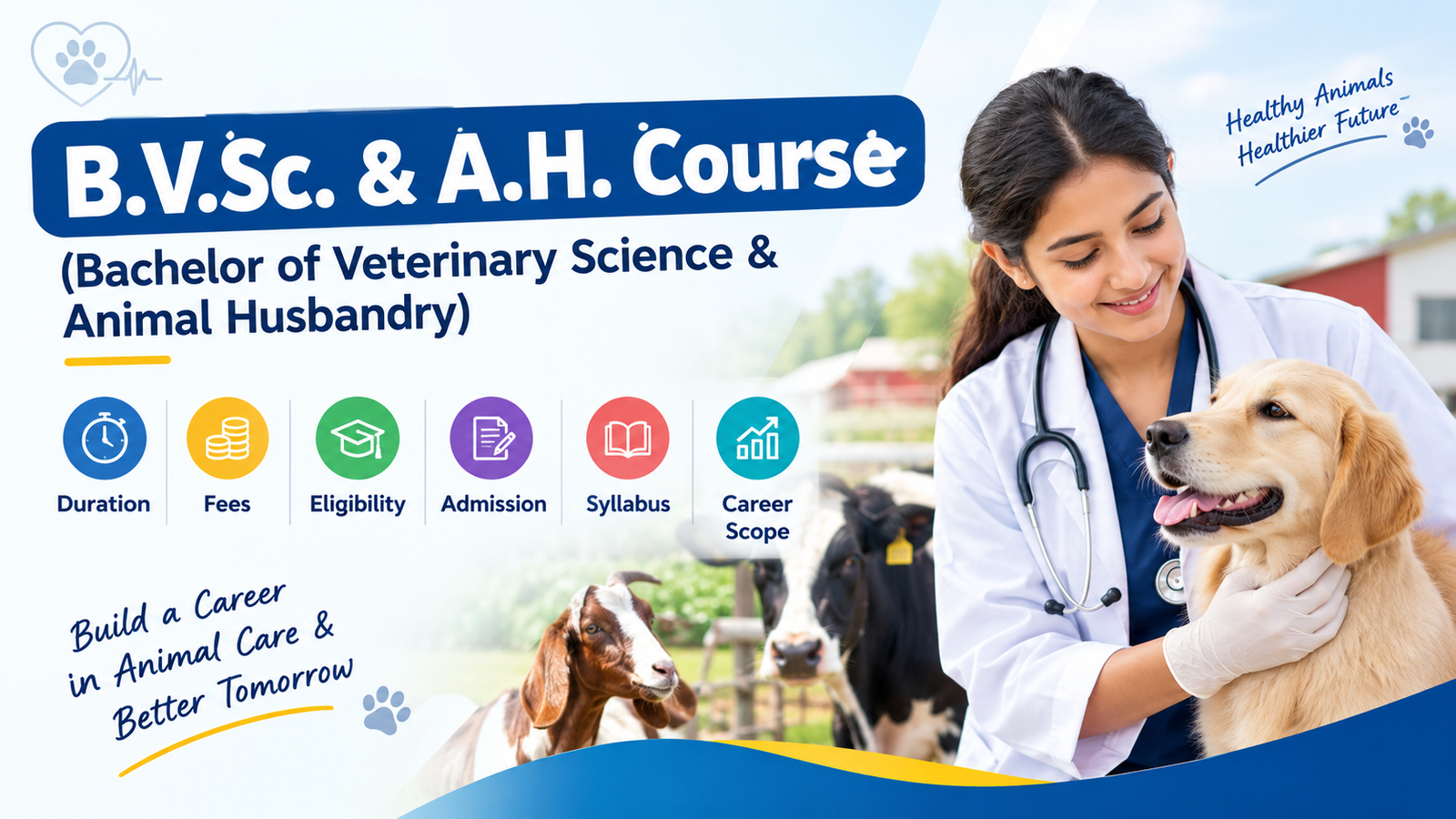
B.V.Sc. & A.H. course, or Bachelor of Veterinary Science and Animal Husbandry, is a professional undergraduate programme that prepares students for careers in veterinary medicine, animal healthcare, livestock management and related fields. The course combines veterinary science with practical training in the prevention, diagnosis and management of diseases in animals.
While veterinary science is not restricted to pets, it extends to numerous animals such as cattle, buffaloes, sheep, goats, horses, poultry, companion animals and others. Veterinary professionals also contribute in livestock production, animal nutrition, breeding, public health, food safety, disease control and veterinary research.
For students with an interest in biology, animals and healthcare, B.V.Sc. & A.H. is one of the major professional courses available after Class 12 with Physics, Chemistry and Biology. Admission to veterinary undergraduate programmes in India is linked with NEET-UG, followed by the counselling process applicable to the relevant seats and institution.
The course involves classroom learning, laboratory work, clinical training and practical exposure. Students also receive a compulsory internship before receiving the professional degree.
What is B.V.Sc. & A.H.?
B.V.Sc. & A.H. stands for Bachelor of Veterinary Science and Animal Husbandry.
It is an undergraduate professional degree that prepares students for careers involving animal health, veterinary clinical practice, livestock management, animal production and related areas.
The course combines two interconnected disciplines:
- Veterinary Science, focusing on animal health, diseases, diagnosis, treatment, surgery and preventive healthcare.
- Animal Husbandry, focusing on the scientific management, nutrition, breeding, production and welfare of domesticated animals.
Students study topics including anatomy, physiology, biochemistry, pathology, pharmacology, microbiology, animal nutrition, genetics, animal breeding, veterinary medicine, veterinary surgery, gynaecology and animal husbandry.
The programme also covers veterinary public health and epidemiology, as some animal diseases can have implications for human health and food safety.
B.V.Sc. & A.H. Course Highlights
|
Particular |
Details |
|
Full Form |
Bachelor of Veterinary Science & Animal Husbandry |
|
Degree Level |
Undergraduate |
|
Course Type |
Professional Degree |
|
Duration |
Generally 5.5 years including internship |
|
Eligibility |
10+2 with Physics, Chemistry, Biology/Biotechnology |
|
Entrance Examination |
NEET-UG |
|
Study Mode |
Classroom, laboratory and clinical training |
|
Internship |
Compulsory rotating internship |
|
Major Areas |
Veterinary medicine, surgery, animal husbandry and animal health |
|
Career Areas |
Veterinary hospitals, clinics, farms, government services, research and industry |
|
Higher Studies |
M.V.Sc. and other relevant postgraduate programmes |
The exact admission conditions, curriculum structure and seat availability can vary according to the applicable veterinary education regulations and counselling authority.
B.V.Sc. & A.H. Course Duration
The B.V.Sc. & A.H. programme generally has a duration of 5.5 years, including a compulsory rotating internship.
The academic component is followed by practical clinical training through internship. The internship gives students the opportunity to apply their classroom knowledge in veterinary hospitals, clinics, farms and other relevant settings.
A broad structure of the programme includes:
|
Component |
Duration |
|
Academic Education |
4.5 years |
|
Compulsory Rotating Internship |
1 year |
|
Total |
5.5 years |
The actual academic year and semester structure may vary according to the regulations and curriculum followed by the veterinary institution. Unlike a conventional three- or four-year bachelor's degree, B.V.Sc. & A.H. is a professional programme with substantial practical and clinical training.
B.V.Sc. & A.H. Eligibility Criteria
Students interested in B.V.Sc. & A.H. admission must satisfy the prescribed educational and entrance requirements.
The basic academic requirement is completion of Class 12 or equivalent education with Physics, Chemistry, Biology/Biotechnology and English, subject to the applicable rules.
Candidates must also qualify for NEET-UG and fulfil the eligibility conditions specified by the relevant counselling authority and veterinary institution.
Basic B.V.Sc. & A.H. eligibility generally includes:
- Passed Class 12 or equivalent examination.
- Studied Physics, Chemistry and Biology/Biotechnology.
- Studied English as a required subject.
- Obtained the prescribed minimum marks in the qualifying examination.
- Qualified NEET-UG.
- Fulfilled the applicable age and other admission requirements.
- Completed the counselling and document-verification process.
Students should check the latest official admission notification because eligibility conditions, category-wise requirements and counselling procedures can be updated for different admission sessions.
Is NEET Required for B.V.Sc. & A.H.?
Yes, NEET-UG is used for admission to B.V.Sc. & A.H. programmes in India under the current undergraduate veterinary admission framework.
Students who want to pursue veterinary science should therefore include NEET preparation in their Class 11 and Class 12 academic planning.
NEET provides a common entrance route for eligible candidates, while the actual seat allotment and counselling process depends on the applicable authority, category, institution and seat type.
Students should not assume that passing NEET alone guarantees admission.
A candidate must also satisfy the relevant eligibility conditions and participate in the appropriate counselling process.
B.V.Sc. & A.H. Admission Process
The B.V.Sc. & A.H. admission process usually involves several stages.
Step 1: Complete Class 12
Candidates should complete their higher secondary education with the required science subjects.
Physics, Chemistry and Biology/Biotechnology form the core academic foundation for veterinary education.
Step 2: Appear for NEET-UG
Eligible students need to appear for NEET-UG and obtain the required qualifying result.
Step 3: Participate in Counselling
After the NEET result, eligible candidates register for the relevant veterinary counselling process.
Depending on the seat category, counselling may be conducted through the appropriate national or state-level authority.
Step 4: Select Veterinary Colleges
Candidates can select their preferred institutions from the colleges and seats available during counselling.
Step 5: Seat Allotment
Seat allotment is conducted according to the applicable counselling rules, NEET performance, candidate category, choices and availability.
Step 6: Document Verification
Candidates must submit and verify the required documents.
Step 7: Admission and Fee Payment
After accepting the allotted seat, candidates complete the fee payment and admission formalities within the specified deadline.
Step 8: Begin the B.V.Sc. & A.H. Programme
Once admission is completed, students begin academic, laboratory and practical training.
B.V.Sc. & A.H. Course Fees
The B.V.Sc. & A.H. fees vary from one college to another.
Government veterinary colleges generally have different fee structures from private institutions. Fees can also vary according to the state, university, hostel facilities and category of seat.
Students should consider the complete cost of education rather than tuition fees alone.
Major expenses can include:
- Tuition fees
- Admission charges
- University fees
- Examination fees
- Laboratory fees
- Library fees
- Hostel fees
- Mess charges
- Clinical training expenses
- Student activity charges
- Other institutional fees
Because veterinary colleges follow different fee structures, students should verify the latest official fee notification of the college and counselling authority before making an admission decision.
Government vs Private B.V.Sc. Fees
|
Factor |
Government College |
Private College |
|
Tuition Fee |
Usually comparatively lower |
Can be higher |
|
Hostel |
Varies |
Varies |
|
Infrastructure |
Depends on institution |
Depends on institution |
|
Clinical Facilities |
Usually associated with teaching hospitals/farms |
Varies by college |
|
Total Cost |
Depends on state and institution |
Often higher but varies |
Students should avoid relying on unofficial websites or old fee figures when planning their education budget.
B.V.Sc. & A.H. Syllabus
The B.V.Sc. & A.H. syllabus covers a broad combination of veterinary sciences, animal husbandry, clinical medicine and practical training.
Students gradually move from basic sciences to specialised veterinary subjects.
Major areas generally covered include:
- Veterinary Anatomy
- Veterinary Physiology
- Veterinary Biochemistry
- Veterinary Histology and Embryology
- Veterinary Pharmacology and Toxicology
- Veterinary Pathology
- Veterinary Microbiology
- Animal Nutrition
- Animal Genetics and Breeding
- Livestock Production and Management
- Veterinary Parasitology
- Veterinary Immunology
- Veterinary Medicine
- Veterinary Surgery and Radiology
- Veterinary Gynaecology and Obstetrics
- Veterinary Public Health
- Epidemiology
- Animal Welfare
- Poultry Production
- Dairy Production
- Clinical training
The detailed curriculum can change according to updates in veterinary education regulations and university curriculum.
B.V.Sc. & A.H. Subjects
Veterinary Anatomy
Veterinary anatomy introduces students to the structure of animal bodies. Students study bones, muscles, organs, tissues and different body systems across relevant animal species.
Veterinary Physiology
This subject explains how animal bodies function. Students learn about cardiovascular, respiratory, digestive, nervous, endocrine and reproductive systems.
Veterinary Biochemistry
Veterinary biochemistry deals with chemical processes occurring within living organisms. It helps students understand metabolism, enzymes, proteins, carbohydrates and other biological processes.
Animal Nutrition
Animal nutrition is an important part of veterinary education. Students learn about nutrients, feed composition, dietary requirements and feeding practices for different animals.
Animal Genetics and Breeding
This subject covers heredity, genetic variation, breeding principles and methods used to improve desirable characteristics in livestock.
Veterinary Pathology
Pathology helps students understand disease processes and the changes that occur in tissues and organs due to disease.
Veterinary Pharmacology
Students learn about veterinary medicines, their actions, dosage principles, therapeutic applications and potential adverse effects.
Veterinary Microbiology
This subject introduces microorganisms associated with animal diseases, including bacteria, viruses and fungi, along with laboratory-based concepts related to diagnosis and disease prevention.
Veterinary Medicine
Veterinary medicine is one of the core clinical areas. Students learn about the diagnosis, prevention and management of diseases affecting animals.
Veterinary Surgery
Students are introduced to surgical principles, clinical procedures, anaesthesia, wound management and other aspects of veterinary surgery.
Veterinary Gynaecology and Obstetrics
This area focuses on reproductive health, breeding, pregnancy, parturition and reproductive disorders in animals.
Veterinary Public Health
Veterinary public health connects animal health with human health and food safety. Students learn about zoonotic diseases, food hygiene and other public-health concerns associated with animals and animal products.
Practical Training in B.V.Sc. & A.H.
Practical education is a major part of veterinary science.
Students do not learn only through lectures. They receive exposure to laboratories, animal farms, veterinary hospitals, diagnostic facilities and clinical environments.
Practical training can include:
- Animal handling
- Clinical examination
- Sample collection
- Laboratory procedures
- Disease identification
- Diagnostic techniques
- Treatment procedures
- Surgical assistance
- Animal husbandry practices
- Farm management
- Reproductive management
- Preventive healthcare
This practical exposure helps students understand the difference between theoretical knowledge and real-world veterinary practice.
B.V.Sc. & A.H. Internship
A compulsory rotating internship is an important component of the B.V.Sc. & A.H. programme.
During the internship, students receive supervised practical exposure in areas such as:
- Veterinary hospitals
- Veterinary clinics
- Livestock farms
- Poultry units
- Dairy farms
- Diagnostic laboratories
- Animal health centres
- Reproductive management facilities
- Public veterinary services
The internship allows students to develop practical skills and become familiar with professional veterinary environments.
It also gives students experience in interacting with animal owners, maintaining clinical records and working as part of a veterinary healthcare team.
Career Scope After B.V.Sc. & A.H.
The career scope after B.V.Sc. & A.H. extends across clinical practice, government services, livestock production, research, education, pharmaceuticals and animal healthcare.
Some common career areas include the following.
1. Veterinary Doctor
Graduates can pursue veterinary clinical practice after completing the required degree, internship and registration requirements.
Veterinarians may work with companion animals, livestock, poultry or other species depending on their area of practice.
2. Government Veterinary Services
Veterinary graduates can apply for relevant government positions when vacancies are announced.
Government veterinary professionals may work in:
- Veterinary hospitals
- Animal health departments
- Livestock development programmes
- Disease-control programmes
- Animal welfare programmes
- Rural veterinary services
Eligibility varies according to the recruitment notification.
3. Private Veterinary Hospitals
Private veterinary hospitals and clinics offer opportunities for graduates interested in clinical care.
The growing interest in companion-animal healthcare has also created opportunities for veterinary professionals in pet clinics and specialised animal hospitals.
4. Livestock Industry
Graduates can work in dairy farms, cattle farms, poultry operations, goat farms and other livestock-related businesses.
Their knowledge can be applied to animal health, nutrition, breeding and farm management.
5. Veterinary Pharmaceutical Industry
Veterinary pharmaceutical companies require professionals with knowledge of animal healthcare, medicines and disease management.
Possible roles can include technical, product, research or field-based positions depending on the candidate's qualifications and experience.
6. Research
Students interested in scientific work can explore research opportunities in veterinary medicine, animal diseases, nutrition, genetics, microbiology and related areas.
7. Veterinary Public Health
Veterinary professionals can work in areas related to zoonotic disease control, food safety, meat and dairy hygiene and public health.
8. Animal Welfare Organisations
Veterinarians can contribute to animal welfare organisations, shelters, rescue centres and other animal-care initiatives.
9. Teaching and Academia
Graduates interested in academics can pursue postgraduate education and subsequently explore teaching and research careers.
Higher Studies After B.V.Sc. & A.H.
Students who want to specialise after graduation can pursue postgraduate education.
One of the major options is Master of Veterinary Science (M.V.Sc.).
Depending on the institution and available specialisations, postgraduate veterinary education can cover areas such as:
- Veterinary Medicine
- Veterinary Surgery
- Veterinary Pathology
- Veterinary Pharmacology
- Veterinary Microbiology
- Animal Nutrition
- Animal Genetics and Breeding
- Veterinary Public Health
- Veterinary Gynaecology
- Animal Husbandry
- Livestock Production
- Veterinary Anatomy
- Veterinary Physiology
Students may also pursue research-oriented programmes and doctoral studies after completing the required postgraduate qualification.
Higher education can be particularly useful for candidates interested in research, teaching, specialised veterinary practice or academic careers.
B.V.Sc. & A.H. Salary in India
There is no fixed salary for all B.V.Sc. & A.H. graduates.
Income depends on several factors, including:
- Job profile
- Employer
- Government or private sector
- Work location
- Clinical experience
- Area of specialisation
- Postgraduate qualifications
- Type of veterinary practice
- Industry experience
A fresh graduate may begin in an entry-level position, while professionals with experience and postgraduate qualifications can move into specialised clinical, research, academic, administrative or managerial roles.
Veterinarians who establish private practices may have income patterns that differ considerably from salaried professionals.
Therefore, students should look at career progression, professional interests and long-term opportunities rather than relying on a single salary estimate.
Skills Required for a Veterinary Career
A successful veterinary professional needs a combination of scientific knowledge, clinical skills and interpersonal abilities.
Important skills include:
- Animal handling
- Clinical observation
- Problem-solving
- Communication
- Patience
- Decision-making
- Scientific reasoning
- Basic research skills
- Record keeping
- Teamwork
- Time management
- Compassion towards animals
- Ability to work in different environments
Veterinary professionals may work in hospitals, farms, laboratories, rural areas and field settings. Adaptability is therefore an important professional skill.
B.V.Sc. & A.H. vs MBBS
Students sometimes compare veterinary science with human medicine because both are professional healthcare programmes.
|
Feature |
B.V.Sc. & A.H. |
MBBS |
|
Full Form |
Bachelor of Veterinary Science & Animal Husbandry |
Bachelor of Medicine, Bachelor of Surgery |
|
Primary Focus |
Animal health and animal husbandry |
Human healthcare |
|
Entrance |
NEET-UG |
NEET-UG |
|
Duration |
Generally 5.5 years including internship |
As prescribed under current medical education regulations |
|
Clinical Training |
Animal patients |
Human patients |
|
Career Areas |
Veterinary hospitals, farms, research, government and industry |
Hospitals, clinics, public health and other medical fields |
|
Higher Studies |
M.V.Sc. and related programmes |
MD, MS and other postgraduate programmes |
The two degrees prepare students for different professional roles. A candidate should select the course based on whether they want to work primarily in animal healthcare or human healthcare.
Is B.V.Sc. & A.H. a Good Career Option?
B.V.Sc. & A.H. can be suitable for students who have a strong interest in animals, biology and healthcare and are comfortable with both clinical and field-based work.
Before choosing the course, students should understand that veterinary medicine involves more than treating pets. Professionals may work with livestock, poultry, dairy animals, companion animals and other species.
The profession also connects with:
- Animal welfare
- Food safety
- Livestock development
- Disease prevention
- Public health
- Research
- Animal production
- Rural healthcare
Students should therefore consider the complete nature of veterinary work before applying.
How to Choose a B.V.Sc. & A.H. College
Selecting a veterinary college requires careful research.
Students should check the following factors:
Recognition and Accreditation
Verify that the institution and programme meet the applicable regulatory requirements.
Teaching Hospital
A veterinary teaching hospital is important for clinical exposure.
Practical Facilities
Check laboratories, animal houses, farms, diagnostic facilities and other practical infrastructure.
Faculty
Look at faculty qualifications, experience and specialisations.
Internship Opportunities
Understand where students complete their compulsory internship and the level of clinical exposure available.
Hostel and Campus
For students relocating to another city or state, hostel and campus facilities can significantly affect overall expenses.
Total Fees
Compare tuition, hostel, examination and other institutional charges.
Location
Consider accessibility, living costs and the type of veterinary exposure available in the region.
Documents Required for B.V.Sc. & A.H. Admission
The exact documents vary according to the counselling authority and institution, but students may generally need:
- NEET-UG scorecard
- NEET-UG admit card
- Class 10 certificate
- Class 12 mark sheet
- Class 12 certificate
- Date-of-birth proof
- Identity proof
- Category certificate, if applicable
- Domicile certificate, where applicable
- Passport-size photographs
- Migration certificate, where required
- Medical fitness certificate, where required
- Counselling allotment letter
- Other documents specified by the concerned authority
Candidates should carefully read the counselling instructions before reporting to the allotted college.
Frequently Asked Questions
What is the full form of B.V.Sc. & A.H.?
B.V.Sc. & A.H. stands for Bachelor of Veterinary Science and Animal Husbandry.
What is the duration of B.V.Sc. & A.H.?
The programme generally takes 5.5 years, including academic education and a compulsory rotating internship.
Is NEET compulsory for B.V.Sc. & A.H.?
Yes. NEET-UG is used as the entrance examination for undergraduate veterinary admissions under the current admission framework.
Can I pursue B.V.Sc. & A.H. after Class 12?
Yes. Students who complete Class 12 with the required science subjects and meet the prescribed eligibility criteria can apply for B.V.Sc. & A.H. admission through the applicable NEET-based counselling process.
What subjects are required for B.V.Sc. & A.H.?
Students generally need Physics, Chemistry, Biology/Biotechnology and English at the Class 12 level, subject to the applicable admission rules.
What is the B.V.Sc. & A.H. course fee?
Fees vary considerably by college, state and institution type. Government colleges generally have different fee structures from private institutions. Students should check the latest official fee notification.
What are the major subjects in B.V.Sc. & A.H.?
Important areas include veterinary anatomy, physiology, pathology, pharmacology, microbiology, animal nutrition, genetics and breeding, veterinary medicine, surgery, gynaecology, animal husbandry and veterinary public health.
Does B.V.Sc. & A.H. include an internship?
Yes. The programme includes compulsory practical and clinical internship training as prescribed under the applicable veterinary education regulations.