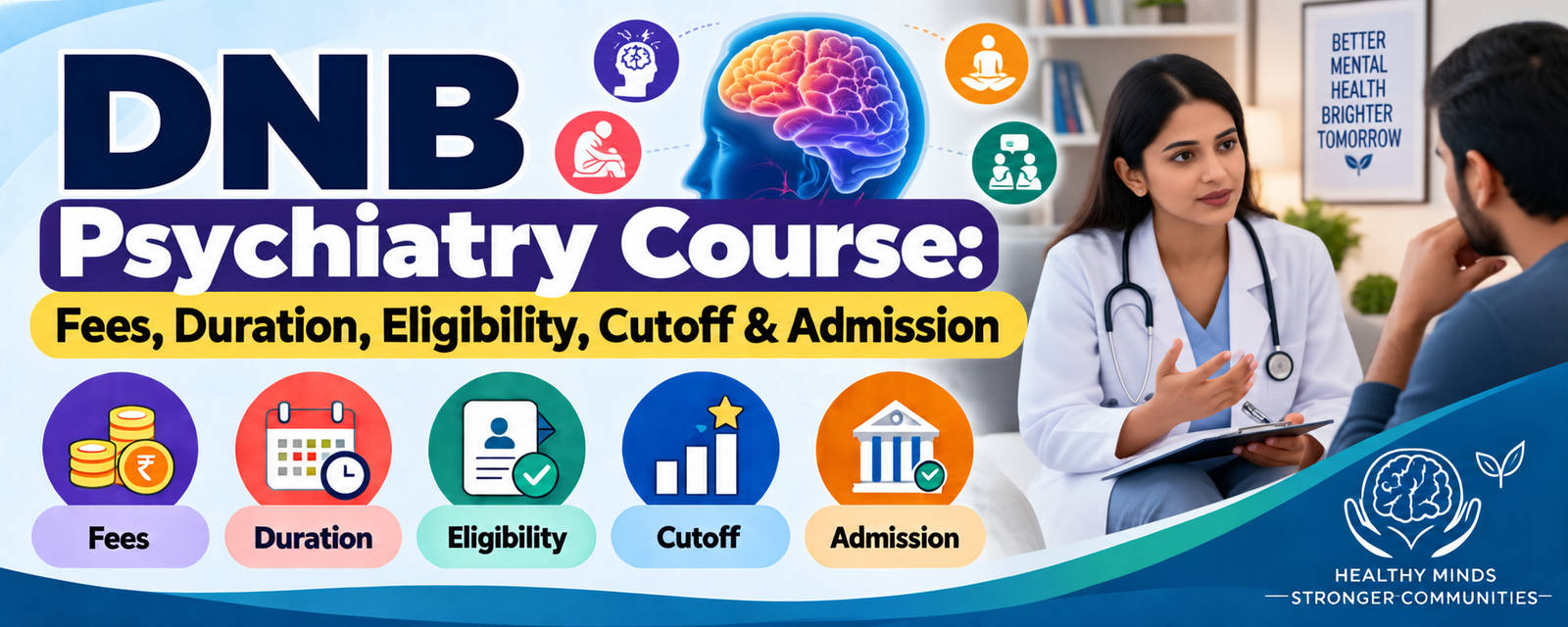
A person who cannot sleep and has stopped going to work may come to a psychiatrist for help. So might someone hearing voices, struggling with alcohol use, or living with recurring episodes of depression. The symptoms differ, and the doctor has to understand the person’s health, circumstances, and immediate safety before choosing a treatment plan.
DNB Psychiatry is postgraduate medical training for MBBS doctors who want to diagnose and treat mental health conditions. DNB stands for Diplomate of National Board, a qualification awarded by the National Board of Examinations in Medical Sciences (NBEMS). Training includes outpatient and inpatient care, emergencies, medicines, psychological approaches, and work with families and other professionals.
MBBS introduces psychiatry as one part of medical education. DNB training makes it a sustained clinical responsibility. Residents follow patients over time, see how treatment is working, and learn to change a plan when the first approach does not help.
Admission to a post-MBBS DNB seat generally follows NEET-PG and postgraduate counselling. The result a candidate needs depends on the hospitals offering seats, the relevant category and seat pool, and the choices made by other applicants.
What is DNB Psychiatry?
Psychiatry is a medical specialty concerned with mental, emotional, and behavioural health. A psychiatrist takes a history, assesses symptoms and functioning, considers physical health and medicines, and discusses care with the patient. Treatment may include medication, psychological interventions, support for daily life, or a combination.
It is not a specialty of quick labels. Similar symptoms can have different causes, and a diagnosis may become clearer over several visits. A psychiatrist must also know when someone needs urgent care and how to involve family or caregivers appropriately while respecting the patient’s rights and privacy.
The NBEMS curriculum covers the scientific foundations of psychiatry, clinical psychology, psychopharmacology, and psychological treatments. It also considers care in the community and across healthcare settings.
After DNB, graduates may work in general psychiatry or pursue eligible further training in areas such as child and adolescent psychiatry, addiction psychiatry, old-age psychiatry, or consultation work with other hospital departments. These opportunities have separate entry rules. MD Psychiatry is another postgraduate qualification; applicants should check which degree an advertised seat awards.
Course Highlights
|
Particular |
Details |
|
Course Name |
DNB Psychiatry |
|
Degree |
Diplomate of National Board |
|
Level |
Postgraduate medical qualification |
|
Duration |
Generally three years for the post-MBBS DNB route |
|
Basic Qualification |
MBBS, subject to current entrance and admission rules |
|
Entrance Exam |
NEET-PG for post-MBBS DNB admission |
|
Admission Process |
Entrance result, counselling registration, choice filling, allotment, reporting, and NBEMS trainee registration |
|
Training Type |
Supervised outpatient, inpatient, emergency, community, academic, and research work |
|
Major Focus |
Assessment and treatment of mental health conditions |
|
Further Study |
Eligible fellowships or focused psychiatry training |
|
Career Areas |
Hospitals, mental health services, clinics, medical colleges, and research |
NBEMS states that post-MBBS trainees enter a three-year DNB programme through NEET-PG. Post-diploma DNB admission, where offered in a specialty, is a separate route with different conditions.
Duration: What Happens Year by Year?
The course generally lasts three years. The precise postings vary by institution, but good training should allow residents to see both acute illness and longer-term recovery. Psychiatry often asks a doctor to keep learning from the same patient across many visits.
Year 1: Learning to listen and assess
New residents learn how to conduct a psychiatric interview, take a relevant medical history, perform a mental-state examination, and explain their initial assessment. They also learn how to speak with families without losing sight of the patient’s own account.
Early work in wards and clinics takes place under close supervision. Residents observe how consultants consider possible diagnoses, assess risk, choose investigations where needed, and discuss treatment. They begin to see why a trusting clinical relationship matters.
Year 2: Following treatment over time
Residents take a more active role in planning care and reviewing its effects. They learn about medicines and side effects, psychological approaches, substance-use problems, and the links between mental and physical health.
Inpatient, outpatient, and emergency experience each teach something different. Research and thesis work also develop during training, and NBEMS uses formative assessment before the final DNB examination.
Year 3: Managing complexity
Senior residents work through cases in which symptoms, medical conditions, family circumstances, and treatment preferences interact. They coordinate with psychologists, social workers, other doctors, and community services where available.
Their decisions still receive supervision, particularly in emergencies or complex situations. The final stage includes completing academic requirements and preparing for NBEMS theory and practical assessments and the applicable thesis process.
Eligibility Criteria
- Base degree: Applicants generally need an MBBS qualification accepted under the current NEET-PG and DNB admission rules.
- Internship: The compulsory rotating internship must be completed by the deadline specified for that admission session.
- Medical registration: Candidates need the provisional or permanent registration accepted in the examination bulletin, ordinarily issued by the National Medical Commission (NMC) or a State Medical Council.
- Entrance examination: NEET-PG is the entrance route for a post-MBBS DNB Psychiatry seat. INI-CET applies to postgraduate seats at participating Institutes of National Importance; it is not an alternative exam for a DNB seat.
- Qualifying and seat conditions: Meeting the NEET-PG qualifying requirement permits consideration under the rules. Allotment still depends on rank, eligibility for the seat, vacancies, and choice order.
NBEMS sets out the broad MBBS, internship, and registration conditions for NEET-PG. Check the current exam bulletin and counselling brochure for the exact deadlines, documents, and category requirements.
Admission Process
Step 1: Complete MBBS and internship. Keep your degree or provisional certificate, internship proof, registration, identification, and any applicable category documents ready.
Step 2: Take NEET-PG. Apply under the NBEMS bulletin for the relevant admission session.
Step 3: Check the result. Note your qualifying status and rank. A qualifying result is not an offer of a Psychiatry seat.
Step 4: Register for counselling. The Medical Counselling Committee (MCC) publishes DNB seat information and allotment results for seats under its postgraduate process. Follow its current schedule for those seats; other specified seat routes should be checked against their own official instructions.
Step 5: Fill choices. Select eligible DNB Psychiatry hospitals in the current matrix. If MD Psychiatry is also acceptable to you, compare its separately listed government, state government, private, or deemed-institution seats before placing choices in your genuine preference order.
Step 6: Review allotment. Rank, eligibility, available seats, and choice order determine the outcome. Read the relevant round’s rules on joining, upgrading, and resignation.
Step 7: Report and join. Complete document verification and institutional formalities within the deadline. Follow subsequent NBEMS trainee registration instructions.
DNB Psychiatry Fees
There is no single DNB Psychiatry fee that applies to every training institution. The terms for the actual DNB seat and current NBEMS guidance matter. A published fee for an MD Psychiatry seat may apply to a different qualification.
|
College or seat type |
What a DNB applicant should check |
|
Government College |
Confirm the seat awards DNB, then read its own fees, stipend, and service terms |
|
State Government College |
Check the exact qualification and any state-linked bond or service obligation |
|
Private College |
Review written charges for the NBEMS-accredited DNB site, which may be a hospital rather than a conventional college |
|
Deemed University |
Establish whether the advertised Psychiatry seat awards DNB or MD before comparing costs |
|
Management Quota |
Do not presume this is a standard DNB seat category; rely on the official matrix and applicable admission rules |
Possible components include course or training fees, registration and examination charges, hostel and mess costs, and a refundable deposit where listed. Ask whether accommodation is offered and which payments are compulsory. A stipend during training should be considered separately from the charges payable. NBEMS publishes fee and stipend guidance for trainees.
Verify the current NBEMS guidance, counselling notice, and institution’s written fee, stipend, refund, and bond terms before paying.
DNB Psychiatry Cutoff
“Cutoff” can describe several different results:
- Qualifying cutoff: The NEET-PG threshold for consideration under that session’s rules.
- Hospital-wise closing rank: The last allotted rank for DNB Psychiatry at a named institution.
- Category-wise cutoff: The outcome for an applicable reservation category.
- Quota-wise cutoff: The result for a specified seat pool, where relevant.
- Round-wise cutoff: The closing result after a particular counselling round.
The qualifying cutoff determines whether a candidate may participate under the rules. A closing rank records one allotment outcome; it is not a permanent entry requirement.
What Determines the Cutoff?
- Seat count: The DNB Psychiatry seats available in the current matrix.
- Hospital preference: Teaching, case mix, supervision, reputation, and location can affect choices.
- Government or private setting: Financial and working terms may influence demand.
- Category: Compare results for the category applicable to you.
- Quota: Outcomes in different seat pools need separate comparison.
- Counselling round: Vacancies and upgrades can alter later results.
- Year-to-year competition: Applicant ranks and preference lists change.
Use official NEET-PG notices, the current DNB seat matrix, and allotment results to assess cutoffs. An MD Psychiatry closing rank should not be treated as the DNB result.
What Rank or Score Is Needed?
There is no universal NEET-PG rank or score that secures DNB Psychiatry. Look at official past allotments for the same DNB course, hospital, category, quota, and counselling round, then check whether the seat appears in the current matrix.
The training hospital deserves careful attention. Do residents see a range of patients in both clinics and wards? Is there supervised psychotherapy teaching and exposure to substance-use care? How are emergency cases handled, and do residents receive feedback on interviews? A seat’s closing rank cannot tell you any of this.
Make a broad preference list that includes institutions you would genuinely join. Add more sought-after options as well as other acceptable departments, ordered according to your real preferences after checking training, fees, location, and working conditions.
Use current official seat availability and counselling instructions for your final choices. Past closing ranks help you plan; they do not guarantee a seat.
DNB Psychiatry Syllabus
Psychiatry training combines medical science with interviewing, observation, treatment, and follow-up. The NBEMS curriculum includes the scientific basis of mental processes, medicines, psychological treatments, and care in different settings.
Foundations and assessment
- Psychiatric history taking and mental-state examination
- Learning, memory, emotion, perception, and behaviour
- Considering medical or substance-related causes of symptoms
- Assessing functioning, distress, and immediate safety concerns
Common and severe mental health conditions
- Depression, anxiety, and related conditions
- Psychotic and bipolar disorders
- Substance-use problems
- Sleep, eating, and other behavioural concerns
Treatment and follow-up
- Principles of psychiatric medicines and monitoring
- Psychological interventions and when to refer for them
- Reviewing response, side effects, and patient preferences
- Supporting recovery over time
Different ages and settings
- Mental health concerns in children and adolescents
- Older adults with psychiatric or cognitive symptoms
- Psychiatry in general hospitals and community settings
- Working with families and multidisciplinary teams
Ethics and academic work
- Consent, privacy, and respectful communication
- Applying current legal and professional requirements
- Case discussion, research, and thesis work
- Teaching junior doctors and other health workers
Practical Training
The interview is a core practical skill. Residents learn to ask questions without putting words in a patient’s mouth, assess symptoms carefully, and listen for what may not emerge in a checklist. They practise explaining a plan so the patient can make an informed decision.
In outpatient clinics, they follow treatment across visits. Wards expose them to patients who need closer observation and coordinated care. Emergency work teaches them to recognise immediate risks and seek timely senior help. The clinical mix and supervision differ by institution.
Psychological treatment is not learned by reading a list of therapy names. Trainees need supervised discussion of when an approach is suitable, how it is delivered, and when another trained professional should be involved. The NBEMS curriculum addresses both medicines and psychological interventions.
When comparing hospitals, ask current residents about supervision in clinics and on call, psychotherapy teaching, substance-use services, community exposure, and case discussions. A busy department is useful only if trainees have time and support to learn from its patients.
Career Scope After DNB Psychiatry
Clinical practice is the direct route. Graduates may work in hospitals, mental health services, or eligible clinics, treating patients within their experience and the facilities available.
Hospital and community services offer opportunities to work alongside psychologists, social workers, physicians, and other teams. Some doctors develop a broad practice; others gradually focus on a particular patient group.
Teaching and research suit psychiatrists interested in training students or studying treatment, access to care, and patient outcomes. Faculty eligibility depends on current recruitment and regulatory rules.
Further focused training may be available in child and adolescent psychiatry, addiction, old-age psychiatry, or related fields, subject to each programme’s entry conditions. DNB Psychiatry provides broad specialist training, while focused expertise may require additional supervised work.
Salary After DNB Psychiatry
Income varies widely between a government appointment, a private hospital post, and an established clinic. City, employer, sector, experience, working hours, and the type of service all influence earnings.
A written offer should explain the duties as well as pay: outpatient and inpatient responsibilities, emergency cover, benefits, and support from other mental health professionals can differ greatly. During residency, compare the stipend with fees, accommodation, and living costs.
Check current recruitment notices and written offers for pay and benefits. A single online salary estimate cannot describe every Psychiatry role.