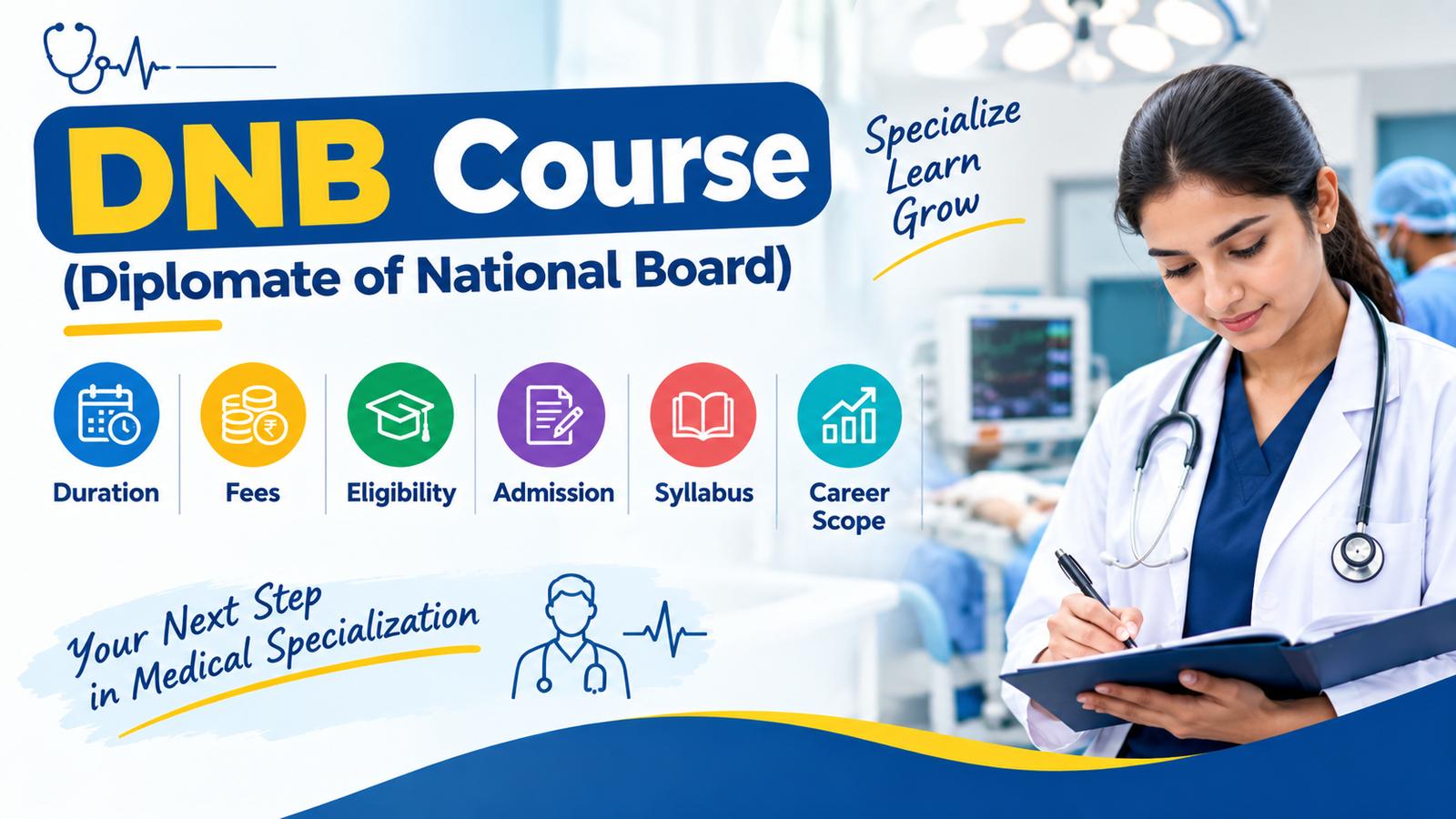
DNB Course (Diplomate of National Board) is a postgraduate medical qualification offered through institutions accredited by the National Board of Examinations in Medical Sciences (NBEMS). It provides postgraduate training in various broad-specialty medical disciplines after MBBS. For many medical graduates, DNB is an important pathway for postgraduate specialization, as DNB seats are available in a wide range of accredited hospitals and institutions in India.
The DNB course after MBBS is generally 3 years, while candidates who have completed a recognized postgraduate diploma in the same specialty may be eligible for a 2-year Post Diploma DNB. NBEMS currently conducts DNB Broad Specialty training in 29 disciplines.
Admission to Post-MBBS DNB programmes is linked with NEET-PG, followed by the applicable counselling and seat-allocation process. During training, students receive clinical exposure, academic teaching, practical experience, assessments and research training.
This guide covers DNB course duration, eligibility, admission process, fees, syllabus, specializations, stipend, examinations, career opportunities and salary prospects.
What is DNB Course?
DNB stands for Diplomate of National Board. It is a postgraduate medical qualification awarded by NBEMS after successful completion of prescribed postgraduate training and the DNB Final examination.
DNB training is conducted at NBEMS-accredited hospitals and institutions, not only conventional medical colleges. The training focuses heavily on clinical practice, patient management, diagnosis, procedures and specialty-specific learning.
DNB Broad Specialty programmes are available in 29 disciplines of modern medicine. For students entering directly after MBBS, the standard training period is three years. Candidates with a recognized two-year postgraduate diploma in the same specialty may pursue a two-year Post Diploma DNB programme.
The qualification is particularly relevant for MBBS graduates who want to pursue postgraduate specialization in areas like General Medicine, Paediatrics, Anaesthesiology, Radiodiagnosis, General Surgery, Orthopaedics, Obstetrics and Gynaecology, Psychiatry and other specialties.
DNB Course Highlights
|
Particular |
Details |
|
Full Form |
Diplomate of National Board |
|
Conducting Body |
National Board of Examinations in Medical Sciences (NBEMS) |
|
Level |
Postgraduate Medical |
|
Entry Qualification |
MBBS for Post-MBBS DNB |
|
Entrance Examination |
NEET-PG for Post-MBBS admission |
|
Course Duration |
3 years after MBBS |
|
Post Diploma Duration |
2 years |
|
Training Institute |
NBEMS-accredited hospitals/institutions |
|
Fields |
29 Broad Specialty disciplines |
|
Training |
Clinical, academic, practical and research-oriented |
|
Final Examination |
DNB Final Theory and Practical |
|
Thesis |
Required as per applicable NBEMS requirements |
|
Admission |
Merit-based counselling |
The exact admission rules, fee structure, seat availability and counselling schedule can vary between sessions, so candidates should always check the latest NBEMS and counselling notifications before applying.
DNB Course Duration
The DNB course duration after MBBS is 3 years for Post-MBBS Broad Specialty programmes. NBEMS also provides a 2-year Post Diploma DNB pathway for candidates who have completed a recognized postgraduate diploma in the relevant specialty.
1. Post-MBBS DNB
Duration: 3 years
Eligibility: MBBS
Admission route: NEET-PG and applicable counselling
Training: Specialty-specific postgraduate clinical training
2. Post Diploma DNB
Duration: 2 years
Eligibility: Recognized PG Diploma in the relevant specialty
Admission: Through the applicable NBEMS counselling process
The three-year programme is generally divided into progressively advanced levels of clinical responsibility. During training, students participate in outpatient services, inpatient care, emergency services, procedures, academic activities and other responsibilities relevant to their specialty.
DNB Eligibility Criteria
Candidates interested in a DNB after MBBS must satisfy the eligibility requirements specified for the relevant admission session.
For Post-MBBS DNB, the basic educational requirement is an MBBS degree or recognized equivalent qualification, along with the applicable registration and internship requirements prescribed for the entrance examination and admission process.
The major eligibility requirements generally include:
- Candidate should possess a recognized MBBS qualification.
- The candidate must satisfy the applicable medical registration requirements.
- The required internship must be completed by the prescribed date.
- The candidate must qualify NEET-PG for Post-MBBS DNB admission.
- Candidates must satisfy the eligibility conditions specified in the relevant admission bulletin.
- Admission is subject to the availability of seats and the counselling rules applicable to that admission session.
As internship cut-off dates and other requirements can vary by admission year, students should not assume an old bulletin while applying.
DNB Admission Process
Admission to Post-MBBS DNB programmes involves multiple stages.
Step 1: Complete MBBS
The candidate must complete MBBS from a recognized institution and satisfy the applicable internship requirements.
Step 2: Appear for NEET-PG
Candidates seeking Post-MBBS DNB admission generally need to qualify for NEET-PG.
Step 3: Participate in Counselling
After the entrance examination, eligible candidates participate in the relevant centralized counselling process and select available DNB specialties and institutions according to the applicable rules.
Step 4: Seat Allotment
Candidates are allotted seats based on the applicable merit, choices, category and counselling rules.
Step 5: Join the Accredited Institution
After allotment, the candidate completes the required documentation and joins the allotted NBEMS-accredited hospital or institution.
Step 6: NBEMS Registration
The candidate completes the required joining and registration formalities with NBEMS.
Step 7: Complete DNB Training
The trainee undergoes the prescribed postgraduate training, assessments, academic activities and research/thesis requirements.
Step 8: Appear for DNB Final Examination
After meeting the eligibility conditions, the trainee appears for the DNB Final examination.
DNB Course Fees
The DNB course fees are not necessarily identical across all institutions. Candidates should distinguish between the NBEMS-prescribed course fee and other charges applicable at the allotted hospital or institution.
NBEMS has changed the mechanism for collection of course fees in recent admission sessions. Under the current framework described by NBEMS, the course fee for the first year is collected through NBEMS during counselling, while fees for subsequent years are paid directly to the respective hospital/institution where applicable. Certain categories, like specified in-service seats, can have different arrangements.
Therefore, students should check:
- Annual course fee
- Institutional charges
- Hostel charges, if applicable
- Examination fee
- Other administrative charges
- Applicable refund rules
- Stipend arrangements
DNB Examination Fee
The examination fee is separate from the course fee. For example, the DNB Final December 2025 bulletin listed an examination fee of ₹5,250 for DNB trainees for theory and practical examinations. Fees can change for future examination sessions.
Important: Students should always verify the latest fee notice issued for their admission or examination session instead of assuming that an older fee remains applicable.
DNB Stipend
DNB trainees receive a stipend according to applicable NBEMS guidelines and institutional/state requirements.
Under an NBEMS accreditation agreement, the basic stipend specified for Post-MBBS DNB Broad Specialty trainees was:
|
DNB Training Year |
Basic Stipend Mentioned in NBEMS Agreement |
|
First Year |
₹35,000/month |
|
Second Year |
₹37,000/month |
|
Third Year |
₹39,000/month |
The same document states that the stipend should follow the applicable State Government policy where that results in a higher amount.
Actual stipend arrangements should therefore be checked against the latest NBEMS stipend guidelines and the policy applicable to the particular institution/state.
DNB Specializations
DNB Broad Specialty programmes cover multiple branches of modern medicine.
Some commonly known DNB specialties include:
- DNB General Medicine
- DNB General Surgery
- DNB Paediatrics
- DNB Anaesthesiology
- DNB Radiodiagnosis
- DNB Orthopaedics
- DNB Obstetrics and Gynaecology
- DNB Psychiatry
- DNB Dermatology, Venereology & Leprosy
- DNB Ophthalmology
- DNB Otorhinolaryngology (ENT)
- DNB Pathology
- DNB Emergency Medicine
- DNB Family Medicine
- DNB Respiratory Medicine
- DNB Nuclear Medicine
- DNB Radiation Oncology
- DNB Physical Medicine & Rehabilitation
- DNB Hospital Administration
- DNB Community Medicine
The exact seat matrix and availability of individual specialties vary by counselling session and accredited institution.
DNB Syllabus
The DNB syllabus depends on the chosen specialty. A candidate pursuing DNB General Medicine will follow a substantially different curriculum from someone pursuing DNB Anaesthesiology, Radiodiagnosis or General Surgery.
However, the overall training structure generally combines the following components:
1. Core Specialty Knowledge
Students develop advanced knowledge of their chosen medical specialty, including:
- Disease mechanisms
- Clinical presentation
- Diagnosis
- Differential diagnosis
- Treatment protocols
- Emergency management
- Pharmacology relevant to the specialty
- Preventive and supportive care
2. Clinical Training
Clinical exposure is one of the major components of DNB training.
Trainees may work in:
- Outpatient departments
- Inpatient wards
- Emergency departments
- Intensive care areas
- Specialty clinics
- Operation theatres
- Diagnostic departments
- Procedure units
The exact rotation structure depends on the specialty and institution.
3. Practical and Procedural Training
Depending on the specialty, trainees learn and perform procedures under appropriate supervision.
For example, surgical specialties include operative training, while anaesthesiology involves airway management, anaesthesia techniques and perioperative care.
4. Academic Activities
DNB training also involves academic learning through:
- Seminars
- Case presentations
- Journal clubs
- Clinical discussions
- Conferences
- Teaching sessions
- Research activities
5. Research and Thesis
Research is another important part of postgraduate medical training. DNB trainees are required to comply with applicable NBEMS requirements relating to thesis/research work.
6. Formative Assessment
NBEMS conducts formative assessments during training. According to NBEMS, the minimum number of mandatory Formative Assessment Tests varies according to the programme; for example, Broad Specialty courses require a specified minimum number of assessments. For trainees admitted from the 2024 session onward, applicable mandatory formative assessments are linked to eligibility for the respective final exit examination.
DNB Examination Pattern
The DNB Final examination is an important part of completing the qualification.
According to NBEMS, the DNB Final examination consists of two broad stages:
- Theory examination
- Practical examination
A trainee who qualifies the theory examination is permitted to appear in the practical examination. Candidates who do not qualify the theory examination have to reappear according to the applicable examination rules.
The final qualification is awarded after the candidate fulfills the prescribed examination and training requirements, including acceptance of the thesis where applicable.
DNB vs MD/MS
Students frequently compare DNB with traditional MD/MS postgraduate programmes.
|
Feature |
DNB |
MD/MS |
|
Full Form |
Diplomate of National Board |
Doctor of Medicine/Master of Surgery |
|
Level |
Postgraduate |
Postgraduate |
|
Entrance |
NEET-PG for Post-MBBS |
NEET-PG |
|
Training |
NBEMS-accredited institutions |
Medical colleges/universities |
|
Broad Specialty Duration |
Generally 3 years |
Generally 3 years |
|
Training Environment |
Often hospital-based |
Medical college-based |
|
Final Assessment |
DNB Final |
University/competent examination system |
|
Clinical Exposure |
Depends on institution and specialty |
Depends on medical college |
|
Research |
Applicable NBEMS requirements |
University/regulatory requirements |
The choice between DNB and MD/MS should be evaluated using factors such as specialty, institution, clinical workload, academic environment, infrastructure, case exposure, faculty, location, fees and personal career plans, not relying on the course name alone.
Career Scope After DNB
DNB opens several career pathways for postgraduate doctors.
1. Specialist Doctor
After completing DNB in a clinical specialty, doctors can work as specialists in hospitals, clinics and healthcare organizations.
For example:
- DNB General Medicine → Physician
- DNB Paediatrics → Paediatrician
- DNB General Surgery → Surgeon
- DNB Anaesthesiology → Anaesthesiologist
- DNB Orthopaedics → Orthopaedic Specialist
- DNB Obstetrics & Gynaecology → Obstetrician/Gynaecologist
The exact professional designation and scope depend on the specialty and applicable registration rules.
2. Government Hospitals
DNB-qualified doctors can pursue opportunities in government healthcare institutions where recruitment rules recognize the qualification and the candidate meets the relevant eligibility criteria.
3. Private Hospitals
Large private hospitals and healthcare networks recruit postgraduate specialists across multiple disciplines.
4. Medical Colleges and Teaching
Doctors interested in academics may explore teaching and institutional positions subject to the applicable regulatory and recruitment requirements.
5. Super-Specialization
After a broad specialty, doctors can consider further specialization through pathways such as DrNB or other recognized super-specialty programmes, depending on eligibility and the specialty.
6. Clinical Practice
Doctors may also establish or join private clinical practice after completing their postgraduate qualification and fulfilling applicable registration requirements.
DNB Salary in India
DNB salary varies substantially depending on specialty, experience, location, employer, type of hospital and job responsibilities.
A newly qualified DNB specialist may receive different compensation in:
- Government hospitals
- Corporate hospitals
- Private hospitals
- Smaller hospitals
- Specialty clinics
- Academic institutions
High-demand specialties and doctors with additional experience, procedural skills or super-specialization may have different earning opportunities.
Therefore, instead of considering a single fixed DNB salary in India, students should compare compensation based on specialty, city, institution and experience.
Benefits of Pursuing DNB
Some important aspects that attract MBBS graduates towards DNB include:
Strong Clinical Exposure
Many DNB programmes are conducted in high-volume hospitals, giving trainees exposure to a broad range of patients and clinical situations.
Multiple Specialties
DNB is available across numerous broad specialties, allowing candidates to pursue different areas of medicine.
Hospital-Based Training
The training model provides substantial exposure to real-world patient management.
Postgraduate Specialization
DNB allows an MBBS graduate to move into specialty-level medical training.
Further Academic Opportunities
After broad-specialty DNB, eligible doctors can explore further postgraduate or super-specialty opportunities.
Things to Check Before Choosing a DNB Seat
Before accepting a DNB seat, candidates should carefully evaluate the institute rather than considering only the specialty name.
Important factors include:
- Number of patients
- OPD load
- IPD admissions
- Emergency workload
- ICU facilities
- Operation exposure
- Diagnostic facilities
- Faculty strength
- Academic schedule
- Previous examination performance
- Research environment
- Hostel availability
- Duty hours
- Leave policy
- Stipend
- Course fee
- Location
- Case diversity
- Availability of specialty procedures
The quality of practical exposure can vary considerably between institutions, making institute-level research an important part of the decision-making process.
Is DNB a Good Option After MBBS?
DNB can be an important postgraduate pathway for MBBS graduates who want specialty training. Its three-year Post-MBBS Broad Specialty structure, hospital-based training and availability across numerous accredited institutions makes it a significant part of India's postgraduate medical education system. NBEMS currently lists 29 Broad Specialty disciplines.
However, candidates should evaluate each seat individually. The specialty, hospital, patient load, infrastructure, faculty, training quality, fees, stipend and long-term career plans can all influence the experience of a DNB programme.
Frequently Asked Questions About DNB Course
What is the full form of DNB?
DNB stands for Diplomate of National Board. It is a postgraduate medical qualification awarded through the National Board of Examinations in Medical Sciences.
What is the duration of DNB after MBBS?
The standard duration of a Post-MBBS DNB Broad Specialty programme is 3 years.
Can MBBS students pursue DNB?
Yes. MBBS graduates who meet the applicable eligibility requirements can pursue Post-MBBS DNB through the prescribed admission process.
Is NEET-PG required for DNB?
For Post-MBBS DNB admission, candidates enter through the applicable NEET-PG-based admission and counselling process.
Is DNB equivalent to MD/MS?
DNB is a recognized postgraduate medical qualification. However, students should check the current regulatory and recruitment requirements applicable to a particular job, academic post or further course rather than assuming identical eligibility in every situation.
What is the DNB fee?
DNB fees vary according to the applicable NBEMS fee structure and institutional arrangements. The first-year course fee is collected through NBEMS during counselling under the current fee-collection framework, while subsequent-year fees may be paid directly to the hospital.
Do DNB students get a stipend?
Yes, DNB trainees are covered by applicable NBEMS stipend guidelines. The actual amount can depend on the applicable state/institutional policy, with the relevant rules providing for the higher applicable basic stipend where specified.
Is DNB only available in government hospitals?
No. DNB training is conducted through NBEMS-accredited institutions, which can include different types of hospitals and healthcare institutions.
What happens after DNB?
After DNB, doctors can work as specialists, pursue eligible super-specialty training, enter hospital practice, explore teaching opportunities or develop a clinical practice, subject to applicable regulations.
Conclusion
The DNB Course (Diplomate of National Board) is a major postgraduate medical education pathway for MBBS graduates in India. The Post-MBBS DNB Broad Specialty programme generally lasts three years, while the Post Diploma DNB route is generally two years. NBEMS conducts training through accredited institutions across multiple medical specialties.
Admission, fees, stipend, counselling rules and examination requirements can change from one admission session to another. Therefore, students should verify the latest information issued by NBEMS and the relevant counselling authority before making admission decisions.
For an MBBS graduate, choosing DNB involves more than comparing course names. The specialty, training hospital, clinical exposure, faculty, infrastructure, fees, stipend, academic environment and future career plans should all be considered before selecting a seat.